Wayground logo

Free Printable Worksheets

Font size

S
M
L
XL
Worksheets

Atom Structure: orbitals, electron configuration and the electromagnetic spectrum

Total questions: 73

Worksheet time: 37mins

Name
Class
Date
1.
True or false: as you move along the spectrum, radio to gamma waves, the wavelengths decrease in size (get smaller)
a)
true
b)
false
2.
A wave with a large wavelength will have a ______ frequency and _____ energy
a)
high, low
b)
high, high
c)
low, high
d)
low, low
3.
Select the correct order of waves on the EMS from the longest wavelength to the shortest wavelength
a)
Radio, Micro, Infra, Visible, Ultra, X-ray, Gamma
b)
Gamma, X-ray, Ultra, Vis, Infra, Micro, Radio
c)
Vis, Micro, Infra, Ultra, X-ray, Gamma, Radio
d)
Micro, Radio, Vis, Infra, Ultra, X-ray, Gamma
4.
Which has the LONGEST wavelength and, therefore, the lowest frequency/energy
a)
Gamma Rays
b)
Radio Waves
c)
Visible Light
d)
Infrared rays
5.
Which section of the spectrum is the ONLY one we can see?
a)
X-rays
b)
Visible Light
c)
Gamma Rays
d)
Ultraviolet Rays
6.
Which has the SHORTEST wavelength and, therefore, the highest frequency/most energy
a)
Radio waves
b)
Ultraviolet Rays
c)
Gamma Rays
d)
X-rays
7.
As the frequency of an electromagnetic wave increases, the amount of energy in that wave...
a)
increases.
b)
decreases.
c)
stays the same.
8.
High frequency waves have _________ wavelengths.
a)
varying
b)
long
c)
the same
d)
short
9.
The distance between two crests or two troughs of a wave is called:
a)
frequency
b)
amplitud
c)
wavelength
d)
hertz
10.
The height of the wave from the rest position is known as the _____________.
a)
amplitude
b)
crest
c)
trough
d)
wavelength
11.
What are electromagnetic waves?
a)
sound waves
b)
electric & magnetic fields (energy) that travel through empty space very quickly
c)
Someone's name
d)
things like longitudinal waves
12.

To calculate the frequency of an electromagnetic wave, you need to know the speed of the wave and its

a)

wavelength.

b)

intensity.

c)

refraction.

d)

amplitude.

13.
What atom matches this electron configuration?
1s22s22p63s2
a)
Neon
b)
Magnesium
c)
Aluminum
d)
Potassium
14.
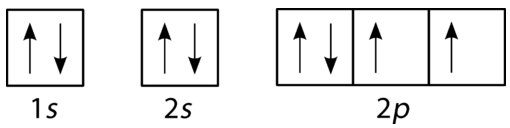
Which element is depicted from this orbital diagram
a)
Fluorine
b)
Neon
c)
Chlorine
d)
Argon
15.
Which is associated with more energy? 
a)
2p
b)
2s
c)
3p
d)
1s
16.
What atom matches this electron configuration?
1s2 2s2 2p6 3s2
a)
Neon
b)
Magnesium
c)
Aluminum
d)
Potassium
17.

How many electron(s) can be found in a s orbital?

a)

2

b)

3

c)

4

d)

1

18.

How many electrons can be found in the p sublevel?

a)

2

b)

3

c)

4

d)

6

19.
What is the electronic configuration of iron?
a)
1s22s22p63s23p64s23d6
b)
1s22s22p63s23p63d8
c)
1s22p63s23p64s23d6
d)
1s22s22p63s23p64s13d6
20.
Which is the electron configuration for an oxygen atom?
a)
1s22s22p63s23p64s2
b)
electronic configuration
1s22s22p4
c)
1s22s22p6
d)
1s22s22p63s23p6
21.
How many electrons can the first energy level hold?
a)
1
b)
2
c)
8
d)
0
22.
This orbital diagram represents:  
a)
C
b)
B
c)
N
d)
O
23.

Each orbital can hold how many electrons?

a)

5

b)

4

c)

8

d)

2

24.
Which orbital has the least amount of energy? 
a)
p orbital
b)
d orbital
c)
s orbital 
d)
What is an orbital?
25.
Which orbital shows a violation of Hund's Rule?
a)
A
b)
B
c)
C
d)
D
26.
Which orbital shows a violation of the Pauli Exclusion Principle?
a)
A
b)
B
c)
C
d)
D
27.

In an electron configuration, what follows 4s?

a)

4p

b)

3d

c)

4s

d)

2f

28.

How many orbitals does a d sublevel have?

a)

1

b)

3

c)

5

d)

7

29.
What atom matches this electron configuration?
1s22s22p63s23p64s23d10
a)
Zinc
b)
Copper
c)
Nickel
d)
Germanium
30.

Which area on the periodic table represents the electrons in the "d" sublevel?

a)

representative elements

b)

columns 3-8

c)

rare earth elements

d)

transition elements

31.
How many valence electrons are in Phosphorus?
a)
15
b)
4
c)
5
d)
31
32.
What's a valence electron?
a)
electrons in the second energy level
b)
electrons in the outermost energy level
c)
the atomic number
d)
electrons in the first level
33.
How many electrons should Beryllium have around its Lewis dot model?
a)
1
b)
2
c)
3
d)
4
34.
This "rule" of Quantum Chemistry states that no 2 electrons in an atom can be in the exact same state...each electron in an atom can be described by a unique set of quantum numbers.
a)
Hund's Rule
b)
Heisenberg Uncertainty Principle
c)
Aufbau Principle
d)
Pauli Exclusion Principle
35.
According to the Aufbau Principle, which sublevel should starting filling with electrons before the 3p sublevel?
a)
3s
b)
2p
c)
4s
d)
4p
36.
How many valence electrons does Si contain? (click to see image)
a)
14
b)
28
c)
2
d)
4
37.
Who stipulated that electrons orbit the nucleus at fixed energies and distances?
a)
Albert Einstein
b)
Max Planck
c)
Ernest Rutherford
d)
Niels Bohr
38.
Who showed it was impossible to determine both the exact position and speed of electrons as they moved around an atom?
a)
Werner Heisenberg
b)
Niels Bohr
c)
Max Planck
d)
Albert Einstein
39.
The current model of the atom, where electrons exist within a range of possible locations, is called _____
a)
the chocolate chip cookie model
b)
the plum pudding model
c)
the quantum model
d)
the planetary model
40.
As electrons circling an atom shift between energy levels, they absorb or release energy in the form of _____
a)
heat at a specific temperature
b)
kinetic energy at a certain speed
c)
light of a specific wavelength
d)
sound waves at a certain intensity
41.

___________ simplify the Bohr Model by showing only the outer valence electrons used for bonding.

a)

Lewis Dot Diagrams

b)

Bohr Models

c)

Electron Clouds

d)

Periodic Tables

42.
How did each model of the atom help to develop the atomic theory? 
a)
Each model provided opinions that were added.
b)
Each model showed different properties of the same structure. 
c)
Each model showed new particles that had been discovered.
d)
Each model built upon the other to show new particles or properties of previously discovered particles. 
43.
How are electrons arranged in an atom?
a)
In groups of five
b)
In energy levels
c)
By color
d)
By shape
44.
An element with five valence electrons is
a)
phosphorus
b)
oxygen
c)
beryllium
d)
rubidium
45.
How many electrons are in the outer (valence) shell of Chlorine (Cl)?
a)
1
b)
3
c)
6
d)
7
46.
How many electrons should Carbon have around its Lewis dot model?
a)
1
b)
3
c)
4
d)
5
47.

The lines in the emission spectrum for hydrogen are formed from ___.

a)

energy given off when the electron moves from higher energy levels to lower energy levels

b)

electrons given off as hydrogen burns

c)

protons given off when protons move from higher energy levels to lower energy levels

d)

electrons given off as hydrogen cools

48.

Which color has the highest frequency?

a)

green

b)

blue

c)

red

d)

yellow

49.

Which color has the longest waves?

a)

red

b)

orange

c)

yellow

d)

green

50.

Energy of a photon is ___ proportional to frequency.

a)

directly

b)

inversely

51.

Frequency of light is ___ proportional to wavelength.

a)

directly

b)

inversely

52.

Which color has the lowest frequency?

a)

yellow

b)

green

c)

blue

d)

indigo

53.
For an electron to change from ground state to an excited stated it must...
a)
Absorb energy
b)
Release energy
54.

In photoelectric effect, electrons should be removed from the

a)

inner shells

b)

surface

c)

from core

d)

nucleus

55.

Which of the following does not describe the photoelectric effect?

I. A metal emits electrons when light strikes it

II. Energy is quantized in bundles called photons

III. It describes the electron path around the nucleus

a)

I only

b)

II only

c)

III only

d)

I and III only

56.

Identify the Concept

a)

Quantum mechanical effect

b)

Photoelectric effect

c)

Bohr atomic model effect

d)

absorption and emission effect

57.

Energy is quantized where energy is emitted or absorbed in discrete amounts of energy called ___________.

a)

Quantum

b)

frequency

c)

Photon

d)

wavelength

58.

When an electron has its lowest possible energy, the atom is in its _______________

a)

Excited state

b)

transition state

c)

Highest energy state

d)

Ground state

59.
The combination of two waves to form a larger amplitude is what type of interference?
a)
Constructive
b)
Destructive
c)
Diffractive
d)
Refractive
60.
Waves can meet and form a smaller amplitude.  If this occurs, it is called
a)
Constructive
b)
Destructive
c)
Diffractive
d)
Refractive
61.
True or False - An energy level has to be full before moving on to the next energy level?
a)
true
b)
false
62.
A region of space around the nucleus where an electron with a particular energy is likely to be found
a)
atomic orbital
b)
electron density
c)
principal energy level
d)
quantum
63.
The amount of energy required to move an electron from its present energy level to the next higher one
a)
quantum
b)
orbital
c)
energy level
d)
photon
64.
The way we picture the location of electrons in our modern model of the atom
a)
electron cloud
b)
orbits
c)
Bohr's model
d)
planetary model
65.

Planck's constant is

a)

6.626 x 10⁻³⁴ J-s

b)

2.998 x 10⁸ m/s

c)

related to wavelength by c = λν

66.
Electrons found in the highest principal energy level of an atom are called
a)
valence electrons
b)
noble gas inner core
c)
paired electrons
d)
unpaired electrons
67.

The difference between an orbit and an orbital is:

a)

an orbit is a set path, but an orbital has no dimension

b)

an orbital is a set path, but an orbit cannot be defined

c)

an orbit is a set path, but an orbital is a 3-dimensional region in which electrons may be found with high probability

d)

there is no difference when it comes to electron configurations

68.

Orbitals are

a)

orbits, or paths were electrons travel at set distances from the nucleus, like the moon around the earth

b)

probability maps where we find the electrons 90% of the time

c)

are all the same shape

d)

probability mapes where we find the electrons 100% of the time

69.

Who studied interference of light that led us to better understanding of how light behaves as waves?

a)

Thomas Young

b)

Sir Isaac Newton

c)

Albert Einstein

d)

Schrodinger

70.

Energy units are

a)

Joules

b)

m/s

c)

1/s

d)

Hz

71.

frequency units are

a)

Joules

b)

m/s

c)

1/s

d)

Hz

e)

J s

72.

wavelength units are

a)

Joules

b)

m/s

c)

nm

d)

m

e)

J s

73.

1 nm = ? m

a)

10-6

b)

10-9

c)

10-3

d)

101