
 Worksheets
Chapter 5 review- periodic trends
Total questions: 54
Worksheet time: 42mins

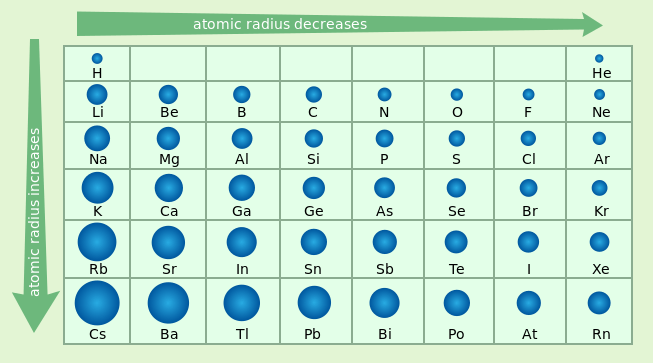
the atoms have more protons and electrons
the atoms have fewer protons and electrons


how well an atom is at attracting electrons while bonded


The electronegativity of Cl is the highest in Period 3. Why?
Which has the greater electronegativity?
P
Mg
Which has the greater Electronegativity?
B
Li
The element with the lowest electronegativity in Period 3 is -
Na
Cl
Mg
Al
The larger the atom the
smaller the ionization energy
larger the ionization energy
The closer an atom is to F what happens to its electronegativity?
It gets bigger
It gets smaller
Put these is order from largest to smallest.
V, K, Ni
K > V > Ni
Ni > V > K
V > Ni > K
K > Ni > V
Put these is order from largest to smallest.
As, Sb, N
Sb > As > N
N > Sb > As
N > As > Sb
Which has the larger first ionization energy?
Ca
Se
P
O

noble gases


F Block atoms are called
inner transition metals
outer transition metals
transition metals
non-metals
F block atoms can be paramagnetic (partially magnetic)
true
false
These have some properties of metals and non-metals. They are semiconductors.
metalloids
metals
non-metals
gases

Where are the group numbers?
At the top of each column on the periodic table
On the right side of each row on the periodic table
Under the element name on the periodic table

Period numbers tell..
how many energy levels the atom has.
how many electrons an atoms has
how many neutrons an atom has
which group an atom is in
The most electronegative element
F
The smallest atom
He
The second most electronegative element
O
The least electronegative element
Fr
A non-metal that is a liquid at room temperature
Br

Usually has a +1 charge
Na
Usually has a +2 charge
Ba
Usually has a -1 charge
Cl
Usually has a -2 charge
O
Usually has a +3 charge
Al

This non-metal is usually solid at room temperature and looks like little gray pieces or balls
Fluorine
Iodine
Arsenic
Chlorine

Gets credit for the modern periodic table
Dalton
Rutherford
Mendeleev
Bohr
the amount of energy required to add an electron to a neutral atom to form an anion
electron affinity
electronegativity
ionization energy
A cation has what charge?
negative
positive

This is the Bohr model of Cs
This is the quantum model of Cs
This is the nuclear model of Cs

removing an electron forms a(an)
cation
adding an electron forms a(an)
anion
which family has 5 valence electrons
Nitrogen family
which family has 4 valence electrons
carbon family
which family has 3 valence electrons
boron family

This reacts like group 1 (1 valence electron) and reacts like group 17 (only needs 1 electron to complete its outer shell)
He
H
Li
F
How is electronegativity determined?
no clue
experimentally
we guess
by thinking about the atoms

Why are anions larger than their parent atoms?
Extra electrons act like shields and extra electrons are repelled by the other electrons
because you add an energy level to the atom
because atoms want more electrons
because atoms want fewer electrons

Why are cations smaller than the parent atoms?
because you add another electron and lower the energy levels
because you remove an electron and lower the number of energy levels
because parent atoms are always bigger than cations and anions
because you add a proton and pull in the electrons more

group 1, period 4
K
group 8, period 5
Ru
group 8A, period 3
Ar
group 3A, period 4
Ga
group 3, period 4
Sc

