wayground logo

Free Printable Worksheets

NEW

Font size

S
M
L
XL
Worksheets

Earth Science Midterm

Total questions: 52

Worksheet time: 1hrs 5mins

Name
Class
Date
1.

Scientists speculate that all the continents were once joined as one supercontinent called _______________.

a)

Laurasia

b)

Pangea

c)

Panthalassa

d)

Europa

2.

The outermost layer of the Earth is called the ________________________.

a)

core

b)

crust

c)

mantle

d)

asthenosphere

3.

Which of the following is not supporting evidence for continental drift?

a)

similar meterological patterns in Africa and South America

b)

A puzzle-like fit between Africa and South America

c)

similar fossils found in Africa and South America

d)

similar rock formations found in Africa and South America

4.

In which type of plate boundary do plates move away from one another?

a)

convergent

b)

divergent

c)

transform-fault

d)

constructive

5.

Which of the following is a major cause of acid rain?

a)

photovoltaic cells

b)

geothermal energy

c)

burning coal

d)

nuclear fission

6.
Compared to the density and composition of the oceanic crust, the continental crust is
a)
less dense and more mafic
b)
less dense and more felsic
c)
more dense and less mafic
d)
more dense and less felsic
7.

Which of the following is igneous rock?

a)
b)
c)
8.
How much of the Earth is covered in water?
a)
70-71%
b)
97%
c)
3%
d)
2%
9.
What percentage of Earth's water is salt water?
a)
70-71%
b)
97%
c)
3%
d)
2%
10.
What percentage of Earth's water is available in rivers, lakes, underground, and in the atmosphere?
a)
70-71%
b)
97%
c)
3%
d)
1%
11.
What is salinity?
a)
the amount of matter in a specific volume
b)
the degree of how hot or cold something is
c)
the landforms of the continent or the oceans
d)
how much salt is dissolved in a liquid
12.
What is density?
a)
the amount of salt dissolved in a liquid
b)
the amount of matter in a specific volume
c)
how hot or cold something is
d)
a large piece of frozen freshwater
13.
The salinity in the ocean can be increased by ____
a)
freezing the water in the oceans near the poles
b)
melting icebergs as the move to warm areas on the conveyor belt
14.
What happens when you increase the temperature of ocean water?
a)
the density increases
b)
the density decreases
c)
the water sinks
d)
the salinity increases
15.
What happens when you increase the salinity of ocean water?
a)
the temperature increases
b)
the salt amount decreases
c)
the density increases
d)
the density decreases
16.
Which ocean landform is made from a divergent plate boundary and looks like small mountains?
a)
mid-ocean ridge
b)
seamount
c)
trench
d)
continental slope
17.
Which landform is the deep hole that can be made at a convergent plate boundary?
a)
continental shelf
b)
continental slope
c)
seamount
d)
trench
18.
What is the elevation of point B? (Contour interval is 100m)
a)
800 ft
b)
850 ft
c)
900 ft
d)
1000 ft
19.
What feature is formed at B?
a)
river
b)
rift valley
c)
sink hole
d)
mountain
20.
What do contour lines that are farther apart represent?
a)
waterfall
b)
steep area
c)
gentle slope
d)
river
21.
The bold lines that appear on the map every 5th contour line with the exact elevation written on it is the ______________________
a)
Index Contour line
b)
Contour interval
c)
Relief
d)
Slope
22.
Which imaginary line divides the Earth into the eastern and western hemispheres?
a)
Prime Meridian
b)
Equator
c)
Axis
d)
North Pole
23.
Which imaginary line divides the Earth into the northern and southern hemispheres?
a)
Prime Meridian
b)
Equator
c)
Axis
d)
North Pole
24.
Which projection is this?
a)
Robinson
b)
Mercator
c)
Eckert IV
d)
Goode's Homolosine
25.
Which projection is this?
a)
Conic
b)
Mercator
c)
Eckert IV
d)
Robinson
26.
An example of a non-point solution is 
a)
waste water from leaking pipe
b)
fertilizer runoff from lawns
27.
An example of point source pollution is
a)
trash floating in the ocean
b)
oil spilling from a supertanker
28.
A body of water that has high turbidity is ...
a)
cloudy
b)
clear
29.
Describes the chemical, physical and biological attributes of water as it is fit for drinking, fishing, swimming, farming, etc
a)
Water Quality
b)
Water Sheds
c)
Dissolved oxygen
d)
nitrates
30.
High turbidity means.....
a)
very clear water
b)
neutral pH
c)
very murky or cloudy water
d)
high nitrates
31.

When the clouds get too heavy and water falls back to earth

a)

Runoff

b)

Condensation

c)

Precipitation

d)

Transpiration

32.

Plants giving off moisture and releasing water into the air

a)

Evaporation

b)

Condensation

c)

Transpiration

d)

Precipitation

33.

Streams that flow into other streams increasing the size of the stream that it is joining

a)

Tributaries

b)

Watershed

c)

Aquifer

d)

River System

34.

The process in which material is worn away by a stream.

a)

Erosion

b)

Alluvil Fan

c)

Meander

d)

Wetland

35.

An area in which one or more rivers enters into the ocean , creating brackish water.

a)

Wetland

b)

Delta

c)

River Basin

d)

Estuary

36.

The attractive force between water molecules

a)

Adhesion

b)

Cohesion

c)

Capillary Action

d)

Temperature

37.

Liquid water is able to dissolve more substances than any other liquid on earth.

a)

Cohesion

b)

Turbidity

c)

Permeability

d)

Universal Solvent

38.

The amount of heat needed to raise the temperature of one gram of a substance by one degree Celsius.

a)

Capillary Action

b)

Specific Heat

c)

Temperature

d)

Density

39.

When molecules of water are attracted to other substances.

a)

Cohesion

b)

Buoyant

c)

Specific Heat

d)

Adhesion

40.
A Fossil Fuel is
a)
Materials that are found on Earth that people use
b)
Rock that contains metal 
c)
Fuels that formed years ago from the remains of things that lived millions of years ago.
d)
Resources that cannot be replaced quickly enough to keep from running out. 
41.
Natural Resources are
a)
Materials that are found on Earth that people use. 
b)
Rocks that contain metal
c)
Resources that are continually being replaced and will not run out.
d)
Resources that cannot be replaced quickly enough to keep from running out. 
42.
Non renewable resources are
a)
Materials that are found on Earth that people use.
b)
Rock that contains metal
c)
Fuels that formed from the remains of things that lived millions of years ago
d)
Resources that cannot be replaced quickly enough to keep from running out. 
43.
Renewable resources are:
a)
Materials that are found on Earth that people use
b)
Rock that contains metal 
c)
Fuels that formed from the remains of things that lived millions of years ago.
d)
Resources that are constantly being replaced and will not run out. 
44.
Which is a Natural Resource
a)
Sunlight
b)
Computers
c)
Cars
d)
Roofs
45.
A valuable, rare mineral
a)
ore
b)
gem
c)
rock
d)
bling
46.
Measure of how easily a mineral can be scratched
a)
fracture
b)
cleavage
c)
hardness
d)
streak
47.
Mineral mined at a profit
a)
ore
b)
luster
c)
silicate
d)
rock
48.
Frank has a paper clip. It has a mass of 9g and a volume of 3cm3. What is its density?
a)
3 g/cm3
b)
1/3 g/cm3
c)
27 g/cm3
d)
39 g/cm3
49.
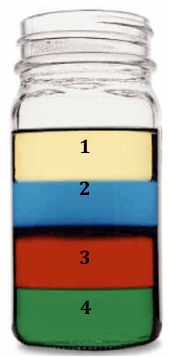
Put the liquids in order from most dense to least dense?
a)
4, 3, 2, 1
b)
1, 2, 3, 4
c)
3, 4, 2, 1, 
d)
4, 3, 1, 2
50.
The following liquids are poured together in a beaker: alcohol (density=0.79), corn syrup (density=1.38), water (density=1.0), and cooking oil (density=0.93).  Which of these liquids will sink to the bottom of the beaker?
a)
alcohol
b)
corn syrup
c)
water
d)
cooking oil
51.

A rock formed from fragments of other rocks is a(n)

a)

Metamorphic Rock

b)

Sedimentary Rock

c)

Extrusive Rock

d)

Igneous Rock

52.

The three groups of rocks are classified by

a)

How they form

b)

Color

c)

Grain size

d)

Chemical Composition