Wayground logo

Free Printable Worksheets

Font size

S
M
L
XL
Worksheets

Unit 3 Quiz Practice: Probability

Total questions: 44

Worksheet time: 1hrs 6mins

Name
Class
Date
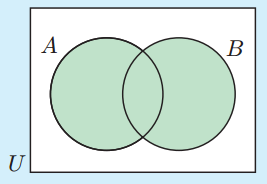
1.

Identify the shaded area...

a)

A

b)

B

c)

A'

d)

B'

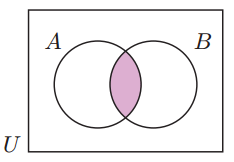
2.

Identify the shaded area...

a)

A∩B

b)

A∪B

c)

A'∩B'

d)

A'∪B'

3.

Identify the shaded area...

a)

A∩B

b)

A∪B

c)

A'∩B'

d)

A'∪B'

4.

Identify the shaded area...

a)

A∩B

b)

A∪B

c)

A'∩B'

d)

A'∪B'

5.

The diagram shows the sports played by 80 students.


If a student is picked at random, what is the probability that they play football?

a)

66/80

b)

4/80

c)

18/80

d)

49/80

6.

The diagram shows the sports played by 80 students.


If a student is picked at random, what is the probability that they play Hockey and Rugby?

a)

36/80

b)

5/80

c)

41/80

d)

44/80

7.
How many students took the survey?
a)
32
b)
47
c)
53
d)
56
8.
How many students do not snowboard?
a)
21
b)
22
c)
28
d)
29
9.
How many senior boys play football but do not wrestle?
a)
9
b)
12
c)
18
d)
104
10.
What statement does the shaded region represent?
a)
A or B
b)
A and B
c)
A
d)
B
11.
What statement does the shaded region represent
a)
A or B
b)
Not A
c)
A and B
d)
Not B
12.
What statement does the shaded region represent?
a)
A or B and C
b)
Not C
c)
A or B
d)
B and C or A
13.
a)

(A ∪ B ) ∩ C'

b)

(A ∪ B ) ∩ C

c)

(A ∪ C ) ∩ B

d)

(A ∪ B )' ∩ C

14.
a)

(A ∩ B)' ∩ (A' ∩ B')

b)

A′ ∩ B

c)

A ∩ B

d)

A′ ∪ B ′

15.
a)

A ∩ B'

b)

A ∩ B ∩ C

c)

A ∩ B ∩ C'

d)

A ∩ B

16.

What is a set?

a)

A collection of objects with similar characteristics

b)

A collection of objects with no similarities

c)

A collection of objects with different characteristics

d)

A collection of objects

17.

Element is

a)

The membership of the set

b)

The cardinality of the set

c)

The components of the set

18.

What is a complement Set A?

a)

The elements that belong to U

b)

The elements that belong to U and to set “A”

c)

The elements that do not belong to U and do not belong to set “A”

d)

The elements that belong to U and do not belong to set “A”

19.

What number should go in the blue box?

a)

21

b)

135

c)

19

d)

22

20.

How many total have no cell phone?

a)

13

b)

9

c)

22

d)

100

21.

How many total people were surveyed?

a)

78

b)

22

c)

70

d)

100

22.

The teacher surveys her students to determine how many own a cell phone. She also records what gaming system they own. What is the value of x?

a)

21

b)

135

c)

19

d)

22

23.

How many Males have Masters/Doctoral Degree?

a)

16

b)

3

c)

46

d)

62

24.

How many Bachelor's Degrees were given?

a)

46

b)

51

c)

97

d)

5

25.

If you are picking a card randomly from a deck of cards, the events of picking a jack and picking a heart are mutually exclusive.

a)

True

b)

False

26.

If you are picking a card randomly from a deck of cards, the events of picking an ace and picking a ‘3’ are mutually exclusive.

a)

True

b)

False

27.

If you are picking a card randomly from a deck of cards, the events of picking a spade and picking a diamond are mutually exclusive.

a)

True

b)

False

28.

When rolling a single die, the events of rolling an even number and rolling a ‘5’ are mutually exclusive.

a)

True

b)

False

29.

When rolling a single die, the events of rolling an odd number and rolling a prime are mutually exclusive.

a)

True

b)

False

30.

If a spinner is numbered 1 – 8, when you spin it the events of spinning an even number and a number less than 4 are mutually exclusive.

a)

True

b)

False

31.
If you draw one card from a standard deck, what is the probability of drawing a 5 or a diamond?
a)
2/52
b)
4/52
c)
16/52
d)
26/52
32.
If you draw one card from a standard deck, what is the probability of drawing a spade or a red card?
a)
13/52
b)
26/52
c)
39/52
d)
Not possible
33.
If you roll one die, what is the probability of getting an odd number or a 4?
a)
2/3
b)
1/3
c)
1/2
d)
1/6
34.
If you roll one die, what is the probability of getting an even number or a multiple of 3?
a)
1/3
b)
2/3
c)
1/2
d)
1/6
35.
Which of the following shows how to determine P(shaded number or number less than five)?
a)
4/8 + 4/8 - 2/8
b)
4/9 + 2/8 - 4/8
c)
4/8 + 6/8 + 2/8
d)
2/8 + 4/8 - 4/8
36.
Find the probability of drawing a 10 from a standard deck of 52 cards.
a)
4 out of 52
b)
13 out of 52
c)
13/52
d)
4/52
37.
Experimental Probability is:
a)
What Will happen 
b)
What actually happens
c)
What should happen
d)
What I think Happens
38.
Which of the following shows how to determine P(diamond or face card)?
a)
13/52 + 12/52 - 3/52
b)
3/52 + 13/52 -12/52
c)
3/52 + 12/52 - 13/52
d)
1/13 + 3/52 - 1/4
39.
If you draw one card from a standard deck, what is the probability of drawing a spade or a red card?  Are the events inclusive or mutually exclusive?
a)
Inclusive
b)
Mutually exclusive
40.
Which formula do you use when two events are mutually exclusive?
a)
P(A or B) = P(A) + P(B)
b)
P(A or B) = P(A) + P(B) - P(both)
c)
P(A and B) = P(A) * P(B)
d)
P (A and B) = P(A) * P(B|A)
41.
Which formula do you use when two events are NOT mutually exclusive?
a)
P(A or B) = P(A) + P(B)
b)
P(A or B) = P(A) + P(B) - P(A or B)
c)
P(A and B) = P(A) * P(B)
d)
P (A and B) = P(A) * P(B|A)
42.
Two events are mutually exclusive if:
a)
they cannot happen at the same time
b)
they can happen at the same time
c)
they always happen 
d)
they never happen 
43.

The complement of rolling a 3 is:

a)

Rolling an odd number

b)

Not rolling a 3

c)

Rolling an even number

44.
Which of the following shows how to determine P(packers or male)?
a)
75/150 + 90/150 - 50/150
b)
75/150 + 35/150 - 25/150
c)
50/150 + 40/150 + 25/150
d)
90/150 + 50/150 - 75/150