wayground logo

Free Printable Worksheets

Font size

S
M
L
XL
Worksheets

Climate and Weather 4 Spheres Mr Davies

Total questions: 78

Worksheet time: 1hrs 1mins

Name
Class
Date
1.
What is going on with the atmosphere at any particular time.
a)
Weather
b)
Climate
2.
Daily temperature, daily rainfall, daily amount of sunshine
a)
Weather
b)
Climate
3.

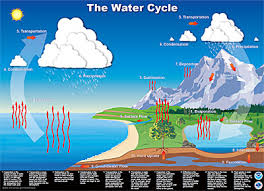
What energy source drives the water cycle?

a)

Clouds

b)

Oceans

c)

Sun

d)

Plants

4.

In which part of the water cycle are the molecules speeding up?

a)

Evaporation

b)

Collection

c)

Precipitation

d)

Condensation

5.
What is it called when plants give off water vapor as a waste product?
a)
condensation
b)
evaporation
c)
sublimation
d)
transpiration
6.
During which stage do clouds form?
a)
condensation
b)
evaporation
c)
precipitation
7.
What kind of weather happens during a cold front?
a)
Light rain or light snow
b)
Heavy rain or heavy snow
c)
Clear skies, temp. warms
d)
Clear skies, temp. cools
8.

Why does it rain more on the windward side of a mountain instead of the leeward side of the mountain?

a)

Lower elevations have warmer temperatures that cannot hold as much moisture as cold air.

b)

Lower elevations have colder temperatures that cannot hold as much moisture as warm air.

c)

Higher elevations have warmer temperatures that cannot hold as much moisture as cold air.

d)

Higher elevations have colder temperatures that cannot hold as much moisture as warm air.

9.
Rain, snow, sleet, or hail that falls from clouds in the sky.
a)
weather
b)
precipitation
c)
humidity
d)
climate
10.
How hot or cold something is.
a)
climate
b)
weather
c)
humidity
d)
temperature
11.
A metal spoon getting heated by contact with hot coffee in a mug is heat transfer by ______. 
a)
conduction
b)
convection
c)
radiation
d)
hydration
12.
The cycle of hot, less-dense stuff rising; & cold, more-dense stuff  sinking is heat transfer by _____. 
a)
conduction
b)
convection
c)
radiation
d)
hydration
13.
The ability of a material to transmit water through interconnected pores is called
a)
capacity
b)
competence
c)
permeability
d)
porosity
14.
Which is most likely an example of point source pollution?
a)
fertilizer sprayed onto a field
b)
water runoff from a city street 
c)
a pipe flowing into a river
15.
How much of the earth's water is freshwater?
a)
50 %
b)
3 %
c)
97 %
d)
93 %
16.

When the clouds get too heavy and water falls back to earth

a)

Runoff

b)

Condensation

c)

Precipitation

d)

Transpiration

17.

Plants giving off moisture and releasing water into the air

a)

Evaporation

b)

Condensation

c)

Transpiration

d)

Precipitation

18.

The movement of water from the earth and into the atmosphere

a)

Percolation

b)

Evaporation

c)

Condensation

d)

Hydrologic Cycle

19.

The system that contains all living things on Earth.

a)

Biosphere

b)

Atmoshpere

c)

Hydrosphere

d)

Geosphere

20.

Humans have an impact on ALL the spheres.

a)

true

b)

false

21.

The biosphere includes plants and animals that live

a)

on land

b)

on land and in the water

c)

on land, in water, and in the air

d)

in water

22.

"Bio-" means

a)

life

b)

water

c)

Earth

d)

air

23.

Which systems are effected when humans build cities? Choose ALL that apply.

a)

Geosphere

b)

Hydrosphere

c)

Biosphere

d)

Atmosphere

24.

Which of the following areas would support the MOST life?

a)
b)
c)
d)
25.

Which of the following areas would support the LEAST life?

a)
b)
c)
d)
26.

A mixture of gases that surrounds the Earth like a blanket.

a)

atmosphere

b)

troposphere

c)

ozone

d)

nitrogen

27.

Gas in the atmosphere that protects the Earth from the Sun's rays

a)

atmosphere

b)

troposphere

c)

ozone

d)

nitrogen

28.

The gas that makes up most of Earth’s atmosphere

a)

lifting

b)

troposphere

c)

wind funnel

d)

nitrogen

29.

Lowest layer of the atmosphere

a)

lifting

b)

troposphere

c)

wind funnel

d)

nitrogen

30.

"atmo-" means

a)

gas or vapor

b)

water

c)

Earth or rocks

d)

life

31.

The air we breathe is mostly made of

a)

nitrogen

b)

oxygen

32.

The highest layer of the atmosphere is

a)

troposhphere

b)

mesosphere

c)

stratosphere

d)

exosphere

33.

Weather happens in the

a)

troposhphere

b)

mesosphere

c)

stratosphere

d)

exosphere

34.

Which layer of the atmosphere do we live in?

a)

troposhphere

b)

mesosphere

c)

stratosphere

d)

exosphere

35.

Airplanes fly in the

a)

troposhphere

b)

mesosphere

c)

stratosphere

d)

exosphere

36.

As you get farther away from the Earth, the layers of the atmosphere get

a)

colder

b)

warmer

37.

Earth's atmosphere is mostly made up of which 2 gases? CHOOSE 2!!!!!!

a)

nitrogen

b)

oxygen

c)

ozone

d)

water vapor

38.

Evaporation of water cools Earth

a)

True

b)

False

39.
How are the layers of the atmosphere classified?
a)
Density
b)
Gases
c)
Humidity
d)
Temperature
40.
Which gas in our atmosphere is most abundant?
a)
Argon
b)
Oxygen
c)
Nitrogen
d)
Carbon Dioxide
41.
The air in the troposphere has a greater density than the air in any other layer of the atmosphere,
a)
True
b)
False
42.
Temperature in the stratosphere warms as altitude increases.
a)
True
b)
False
43.
What is the percentage of oxygen in Earth's atmosphere?
a)
1%
b)
21%
c)
78%
d)
90%
44.
What decreases as you go up in the atmosphere?
a)
Altitude
b)
Atmosphere
c)
Meteors
d)
Air Pressure
45.
Where is the air pressure the greatest?
a)
1
b)
2
c)
3
d)
4
46.
Where is the altitude the greatest?
a)
1
b)
2
c)
3
d)
4
47.
What are the 2 most abundant gases in Earth's atmosphere?
a)
carbon dioxide and oxygen
b)
carbon dioxide and nitrogen
c)
nitrogen and oxygen
d)
nitrogen and hydrogen 
48.
Which of the following is NOT a reason why the atmosphere is important?
a)
It is made of many layers.
b)
It provides gases living things need.
c)
It provides warm temperatures.
d)
It protects us from UV rays and meteors.
49.

The study of how Earth's lithospheric plates interact is called __________.

a)

weathering

b)

earth quakes

c)

bedrock

d)

plate tectonics

50.
a)
removing grass from the steepest slope.
b)
building terraces into the sides of a slope.
c)
heavily watering the vegetation on the slope.
d)
increasing the slope of the land by adding more soil.
51.
a)
the overuse of fossil fuels and extensive crop irrigation
b)
a severe drought and the overuse of prairie farmland
c)
wide-scale deforestation and gradual climate change
d)
a long period of cool weather and a volcanic eruption
52.
What is the process that is thought to move the tectonic plates?
a)
Earth's rotation
b)
tidal forces from the Sun and Moon
c)
convection currents
d)
magnetic anomalies
53.

The sun's rays are least direct near the equator.

a)

True

b)

False - near the poles

c)

False - at high altitudes

d)

False - far from the ocean

54.

Climates are classified according to two major factors:

a)

elevation and precipitation

b)

latitude and temperature

c)

elevation and latitude

d)

precipitation and temperature

55.

Which of the following has caused repeating 100,000-year cycles of ice ages in the past?

a)

an increase in sun spots

b)

several major volcanic eruptions

c)

changes in Earth's orbit and the tilt of its axis

d)

continental drift

56.

The closer you live to the ocean, the more likely your climate will be a...

a)

marine climate

b)

tropical climate

c)

continental climate

d)

subtropical climate

57.

Clues to ancient climates were like come from...

a)

ice cores

b)

fossil tree rings

c)

plant pollens

d)

all of the above

58.

What is the direct cause of rising sea levels?

a)

Melting Sea Ice

b)

Melting Land Ice

c)

Climate Change

59.

Floating sea ice melts...

a)

and causes sea levels to rise because it adds water to the ocean.

b)

but does not cause sea levels to rise because the ice displaces the same amount of ocean water as the melted ice would displace.

60.

Melting land ice...

a)

causes sea levels to rise because it adds water to the ocean.

b)

does not cause sea levels to rise because the water fills the space left by the melted sea ice.

61.
Which of the following is the best conclusion that can be made from this graph?
a)
atmospheric carbon dioxide levels have been decreasing since 1960
b)
Hawaii has a lot of carbon dioxide
c)
humans have been working hard to decrease carbon dioxide levels
d)
atmospheric carbon dioxide levels have increased steadily since 1960
62.

Which of the following have been changed or altered due to climate change ?

a)

droughts

b)

flooding

c)

melting of polar ice caps

d)

all of the above

63.

The main human activity that releases greenhouse gases is

a)

using public transportation and there by reduce the affects of greenhouse gases.

b)

burning fossil fuels

c)

texting on cellphones

d)

eating meat

64.

Which of the following is contributing to an INCREASE in carbon dioxide in the atmosphere?

a)

deforestation

b)

photosynthesis

c)

oceans

d)

all of the above

e)

the loss of animal species

65.
 What is the greenhouse effect?
a)
The warming of a planet due to trapped radiation.
b)
The cooling of Earth due to air pollution.
c)
The heating of a solid, such as a rock.
66.
What do scientists think the effect will be of having more greenhouse gases in our atmosphere?
a)
More warming of the atmosphere
b)
More cooling of the atmosphere
c)
More air in the atmosphere
d)
Less air in the atmosphere
67.
What do humans do that releases greenhouse gases into the atmosphere?
a)
Burn fossil fuels (like gas and coal)
b)
Build cement buildings
c)
Ride bikes and use solar energy
d)
Compete in the Olympics
68.
T/F: Some greenhouse gases are naturally present in the Earth's atmosphere
a)
True
b)
False
69.
Which of the following is an example of a greenhouse gas?
a)
Carbon Dioxide
b)
Nitrogen
c)
Oxygen
d)
Neon
70.
Increased carbon dioxide may cause global warming by trapping more ____________ in the atmosphere.
a)
water
b)
gases
c)
heat
d)
water vapor
71.
Which is a natural source of greenhouse gases?
a)
aerosols
b)
deforestation
c)
volcanic eruptions
d)
burning fossil fuels
72.
Which natural process removes carbon dioxide from the atmosphere?
a)
forest fires
b)
volcanic eruptions
c)
cellular respiration
d)
photosynthesis
73.
Which is a green-house gas?
a)
Methane
b)
Oxygen
c)
Hydrogen
d)
Ammonium
74.
How does the concentration of carbon dioxide in the atmosphere affect climate?
a)
As carbon dioxide concentrations increase, temperatures increase
b)
As carbon dioxide concentration increase, temperatures decrease.
c)
Carbon dioxide concentrations have no affect on climate
d)
As carbon dioxide concentrations increase, temperatures become more random.
75.
The impact on the planet due to global warming is called...
a)
climate change
b)
the seasons
c)
the weather
d)
natural change
76.
Any amount of CO2 (Carbon Dioxide) in the atmosphere is bad for our planet.
a)
True
b)
False
77.
The conditions in an area over a long period of time?
a)
Climate
b)
Weather
78.
Changes from minute-to-minute, hour-to-hour, day-to-day
a)
Climate
b)
Weather