Wayground logo

Free Printable Worksheets

Font size

S
M
L
XL
Worksheets

Science, Numbers, and Matter Test Study

Total questions: 80

Worksheet time: 3hrs 55mins

Name
Class
Date
1.

Metric unit used to measure the temperature of an object.

a)

Meter

b)

Liter

c)

Kelvin

d)

Gram

2.
Metric unit used to measure the amount of time.
a)
Liter
b)
Degree Celsius
c)
Second
d)
Gram
3.
Metric unit to measure the length of an object or distance.
a)
Meter
b)
Liter
c)
Degree Celsius
d)
Second
4.
Metric unit used to measure the amount of matter in an object.
a)
Meter
b)
Liter
c)
degree Celsius
d)
Gram
5.
Metric unit used to measure the space an object takes up.
a)
Meter
b)
Liter
c)
degree Celsius
d)
Second
6.
Scientists measure the height of an ash cloud from the Mt. Saint Helens volcano.
a)
Meter
b)
Liter
c)
degree Celsius
d)
Second
7.
Mammalogists measure the time a cheetah runs a distance of 1 mile. 
a)
Meter
b)
Liter
c)
degree Celsius
d)
Second
8.

5 cm = _____________ mm

a)

10

b)

50

c)

500

d)

5,000

9.

3,000 mm = ______________ m

a)

3

b)

30

c)

300

d)

30,000

10.

10 L = ________________ mL

a)

100

b)

1,000

c)

10,000

d)

100,000

11.

7 km = ____________ m

a)

70

b)

700

c)

7,000

d)

70,000

12.

8,000 g = ___________ kg

a)

8

b)

80

c)

800

d)

8,000

13.

2 m = _____________ mm

a)

20

b)

200

c)

2,000

d)

400

14.

60 cm = ________ dm

a)

1

b)

6

c)

10

d)

60

15.

9 km = __________ m

a)

90

b)

900

c)

9,000

d)

90,000

16.
It is a measure of how close measurements come to each other when they are made in the same way
a)
Accuracy
b)
Precision
c)
Error
d)
Extrapolation
17.

How close a measurement is to the accepted value is called..

a)

Accuracy

b)

Precision

c)

Significant

d)

Estimate

18.
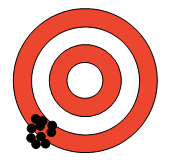
This bullseye demonstrates...
a)
High Accuracy & High Precision
b)
High Accuracy & Low Precision
c)
Low Accuracy & High Precision
d)
Low Accuracy & Low Precision
19.
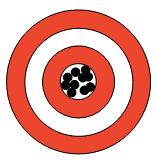
?
a)
High Accuracy & High Precision
b)
High Accuracy & Low Precision
c)
Low Accuracy & High Precision
d)
Low Accuracy & Low Precision
20.
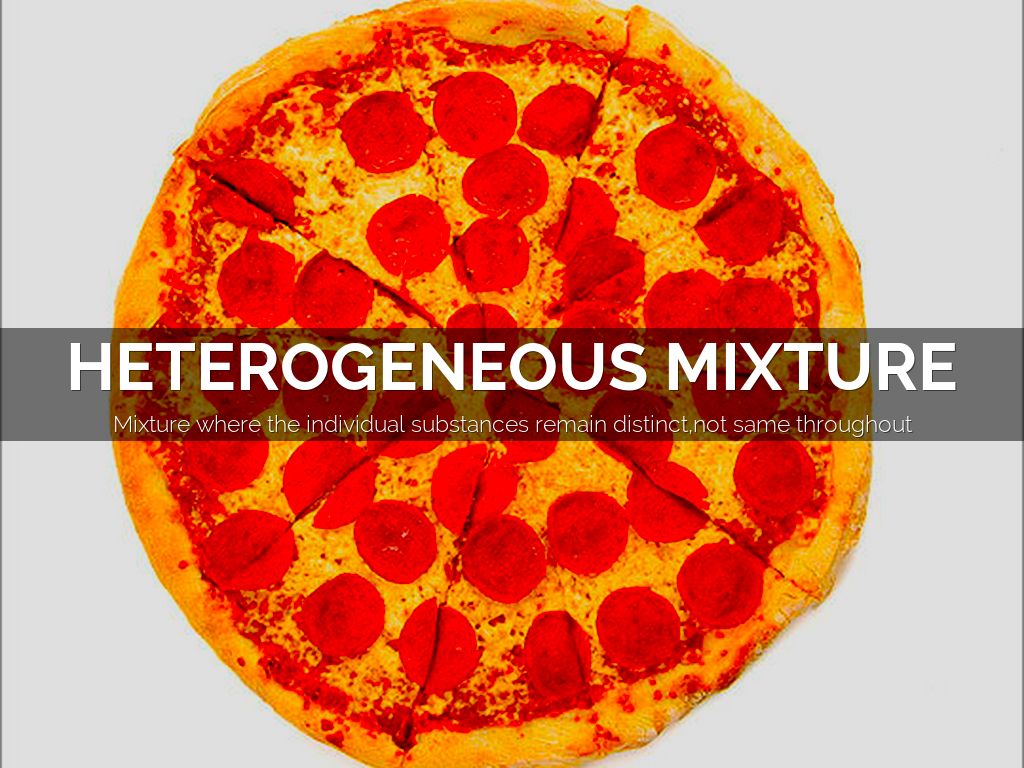
This image is an example of...
a)
precision ONLY
b)
accuracy ONLY
c)
BOTH precision and accuracy
d)
NEITHER precision and accuracy 
21.
A set of data are all close to each other, but they are not close to the actual value.  This set of data can be described as...
a)
accurate
b)
precise
c)
both precise and accurate
22.
You are doing an experiment recording the growth of plants under different amounts of sunlight. What is the dependent variable?
a)
The sunlight
b)
The growth
c)
The experiment
d)
The amounts of photons
23.
The variable that causes a change is the
a)
constant
b)
independent variable
c)
dependent variable
d)
control
24.
The variable that is the result of the experiment is the 
a)
constant
b)
independent variable
c)
dependent variable
d)
control
25.
A variable that never changes is known as a 
a)
constant
b)
independent variable
c)
dependent variable
d)
control
26.
"Will ice melt faster in salt water?", is an example of a
a)
Hypothesis
b)
Question
c)
Dependent variable
d)
Control
27.
"Ice will melt faster in salt water.", would make a good
a)
Hypothesis
b)
Question
c)
Analysis
d)
Conclusion
28.
What is the independent variable for the hypothesis: If ice melts in salt & fresh water, then it will melt faster in salt water.
a)
The amount of water
b)
The melt time
c)
The size of the ice cube
d)
The amount of salt
29.
What is the dependent variable for the hypothesis: If ice melts in salt & fresh water, then it will melt faster in salt water.
a)
The melt time
b)
The amount of salt
c)
The fresh water
d)
The size of the beaker
30.
What is a constant variable for the hypothesis: If ice melts in salt & fresh water, then it will melt faster in salt water.
a)
The amount of salt
b)
The melt Time
c)
The fresh water.
d)
The temperature of the water
31.
A student wants to test the effects of type of exercise on heart rate.  What is the dependent variable?
a)
heart rate
b)
type of exercise
c)
amount of exercise
d)
time of day exercise occurs
32.
How many manipulated variables does an experiment have?
a)
0
b)
1
c)
between 1 and 5
d)
as many as needed
33.
The variable that is being tested or changed
a)
independent variable
b)
dependent variable
c)
control variable
34.

Mrs. Bynoe sets up an experiment to see how the mass of a ball affects the distance it rolls off a ramp. Identify the independent variable.

a)

distance traveled by the ball

b)

height of the ramp

c)

mass of the ball

d)

weight of the ball

35.
An experiment is performed on plants to see how different liquids affect plant growth. Each plant in the experiment is given a different liquid; water, apple juice, or milk. Each plant has the same amount of soil, sunlight, and listens to the same music. In this investigation, what is the dependent variable?
a)
Type of plant
b)
Water, apple juice, milk
c)
Plant growth
36.
When experimenting with the growth of a plant, a scientist uses three (of the same type of) plants, two different fertilizers, equal light, and equal water. What type of variable is the fertilizer?
a)
Dependent
b)
Independent
c)
Control
d)
Compound
37.
The educated guess you make at the beginning of the scientific method is called the....
a)
variable
b)
conclusion
c)
hypothesis
d)
procedure
38.
The variable that is being measured
a)
independent variable
b)
dependent variable
c)
control variable
39.

Mr. Hilgartner normally uses praise as a reward to train his dog. He wants to know the best way to train his dog, so he sets up an experiment to find out if there is a better way to get his dog to respond to commands. What is his independent variable?

a)

amount of times the dog follows the command

b)

type of reward

c)

praise

d)

type of dog

40.
Which scientific instrument would best be used to measure a small distance?
a)
Ruler
b)
Stopwatch
c)
Balance
d)
Pipette
41.
What are the three states of matter?
a)
solid, volume, mass
b)
density, volume, mass
c)
solid, liquid, gas
d)
density, gas, volume
42.
Something that takes up space and has mass.
a)
volume
b)
matter
c)
mass
d)
density
43.
A state of matter that has a definite volume and shape.
a)
solid
b)
liquid
c)
gas
d)
matter
44.
The amount of space something takes up
a)
density
b)
volume
c)
mass
d)
matter
45.
A watermelon has more matter than a grape, so it has more
a)
mass
b)
eat
c)
solid
d)
greater
46.
You can measure ______ with grams.
a)
mass
b)
volume
c)
conductivity
d)
melting point
47.
Solids have a definite _______________.
a)
smell
b)
shape
c)
picture
d)
sound
48.
Liquid matter takes the shape of _______.
a)
a gas
b)
water
c)
a pet
d)
Its container
49.
Water in its solid form is _____________.
a)
a vapor
b)
ice
c)
a liquid
d)
boiling
50.
The amount of matter something contains is its ______________.
a)
gas
b)
solid
c)
weight
d)
mass
51.

Which example is a compound?

a)

N2

b)

O2

c)

Cu

d)

H2O2

52.

Two or more atoms joined together for a(n)...

a)

Element

b)

Compound

c)

Molecule

d)

Mixture

53.
Salt has a chemical formula of NaCl.  Salt is a...
a)
Compound
b)
Element
c)
Mixture
d)
None of the Above
54.
What cannot be broken down into other substances?
a)
Compound
b)
Mixture
c)
Solids
d)
Element
55.
An element is made up of only one kind of _____.
a)
isotope
b)
plastic
c)
atom
d)
metal
56.
What happens when my glass of water is sitting in the sun and disappears into a gas?
a)
evaporation
b)
burning
c)
melting
d)
freezing
57.
How is a gas defined?
a)
Indefinite shape, indefinite volume
b)
Definite shape, definite volume
c)
Found in stars
d)
Definite volume, indefinite shape
58.
What term describes a solid changing to a gas?
a)
Deposition
b)
Sublimation
c)
Evaporation
d)
Freezing
59.
What term describes a liquid changing to a solid?
a)
Deposition
b)
Sublimation
c)
Evaporation
d)
Freezing
60.
Particles of a liquid
a)
are tightly packed together and stay in a fixed position.
b)
have no viscosity.
c)
decrease in volume with increasing temperature.
d)
are free to move around one another but still touch.
61.
When a gas changes directly to a solid, the process is known as what?
a)
Sublimation
b)
Condensation
c)
Deposition
d)
Evaporation
62.

When two liquids react to form a solid...

a)

it is a physical change and a precipitate formed

b)

it is a physical change and is the opposite of dissolving

c)

it is a chemical change change and a precipitate formed

d)

it is a chemical change and the solid has the same properties as the liquids

63.

Which of the following is a physical change?

a)

burning sugar

b)

a neutralization reaction

c)

baking bread

d)

slicing bread

64.

Which of the following is a chemical change?

a)

frost forming

b)

sugar dissolving in water

c)

burning sugar

d)

sharpening a pencil

65.
What kind of properties can only be observed when a substance changes into a different substance?
a)
physical properties
b)
chemical properties
c)
liquid properties
d)
real properties
66.
A change in the size, shape, or state of matter.
a)
chemical change
b)
physical change
c)
chemical reaction
d)
electron change
67.
Kim puts an ice cube in a beaker and it melts. This is a good example of:
a)
a physical change.
b)
a chemical change.
c)
an experiment.
d)
an analysis.
68.
What is an example of a Chemical change?
a)
Ripped paper 
b)
boiled egg
c)
cracked egg
d)
sugar in water
69.
Which is a chemical change?
a)
freezing fruit juice
b)
slicing a potato
c)
boiling water
d)
copper metal turning green
70.
One cup of water is left outside for two days when it was checked there was only half a cup left. What happened?
a)
evaporation; chemical change
b)
condensation; physical change 
c)
evaporation; physical change
d)
condensation; chemical change
71.
A mixtures is a combination of two or more____________ in which no new kinds of matter are formed.
a)
 subtances
b)
parts
c)
leaves
d)
pebbles
72.
Making a mixture results in ___________________ only.
a)
chemical reactions
b)
separate parts
c)
physical changes
d)
two subtances
73.
Lemonade is a special mixture called a 
a)
substance
b)
solution
c)
plasma
d)
ingredient
74.
A solution is a mixture of one or more substances _________ evenly into another substance.
a)
dissolved
b)
evaporated
c)
carried
d)
split
75.
What does it mean if a mixture is heterogeneous?
a)
you can see the different parts
b)
cannot tell one part from another
c)
very well blended
d)
made of elements
76.
What does it mean if a mixture is homogeneous?
a)
you can see the different parts
b)
cannot tell one part from another
c)
chunks of particles
d)
made of elements
77.
To separate trail mix what method should you use?
a)
filtration 
b)
sorting
c)
magnet
d)
boiling
78.
To separate iron filings and sulfur what method should you use?
a)
filtration 
b)
sorting
c)
magnet
d)
boiling
79.
Which mixture separation method uses a net?
a)
filtration 
b)
magnet
c)
boiling/evaporation
d)
sorting physically
80.
Which mixture separation method would use to separate sugar from water?
a)
filtration 
b)
magnet
c)
boiling/evaporation
d)
sorting physically