
 Worksheets
SSS & SAS Congruence Thms
Total questions: 20
Worksheet time: 2hrs 40mins
Name
Class
Date
1.

Name the postulate, if possible, that makes the triangles congruent.
a)
SSS
b)
SAS
c)
ASA
d)
Not Possible
2.
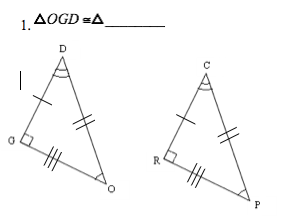
Complete the congruence statement.
a)
CRP
b)
PCR
c)
RPC
d)
PRC
3.

Use the congruency statement to answer the following:
<F = ___
<F = ___
a)
<H
b)
<I
c)
<G
d)
not congruent to another angle
4.
∆ABC≅∆XYZ
which is true?
which is true?
a)
AB≅XY
b)
AB≅YX
c)
AB≅XZ
d)
BC≅CB
5.

∆ABC ≅ ∆LMN. Which statement is NOT true?
a)
LM ≅ AB
b)
∆CAB ≅ ∆NLM
c)
∠C ≅ ∠N
d)
BC ≅ ML
6.

a)
A
b)
B
c)
C
d)
D
7.
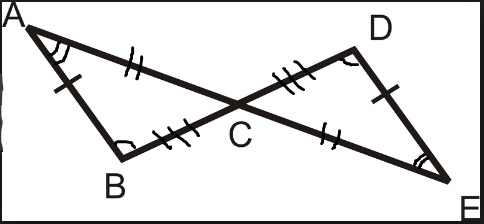
∠E ≅ ∠ __
a)
A
b)
B
c)
C
d)
D
8.
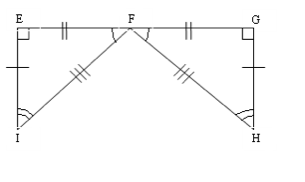
Which segment is congruent to EF?
a)
HG
b)
HF
c)
GF
d)
IE
9.

Find the value of x.
a)
4
b)
1
c)
-5
d)
-1/2
10.

△BAC ≅ △QPR. If ∠B = 2x and ∠Q = 10, find the value of x.
a)
2
b)
4
c)
5
d)
-5
11.

State if the two triangles are congruent. If they are, state how you know.
a)
A
b)
B
c)
C
d)
D
12.

Congruent by
a)
SSS
b)
SAS
c)
ASA
d)
Not enough information
13.

What is the measure of angle b?
a)
36o
b)
56o
c)
63o
d)
117o
14.
If L is the midpoint of TJ, what must be true?
a)
TL=JT
b)
JL=TJ
c)
TL=LJ
d)
T is also the midpoint of JL
15.

If DA bisects IE, then
a)
ID=ED
b)
IA=EA
c)
<IDA=<EDA
d)
<IAD and <EAD are right angles
16.

If AD bisects <EDI, then
a)
<ADE=<IDA
b)
IA=AE
c)
ID=ED
d)
All of the above
17.
An angle bisector cuts an angle into two congruent _________
a)
Angles!
b)
Segments
c)
Mysteries
18.
A segment bisector cuts a segment into two congruent
a)
Segments!
b)
Angles
c)
Mysteries
19.

In this picture,
a)
<BCA=<DCE because they are vertical angles and vertical angles are always congruent to each other
b)
<C=<C because they are vertical angles and vertical angles are always congruent to each other
c)
<EDC=<ACB because they are vertical angles and vertical angles are always congruent to each other
d)
None of the above; we don't actually have vertical angles
20.

What are the 2 missing pieces of information?
a)
Transitive Property, SAS(Side-Angle-Side)
b)
Reflexive Property, SAS(Side-Angle-Side)
c)
Transitive Property, SSS(Side-Side-Side)
d)
Reflexive Property, SSS(Side-Side-Side)
100 %

