wayground logo

Free Printable Worksheets

Font size

S
M
L
XL
Worksheets

Chapter 3 Review

Total questions: 94

Worksheet time: 1hrs 14mins

Name
Class
Date
1.
What atom matches this electron configuration?
1s22s22p63s23p64s23d10
a)
Zinc
b)
Copper
c)
Nickel
d)
Germanium
2.
The electron configuration of an atom is 1s22s22p6.  The number of electrons in the atom is 
a)
3
b)
6
c)
8
d)
10
3.
Which electron configuration belongs to Chlorine (Cl)?
a)
1s2s2p3s3p5
b)
1s2s2p3s3p6
c)
1s2s2p3s3p7
4.
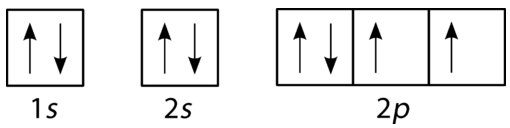
This orbital diagram represents:  
a)
C
b)
B
c)
N
d)
O
5.
This orbital diagram represents:  
a)
C
b)
B
c)
N
d)
O
6.
What is incorrect about this orbital diagram?
a)
Both arrows in the 2p box should be pointing up
b)
There is nothing incorrect with this diagram
c)
In the there should only be 1 orbital in the first 2p box and one in the 2nd 2p box
d)
All the arrows should be pointing up.
7.
How many electrons can the d sublevel hold?
a)
14
b)
10
c)
2
d)
6
8.
How many electrons can the s sublevel hold?
a)
14
b)
10
c)
2
d)
6
9.
How many electrons can the p sublevel hold?
a)
14
b)
10
c)
2
d)
6
10.

How many electrons are in the following electron configuration? 1s22s22p3

a)

7

b)

5

c)

12

d)

it is impossible to determine

11.
What is the noble gas configuration for Sulfur?
a)
[Ar] 3p4
b)
[He] 3s2 3p4
c)
[Ne] 3s2 3p4
d)
[Na] 3s2 3p4
12.
What is the noble gas configuration for beryllium?
a)
[He]1s2
b)
[He]2s2
c)
[Li]2s1
d)
[Li]2s2
13.
[Ne]3s23p1 is the noble gas configuration for which element?
a)
scandium
b)
boron
c)
nitrogen
d)
aluminum
14.
[He]2s22p4 is the noble gas configuration for which element?
a)
oxygen
b)
sulfur
c)
phosphorus
d)
fluorine
15.
The electron configuration of an atom is 1s22s22p6.  The number of electrons in the atom is 
a)
3
b)
6
c)
8
d)
10
16.

What is the noble gas shorthand electron for Phosphorus atom?

a)

[Ar] 3p4

b)

[He] 3s23p4

c)

[Ne] 3s23p3

d)

[Na] 3s23p4

17.
An electron occupies the lowest energy orbital that can receive it.
a)
Hund’s rule
b)
Pauli exclusion principle
c)
Bohr model of the atom
d)
Aufbau principle
18.
All orbitals of equal energy are occupied by one electron before any single orbital is occupied by a second electron.
a)
Aufbau principle
b)
Pauli exclusion principle
c)
Hund’s rule
d)
Core Notation
19.
No two electrons in the same atom can have the same four quantum numbers.
a)
Aufbau principle
b)
Pauli exclusion principle
c)
Hund’s rule
d)
Noble gas notation
20.
Which guideline, Hund’s rule or the Pauli exclusion principle, is violated in the following orbital diagrams?
a)
Hund's
b)
Aufbau's
c)
Pauli's Exclusive
21.
Which guideline, Hund’s rule or the Pauli exclusion principle, is violated in the following orbital diagrams?
a)
Hund's
b)
Aufbau's
c)
Pauli's Exclusive
22.
Which guideline, Hund’s rule or the Pauli exclusion principle, is violated in the following orbital diagrams?
a)
Aufbau's
b)
Hund's
c)
Pauli exclusive
23.
Electrons are paired based on their spin directions, clockwise and counterclockwise, is what electron configuration rule?
a)
Hund’s Rule
b)
Aufbau Principle
c)
Pauli Exclusion Principle
24.
Which element is pictured?
a)
neon
b)
fluorine
c)
magnesium
d)
argon
25.
What is incorrect about this orbital diagram?
a)
Both arrows in the 2p box should be pointing up
b)
There is nothing incorrect with this diagram
c)
In the 2p box there should only be 1 electron in the first 2p box and one in the 2nd 2p box
d)
All the arrows should be pointing up.
26.
Electrons occupy orbitals of lowest energy first is part of what electron configuration rule?
a)
Hund’s Rule
b)
Aufbau Principle
c)
Pauli Exclusion Principle
27.
Each column in the periodic table is called a 
a)
period
b)
group
c)
cluster
d)
unit
28.
Elements which are shiny, conduct electricity and heat are called
a)
metal
b)
nonmetal
c)
metalloid
d)
nonexistent
29.
Which element is not a metal?
a)
H
b)
Re
c)
Al
d)
B
30.
The atoms along the staircase are called 
a)
metals
b)
nonmetals
c)
metalloids
d)
noble gases
31.
Which is a halogen?
a)
Helium
b)
Chlorine
c)
Oxygen
d)
Neptune
32.
Which is an alkali metal?
a)
Magnesium
b)
Iron
c)
Sodium
d)
Europium
33.
A horizontal row of elements in the periodic table.
a)
column
b)
group
c)
period
34.
Elements in a ..................have similar chemical properties.  
a)
period
b)
group
c)
row
35.
Which has the greater EN: 
Cl or Al?
a)
Cl
b)
Al
36.
Which has the greater EN: 
N or C?
a)
C
b)
N
37.
Which has the greater EN: 
H or F?
a)
H
b)
F
38.
Which of the following will have a larger radius than Zinc?
a)
Gallium
b)
Aluminum
c)
Magnesium
d)
Strontium
39.
Which of the following will have a higher electronegativity than arsenic (As)?
a)
Carbon (C)
b)
Neon (Ne)
c)
Antimony (Sb)
d)
Germanium (Ge)
40.
Which of the following will have a lower ionization energy than Scandium (Sc)?
a)
Helium (He)
b)
Titanium (Ti)
c)
Calcium (Ca)
d)
Magnesium (Mg)
41.
As atoms of elements in group 16 are considered in order from top to bottom, the electronegativity of each successive element....
a)
decreases
b)
increases
c)
remains the same
d)
none of the above
42.
Which atom has the largest atomic radius?
a)
potassium
b)
rubidium 
c)
francium
d)
cesium
43.
As you move down the periodic table atoms get bigger.  This is because ____________.
a)
The atoms have more mass.
b)
The atoms have more protons.
c)
The atoms have more energy levels
d)
The atoms have more nuetrons
44.
Atoms that have a high electronegativity, _______________.
a)
give up their electrons more easily.
b)
hold on to their electrons more tightly.
c)
have more electron shells.
45.
Electronegativity is...
a)
how good an atom is at attracting electrons
b)
the ability of an atom to lose electrons
c)
the energy required to remove an electron from a specific atom
d)
how easy it is to make friends. 
46.
Ionization energy is...
a)
the energy required to add an electron to a specific atom
b)
how much energy it takes to remove an electron from an atom
c)
the energy required to shield the outer electrons from the nucleus
d)
a measure of the ability of an atom to attract electrons
47.
The atom with the largest atomic radius in Group 18 is - 
a)
Ar
b)
He
c)
Kr
d)
Rn
48.
Which statement correctly and completely identifies a trend?
a)
Atomic radius decreases across a period and increases down a group.
b)
Electronegativity decreases across a period and decreases down a group.
c)
Ionization energy increases across a period and increases down a group.
d)
Ionic radius increases across a period and increases down a group.
49.
The element with the largest electronegativity in the halogens is - 
a)
At
b)
F
c)
Cl
d)
Br
50.

The element with the lowest electronegativity in Period 3 is -

a)

Na

b)

Cl

c)

Ar

d)

Mg

51.
Atomic radius generally increases as we move __________.  
a)
down a group and from right to left across a period 
b)
up a group and from left to right across a period 
c)
down a group and from left to right across a period 
d)
up a group and from right to left across a period 
52.
Electronegativity __________ from left to right within a period and __________ from top to bottom within a group.
a)
decreases, increases 
b)
increases, increases
c)
increases, decreases 
d)
stays the same, increases
53.
Name group 1 on the periodic table.
a)
alkali metals
b)
alkaline earth metals
c)
noble gases
noble gases
d)
halogens
54.
Name group 2 on the periodic table.
a)
alkali metals
b)
alkaline earth metals
c)
noble gases
d)
transition metals
55.
Name group 18 on the periodic table.
a)
alkali metals
b)
alkaline earth metals
c)
transition metals
d)
noble gases
56.
Name groups 3 - 12 on the periodic table.
a)
noble gases
b)
halogens
c)
metalloids
d)
transition metals
57.
Name group 17 on the periodic table.
a)
transition metals
b)
metalloids
c)
halogens
d)
alkali metals
58.
Where are the nonmetals located on the periodic table?
a)
top left corner
b)
bottom left corner
c)
top right corner
d)
bottom left corner
59.
What do the numbers down the side tell us about the atoms in each row?
a)
number of protons
b)
number of electrons
c)
number of energy levels
d)
absolutely nothing
60.
How many electrons can the first energy level hold?
a)
1
b)
2
c)
8
d)
0
61.

How many orbitals does an s sublevel have?

a)

1

b)

3

c)

5

d)

7

62.

How many orbitals does a d sublevel have?

a)

1

b)

3

c)

5

d)

7

63.

How many orbitals does an f sublevel have?

a)

1

b)

3

c)

5

d)

7

64.

Electrons fill energy levels and sublevels _____ in energy first.

a)

lower

b)

higher

65.
Which of the following statements is true about the 3s and the 4s sublevels?
a)
These sublevels have the same energy
b)
These sublevels are the same distance from the nucleus
c)
These sublevels hold different amounts of electrons
d)
These sublevels have the same shape
66.

The maximum number of electrons that can fit into the 2nd energy level is

a)

2

b)

8

c)

18

d)

32

67.

For each of the following sublevels, which is lowest in energy?

a)

4s

b)

3d

c)

4p

d)

5s

68.

Of the following sublevels, which is the highest in energy?

a)

4s

b)

3d

c)

4p

d)

5s

69.
What is the shape of s orbitals?
a)
Dumbbell shaped
b)
Peanut shaped
c)
Spherical shaped
d)
Hybrid structure
70.

A silicon atom has 14 electrons. What is the electron configuration of silicon?

a)

1s22s22p63s23d2

b)

1s22s22p63s23p2

c)

1s22s22p63s23s2

71.

How many valence electrons should Lithium have in its Lewis dot model?

a)

1

b)

2

c)

3

d)

4

72.

How many valence electrons should Oxygen have in its Lewis dot model?

a)

5

b)

6

c)

7

d)

8

73.

How many valence electrons should Magnesium have in its Lewis dot model?

a)

1

b)

2

c)

3

d)

4

74.

This is a correct dot diagram for nitrogen (N)

a)

true

b)

false

75.

This is a correct dot diagram for neon (Ne)

a)

true

b)

false

76.

Which of these is incorrect?

a)
b)
77.

This could be the dot diagram of

a)

Mg

b)

Cl

c)

C

d)

O

78.

How would you draw a Lewis dot diagram for Magnesium?

a)
b)
c)
d)
79.

Which of the following shows a correct Lewis dot structure?

a)
b)
c)
d)
80.

Which of these is correct?

a)
b)
c)
81.
What element is this?
a)
Helium
b)
Hydrogen
c)
Argon
d)
Silver
82.
What element is represented in this Bohr Model? 
a)
Carbon
b)
Hydrogen
c)
Aluminum
d)
Lithium
83.
What's a valence electron?
a)
electrons in the second energy level
b)
electrons in the outermost energy level
c)
the atomic number
d)
electrons in the first level
84.
How many dots would a Lewis Dot structure of Helium have?
a)
1
b)
2
c)
8
d)
0
85.
How many electrons are in the outer shell of Sodium (Na)?
a)
3
b)
1
c)
2
d)
4
86.
?
a)
Boron
b)
Carbon
c)
Nitrogen
d)
Lithium
87.
?
a)
Lithium
b)
Boron
c)
Carbon
d)
Neon
88.
?
a)
Helium
b)
Hydrogen
c)
Argon
d)
Silver
89.
?
a)
Helium
b)
Oxygen
c)
Sodium
d)
Phosphorous
90.
How many electrons should Chlorine have around its Lewis dot model?
a)
5
b)
6
c)
7
d)
8
91.
How are electrons arranged in an atom?
a)
In groups of five
b)
In energy levels
c)
By color
d)
By shape
92.
What is the name of the group that never reacts--ever ever they are stable with a full outermost ring!!!
a)
noble gases
b)
transition
c)
halogens
d)
borons
93.
The period for Bromine is ___________.
a)
3
b)
2
c)
4
94.
What does an atom's group tell us?
a)
Number of protons
b)
Number of electrons
c)
Number of valence electrons
d)
Number of shells