wayground logo

Free Printable Worksheets

Font size

S
M
L
XL
Worksheets

Test 3 Review

Total questions: 174

Worksheet time: 4hrs 24mins

Name
Class
Date
1.
Aerobic respiration occurs in which organelle?
a)
chloroplast
b)
mitochondrion
c)
ribosome
d)
nucleus
2.
Which statement best compares aerobic and anaerobic respiration? 
a)
Less ATP is generated during anaerobic respiration than during aerobic respiration. 
b)
More water is generated during anaerobic respiration than during aerobic respiration. 
c)
More oxygen is generated during anaerobic respiration than during aerobic respiration. 
d)
Less lactic acid is generated during anaerobic respiration than during aerobic respiration. 
3.
How does the amount of energy resulting from fermentation compare with that of aerobic respiration? 
a)
Aerobic respiration results in less energy.
b)
Aerobic respiration results in more energy.
c)
Each process results in equal amounts of energy. 
d)
Each process results in variable amounts of energy. 
4.
Aerobic respiration occurs in the presence of ______________.
a)
nitrogen
b)
carbon dioxiide
c)
oxygen
d)
carbon monoxide
5.
This organelle could likely be found in 
a)
plant cells only.
b)
animal cells only.
c)
prokaryotes only.
d)
plant and animal cells.
6.
Muscle cells that are used during heavy exercise often do not receive enough oxygen for energy production.  What waste product builds up in muscle cells resulting in soreness?
a)
water
b)
alcohol
c)
carbon dioxide
d)
lactic acid
7.
Which of the following is the correct equation for aerobic cellular respiration?
a)
6CO2 + 6H2O     --->   C6H12O6 + 6O+ ATP
b)
6O2 + C6H12O6  ---> 6H2O + 6CO+ ATP
c)
C6H12O+ 6H2O ---> 6CO2 + 6O+ ATP
d)
6O2 + 6H2O ---> C6H12O6 + 6CO+ ATP
8.
Aerobic respiration yields about  ___ ATP molecules per glucose, whereas anaerobic respiration yields ____ ATP molecules per glucose.
a)
36; 2
b)
2; 36
c)
6; 2
d)
36; 18
9.
What is the name of the 1st step of cellular respiration?
a)
Glycolysis
b)
Kreb's Cycle
c)
ETC
d)
Anaerobic respiration
10.
Where does glycolysis take place?
a)
Cytoplasm
b)
Stroma
c)
Thylakoid
d)
Mitochondria
11.
Where does aerobic respiration take place?
a)
Cytoplasm
b)
Mitochondria
c)
Stroma
d)
Thylakoid
12.
What is the net gain of ATP during glycolysis?
a)
1
b)
2
c)
4
d)
34
13.
Which type of respiration occurs in the presence of oxygen?
a)
Aerobic
b)
Anaerobic
14.
Which type of respiration occurs without the presence of oxygen?
a)
Aerobic 
b)
Anaerobic 
15.
What are the two reactants of cellular respiration?
a)
C6H12O6 & 6CO2
b)
6 CO2 & 6H2O
c)
C6H12O& 6O2
d)
6CO2 & 6O2
16.
Glucose is broken down during which process?
a)
Calvin cycle
b)
Glycolysis
c)
Krebs Cycle
d)
Photosynthesis 
17.
___ produces the most ATP.
a)
Aerobic respiration
b)
Anaerobic respriation
c)
Glycolysis
d)
Photosynthesis
18.
What are the two produces of aerobic respiration?
a)
Glucose & oxygen
b)
Carbon dioxide & water
c)
Lactic acid
d)
Carbon monoxide 
19.
The overall goal of cellular respiration is to make:
a)
Glucose
b)
ATP
c)
Oxygen
d)
Water
20.
What is the total net gain of ATP at the end of aerobic respiration?
a)
2 ATP
b)
34 ATP 
c)
36 ATP
d)
38 ATP
21.
Which is a product of Kreb's Cycle?
a)
Carbon dioxide
b)
Glucose
c)
Pyruvate
d)
Water
22.
Which is a product of the ETC?
a)
Carbon dioxide
b)
Glucose
c)
Oxygen
d)
Water
23.
What is the name of the process that helps make beer and wine?
a)
Fermentation
b)
Alcoholic fermentation
c)
Lactic acid fermentation
d)
Glycolysis
24.
Which type of fermentation occurs in muscles?
a)
Alcoholic 
b)
Lactic acid
25.
How does the amount of energy resulting from fermentation compare with that of aerobic respiration? 
a)
Aerobic respiration results in less energy.
b)
Each process results in equal amounts of energy.
c)
Aerobic respiration results in more energy.
d)
Each process results in variable amounts of energy. 
26.
This is referred to as the energy currency of the cell
a)
ADP
b)
ATP
c)
Mitochondria
d)
Nucleus
27.
This molecule contains three phosphate groups
a)
ADP
b)
ATP
c)
Mitochondria
d)
Nucleus
28.
This molecule contains two phosphate groups
a)
ADP
b)
ATP
c)
Mitochondria
d)
Nucleus
29.
This process releases chemical energy from sugars and other carbon-based molecules to make ATP when oxygen is present.
a)
photosynthesis
b)
light-independent reaction
c)
cellular respiration
d)
light-dependent reaction
30.
Cellular respiration takes place in the
a)
nucleus
b)
cytoplasm
c)
ribosomes
d)
mitochondria
31.
Glucose is broken down during which process
a)
Krebs cycle
b)
Calvin cycle
c)
Glycolysis
d)
Photosynthesis
32.
Glycolysis 
a)
does not need oxygen
b)
does need oxygen
33.
This is made of proteins that need energy-carrying molecules from the Krebs cycle and oxygen to make ATP
a)
Glycolysis
b)
Kreb's Cycle
c)
Photosynthesis
d)
Electron Transport Chain
34.
Which is not a waste product of cellular respiration?
a)
Water
b)
Heat
c)
Carbon Dioxide
d)
Oxygen
35.
Up to how many ATP molecules are made from the breakdown of one glucose molecule?
a)
2
b)
24
c)
38
d)
45
36.
What is the major difference in ADP and ATP?
a)
ADP has less energy because it is composed of only two phospates, ATP has more energy because it is composed of three phosphates.
b)
ADP has more energy because it is composed of two phosphates, ATP has less energy because it is composed of three phosphates.
c)
ADP is not a real source of energy because there are no double bonds.
d)
ATP can be compared to an uncharged battery because it does not have a lot of energy.
37.
Only about 40% of energy contained in one glucose molecule is converted to ATP.  What happens to the remaining 60%?
a)
Turns in to water
b)
Released as Carbon Dioxide
c)
Released as Heat
d)
Magically Disappears
38.
What two products are made during photosynthesis that are used in cellular respiration?
a)
water and carbon dioxide
b)
glucose and oxygen
c)
ATP and ADP
d)
Sunlight and water
39.
Only plants go through the process of photosynthesis.  What types of organisms undergo cellular respiration?
a)
Only Plants
b)
Only Animals
c)
Both Plants and Animals
d)
All Living Things
40.
Cellular respiration is the ...........
a)
process that releases energy by breaking down glucose and other food moleucules in the presence of oxygen.
b)
process of trapping sunlight to make glucose and oxygen.
c)
a process that only plants use to make food.
d)
a process that animals use to make food.
41.
The two types of cellular respiration are: ____________ and ____________.
a)
aerobic respiration: oxygen required
anaerboic respiration: no oxygen needed
b)
aerobic respiration: no oxygen required
anaerboic respiration: no oxygen 
c)
light independent and light dependent reaction
d)
ATP or ADP
42.
Which of the following steps in cellular respiration is aerobic and DOES NOT happen in the cytoplasm?
a)
Glycolysis
b)
Alcohol Fermentation
c)
Lactic Acid Fermentation
d)
Krebs Cycle
43.
What is the by-product of the Kreb's Cycle?
a)
Oxygen
b)
Carbon Dioxide
c)
Glucose
d)
NADP
44.
What is the by-product of the Electron Transport Chain?
a)
Water
b)
Oxygen
c)
Carbon Dioxide
d)
ADP
45.
Identify the phase of mitosis.
a)
prophase
b)
metaphase
c)
anaphase
d)
telophase
46.
Which is the correct order?
a)
C,D, B, A, F, E
b)
D,A,F,C,E,B
c)
B,E,C,F,A,D
d)
C,B,D,A E,F
47.
This picture shows which process? 
a)
mitosis
b)
meiosis
c)
the cell cycle
48.
This diagram depicts which phase of mitosis? 
a)
prophase
b)
metaphase
c)
anaphase
d)
telophase
49.
The division of the cytoplasm following mitosis ...
a)
cytoplasm
b)
cytokinesis
c)
telophase
d)
mitosis
50.
The uncontrolled division of cells...
a)
meiosis
b)
cancer
c)
nondisjunction
d)
crossing over
51.
Stage in which the cell's nuclear material divides and separates...
a)
G1
b)
Synthesis
c)
G2
d)
Mitosis
52.
The chromosomes line up across the middle of the cell
a)
Anaphase
b)
Interphase
c)
Prophase
d)
Metaphase
53.
What phase of mitosis is pictured?
a)
Prophase
b)
metaphase
c)
anaphase
d)
telephase
54.

How many times does the cell divide in mitosis?

a)

Once (PPMAT)

b)

4 times

c)

2 times

d)

none of these

55.
How many daughter cells are produced in mitosis?
a)
4 new cells
b)
2 new cells
c)
One new cell
d)
none of these
56.

How many times does the cell divide in meiosis?

a)

twice (PPMAT)

b)

none of these

c)

3 times

d)

once

57.
How many daughter cells are produced in meiosis?
a)
4 daughter cells
b)
none of these
c)
3
d)
1
58.
The cells produced via meiosis are called:
a)
gametes
b)
somatic cells
c)
body cells
d)
skin cells
59.
This process produces cells with only 1/2 of the chromosomes as body cells.
a)
mitosis
b)
meiosis
60.
This produces cells for growth and repair.
a)
mitosis
b)
meiosis
61.
The end of meiosis results in  ________ to each other.
a)
2 cells that are identical
b)
4 cells that are identical
c)
2 cells that are not identical
d)
4 cells that are not identical
62.
Name that process...
a)
Mitosis
b)
Meiosis
c)
Cell Cycle 
d)
DNA replication
63.

Which effect is most likely caused by nondisjunction during meiosis?

a)

A. an increase in nuclei

b)

B. an extra chromosome

c)

C. only two types of nitrogenous bases

d)

D. increased survival benefits from traits

64.

Which statement describes one difference between mitosis and meiosis in animal cells?

a)

A. Mitosis produces sex cells, and meiosis produces diploid cells.

b)

B. Mitosis produces haploid cells, and meiosis produces somatic cells.

c)

C. Mitosis produces four daughter cells, and meiosis produces two diploid cells.

d)

D. Mitosis produces two daughter cells, and meiosis produces four daughter cells.

65.

Which statement best describes the outcomes of both meiosis and mitosis?

a)

A. Cell division results in daughter cells that contain DNA.

b)

B. Each daughter cell has two complete sets of chromosomes.

c)

C. Within a cell, two chromosomes pair up and exchange segments of genetic material.

d)

D. Genetically identical daughter cells are produced that can function as body cells or sex cells.

66.

Which event most likely occurs next in mitosis?

a)

A. The chromatin condenses.

b)

B. The nuclear envelope dissolves.

c)

C. The chromosomes double in number.

d)

D. The cell membrane pinches inward to divide the cytoplasm.

67.

What type of cell is produced following meiosis?

a)

gamete cell

b)

somatic cell

c)

diploid cell

d)

nerve cell

68.

For each of the following state if the cell is haploid or diploid.

a. Sperm cell = b. nerve cell = c. Egg cell = d. stomach cell =

a)

haploid, diploid, diploid, diploid

b)

diploid, haploid, haploid, diploid

c)

diploid, haploid, diploid, haploid

d)

haploid, diploid, haploid, diploid

69.

Which of the following best describe the term “crossing over”?

a)

a. separation of two sister chromatids

b)

b. A molecular interaction between two sister chromatids

c)

c. An exchange of information between two homologous chromosomes

d)

d. A molecular interaction between two non-sister chromatids

70.

Which letter in Figure 1 represents meiosis?

a)

a. a

b)

b. b

c)

c. c

d)

d. d

71.

Which letter in Figure 1 represents mitosis?

a)

a. a

b)

b. b

c)

c. c

d)

d. d

72.

During which phase of the cell cycle does the cell spend the most time?

a)

interphase

b)

mitosis

c)

cytokinesis

d)

meiosis

73.

Which phase of mitosis is shown in the picture?

a)

interphase

b)

cytokinesis

c)

telophase

d)

prophase

74.

During the ___ phase, DNA is replicated.

a)

S

b)

G1

c)

G2

d)

M

75.

The chromosomes that pair up during meiosis, are called __________ chromosomes.

a)

homozygous

b)

asexual

c)

homologous

d)

heterozygous

76.
What stage of cell division is this?
a)
Interpahse
b)
Prophase
c)
Metaphase
d)
Telophase
77.
What stage of cell division is this?
a)
Prophase
b)
Metaphase
c)
Anaphase
d)
Telophase
78.
What phase of cell division is this?
a)
interphase
b)
anaphase
c)
prophase
d)
cytokinesis
79.
What stage of cell division is this?
a)
Prophase
b)
Metaphase
c)
Telophase
d)
Cytokinesis
80.
What structure connects the duplicate halves of sister chromatids?
a)
chromatin
b)
centromere
c)
microtubule
d)
spindle
81.

What is the network of fibers extending from the centrioles - made of microtubules to which chromatids attach and are pulled apart?

a)

centrioles

b)

spindle

c)

chromatids

d)

nucleolus

82.
During which stage of cell division are chromosomes pulled to opposite ends of the cell?
a)
Prophase
b)
Metaphase
c)
Anaphase
d)
Telophase
83.
During which stage of cell division is the cytoplasm divided resulting in 2 identical cells?
a)
Interphase
b)
Anaphase
c)
Telophase
d)
Cytokinesis
84.
During which stage of cell division do the chromosomes shorten, condense, and become visible?
a)
Interphase
b)
Prophase
c)
Metaphase
d)
Anaphase
85.

During which stage of interphase does the cell double in size and produce a second set of cell organelles, and carry out normal cell functions?

a)

G1

b)

S

c)

G2

d)

All 3 stages

86.
Which phase of cell division is this?
a)
interphase
b)
prophase
c)
metaphase
d)
anaphase
87.
During which stage of interphase does the cell form the special structures that will be needed for division?
a)
G1
b)
S
c)
G2
d)
All 3 stages
88.

What happen during replication in the S phase of the cell cycle?

a)

The number of chromatids doubled.

b)

The number of chromosomes doubled.

c)

The number of homologous chromosomes doubled.

d)

The amount of energy in mitochondria doubled.

89.

Which of the following sentences about meiosis are correct?

I. Meiosis halves the amount of DNA.

II. Meiosis enables sexual reproduction.

III. Meiosis results in the genetic diversity of offspring.

IV. The first meiotic division in eukaryotes is similar to mitosis.

V. Meiosis in higher eukaryotes occurs in somatic cells and gametes.

a)

I, II and IV

b)

I, II and III

c)

II, III and V

d)

II, III and IV

90.
During what phase of the cell cycle does the cell prepare for mitosis?
a)
G1 phase
b)
S phase
c)
G2 phase
d)
M phase
91.
Put the following in order: G2, G1, S, mitosis, cytokinesis. 
a)
G1, G2, S, Mitosis, cytokinesis
b)
G1, S, G2, Mitosis, cytokinesis
c)
G1, G2, S, cytokinesis, mitosis
d)
G1, S, G2, cytokinesis, mitosis
92.
There are a TOTAL of ___ chromosomes in human body cells.
a)
23
b)
46
c)
92
d)
scientists don't know
93.

meoisis results in the production of

a)

2 haploid cells

b)

2 diploid cells

c)

4 haploid cells

d)

4 diploid cells

94.

daughter cells produced asexually are

a)

identical to each other

b)

identical to parent cell

c)

different from each other

d)

identical to each other and parent cell

95.

which statement correctly describes homologous chromosomes?

a)

they are form during meoisis

b)

they are held together by centromeres

c)

they are identical

d)

they carry the same genetic information

96.

In eukaryotic cell division, the process of cytoplasmic division is called....

a)

cytokinesis

b)

cytomeiosis

c)

cytoplasmosis

d)

cytomitosis

97.

as mitosis begins, a condensed chromosome consists of two...

a)

centromeres

b)

centrioles

c)

chromatins

d)

chromatids

98.

which event does not occur during prophase in an animal cell?

a)

chromosome condense

b)

spindle begins to form

c)

chromosome replicate

d)

nuclear envelope disperses

99.

cytokinesis usually but not always follows mitosis. if a cell completed mitosis but not cytokinesis, the result would be a cell with....

a)

two nuclei

b)

a single large nucleus

c)

high concentration of actin and myosin

d)

two abnormally small nuclei

100.
Name the process in the diagram. 
a)
Meiosis 
b)
Mitosis 
c)
Endocytosis 
d)
Phagocytosis 
101.
Which of the following best describes cancer?
a)
absence of cyclins in the DNA
b)
Multiple gene mutations on a chromosome of DNA
c)
Uncontrolled cell growth caused by mutations in genes that control the cell cycle.
d)
Presence of genetic defects caused by hereditary disorders. 
102.

If there are 16 chromosomes in the egg cells of an organism, how many chromosomes would be found in its muscle cells?

a)

16

b)

32

c)

8

d)

64

103.

If there are 20 chromosome in the egg cells, how many chromosomes would be found in the sperm cells of the same species?

a)

10

b)

40

c)

20

d)

80

104.

Which of the following best describe the term “crossing over”?

a)

a. separation of two sister chromatids

b)

b. A molecular interaction between two sister chromatids

c)

c. An exchange of information between two homologous chromosomes

d)

d. A molecular interaction between two non-sister chromatids

105.
The center cell is experiencing  the following phase
a)
telophase
b)
metaphase
c)
anaphase
d)
prohase
106.
True or false.  Cancer begins when mutations disrupt the normal cell cycle, causing cells to divide in an uncontrolled way.
a)
True
b)
False
107.
Structure B is pointing to the _____. 
a)
chromosome
b)
centromere
c)
DNA
d)
chromatid
108.
Structure C is pointing to one ____. 
a)
sister chromatid
b)
chromosome
c)
centromere
d)
gene
109.

How many chromosomes are normally found in human body cells?

a)

46

b)

23

c)

26

d)

44

110.
What is the name of the structure labeled X?
a)
Centriole
b)
Centrosome
c)
Chromatid
d)
Chromosome 
111.
Which phase comes NEXT?
a)
prophase
b)
metaphase
c)
anaphase
d)
telophase
112.
In which cell below would a student likely observe a cell plate during mitosis?
a)
rat muscle cell
b)
alligator stomach cell
c)
pea leaf cell
d)
human lung cell
113.
The process by which the nuclear material is divided equally between two new cells
a)
mitosis
b)
cancer
c)
spindle
d)
centromere
114.
Name the phase:
a)
Anaphase
b)
Telophase
c)
Metaphase
d)
Prophase
115.
What is the next phase of mitosis?
a)
Prophase
b)
Metaphase
c)
Anaphase
d)
Telophase
116.
What is the next phase of mitosis?
a)
Prophase
b)
Metaphase
c)
Anaphase
d)
Telophase
117.
Name the previous phase.
a)
Prophase
b)
Metaphase
c)
Anaphase
d)
Telophase
118.
Name the previous phase.
a)
Prophase
b)
Metaphase
c)
Anaphase
d)
Telophase
119.
Name the phase:
a)
Prophase
b)
Metaphase
c)
Anaphase
d)
Telophase
120.
The organelle that helps in cell division and produces spindle fibers.
a)
Chromosome
b)
Centriole
c)
Cytoplasm
d)
Chloroplast
121.
The stages of mitosis in order
a)
Metaphase, Anaphase, Prophase, Telophase
b)
Prophase, Anaphase, Metaphase, Telophase
c)
Prophase, Metaphase, Anaphase, Telophase
d)
Anaphase, Prophase, Telophase, Metaphase
122.
The phase in mitosis where chromosomes move away and are pulled apart by spindles to opposite sides of the cell.
a)
prophase
b)
anaphase
c)
metaphase
d)
telephase
123.
The time between cell divisions in the life cycle of the cell is called
a)
anaphase
b)
interphase
c)
prophase
d)
metaphase
124.

Mitosis produces daughter cells which are ?

a)

similar

b)

different

c)

identical

d)

almost the same

125.
Meiosis makes sperm and egg cells. In humans, sperm and egg cells each have _____ chromosomes. Therefore a fertilized human egg cell (sperm and egg cell combined) would create a cell with _____ chromosomes.
a)
23, 46
b)
46, 23
c)
2, 4
d)
50, 100
126.
When an area of a chromatid is exchanged with the matching area on a chromatid of its homologous chromosome, _________________ occurs
a)
crossing over
b)
mutagenesis
c)
hybridization
d)
fertilization
127.
What kind of cells are made in MEIOSIS?
a)
Haploid Gametes
b)
Diploid Somatic Cells
c)
Skin Cells
d)
Liver Cells
128.
Diploid Cells are represented by
a)
2n
b)
n
c)
4n
d)
1/2 n
129.
If the Diploid number of Carrots is 18, the haploid number is
a)
18
b)
9
c)
27
d)
36
130.
Which process and type of resulting cells are represented?
a)
mitosis, gametes
b)
mitosis, body cells
c)
meiosis, gametes
d)
meiosis, body cells
131.
Which of these cells would be produced through meiosis?
a)
skin cells
b)
liver cells
c)
brain cells
d)
sperm cells
132.
Crossing over helps promote 
a)
male genotype
b)
genetic variation
c)
DNA replication
d)
mitosis
133.

Each of the four different nucleotides in DNA vary in one of these.

a)

spontaneous generation

b)

nitrogen bases

c)

homunculs

d)

phosphate

134.
What molecules do both DNA and RNA contain?
a)
Uracil
b)
Thymine
c)
Nucleotides
d)
Deoxyribose
135.
Which of the following shows bases correctly paired together for DNA replication?
a)
G bonds with T
b)
T bonds with A
c)
C bonds with A
d)
C bonds with T
136.
What is the weak bond that holds together the bases in DNA?
a)
covalent
b)
hydrogen
c)
ionic
d)
bondy
137.
What is the first step of DNA replication?
a)
DNA condenses
b)
DNA uncoils and unzips
c)
Bases pair together
d)
The two strands twist together into the helical shape
138.
When is DNA replicated?
a)
after cell division
b)
during cytokinesis
c)
before mitosis (interphase)
d)
during mitosis
139.
Which is NOT a component that makes up nucleotides?
a)
sugar
b)
phosphate
c)
genes
d)
nitrogen base
140.
DNA and RNA are very long polymers. Polymers are made up of repeating units called monomers (like building blocks). What is the monomer that makes up DNA and RNA? (both nucleic acids)
a)
sugars
b)
phosphates
c)
base pairs
d)
nucleotides
141.
What is the three dimensional shape of DNA?
a)
double spiral
b)
spiral
c)
double helix
d)
helix
142.
Adenine, cytosine, and guanine are only in DNA.
a)
True
b)
False
143.
What is produced during transcription?
a)
protein
b)
DNA
c)
RNA
d)
Amino Acid
144.
Where is DNA found in a eukaryotic cell?
a)
cytoplasm
b)
mitochondria
c)
nucleus
d)
cell membrane
145.
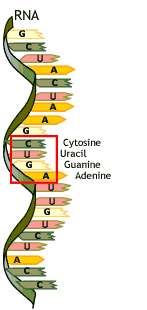
A DNA molecule with the base sequence A-G-C-T-C-A was used as a template to create an RNA molecule. Which base sequence correctly represents the corresponding RNA molecule?
a)
T-C-A-G-C-A
b)
U-C-G-A-G-U
c)
A-G-C-U-C-A
d)
A-T-G-A-C-T
146.
Which chemical components may be parts of a RNA molecule?
a)
deoxyribose, phosphate group, guanine base
b)
glucose, amino group, thymine base
c)
ribose, phosphate group, thymine base
d)
ribose, phosphate group, uracil base
147.

What is the base sequence of strand X?

a)

A. G-T-A-C

b)

B. T-G-C-A

c)

C. G-T-C-A

d)

D. A-T-C-G

148.

The diagram represents an incomplete section of a DNA molecule. The boxes represent unidentified bases. When the boxes are filled in, how many letter A's will there be (BOTH inside AND outside the boxes)?

a)

A. 1

b)

B. 2

c)

C. 3

d)

D. 4

149.

In the accompanying diagram, strands I and II represent portions of a DNA molecule. Strand II would normally include

a)

A. AGC

b)

B. TCG

c)

C. TAC

d)

D. GAT

150.

If one strand of DNA molecules has a base sequence of A-G-C-T-A, the complementary strand of DNA would have the base sequence

a)

1. A-G-C-T-A

b)

2. U-C-G-A-T

c)

3. U-C-G-A- U

d)

4. T-C-G-A-T

151.

What is the name of the basic unit of DNA containing a sugar, a phosphate and one of four nitrogen bases?

a)

1. Adenine

b)

2. Nucleotide

c)

3. Helix

d)

4. RNA

152.

What is the shape of a DNA molecule?

a)

1. rectangle

b)

2. triangle

c)

3. circle

d)

4. double helix

153.

What is the name of the five carbon sugar found in DNA?

a)

1. deoxyribose

b)

2. glucose

c)

3. phosphate

d)

4. protein

154.
If the sequence of the 5'-3' strand is AATGCTAC, then the complementary sequence has the following sequence:
a)
3'-AATGCTAC-5'
b)
3'-CATCGTAA-5'
c)
3'-TTACGATG-5'
d)
3'-GTAGCATT-5'
155.
In eukaryotes, what is the DNA wrapped around?
a)
single-stranded binding proteins
b)
sliding clamp
c)
polymerase
d)
histones
156.
Meselson and Stahl's experiments proved that DNA replicates by which mode?
a)
conservative
b)
semi-conservative
c)
dispersive
d)
none of the above
157.
mRNA stands for: 
a)
Mr. RNA 
b)
Meaningful RNA
c)
Much RNA
d)
Messenger RNA
158.
tRNA stands for:
a)
Transfer RNA
b)
Transcription RNA
c)
Translation RNA 
d)
Tippy Top RNA
159.
DNA is always read in 3's (triplets)..... ACA is an example of?
a)
Nothing
b)
Everything
c)
A codon 
d)
An anticodon
160.
Translation occurs in the.......
a)
Ribosomes
b)
Nucleus
c)
Mitchondria
d)
Golgi bodies
161.
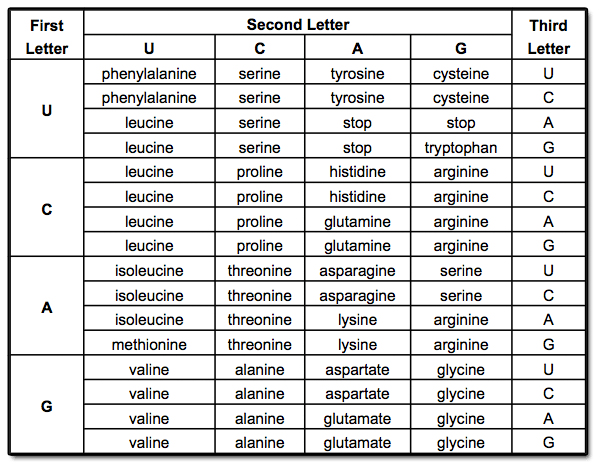
What is the the name for the amino acid that starts protein synthesis?
a)
Leucine
b)
Valine
c)
Glycine
d)
Methonine
162.
What is the name of the 5 carbon sugar found in RNA?
a)
Ribose
b)
Deoxyribose
c)
Base
d)
Sugar
163.
If you take this piece -ATT- what will the mRNA be? 
a)
TAA
b)
UAA
c)
TUA
d)
UAT
164.
The process of when DNA copies itself is called:
a)
Transcription
b)
Translation
c)
Replication
d)
Nope
165.
Which RNA bases would pair with TACGAA in transcription
a)
AUGCUU
b)
ATGCTT
c)
GCATCC
d)
GCAUCC
166.
One difference between DNA and RNA is that....
a)
Only RNA has the base Uracil
b)
only RNA contains the base Thymine
c)
only RNA contains the base Cytocine
d)
only RNA contained the base Guanine
167.
In RNA, Uracil pairs with ______. 
a)
cytosine
b)
adenine
c)
guanine
d)
thymine
168.
The process to go from DNA to mRNA is _______
a)
translation
b)
transcription
c)
replication
169.
The process to go from mRNA to a protein is called ____
a)
transcription
b)
rRNA
c)
replication
d)
translation
170.
Choose the nucleotide sequence of the RNA strand that would be complementary to the following strand: 
GTAGTCA
a)
UATUAGA
b)
ACGACTG
c)
CAUCAGU
d)
CATCAGT
171.
What amino acid is represented by the codon UUA?
a)
Phenylalanine
b)
Tyrosine
c)
Leucine
d)
Stop codon
172.
The codon 5'-UAC-3' would have an anti-codon match:
a)
3'-AUG-5'
b)
3'-TAC-5'
c)
5'-AUG-3'
d)
5'-CAU-3'
173.
What is the correct amino acid sequence for the mRNA code AUGCCAGUAUGA?
a)
 Met-Pro-Val-Stop
b)
Met-Pro-Arg-Stop
c)
 Tyr-Gly-His
d)
Tyr-Gly-Arg-His
174.
What mutation has occurred here? 
T-G-A-C-C-A
T-G-A-G-C-A
a)
Substitution
b)
Deletion
c)
Insertion
d)
Frameshift