
 Worksheets
DNA and Protein Synthesis
Total questions: 40
Worksheet time: 21mins
DNA polmerase functions to
read DNA and build new DNA strand
unwind the DNA helixThis is a wrong answer
read DNA and build mRNA
"zip" up the new copy of DNA
A DNA nucleotide is made up of
DNA and RNA
deoxyribose, phosphate group and nitrogenous base
ribose, phosphate group and nitrogenous base
deoxyribose, phosphate and uracil
"We have discovered the secret of life" was proudly proclaimed by
Hershey and Chase
Avery, McCleod and McCarty
Wilkens and Frankline
Watson and Crick
As DNA is replicated, the new strands formed from 1/2 the old strand and 1/2 new built up from nucleotides. This is known as DNA's ____ nature
complimentary
semi-conservative
anti-parallel
helical
Thymine bonds with
guanine
uracil
cytosine
adenine
Who found out the base pair rule and that percentages of bases where species specific?
Watson
Chargaff
Franklin
Pauling
What type of bonds hold nitrogenous bases together?
hydrogen
peptide
covalent
ionic
The enzyme that works to unwind the helix for replication or transcription is
helicase
ligase
DNA polymerase
proteinase
Which of the following is NOT a difference between DNA and RNA?
sugar present
phosphate present
the number of strands
length of molecule
The triplet ATT in DNA codes for __ in mRNA
UAA
AUU
TAA
start
The codon AUG codes for
leucine
threonine
methionine
proline
Which molecule delivers protein assembly instructions to the ribosome?
tRNA
rRNA
mRNA
DNA
Transcription makes
DNA
mRNA
protein
tRNA
Translations occurs in the
cytoplasm at the ribsomes
cytoplasm at the golgi bodies
nucleus
cell membrane
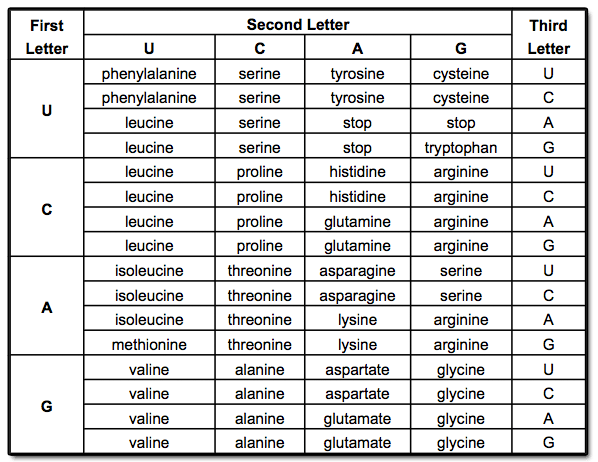
Which anticodon and amino acid would the mRNA codon of GUC bring to the ribosome?
GUC, valine
AUG, methionine
CAG, glutamine
GAC, apartate
How many bases make up a codon?
1
2
3
4
How many codons are needed to code for one amino acid?
1
2
3
4

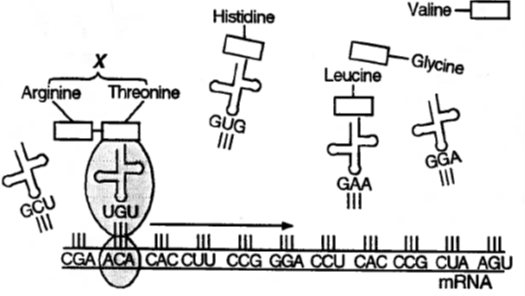
What type of molecule is found at #5?
mRNA
DNA
amino acid
tRNA

The shaded area labeled 2 on the diagram represents the
ribosome
RNA polymerase
mRNA
protein

The image is representing which process studied?
DNA replication
Transcription
Translation
meiosis

The molecule represented at point 2 is
DNA
mRNA
rRNA
tRNA
T or F: Bacteria carry out transcription and translation
true
false
DNA electrophoresis sorts DNA fragments by their
bases
charge
length
bases

Who is the likely suspect of the crime?
1
2
3

Part 3 of the diagram represents
sugar phosphate backbone
base pair
deoxyribose
hydrogen bonds

Part C of the diagram represents
base pair
sugar phosphate backbone
hydrogen bonds
ribosomes
DNA is found where in eukaryotic cells
mitochondria
nucleus
golgi bodies
cytoplasm
Who is famous for her x-ray photo of the DNA molecule
Franklin
Chargaff
Watson
Griffith
The rungs of the "twisted ladder" analogy for DNA's shape are formed by
base pairs
sugar phosphate backbone
helicase
DNA replication
GTAGTCA
DNA is the _ of cells.
complete set of blueprints
UPS
powerhouse
protein assemblers

