
 Worksheets
HBS - Neuron & Action Potential
Total questions: 60
Worksheet time: 2hrs 0mins
The part of the neuron that receives incoming messages is the
dendrite
axon
cell body
axon terminal
The part of the neuron that is protected by the myelin sheath is the
cell body
dendrites
axon
axon terminals
The cell body contains the
dendrites
axon terminals
nucleus and many organelles
myelin sheath
When a neuron is at REST,
the inside of the neuron is negatively charged compared to the outside.
the inside of the neuron is positively charged compared to the outside.
there is no charge difference established
none of these is true
An electrical impulse within a single neuron is called a
synapse
membrane potential
action potential
cell body

Depolarization is occuring at number
1
2
4
5

What maintains the resting membrane potential in a neuron?
sodium-potassium pumps
sodium channels
potassium channels
gravity
Which of the following uses ACTIVE transport?
sodium-potassium pump
sodium channel
potassium channel
diffusion
Which ion is pumped into the axon of a neurone to help maintain the resting potential?
calcium
hydrogen
potassium
sodium
Which of the following restores the resting membrane potential in a neurone?
I. Na+ channels opening
II. K+ channels closing
III. The Na+/K+ ATP pump
I and II only
II and III only
I and III only
III only
Which one of the following is involved in maintaining a resting membrane potential?
Na+/K+ ATPase pump moves 3Na+ in for every 2K+ out
Na+/K+ ATPase pump moves 3K+ in for every 2Na+ out
Na+/K+ ATPase pump moves 3Na+ out for every 2K+ in
Na+/K+ ATPase pump moves 3K+ out for every 2Na+ in
What do we call a nerve cell that is the basic working unit of the brain and nervous system?
axon
neuron
dendrite
neurotransmitter


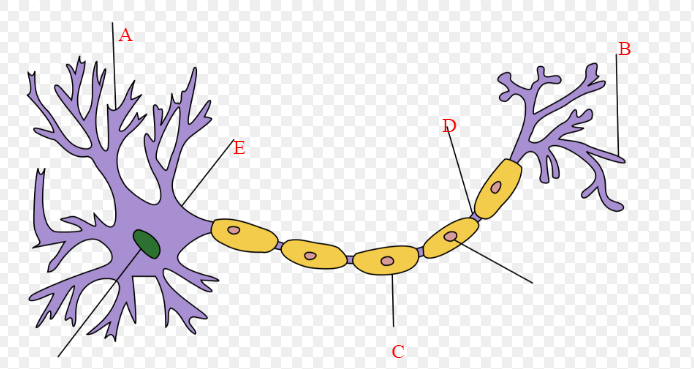
B
Dendrite
Axon
Axon Terminal
Cell Body


What is the Na+/K+ pump in charge of?
a protein in the membrane that pumps sodium IN and potassium OUT a cell
processes of a neuron
moves the neurotransmitters
a protein in the membrane that pumps sodium OUT and potassium INTO a cell
Define Channel.
electrical difference between the inside and the outside of a neuron
electrical energy measured in volts or millivolts
when membrane potential becomes less negative
a protein in a cell membrane that forms a hole that opens and closes so ions can move in or out of a cell
Define action potential
A rapid change in the membrane potential from negative to positive and back to negative that moves along the axon
the membrane potential when the neuron is not sending an action potential
the depolarized membrane potential where the action potential begins--At or above threshold--nothing can stop action potential
when the membrane potential moves back to resting level
Depolarization is...
makes the membrane more negative
when membrane potential becomes less negative
when the membrane potential moves back to resting level
the membrane potential when the neuron is not sending an action potential
Hyperpolarization is...
the depolarized membrane potential where the action potential begins--at or above threshold--nothing can stop action potential
when the membrane potential moves back to resting level
when membrane potential becomes less negative
make the membrane more negative
Define Repolarization...
when the membrane potential moves back to resting level
make the membrane more negative
when membrane potential becomes less negative
the membrane potential when the neuron is not sending an action potential
What are Neurotransmitters?
the difference in concentration of an ion across a membrane
the chemical that a nerve terminal releases to send a signal to the next neuron
electrical difference between the inside and the outside of a neuron
the amount of an ion in a certain place or volume

What are the same as "nerve ending"?
Neurontransmitters
Dendrites
Axon Transmitters
Nucleus
What does the neuron's Myelin Sheath do?
Controls the actions of the neuron
Produces food for the neuron
Carries information from the cell body to other neuronsThis is a wrong answer
Surrounds and insulates the axon
What do Dendrites do?
Intakes information from other neurons
Produces fatty tissue for the Myelin Sheath
Sends information to the next cell
Controls the speed of electrical signal through the axon
What do Nodes of Ranvier do?
Intakes information from other neurons
Produces fatty tissue for the Myelin Sheath
Sends information to the next cell
Controls the speed of electrical signal through the axon
What do Schwann Cells do?
Intakes information from other neurons
Produces fatty tissue for the Myelin Sheath
Sends information to the next cell
Controls the speed of electrical signal through the axon
What do Axon Terminals do?
Intakes information from other neurons
Produces fatty tissue for the Myelin Sheath
Sends information to the next cell
Controls the speed of electrical signal through the axon
Type of neuron that sends nerve impulses to muscles and gland, by the command of other neurons.
Motor Neurons
Interneurons
Sensory Neurons
Type of neuron that perceive information about your environment.
Motor Neuron
Interneuron
Sensory Neuron
The head of a phospholipid is ?
Hydrophobic
Hydrophillic
Amphiphathic
The tail of a phospholipid is?
Hydrophobic
Hydrophillic
Amphiphathic


the double layer of phospholipid molecules that makes up the membranes of a cell, the phospholipids are composed of a hydrophillic head and a hydrophobic tail
homeostasis
diffusion
metabolism
phospholipid bilayer
A barrier that lets some substances into and out of the cell while preventing the movement of other substances
cell membrane
diffusion
phospholipid bilayer
metabolism



