wayground logo

Free Printable Worksheets

Font size

S
M
L
XL
Worksheets

MP1 Living Environment

Total questions: 49

Worksheet time: 29mins

Name
Class
Date
1.
The living portions of the ecosystem.
a)
Biotic factors
b)
Abiotic factors
2.
The nonliving aspects of an ecosystem.
a)
Abiotic factors
b)
Biotic factors
3.
Which is a true statement?
a)
All microorganisms are harmful.
b)
All microorganisms are beneficial.
c)
Some microorganisms are harmful while others are beneficial.
d)
Microorganisms are beneficial only to humans.
4.
Most microorganisms cannot be seen without a...
a)
microscope
b)
magnifying lens
c)
telescope
d)
x-ray machine
5.
Bio means _________.
a)
non-living
b)
not/without
c)
life
d)
living
6.
A place where an organism lives.
a)
Terrain
b)
Habitat
c)
Community
d)
Population
7.

What happens to an enzyme when it denatures?

a)

The activation energy of the reaction is doubled.

b)

The activation energy of the reaction is lowered.

c)

It's optimal conditions for temperature of the enzyme are doubled.

d)

The shape of the enzyme molecule is changed.

8.

Most enzymes are composed of .....

a)

Lipids

b)

Carbohydrates

c)

Proteins

d)

Nucleic Acids

9.

Organisms living in a bog environment must be able to tolerate nitrogen-poor acidic conditions. Bog plants such as the Venus flytrap and sundew are able to obtain their nitrogen by attacking and consuming insects. These plants produce chemicals that break down the insects into usable compounds.

These chemicals present in the bog plants that break down the insects mentioned in the reading passage are most likely...

a)

hormones

b)

lipids

c)

enzymes

d)

carbohydrates

10.
Where do substrates bind on an enzyme?
a)
voltage-gated channels
b)
surface receptor
c)
calcium channels
d)
active site
11.

With what 3 letters do carbohydrates typically end?

a)

-ose

b)

-ase

c)

-ese

d)

-tic

12.
With what 3 letters do enzymes typically end?
a)
-ose
b)
-ase
c)
-ese
d)
-tic
13.
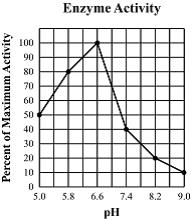
Which of the following conclusions can be drawn from this graph?
a)
The optimum pH of the enzyme is 6.6.
b)
The optimum pH of the enzyme is 5.8
c)
The enzyme’s activity increases as pH increases 5.0 to 9.0
d)
The enzyme’s activity is greater around pH of 8.0 .
14.
What happens when enzymes are heated to a high temperature?
a)
The enzymes die.
b)
The shapes of the enzyme are altered denature
c)
The enzymes' amino acid sequence changes.
d)
The enzymes remain the same
15.
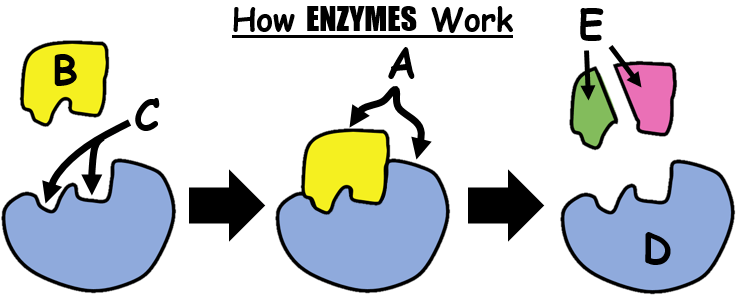
Letter D...
a)
active site
b)
enzyme
c)
substrate
d)
products
16.
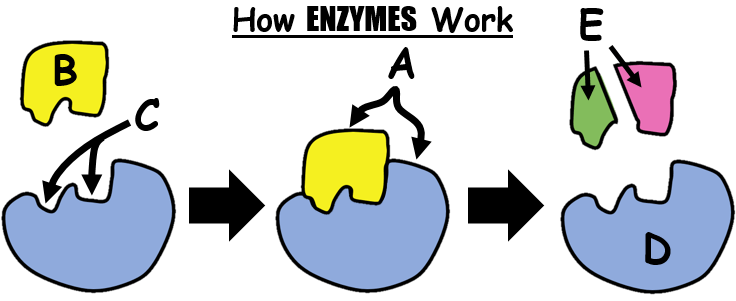
Letter B...
a)
active site
b)
enzyme
c)
substrate
d)
products
17.
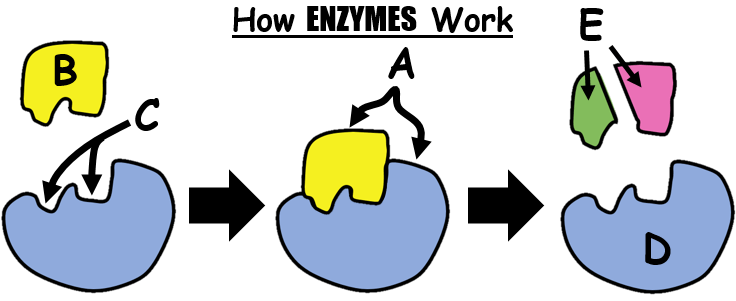
Letter E...
a)
active site
b)
enzyme
c)
substrate
d)
products
18.

Which 2 factors can affect the rate of enzyme activity?

a)

Light intensity

b)

Temperature

c)

pH

d)

Oxygen concentration

19.
What is one of the reactants of cellular respiration?
a)
energy
b)
glucose
c)
carbon dioxide
d)
water
20.
______________ produces the most ATP.
a)
photosnthesis
b)
aerobic respiration
c)
anaerobic respiration
d)
glycolysis
21.
Where does aerobic respiration take place?
a)
Cytoplasm
b)
Mitochondria
c)
Stroma
d)
Thylakoid
22.
Which type of respiration occurs without the presence of oxygen?
a)
Aerobic 
b)
Anaerobic 
23.
What are the two reactants of cellular respiration?
a)
C6H12O6 & 6CO2
b)
6 CO2 & 6H2O
c)
C6H12O& 6O2
d)
6CO2 & 6O2
24.
The overall goal of cellular respiration is to make:
a)
Glucose
b)
ATP
c)
Oxygen
d)
Water
25.

What is Mr. Spyra's favorite sport?

a)

basketball

b)

cleaning

c)

football

d)

volleyball

26.

What is Mr. Spyra's favorite color?

a)

black

b)

purple

c)

burnt orange

d)

green

27.
What is the volume of the liquid in this graduated cylinder?
a)
19 mL 
b)
35 mL 
c)
24 mL 
d)
1.9 mL
28.
What is the volume of the liquid in this graduated cylinder?
a)
43 mL 
b)
30.7 mL 
c)
37 mL 
d)
38 mL
29.
What is the volume of the liquid in this graduated cylinder?
a)
44 mL 
b)
30.6 mL 
c)
37 mL 
d)
36 mL
30.
Identify the equipment shown here:
a)
beakers
b)
flasks
c)
decanters
d)
graduated cylinders
31.
Identify the equipment shown here:
a)
pipette
b)
eye dropper
c)
tweezer
d)
forceps
32.
Each cell has a specific job. Whatever job a cell does is called its ______________.
a)
Structure
b)
Function
c)
Career
d)
Jobanelle
33.
What type of cells have a cell wall and chloroplasts?
a)
Plant cells
b)
Animal cells
c)
Plant and animal cells
d)
Neither plant NOR animal cells
34.

Found in plants cells and helps plants stand upright. Makes treebark rough and rigid.

a)

Cell wall

b)

Cell membrane

c)

Cytoskeleton

d)

Cytoplasm

35.
Controls all cell activities and contains DNA
a)
Ribosome
b)
Chloroplast
c)
Endoplasmic reticulum
d)
Nucleus
36.
Uses energy from the sun to make sugars/food for the cell
a)
Mitochondria
b)
Chloroplast
c)
Vacuole
d)
Lysosome
37.

Controls what enters and exits the cell, like Mr Blue

a)

Cell membrane

b)

Cytoplasm

c)

Nucleus

d)

Ribosome

38.
Makes proteins, works like a “contractor”, building more cell parts
a)
Endoplasmic reticulum
b)
Mitochondria
c)
Chloroplast
d)
Ribosome
39.
Jelly-like substance that holds all the organelles in place
a)
Cytoplasm
b)
Cytoskeleton
c)
Nucleus
d)
Cell membrane
40.
“Powerhouse” of the cell, breaks food down into energy for the cell
a)
Vacuole
b)
Chloroplast
c)
Nucleus
d)
Mitochondria
41.
Stores food and water like a refrigerator for the cell
a)
Chloroplast
b)
Vacuole
c)
Lysosome
d)
Cytoplasm
42.

Diffusion is the net movement of molecule from a region of ...1...to region of ...2....

a)

1: lower concentration, 2: higher concentration

b)

1: higher concentration, 2: lower concentration

c)

1: lower concentration, 2: lower concentration

d)

1: higher concentration, 2: higher concentration

43.

Active transport is movement of particles through the cell membrane from a region of ...1... to a region of ...2... using energy in the form of ...3...

a)

1: lower concentration, 2: higher concentration, 3: NADPH

b)

1: higher concentration, 2: lower concentration, 3: NADPH

c)

1: higher concentration, 2: lower concentration, 3: ATP

d)

1: lower concentration, 2: higher concentration, 3: ATP

44.

Which of the following is a sample of osmosis?

a)

plant root absorbing mineral ions from the soil

b)

the scent from a bunch of flowers spreads throughout a room

c)

carbon dioxide move from air into leaves through stomata.

d)

plant root absorbing water from the soil

45.

What will be happen?

a)

water molecule move from solution 1 to solution 2 by osmosis

b)

water molecule move from solution 2 to solution 1 by osmosis

c)

water molecule move from solution 1 to solution 2 by active transport

d)

Sugar molecule move from solution 1 to solution 2 by osmosis

46.

This red blood cell swell and burst in a ....solution

a)

fresh water

b)

salt water

c)

.7% salt concentration

d)

magic water

47.
What is structure E, F, G?
a)
Substrate
b)
Active site
c)
Enzyme
d)
Products
48.
Each enzyme only has 1 substrate that will fit its active site.  What is this called?
a)
reusable
b)
catalyst
c)
specific
d)
fragile
49.

What is the name for the mechanism of enzyme activity?

a)

Lock and key

b)

do your Homework

c)

hammer and nail

d)

two hands pattern