
 Worksheets
Waves
Total questions: 66
Worksheet time: 2hrs 51mins
Name
Class
Date
1.
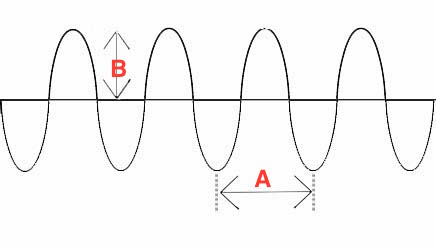
What property of the wave is represented by the letter "B"?
a)
amplitude
b)
crest
c)
trough
d)
wavelength
2.
The lowest point on a wave is the:
a)
Amplitude
b)
Crest
c)
Trough
d)
Wavelength
3.
The highest point on a wave is:
a)
the crest
b)
the trough
c)
the top
d)
the coast
4.

Which vocabulary term is used to identify the distance between points C & G?
a)
Amplitude
b)
Crest
c)
Frequency
d)
Wavelength
5.
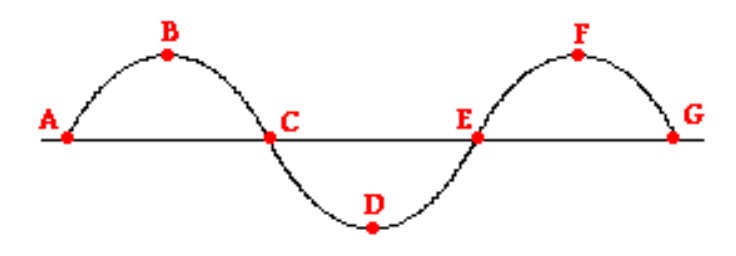
Which letter(s) represent the trough of the wave?
a)
A
b)
B & D
c)
D
d)
C & G
6.
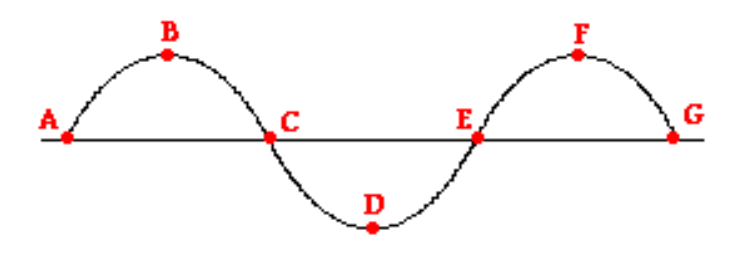
Which letter(s) represent the crest of the wave?
a)
A
b)
B & D
c)
B & F
d)
F
7.
Amplitude is the distance between
a)
the crest and the trough
b)
each wave
c)
the middle point of a wave and the clouds
d)
the crest or trough and the middle point of the wave
8.
The distance from one crest to the next crest in a wave is
a)
wavelength
b)
crest
c)
trough
d)
amplitude
9.
Waves move ___ through vibrations
a)
Energy
b)
Matter
c)
Mass
d)
Weight
10.
Longitudinal waves are ______.
a)
Parallel
b)
Perpendicular
c)
Crazy
11.
Transverse waves are ___.
a)
Parallel
b)
Perpendicular
c)
Weird
12.
What is the amplitude?
a)
length
b)
height
c)
# of waves
13.

Which is the wavelength?
a)
1
b)
2
c)
3
d)
4
14.
If the frequency gets higher, the wavelength gets
a)
longer
b)
shorter
15.
If the wavelength gets longer, the frequency gets
a)
higher
b)
lower
16.
The pitch of the sound depends on
a)
frequency
b)
amplitude
c)
wavelength
17.
The loudness of the sound depends on
a)
wavelength
b)
amplitude
c)
frequency
18.
Which electromagnetic wave is responsible for cell phones?
a)
gamma
b)
xray
c)
microwaves
d)
radio
19.
Which EM wave is used to treat cancer?
a)
gamma
b)
radio
c)
xray
d)
infrared
20.

Which EM wave has the lowest frequency?
a)
radio
b)
xray
c)
gamma
d)
infrared
21.

Which EM wave has the longest wavelength?
a)
light
b)
radio
c)
ultraviolet
d)
red
22.
How often a wave occurs is the wave's __________________
a)
crest
b)
frequency
c)
wavelength
d)
resting point
23.
The frequency of a wave is measured in __________________.
a)
inches
b)
hertz
c)
periods
d)
eras
24.
Mechanical waves are created when a source of energy causes a medium to _________________.
a)
vibrate
b)
expand
c)
move
d)
compress
25.
Any material that a wave travels through is called a ____________________.
a)
vibration
b)
compression
c)
medium
d)
crest
26.
In what type of wave does the medium vibrate parallel to the direction of the wave?
a)
surface wave
b)
longitudinal wave
c)
transverse wave
d)
electromagnetic wave
27.
The three types of mechanical waves are transverse, surface, and _______________ waves
a)
medium
b)
water
c)
longitudinal
d)
crest
28.
What are the highest parts of a transverse wave called?
a)
amplitude
b)
trough
c)
resting point
d)
crest
29.
In what type of wave does the medium move perpendicular to the movement of the wave?
a)
Transverse
b)
Longitudinal
c)
Electromagnetic
d)
Radio
30.
As the frequency of a wave increases, the __________________ decreases.
a)
amplitude
b)
resting point
c)
wavelength
d)
crest
31.
In a longitudinal wave, the parts where the coils are close together are called what?
a)
longitudes
b)
rarefactions
c)
compressions
d)
contractions
32.
The number of wavelengths that pass a point each per second is:
a)
frequency
b)
period
c)
longitudinal
d)
transverse wave
33.
The type of waves that require medium to pass:
a)
Mechanical Waves
b)
Electromagnetic Waves
34.
A mechanical wave cannot travel through...
a)
a vacuum(empty space).
b)
water.
c)
air.
d)
glass.
35.
When the frequency of a wave increases, what happens to the wavelength?
a)
The wavelength is not directly affected by the frequency of a wave.
b)
The wavelength increases.
c)
The wavelength decreases.
d)
More specific information is needed to form a conclusion about the wavelength.
36.
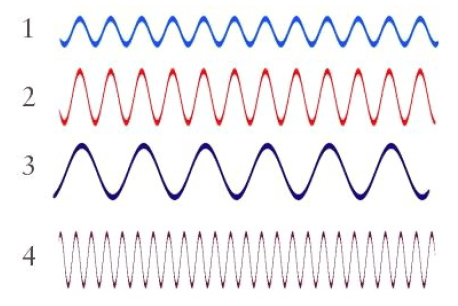
Which wave in the diagram has the greatest frequency?
a)
1
b)
2
c)
3
d)
4
37.
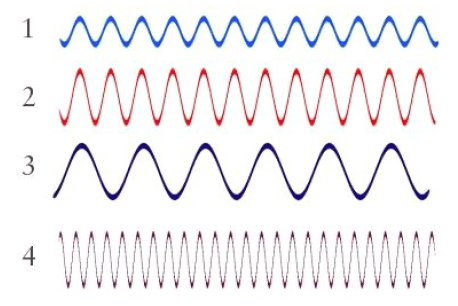
Which wave in the diagram has the greatest wavelength?
a)
1
b)
2
c)
3
d)
4
38.
Which of the following can sound travel through?
a)
solid
b)
liquid
c)
gas
d)
all of the above
39.
Electromagnetic waves include the following except
a)
radio waves
b)
X-rays
c)
doing the wave at a football game
d)
microwaves
40.
which material does sound travel the fastest?
a)
solid
b)
liquid
c)
gases
41.
regular disturbances that carry energy through matter or space
a)
crest
b)
energy
c)
wave
d)
trough
42.
Which is the correct equation for calculating the speed of a wave?
a)
T = 1/f
b)
Speed= Wavelength x Period
c)
Speed = Wavelength/Frequency
d)
Speed= Wavelength x Frequency
43.
1. A wave has frequency of 50 Hz and a wavelength of 10 m. What is the speed of the wave?
a)
500 m/s
b)
50 m/s
c)
5 m/s
d)
0.5 m/s
44.
Velocity= ________
Wavelength= .5m
Frequency= 150 hertz
Wavelength= .5m
Frequency= 150 hertz
a)
.75 m/s
b)
75 m/s
c)
300 m/s
45.
A wave has wavelength of 10 m and a speed of 340 m/s. What is the frequency of the wave?
a)
34 m/s
b)
3400 Hz
c)
3.4 Hz
d)
34 Hz
46.
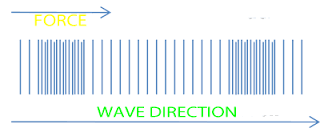
What type of waves have compressions and rarefactions?
a)
longitudinal
b)
transverse
47.
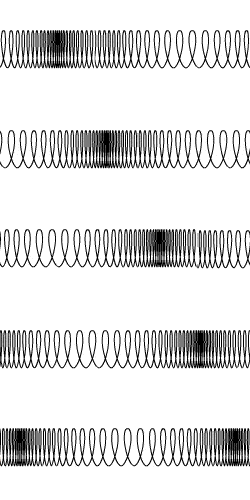
What type of wave is this?
a)
Longitudinal
b)
Transverse
48.

Which part of a longitudinal wave is where particles are packed closely together?
a)
compression
b)
rarefaction
c)
crest
d)
amplitude
49.
The type of waves that require medium to pass:
a)
Mechanical Waves
b)
Electromagnetic Waves
50.
What types of waves carry energy at a right angle or perpendicular to the direction of the energy flow?
a)
Longitudinal waves
b)
Transverse waves
c)
Sound waves
d)
P-waves
51.
What do waves carry from place to place?
a)
Energy, but not matter or particles
b)
Energy and matter or particles
c)
Matter or particles but not energy
d)
Neither energy nor matter or particles
52.
What are the parts of a longitudinal wave?
a)
Compressions and rarefactions
b)
Crests and troughs
c)
Compressions and crests
d)
Rarefactions and troughs
53.

Which wave is pictured?
a)
Transverse
b)
Longitudinal
c)
Both
d)
Neither
54.
Sound is an example of which type of wave?
a)
Transverse
b)
Longitudinal
c)
Both
d)
Neither
55.
Light is an example of which type of wave?
a)
Transverse
b)
Longitudinal
c)
Both
d)
Neither
56.
Which wave travels parallel in relation to a medium?
a)
Transverse
b)
Longitudinal
c)
Both
d)
Neither
57.
Sound needs a medium to travel through. What is a medium?
a)
solid, liquid, gas
b)
open space
c)
waves
d)
nothing
58.
Digital offers better clarity, but analog gives you richer quality.
a)
True
b)
False
59.

This is how analog signal looks like.
a)
True
b)
False
60.
A big advantages of digital technology is the recording does degrade over time.
a)
True
b)
False
61.

Is this digital or analog?
a)
Digital
b)
Analog
62.

Is this digital or analog?
a)
Digital
b)
Analog
63.
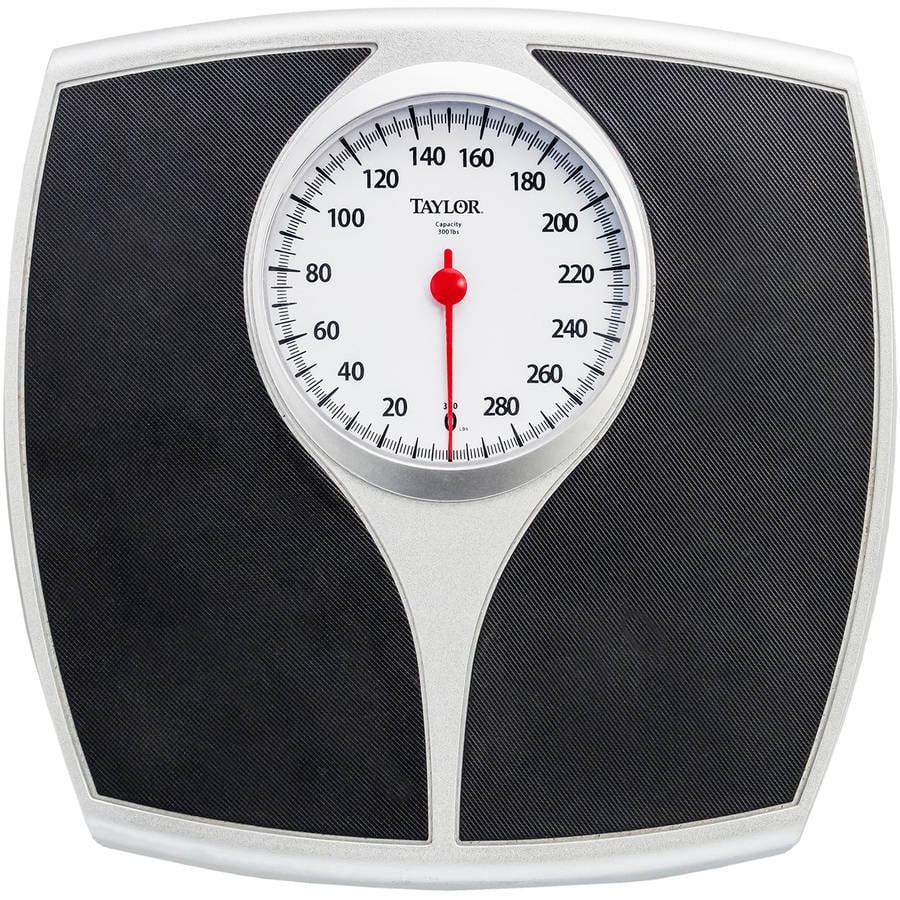
Is this digital or analog?
a)
Digital
b)
Analog
64.

Is this digital or analog?
a)
Digital
b)
Analog
65.

Is this digital or analog?
a)
Digital
b)
Analog
66.

Is this digital or analog?
a)
Digital
b)
Analog
100 %

