
 Worksheets
Marine Biology Chapter 3
Total questions: 40
Worksheet time: 26mins

Earth is the only known planet with _____ water on its surface.
Solid
Gas
Heat
Liquid

What makes the water molecules different from any other substance on Earth? Also represented by the dotted lines on the image.
Ionic bonds
Covalent bonds
Strong bonds
Hydrogen bonds

Why does ice float?
As water freezes, it expands and its density decreases.
As water freezes, it takes up more hydrogen from the atmosphere, causing it to have a greater buoyancy.
As water freezes, air becomes trapped between the hydrogen bonds of water molecules.
As water freezes, it takes up more oxygen from the atmosphere, causing it to have a greater buoyancy.

Large bodies of water, such as lakes and oceans, do not quickly fluctuate in temperature. What is the reason for this phenomenon?
Water is an acid.
Water is a versatile solvent.
Water has a high heat capacity.
Water acts as a buffer.

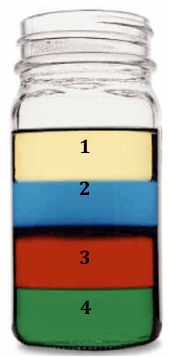
Put the liquids in order from most dense to least dense?
4, 3, 2, 1
1, 2, 3, 4
3, 4, 2, 1,
4, 3, 1, 2

______ causes deep ocean currents
The Coriolis Effect
gravity
wind
density differences

______ causes surface currents.
The Coriolis Effect
gravity
density differences
wind

Cold ocean currents generally come from
The North Pole
The South Pole
The Equator
Either Pole

Warm ocean currents generally come from
The North Pole
The South Pole
The Equator
Both A and B

The Gulf stream carries _____________ water from the east coast of The United States to the West coast of Europe.
Cold
Warm
Freezing
Fresh

A cool current in the Pacific Ocean near North America that brings cold water down from Canada.
California Current
Global Conveyor Belt
Gulf Stream
Surface Current

What is the most abundant salt in the sea?
calcium chloride
potassium chloride
magnesium chloride
sodium chloride

The highest salinity would be found in which of the following areas?
an area with high rates of precipitation
an area with high rates of evaporation
an area with plenty of runoff
all of the above

What happens to a current when it comes in contact with a continent or landmass?
It continues over the continent
It stops
It changes direction
It is absorbed by the land

Constantly moving system of deep-ocean circulation driven by temperature and salinity. It moves water around the globe.
California Current
Global Conveyor Belt
Surface Currents
Gulf Stream

Explain the importance of upwelling to ocean life.
brings nutrients from the deep ocean to the surface
it allows animals to find new homes
causes density changes that circulate temperature
brings nutrients from the surface to the deep ocean

Besides the Moon, the daily tides around the world are MOST affected by the
wind
rain
Sun
Coriolis effect

Which of the following can be caused by El Nino~?
Flash floods
Mudslides
Droughts
All of the above

What name is given to large, destructive waves caused by underwater earthquakes and volcanoes?
Spring tide
Longshore current
Tsunami
Swell

Why do waves increase in height as they approach the shore?
waves are forced into inlets
water particles speed up
water density increases
they interact with ocean floor


The lowest point (C) of a wave is called the ____________.
crest
wavelength
trough
wave height

The highest point (D) in a wave is the ______________.
crest
wavelength
trough
wave height


What type of tidal pattern is displayed on the graph?
Semi-diurnal
Diurnal
Mixed

What type of tidal pattern is found in the Bay of Fundy?
Semi-diurnal
Diurnal
Mixed

All are aspects of the ocean greatly influenced by tidal patterns, EXCEPT:
Fish spawning
Global Winds
Flow of water into bays and estuaries
Exposure and submersion of rocky intertidal organisms

All are factors that influence tidal patterns along the coastline, EXCEPT:
Seafloor features
Shape of the coastline
Depth of the ocean basin
Climate of the country

