wayground logo

Free Printable Worksheets

Font size

S
M
L
XL
Worksheets

Waves - Basic Review

Total questions: 54

Worksheet time: 58mins

Name
Class
Date
1.
Which diagram shows an example of a longitudinal wave ? 
a)
A
b)
B
c)
C
d)
D
2.
Which statement best describes what waves are?
a)
wavy lines on graph paper
b)
disturbances that transfer energy
c)
light energy that changes particles of matter
d)
circles that move out from a central place 
3.
How do earthquake waves travel through the earth?
a)
Heat waves
b)
Light waves
c)
Sound waves
d)
Mechanical waves
4.
Can travel through matter (gas, liquid, solid) but not space. 
a)
light
b)
sound
5.
Can travel through matter (gas, liquid, solid) and empty space. 
a)
sound
b)
light
6.
The highest point on a wave
a)
trough
b)
amplitude
c)
crest
d)
wavelength
7.
Waves are a transfer of what?
a)
Heat
b)
Light
c)
Energy
d)
Food
8.

The lowest point on a transverse wave is the

a)

compression

b)

crest

c)

rest position

d)

trough

9.

If the wavelength of a wave increased, what would happen to the frequency?

a)

decrease

b)

increase

c)

stay the same

10.

The number of waves that pass somewhere in a second is:

a)

amplitude

b)

frequency

c)

wavelength

11.

A wave that can travel through matter and empty space is a:

a)

electromagnetic wave

b)

longitudinal wavy

c)

transverse wave

12.

What kind of wave is this?

a)

electromagnetic

b)

longitudinal

c)

transverse

13.

Which are properties of a mechanical wave?

a)

can be longitudinal or transverse

b)

can move through space

c)

must have matter to move

d)

carries energy

14.

As a longitudinal wave moves forward, the particles move:

a)

perpendicular to the wave's motion

b)

parallel to the wave's motion

c)

stand in one place

d)

move completely down the spring

15.
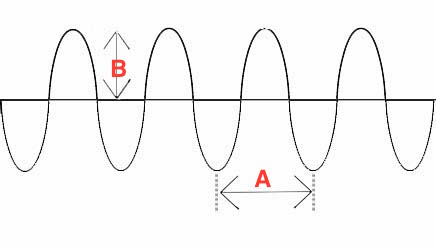
What property of the wave is represented by the letter "B"?
a)
amplitude
b)
crest
c)
trough
d)
wavelength
16.
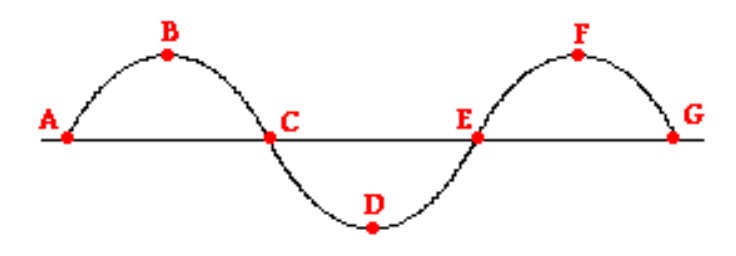
Which vocabulary term is used to identify the distance between points C & G?
a)
Amplitude
b)
Crest
c)
Frequency
d)
Wavelength
17.
Which letter(s) represent the trough of the wave?
a)
A
b)
B & D
c)
D
d)
C & G
18.

The distance from one crest to the next crest in a wave is

a)

wavelength

b)

crest

c)

trough

d)

amplitude

19.
The frequency of a wave is measured in __________________. 
a)
inches
b)
hertz
c)
periods
d)
eras
20.
Any material that a wave travels through is called a ____________________.
a)
vibration
b)
compression
c)
medium
d)
crest
21.
In what type of wave does the medium move perpendicular to the movement of the wave?
a)
Transverse
b)
Longitudinal
c)
Electromagnetic
d)
Radio
22.
What type of wave is this?
a)
Transverse
b)
Longitudinal
23.
What is represented by the  letter 'y'?
a)
Compression
b)
Rarefaction
c)
Wavelength
d)
Amplitude
24.
What is represented by the letter 'x'?
a)
Crest
b)
Compression
c)
Rarefaction
d)
Wavelength
25.
What two factors effect the amount of energy a wave has?
a)
Frequency and wavelength
b)
Frequency and amplitude
c)
Amplitude and rest
d)
Wavelength and crest
26.
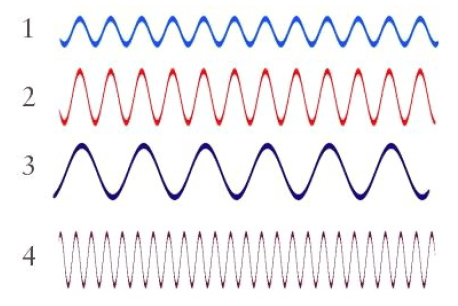
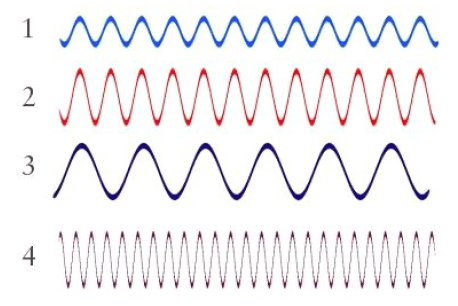
Which wave in the diagram has the greatest frequency?
a)
1
b)
2
c)
3
d)
4
27.
Which wave in the diagram has the greatest wavelength?
a)
1
b)
2
c)
3
d)
4
28.
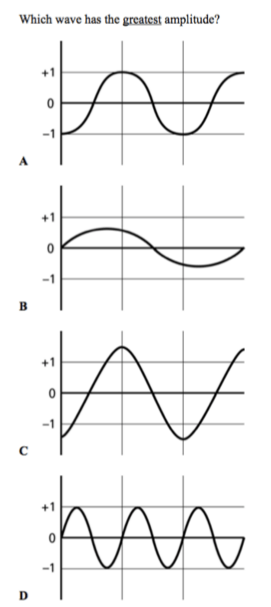
Which wave has the greatest amplitude?
a)
A
b)
B
c)
C
d)
D
29.
What kind of wave is pictured?
a)
Transverse
b)
Longitudinal
c)
surface
d)
none of the above
30.

What is the amplitude of this wave?

a)

4

b)

8

c)

2

d)

6.3

31.

You can't hear sounds in outer space because there is no

a)

medium

b)

light

c)

energy

d)

heat

32.

A wave that can travel through matter and empty space is a:

a)

electromagnetic wave

b)

longitudinal wavy

c)

transverse wave

33.
What three things may happen to light that strikes an object? 
a)
The light may be reflected, transmitted or absorbed.
b)
The light may be reflected and refracted.
c)
The light may be absorbed and transmitted.
34.

Which of the following is the best example of an object absorbing light?

a)

A black sweater in the sun.

b)

A clean window in the sun.

c)

A curved mirror in the sun.

d)

A long shadow in the sun.

35.

This leaf will

a)

Reflect green light

b)

Absorb green light

c)

Reflect red light

d)

Reflect no light

36.

Which has more energy than visible light?

a)

Microwaves

b)

Radio waves

c)

Infrared light

d)

Gamma rays

37.

Which of the following has the shortest wavelength?

a)

microwaves

b)

UV rays

c)

Infrared

d)

the color blue

38.

Which of the following has the most energy?

a)

Red

b)

Blue

c)

Green

d)

Violet

39.

Which of the following has the lowest energy?

a)

The color yellow

b)

The color blue

c)

The color indigo

d)

The color orange

40.

The diagram shows a person observing a thunderstorm located several kilometers away. The person hears the thunder several seconds after seeing the lightning. Which statement accurately explains the difference in observations of sound and light by the observer?


a)

Human eyes see light faster than their ears can hear sound.

b)

The medium the waves are traveling through is different for each type of wave.

c)

Light waves travel faster than sound waves.

d)

Sound waves travel faster than light waves.

41.

The diagram below shows a light ray. In this diagram, the light ray is being

a)

 transmitted

b)

absorbed

c)

reflected

d)

refracted

42.

The diagram below shows a pencil in a glass of water. When viewed from the side, the pencil appears to be broken. What process causes this to happen?

a)

absorption

b)

evaporation

c)

reflection

d)

refraction

43.
Which section of the spectrum is the ONLY one we can see?
a)
X-rays
b)
Visible Light
c)
Gamma Rays
d)
Ultraviolet Rays
44.
High frequency waves have _________ wavelengths.
a)
varying
b)
long
c)
the same
d)
short
45.

Which of the following is not in the electromagnetic spectrum?

a)

Light waves

b)

Sound waves

c)

Radio Waves

d)

X-rays

46.

The medical profession uses _______ to sterilize medical equipment - just like the google cabinet in the science classroom.

a)

Infrared

b)

x ray

c)

Gamma

d)

Ultraviolet

47.

Heat seeking missiles use _____________ electromagnetic technology.

a)

Gamma

b)

X ray

c)

Microwave

d)

Infrared

48.
What are the three primary colors of light?
a)
Red, Green, Blue
b)
Green, Yellow, Blue
c)
Cyan, Magenta Yellow
d)
Cyan, Magenta, Black
49.
A blue shirt looks blue because...
a)
it absorbs blue and reflects all the colors
b)
it reflects blue and absorbs all the other colors
c)
it absorbs cyan and reflects all the other colors
d)
it reflects cyan and absorbs all the other colors
50.
What kind of light is sunlight?
a)
White Light
b)
Infrared Light
c)
Yellow Light
d)
Red Light
51.

What happens to light when its wavelength changes?

a)

It slows down

b)

It changes color

c)

Nothing else changes

52.

What property of a wave is related to the brightness of the color?

a)

wavelength

b)

frequency

c)

amplitude

53.
Which example shows light being reflected?
a)
using a microscope to make small objects look larger
b)
using a prism to show the colors of the spectrum
c)
using eyeglasses to see things better
d)
using a mirror to see your image
54.
When a pencil is put into a glass of water, it appears to be broken? Why does the pencil look broken?
a)
because the shiny glass reflects light
b)
because the water separates light into many colors
c)
because the part of the pencil outside the water casts a shadow
d)
because light rays are bent when they pass from air into water