
 Worksheets
Phase Change Quiz
Total questions: 33
Worksheet time: 27mins

You have decided to start sealing all your letters with glittery wax because you are so "cool". Which answer BEST explains what you must do to make the SOLID wax a LIQUID?
In order to make the SOLID wax a LIQUID you must ADD HEAT ENERGY by putting the wax in the FREEZER.
In order to make the SOLID wax a LIQUID you must ADD HEAT ENERGY by putting the wax over a FLAME.
In order to make the SOLID wax a LIQUID you must REMOVE HEAT ENERGY by putting the wax in an OVEN.

You have dropped your popsicle and are watching it become a LIQUID. Which answer BEST explains what PHASE CHANGE has occurred AND how the molecule MOVEMENT has changed?
The PHASE CHANGE that has occurred is CONDENSATION and the molecule MOVEMENT has become FASTER.
The PHASE CHANGE that has occurred is EVAPORATION and the molecule MOVEMENT has become SLOWER.
The PHASE CHANGE that has occurred is MELTNG and the molecule MOVEMENT has become FASTER.

You are drinking a cold drink on a hot day when you notice LIQUID water has collected on the can. Which answer BEST explains what PHASE CHANGE has occurred as the water vapor turned to liquid AND how the molecule ARRANGEMENT has changed?
The PHASE CHANGE that has occurred is CONDENSATION and the molecule ARRANGEMENT has become CLOSER.
The PHASE CHANGE that has occurred is FREEZING and the molecule ARRANGEMENT has become CLOSER.
The PHASE CHANGE that has occurred is EVAPORATION and the molecule MOVEMENT has become FASTER.

You are relaxing on some grass when you notice LIQUID water droplets have begun to seemingly disappear off the grass leaves. Which answer BEST explains what PHASE CHANGE has occurred AND how the molecule ARRANGEMENT has changed?
The PHASE CHANGE that has occurred is EVAPORATION and the molecule ARRANGEMENT has become FARTHER APART.
The PHASE CHANGE that has occurred is FREEZING and the molecule ARRANGEMENT has become CLOSER.
The PHASE CHANGE that has occurred is MELTING and the molecule MOVEMENT has become FASTER.

Your teacher asks your group to discuss molecule MOVEMENT and molecule ARRANGEMENT in a SOLID. Each of your group members shares their answer. Decide who has the BEST answer.
Betsy says molecule MOVEMENT in a SOLID is SLOW and the molecule ARRANGEMENT is FAR APART.
Yazmin says molecules DO NOT MOVE in a SOLID and the molecule ARRANGEMENT is CLOSE.
Leila says molecule MOVEMENT in a SOLID is SLOW and the molecule ARRANGEMENT is CLOSE.

Your teacher asks your group to discuss HOW molecule MOVEMENT and molecule ARRANGEMENT in a LIQUID is DIFFERENT than in a SOLID. Each of your group members shares their answer. Decide who has the BEST answer.
Zachary says molecule MOVEMENT in a LIQUID is SLOWER and the molecule ARRANGEMENT is FARTHER APART than a SOLID.
Miguel says molecule MOVEMENT in a LIQUID is SLOWER and the molecule ARRANGEMENT is CLOSER than a SOLID.
Julian says molecule MOVEMENT in a LIQUID is FASTER and the molecule ARRANGEMENT is FARTHER APART than a SOLID.

Your teacher asks your group to discuss HOW molecule MOVEMENT and molecule ARRANGEMENT in a GAS is DIFFERENT than in a LIQUID. Each of your group members shares their answer. Decide who has the BEST answer.
Villette says molecule MOVEMENT in a GAS is FASTER and the molecule ARRANGEMENT is FARTHER APART than a LIQUID.
Vivian says molecule MOVEMENT in a GAS is SLOWER and the molecule ARRANGEMENT is FARTHER APART than a LIQUID.
Griselda says molecule MOVEMENT in a GAS is FASTER and the molecule ARRANGEMENT is CLOSER than a LIQUID.
Phase change of a liquid to a solid
Freezing
Sublimation
Condensation
Melting
Phase change of a solid directly to a gas
Condensation
Freezing point
Sublimation
Vaporitzation
Phase change of a gas to a liquid
Condensation
Evaporation
Sublimation
Melting point
Temperature at which a liquid changes to a solid
Evaporation
Melting
Freezing point
Sublimation
Phase change of a liquid to a gas
Vaporization
Sublimation
Melting point
Evaporation
Phase change of a solid to a liquid
Freezing
Sublimation
Condensation
Melting
Which diagram best represents molecules of matter in the solid phase?


During a phase change like melting or boiling, the temperature
increases
decreases
fluctuates
stays the same
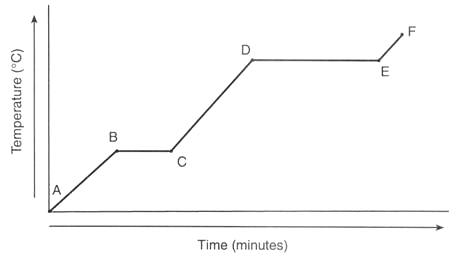
Is the substance gaining or losing energy?
Gaining
Losing
What state/phase is the object likely from points A to B?
Solid
Liquid
Gas
Plasma
What is happening to the movement of the particles in the substance between points A and B?
Melting
Freezing
Speeding Up
Slowing Down
What is happening to the particles in the substance between points D and E?
Melting
Freezing
Vaporizing
Sublimating

Is the substance gaining or losing energy?
Gaining
Losing

Where on the graph are phase changes taking place?
1
2
3
4
5

Which has more heat energy, and iceberg or a cup of hot chocolate?
Iceberg
Hot Chocolate
They are equal
Which has a higher temperature, an iceberg or a cup of hot chocolate?
Iceberg
Hot Chocolate
They are both equal
Why does an iceberg have more heat energy than a cup of hot chocolate?
The iceberg's molecules are moving faster
The iceberg has more molecules than the hot chocolate
The iceberg has a higher average temperature
What does temperature measure?
The average movement of the molecules in a substance
The number of molecules in a substance
The amount of mass in an object
The amount of space an object takes up

