wayground logo

Free Printable Worksheets

NEW

Font size

S
M
L
XL
Worksheets

7. BMS191 Skeletal System Quiz

Total questions: 66

Worksheet time: 59mins

Name
Class
Date
1.

The skeletal system is composed of all the bones and their cartilages.

a)

True

b)

False

2.

Which of the following best describes the job of the skeletal system?

a)

Gives shape and support to the body.

b)

Sends messages from the stomach to the brain.

c)

Brings in and breaks down all nutrients for the body

3.

Which system of the human body provides protection to most of the major organs?

a)

skeletal system

b)

circulatory system

c)

respiratory system

d)

muscular system

4.
_________ is a function of the skeletal system that is completed by joints, ligaments, and tendons.
a)
Protection
b)
Storage
c)
Synthesis
d)
Movement
5.
Bone tissue is also called osseous tissue.
a)
True
b)
False
6.

Bones can release minerals to maintain homeostatic levels.

a)

True

b)

False

7.

Which system is responsible for creating red blood cells?

a)

skeletal

b)

muscular

c)

respiratory

d)

nervous

8.

This attaches bone to muscle.

a)

cartilage

b)

tendon

c)

ligament

9.

This attaches bone to bone

a)

cartilage

b)

tendon

c)

ligament

10.

What is hard bone?

a)

Cartilage

b)

Tendon

c)

Spongy Bone

d)

Compact Bone

11.

What is the function of marrow?

a)

To make protein

b)

To make red blood cells and store fat.

c)

reduce friction

d)

to hold bones together

12.

Where is marrow found?

a)

In the cartilage

b)

In compact bone

c)

in spongy bone

d)

in the periosteum

13.
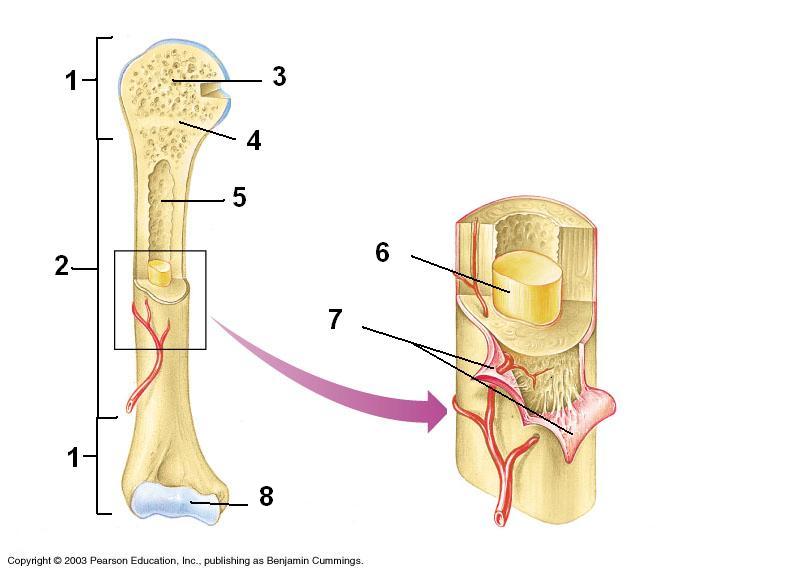
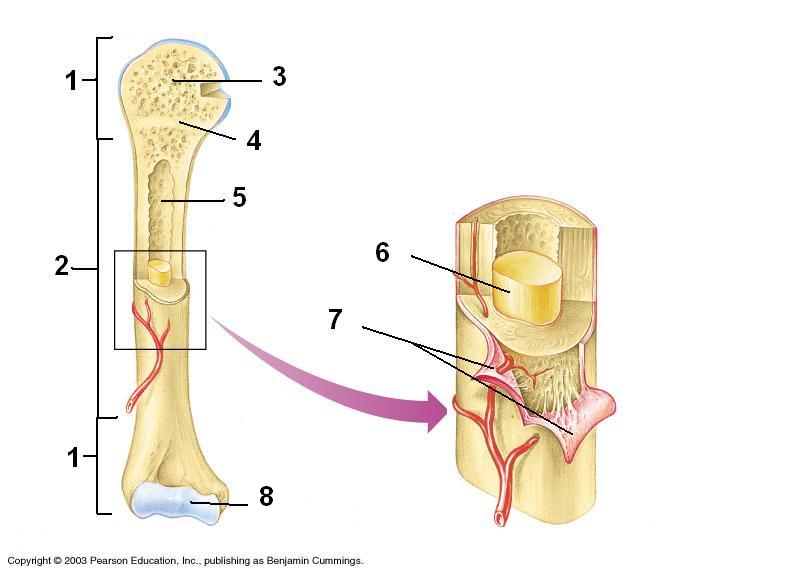
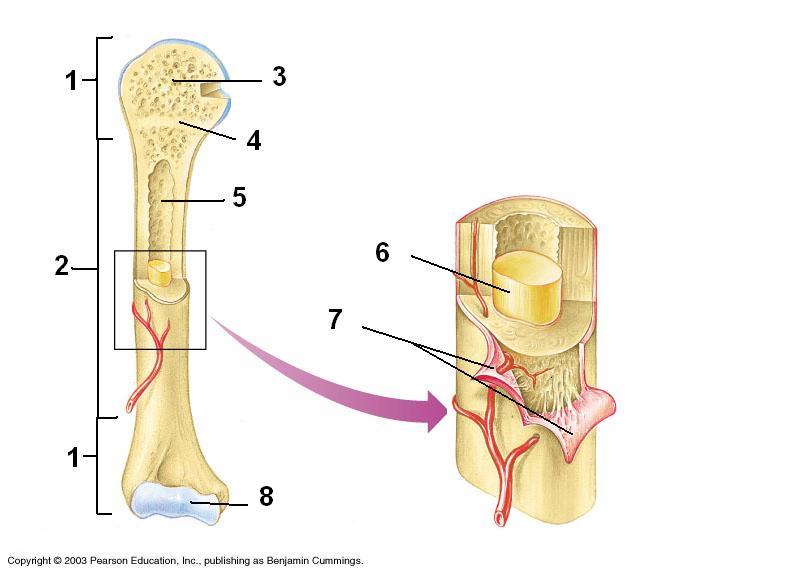
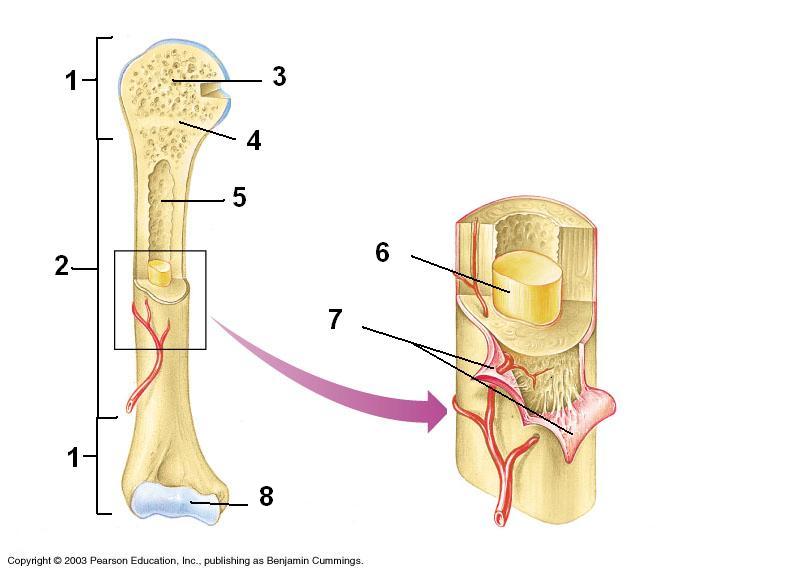
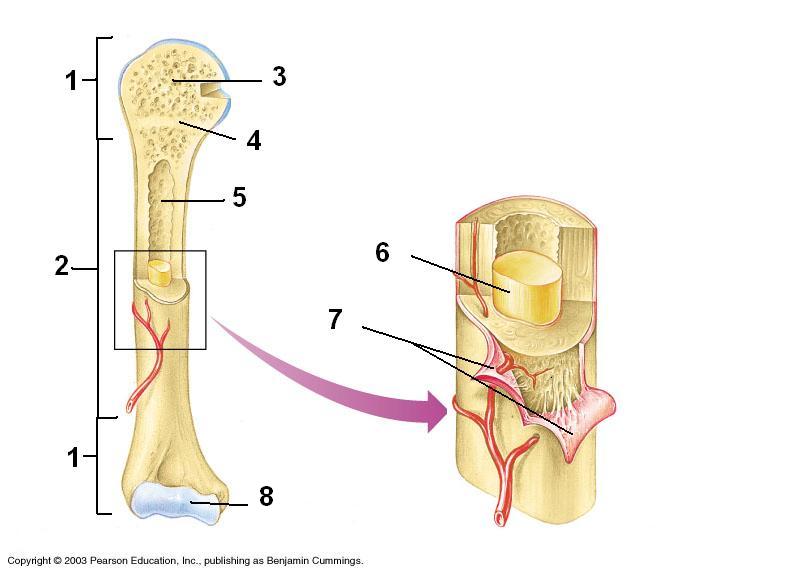
Structure #2 is the 
a)
medullary cavity
b)
periosteum
c)
epiphysis
d)
diaphysis
14.
The shiny white substance at #8 is the 
a)
articular cartilage
b)
periosteum
c)
yellow marrow
d)
diaphysis
15.
Structure #5 is the 
a)
medullary cavity
b)
periosteum
c)
epiphysis
d)
diaphysis
16.
Structure #7 is the 
a)
medullary cavity
b)
periosteum
c)
epiphysis
d)
diaphysis
17.
In adults, the substance at #6 would be 
a)
red marrow
b)
yellow marrow
c)
spongy bone
d)
clotted blood
18.
The epiphysis is 
a)
The shaft of a bone
b)
a bone cell
c)
the end of a long bone
d)
the covering of a bone
19.
Periosteum
a)
the membrane lining the bone cavity
b)
the tough membrane covering the shaft of the bone
c)
the shiny, articulating cartilage on the ends of a bone
d)
the blood vessels inside a bone
20.
Where are blood cells made? 
a)
Yellow marrow 
b)
Red marrow
c)
Spongy Bone 
d)
Periosteum
21.
Spongy bone would primarily be found where in a bone?
a)
diaphysis
b)
epiphysis
c)
periosteum
d)
endosteum
22.
What type of bone makes up the diaphysis?
a)
spongy bone
b)
compact bone
c)
rigid bone
d)
soft bone
23.

The small spaces in bone tissue that are holes in which osteocytes reside are called _______________.

a)

Trabeculae

b)

Volkmann's canals

c)

Haversian canals

d)

Lacunae

24.

Cells that dissolve the bony matrix.

a)

Osteoclasts

b)

Osteoblasts

c)

Canaliculi

d)

Lamellae

25.

Small channels that radiate through the matrix of bone.

a)

Osteoblast

b)

Osteoclast

c)

Canaliculi

d)

Lamellae

26.

Layers of bone matrix.

a)

Osteoclast

b)

Osteoblast

c)

Canaliculi

d)

Lamellae

27.

Cells that can build bony matrix.

a)

Osteoblasts

b)

Osteoclasts

c)

Canaliculi

d)

Lamellae

28.
A mature bone cell is called a _________.
a)
osteon
b)
osteocyte
c)
osteoclast
d)
osteoblast
29.

What is the name of the central canal that runs vertical through compact bone?

a)

Volkmann's

b)

Haversian

c)

Canaliculi

d)

Lacunae

30.
During endochondral ossification
a)
hyaline cartilage turns into bone 
b)
fibrocartilage turns into bone
c)
elastic cartilage turns into bone
d)
bone differentiates into cartilage
31.
The band of cartilage in the epiphysis where secondary ossification occurs.
a)
zone of ossification 
b)
ephiphyseal plate
c)
hyaline plate
d)
Z line
32.
The human skeleton can be subdivided into two parts, what part is made up of the skull, sternum, vertebral column and rib cage?
a)
appendicular
b)
axial
33.
The bone indicated by #3 is the 
a)
frontal bone
b)
nasal bone
c)
ethmoid bone
d)
temporal bone
34.
The bone indicated by #2 is the 
a)
parietal bone
b)
temporal bone
c)
ethmoid bone
d)
occipital bone
35.
The bone indicated by #4 is the 
a)
frontal bone
b)
nasal bone
c)
ethmoid bone
d)
temporal bone
36.
The bone indicated by #1 is the 
a)
parietal bone
b)
temporal bone
c)
ethmoid bone
d)
occipital bone
37.
First cervical vertebra.
a)
Axis
b)
Body
c)
Vertebra prominens
d)
Atlas
38.
Second cervical vertebra.
a)
Axis
b)
Body
c)
Vertebra prominens
d)
Atlas
39.

The first curve of the spine; thinnest most delicate vertebrae in the spine; function to allow flexibility for the neck, support the cranium, and to protect the spinal cord.

a)

cervical vertebrae

b)

thoracic vertebrae

c)

lumbar vertebrae

d)

vertebral foramen

40.
A hollow space that contains the spinal cord and meninges. 
a)
Vertebral foramen 
b)
Spinous process
c)
Transverse process 
d)
Intervertebral disc 
41.
Thin regions of cartilage between vertebrae that provide cushioning; Outer portion made of fibrocartilage that binds vertebrae together and allows flexibility for movement; soft inner portion acts as shock absorber
a)
spinous process
b)
transverse process
c)
intervertebral disk 
d)
vertebral foramen 
42.
Which section of the vertebral column has 5 fused vertebrae?
a)
Cervicle
b)
Thoracic
c)
Lumbar
d)
Sacrum
43.
Name the bone
a)
Ribs
b)
Sternum
c)
Clavicle
d)
Ulna
44.
Name the bone
a)
sternum
b)
radius
c)
clavicle
d)
scapula
45.
Name the bone
a)
Clavicle
b)
Radius
c)
Ulna
d)
Scapula
46.
Name the bone
a)
Radius
b)
Humerus
c)
Ulna
d)
Patella
47.
Name the bone (thumb side)
a)
ulna
b)
humerus
c)
radius
d)
scapula
48.
Name the bone (pinky side)
a)
humerus
b)
tibia
c)
ulna
d)
radius
49.

In this picture, what is represented in multi-colors?

a)

Carpals

b)

Tarsals

c)

Phalanges

d)

Radius

50.

What is the section of the hand highlighted in red?

a)

Phalanges

b)

Meta-Tarsals

c)

Meta-Carpals

d)

Cranium

51.

In this picture, what would you call the section colored in blue?

a)

Phalanges

b)

Carpals

c)

Tarsals

d)

Meta-Tarsals

52.
Name this bone.
a)
femur
b)
radius
c)
tibia
53.
Name this bone.
a)
patella
b)
phalange
c)
femur
54.
Name this bone.
a)
xyphoid process
b)
coccyx
c)
sternum
55.
Name this bone.
a)
fibula
b)
tibia
c)
femur
56.
Name this bone.
a)
tibia
b)
fibula
c)
femur
57.

tarsal bone

a)

ankle bone

b)

wrist bone

c)

tail bone

d)

shoulder bone

58.

The bones of the toes

a)

phalanges

b)

tarsals

c)

metatarsals

d)

carpals

59.

The long bones in the foot between the toes and tarsals.

a)

carpals

b)

metatarsals

c)

phalanges

d)

vertebrae

60.
What are joints
a)
A place where one bone meets 
b)
A place where  two  bones meet 
c)
Bones don't meet 
d)
A place where three bones meet 
61.

What is the proper name of your "hip bone?"

a)

Patella

b)

Pelvis

c)

Femur

d)

Fibula

62.
What bone is this?
a)
axis
b)
atlas
63.
What bone is this?
a)
axis
b)
atlas
64.
How many cervical vertebrae are there?
a)
5
b)
7
c)
12
65.
How many thoracic vertebrae are there?
a)
5
b)
7
c)
12
66.
How many lumbar vertebrae are there?
a)
5
b)
7
c)
12