
NEW
Font size
 Worksheets
Med term Objective Review
Total questions: 48
Worksheet time: 24mins

How many anatomical planes are there?
three
four
six
two

Which anatomical plane divides the body into front and back
frontal/coronal
transverse/horizontal
sagittal plane
none of the above

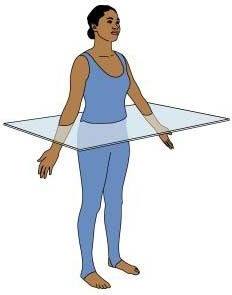
What plane is this?
Saggital
Transverse
Frontal
Medial

What is the motion indicated by letter A
Abduction
Extension
Flexion
Hyperextension

What motion is indicated by letter B
Abduction
Extension
Flexion
Hyperextension

What motion is indicated by letter C
Abduction
Flexion
Extension
Hyperextension

What motion is indicated by letter A
PlanterFlexion
Adduction
Abduction
Dorsiflexion

What motion is indicated by letter B
Plantarflextion
Rotation
Inversion
Dorsiflexion

What motion is indicated by Letter A
Plantarflexion
Inversion
Eversion
Dorsiflexion

What movement is indicated by Letter A
Rotation
Circumduction
Abduction
Adduction

What movement is indicated by letter B
Rotation
Extension
Abduction
Adduction

What movement is indicated by Letter C
Lateral Rotation
Flexion
Abduction
Adduction
What are the three types of muscle?
Smooth, Hard, Cardiac
Cardiac, Smooth, Skeletal
Skeleton, Heart, Bladder
Human blood vessels are
artries, capillaries, and atria
ventricles, atria and pulmonary veins
capillaries, artries, and veins
veins, artries, and aorta

skull, contains the brain
cranial
spinal
thoracic
diaphragm
vertebra, contains the spinal cord
cranial
spinal
thoracic
diaphragm
separates thoracic from abdominal
cranial
spinal
thoracic
diaphragm
contains both the abdominal and pelvic cavities
mediastinum
abdominopelvic
abdominal
pelvic
contains stomach, pancreas, liver, gallbladder, spleen, intestines and kidneys
mediastinum
abdominopelvic
abdominal
pelvic
back of the pelvis and contains reproductive organs and bladder
mediastinum
abdominopelvic
abdominal
pelvic
mouth, contains teeth and tongue
oral
orbital
middle ear
synovial
front of the body
dorsal
ventral
nasal
viscera
back of the body
dorsal
ventral
nasal
viscera
Where is the prefix always located in a medical term?
beginning
end
middle
no prefix in a medical term
What does the root word or combining form usually indicate in a medical term?
time
location
body part involved
procedure
Where is a suffix located in a medical term?
end
beginning
middle
between two combining forms
Does every medical term have a prefix?
yes
no
maybe
Does every medical term have a suffix?
yes
no
maybe
When do you use a root word before the suffix? (drop the "o")
when the suffix begins with a vowel
when the suffix begins with a consonant
always use the root word
never use the root word

Incomplete break in a bone that have not completely ossified.
Greenstick Fracture
Oblique Fracture
Spiral Fracture
Transverse Fracture

S-shaped separation of the bone. Occurs when the foot is firmly planted and body is suddenly rotated.
Greenstick Fracture
Oblique Fracture
Spiral Fracture
Transverse Fracture

Consists of three or more fragments at the fracture site. Difficult for healing because of the displacement of the fragments. Often requires surgical intervention because of involvement of soft tissue.
Avulsion Fractue
Comminuted Fracture
Impacted Fracture
Longitudinal Fracture


Irregularly shaped cell fragments that help clot blood
Platelets
Lymph
Plasma
White Blood Cells
Contains hemoglobin, supplies body with oxygen
Plasma
Platelet
White Blood Cell
Red Blood Cell
Fight bacteria and viruses by entering infected tissue, destroying bacteria/viruses and absorb dead blood cells
White Blood Cells
Red Blood Cells
Platelets
Plasma

