wayground logo

Free Printable Worksheets

Font size

S
M
L
XL
Worksheets

2019 Fall History Final Exam

Total questions: 119

Worksheet time: 10hrs 55mins

Name
Class
Date
1.

How many continents are on the Earth?

a)

7

b)

4

c)

5

d)

2

2.

How many oceans are on the Earth?

a)

7

b)

6

c)

5

d)

2

3.

Which theme of geography tells your WHERE something is?

a)

Location

b)

Place

c)

Human Environment Interaction

d)

Movement

4.

Which theme of geography discusses the TRAVEL of people, objects or ideas?

a)

Location

b)

Region

c)

Human Environment Interaction

d)

Movement

5.

Which theme of geography DESCRIBES what a place looks like?

a)

Location

b)

Place

c)

Region

d)

Human Environment Interaction

6.

Which theme of geography is the CHANGE of humans and the environment?

a)

Place

b)

Region

c)

Human Environment Interaction

d)

Movement

7.
What do we use to find absolute location?
a)
latitude and longitude
b)
the equator and international dateline
c)
a GPS and an XLP
d)
landmarks and distances
8.
What is movement?
a)
Tells us how people, goods, recourses, and ideas move from one place to another
b)
Tells us what makes an area special and what makes it different from every other area
c)
Tells us ways in which the places in an area are alike.
9.
What is location?
a)
Tells us where people and places are
b)
Tells us what makes an area special and what makes it different from every other area.
c)
Tells how people, goods, resources, and ideas move from one place to another.
10.
The imaginary line that runs through the middle of the earth east and west is called?
a)
Prime Meridian
b)
Equator
c)
Date Line
11.
Cutting down trees to build houses is an example of which?
a)
Location
b)
Place
c)
Human-Environment Interaction
d)
Movement
12.
The fact that Africa is south of Europe is an example of which?
a)
Movement
b)
Absolute Location
c)
Relative Location
d)
Place
13.
Biochemical warfare that pollutes the water in a country is an example of which?
a)
Place
b)
Human-Environment Interaction
c)
Region
d)
Movement
14.

What is the acronym to remember the Five Themes of Geography?

a)

MAP GO

b)

MR HELP

c)

MS. HELP

d)

MAPS

15.
Using lines of latitude and longitude to find an exact location is...
a)
Absolute Location
b)
Relative Location
c)
Prime Meridian
d)
Place
16.

This Emperor (originally a laughing stock) had 2 major aqueducts built for the Roman Empire

a)

Augustus

b)

Claudius

c)

Nero

d)

Vespasian

17.

This structure was the first such colleseum (forerunner to modern-day football stadiums) built in 79 AD by

a)

Julius Caesar

b)

Augustus Caesar

c)

Nero Caesar

d)

Vespasian

18.

This emperor had his mother murdered because he suspected her of conspiring against him.

a)

Claudius

b)

Augustus

c)

Nero

d)

Vespasian

19.

Early Romans were influenced heavily not only by the Greeks, but also the early inhabitants of the Italian Peninsula. These people were known as the

a)

Britanni

b)

Celts

c)

Etruscans

d)

Africans

20.

How long did it take Julius Caesar to have his men build a bridge across the Rhine River to get to the Germanic tribes?

a)

6 months

b)

2 years

c)

10 days

d)

1 month

21.

This Roman leader doubled the size of the Roman Empire by conquering Gaul (modern-day France).

a)

Augustus Caesar

b)

Nero Caesar

c)

Claudius Caesar

d)

Julius Caesar

22.

This Emperor's dying words were, "What an artist dies in me."

a)

Augustus

b)

Nero

c)

Claudius

d)

Vespasian

23.

Founders of Rome 753 BC

a)

Julius Caesar

b)

Romulus and Remus

c)

Numa

d)

Vespasian

24.

Rome's "downtown" district was called

a)

Forum

b)

Agora

c)

Pantheon

d)

Macellum

25.

Special concrete invented by Roman engineers to be waterproof because it had this ingredient

a)

limestone

b)

volcanic ash

c)

rocks

d)

clay

26.

What is the engineered structure in the photograph?

a)

bridge

b)

aquaduct

c)

groma

d)

dome

27.

"Domus Aurea" which translates "Golden Home" and also known as "the pleasure palace", was the home of this emperor who only lived in the finished house only a few months before he was dead.

a)

Augustus

b)

Vitellius

c)

Cladius

d)

Nero

28.

Which is NOT true of the Colosseum

a)

it would have collapsed without implementation of arches

b)

was built by Jewish slave labor and Jewish money

c)

was the size of modern-day football stadium 100 yards (blueprint of modern stadiums)

d)

was built by Emperor Nero

29.

Murderous wife of Emperor Claudius, mother of Emperor Nero

a)

Claudia

b)

Agrippina

c)

Calpurnia

d)

Octavia

30.
Many areas of the Roman culture such as writing, religion, and architecture came from
a)
Greece
b)
Asia
c)
Egypt
d)
their own ideas
31.
Which of the following was a reason Rome was so well connected around the empire?
a)
paved roads
b)
use of telephones
c)
strong, fast horses
d)
nobody ever attacked Rome
32.

The first emperor of Rome, who was Julius Caesar's adopted son and that marked the end of the Roman Republic and the beginning of the Roman Empire was

a)

Julius

b)

Augustus

c)

Tiberius

d)

Pompey

33.
The city of Rome is located on the ___ River.
a)
Tigris
b)
Nile
c)
Indus
d)
Tiber
34.
The Romans designed many large buildings and bridges with ____ that allowed them to build higher and larger structures.
a)
domes
b)
arches
c)
windows
d)
steel
35.
____ was the language spoken in Rome.
a)
Greek
b)
Roman
c)
Latin
d)
English
36.
What engineering achievement was most important for the city of Rome to reach a high population?
a)
advanced sewer system
b)
using arches in buildings
c)
the Coliseum
d)
domes to cover buildings
37.
What effect did the aqueduct have on the Roman Empire?
a)
The god Neptune became more popular
b)
Cities could support larger populations
c)
Boats could ship goods farther away
d)
Floods were prevented from damaging cities
38.

Which is the BEST description of plebeians in Ancient Rome?

a)

a powerful group of judges in Ancient Rome

b)

A large group of citizens who were considered commoners

c)

An elite, well-trained group of gladiators

d)

A small group of wealthy nobles who had the most control over the government

39.

Rome's location made it difficult for invaders to attack the city because of the peninsula's thin shape and the ___ to the north

a)

Mediterannean Sea

b)

Alps Mountains

c)

Apennine Mountains

d)

Atlantic Ocean

40.

Which is the best description of patricians in Ancient Rome?

a)

a powerful group of judges in Ancient Rome

b)

A large, but politically limited group who were considered commoners

c)

An elite, well-trained group of gladiators

d)

A small group of wealthy nobles who had the most control over the government

41.

Which statement is true of Rome´s roads, bridges, and aqueducts?

a)

They were usually made of wood

b)

They were weak and fell apart quickly

c)

They were copied from those of the Greeks

d)

They were the greatest in the ancient world

42.
Engineering feat that connected the city of Rome with territory throughout the empire
a)
Roads
b)
Aquaducts
c)
Sewers
43.

Romans used these to help deliver water to its citizens.

a)

aqueducts

b)

pipes

c)

slaves

d)

hoses

44.

The Coliseum in ancient Rome was used for

a)

training soldiers

b)

holding political rallies

c)

entertaining the public

d)

buying and selling slaves

45.

Material that made Roman engineering better

a)

concrete

b)

rubber

c)

steel

d)

roads

46.
What Roman architectural legacy would you find in the U.S. Capitol building?
a)
stadium
b)
dome
c)
cameo
d)
aqueduct
47.

What Roman architectural contribution allowed the construction of higher, more stable structures such as the aqueducts and the Colosseum?

a)

columns

b)

arches

c)

lintels

d)

marble

48.
Which architectural structure was introduced by the Ancient Romans
a)
Doric Columns
b)
Stupas
c)
Minarets
d)
Domes
49.

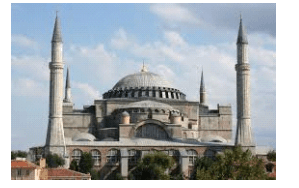
What does this image have to do with cultural influences from Rome?

a)

It was built using concrete

b)

It was built by a Roman

c)

Its architecture was inspired by Rome

d)

It was built to honor the Roman gods

50.

What did an Aqueduct allow Rome to do?

a)

Get dirty water out of the cities

b)

Get fresh water into lakes

c)

Get fresh water into the hills

d)

Get fresh water into the cities

51.
Who was Julius Caesar?
a)
He declared himself dictator for life, which led to change of the Roman government from a republic to an empire
b)
He was the founder of Rome.
c)
He was the last emperor of Rome.
d)
He was a brilliant architect who built the first aqueduct.
52.
What was the main reason Diocletian divided the Roman Empire into the Western Empire and the Eastern Empire?
a)
He was afraid of the Germanic tribes in the west.
b)
He believed it was too large for one person to govern.
c)
He wanted to create a new capital in the east and name it after himself.
d)
He wanted a separate empire for the wealthy people of Rome.
53.
Maintaining a military presence in distant lands and protecting the empire’s trade was very costly and led to which of the following?
a)
economic problems and higher taxes
b)
more wealth for the empire
c)
less war
d)
Octavian changing his name to Augustus
54.
What impact did the Vandals, Angles, Saxons, Huns, and Visigoths have on the Roman Empire?
a)
The Romans admired their religion and adopted as the official religion of the Roman Empire.
b)
The Rome changed its language from Latin to the language of these groups.
c)
They weakened the Roman Empire through numerous invasions.
d)
The Roman Empire rescued these groups from Greek invaders.
55.
Which of the following is an example of cultural diffusion?
a)
The Romans building roads throughout Italy.
b)
The Romans basing their mythology on Greek mythology.
c)
The Romans persecuting the Christians.
d)
The Romans writing stories of Remus and Romulus.
56.
One great Roman engineering product is the aqueduct. What is the purpose of an aqueduct?
a)
It is a strong road used by the Roman army to travel quickly from city to city.
b)
It is a structure design to house gladiator fights.
c)
It is a structure that carries water from mountains to cities.
d)
It is a temple designed to worship the gods.
57.

Why was the Roman Empire hard to defend

a)

It had a very long border

b)

It lacked harbors for ships

c)

its population was very small

d)

its rulers were unwilling to fight

58.
Why is Justinian important?
a)
He preserved Roman law in the Justinian Code.
b)
He destroyed Roman architecture and designed his own.
c)
He fought bravely against Rome in the Carthage Wars.
d)
He created Latin.
59.
What does it mean to “veto” a law?
a)
To pay as the law instructs
b)
To join a law to another law
c)
To forbid a law to take effect
d)
To call for a vote on a law
60.
What portion of the Roman Empire fell to the Germanic barbarians?
a)
Northern
b)
Southern
c)
Eastern
d)
Western
61.
After the collapse of the western part of the Roman Empire, the eastern half  became known as what
a)
 Mesopotamia
b)
 Egypt
c)
 Byzantine
d)
 Greece
62.
In what ways was Constantinople important?
a)
It was named after Emperor Constantine.
b)
It was a very noble city in Turkey.
c)
It was the cultural and political center of the Byzantine Empire.
d)
It was the home of the Roman Catholic Church.
63.
What was the primary language of the Byzantine Empire?
a)
Greek 
b)
Roman
c)
Latin
d)
Turkish
64.
Why was Constantinople such a prosperous city?
a)
Trade hub for Europe, Asia, and Africa
b)
Great architecture 
c)
Autocratic rulers 
d)
The pope lives there
65.
Identify this Byzantine Church that was commissioned by Justinian.
a)
Hagia Sophia
b)
National Cathedral
c)
Notre Dame
d)
Taj Mahal
66.

Which of the following issues divided the Western and Eastern Churches?

a)

practices of animal sacrifices

b)

practices such as scalping

c)

use of icons in worship

d)

belief in Jesus

67.

What church was found in the Byzantine Empire?

a)

Eastern Orthodox

b)

Roman Catholic

c)

Lutheran

d)

Methodist

68.
Who was the famous lady that influenced her husband to increase some legal rights of women?
a)
Irene
b)
Theodora
c)
Joan of Arc 
d)
Eleanor of Aquitaine 
69.

Why is Justinian's Code of laws so important today?

a)

It established all rules regarding. taxation.

b)

It established codes regarding the Eastern Orthodox Church.

c)

It established the basis for legal codes in Western World.

d)

It established what entertainment acts were at Hippodrome.

70.

Who split (divided) the Roman Empire?

a)

Constantine

b)

Diocletian

c)

Justinian

d)

Augustus

71.

What was the capital city of the Byzantine Empire?

a)

Rome

b)

Athens

c)

Constantinople

d)

Italy

72.

One economic advantage of naming Constantinople as the capital of the Eastern Roman Empire was that it __________

a)

was surrounded by protective walls.

b)

was a center of religious power.

c)

had shrunk in size.

d)

was located near trade routes between Europe and Asia.

73.

Which group conquered Constantinople?

a)

Persians

b)

Huns

c)

Ottoman Turks

d)

Carthage

74.

What does "Hagia Sophia" mean?

a)

Holy Wisdom

b)

High Sights

c)

Home in the West

d)

Home in the east

75.

Cast out from the church

a)

uncommunicate

b)

decommunicate

c)

excommunicate

d)

Include

76.

Statement of beliefs

a)

Devotion

b)

Core

c)

Creed

d)

Ethics

77.

Schism means

a)

a division between people, usually belonging to an organization, movement, or religious denomination

b)

to try and stop or defeat something.

c)

to oppose or disobey one in authority or control

d)

someone who governs a country in the name of a ruler who is unable to rule

78.

A strait is a

a)

large natural elevation of the earth's surface rising abruptly from the surrounding level

b)

large natural stream of water flowing in a channel to the sea, a lake, or another such stream.

c)

Physical features of a place

d)

Narrow body of water that cuts through land, connecting two larger bodies of water

79.

A moat is

a)

A hollow place in a solid body or surface

b)

Trench filled with water as a part of fortification

c)

Succeed in understanding or gaining insight into something complex or mysterious

d)

A secret or private place in which a person seeks concealment or seclusion

80.

Justinian was able to reconquer lands once held by the Western Roman Empire?

a)

True

b)

False

81.

Cultural diffusion means?

a)

sharing of secrets

b)

sharing and spreading of culture

c)

practice of one religion such as Christianity

d)

creating culture and forcing it upon people

82.
Which of the following statements correctly describes Justinian's impact on the Byzantine empire?
a)
Under Justinian, the Byzantine empire began a centuries long expansion
b)
Under Justinian, the Byzantine empire reached its largest size ever
c)
Under Justinian, the Byzantine empire shrank to half its original size
d)
Under Justinian, the Byzantine empire fell to the Turks
83.
Why did the use of icons anger iconoclasts?
a)
they believed using icons was like worshiping objects
b)
they believed using icons led to the Great Schism
c)
they believed that only bishops should use icons
d)
they believed using icons taught people about God
84.
How did the invention of gunpowder contribute to the Ottomans' conquest of Constantinople?
a)
The Ottomans used gunpowder to help them break through the city's walls with cannons
b)
The invention of gunpowder made the Ottoman's rich enough to buy the city
c)
The Byzantines did not use gunpowder properly in the city's defense.
d)
The European crusaders helped the Ottomans invade the city with guns
85.
The controversy over icons divided Christians in the Byzantine empire from Christians  in
a)
Constantinople
b)
Greece
c)
Eastern Europe
d)
Western Europe
86.

Who was the leader of the church in the Byzantine empire?

a)

The pope

b)

The patriarch

c)

The emperor

d)

The people

87.

Who conquered the Byzantines in 1453?

a)

The Franks

b)

The Ottoman Turks

c)

The Holy Roman Empire

d)

The Mongols

88.

What is another name for the Church of Holy Wisdom?

a)

Hagia Sophia

b)

Great Cathedral

c)

St. Peter's Cathedral

d)

None of these

89.
Constantinople was a strategic location for the capital of the Byzantine Empire because it was a crossroads of trade.
a)
True
b)
False
90.
The Code of Justinian later served as the basis for most
a)
Indian religious ceremonies.
b)
African trade agreements.
c)
European legal systems.
d)
Chinese government principles.
91.

People living in the Byzantine Empire called themselves ___ citizens.

a)

Roman

b)

Greek

c)

Byzantine

d)

Turkish

92.
Why was Constantinople such a prosperous city?
a)
Trade hub for Europe, Asia, and Africa
b)
Great architecture 
c)
Autocratic rulers 
d)
The pope lives there
93.

The Byzantine Empire was the eastern half of what remained of what ancient empire?

a)

The Ottoman Empire

b)

The Roman Empire

c)

The Holy Roman Empire

d)

The Mongolian Empire

94.
Based on your knowledge of Justinian I what was his opinion of women’s rights?
a)
Women were considered property of their fathers or husbands.
b)
Women should have some rights and could own property
c)
Women who divorced their husbands had no rights.
d)
Women had no rights of guardianship over their children.
95.
Where was Constantinople located?
a)
on a strait linking the Mediterranean Sea with the Atlantic Ocean
b)
on a river delta at the northern edge of Africa
c)
on a peninsula at the southeastern end of Europe
d)
on an island in the southern part of the Mediterranean Sea
96.

The Byzantine Empire lasted about __________ years after the fall of the Western Roman Empire.

a)

1000

b)

100

c)

500

d)

5000

97.
What are people who believe and follow the religion of Islam called?   
a)
Islams 
b)
Muslims 
c)
Arabs 
d)
Middle Easterners
98.
What is the Quran?
a)
The most holy city of Islam
b)
 The leader of the Muslim world
c)
The pilgrimage Muslims make to Mecca
d)
The holy book of Islam
99.
What are the five basic acts that form the framework of the religion of Islam? 
a)
Five Holy Books
b)
The Five Caliphs
c)
Five Pillars of Islam
d)
Five Commandments
100.
What is it called when Muslims don't eat or drink from dawn to sunset during Ramadan?
a)
Shahadah 
b)
Salat
c)
Fasting
d)
Hajj
101.
What is the pilgrimage to Mecca made by Muslims called? 
a)
Shahadah
b)
Salat
c)
Hajj
d)
Zakat
102.
What is a Muslim place of worship called?     
a)
Mosque
b)
Church 
c)
Cathedral 
d)
Temple
103.
What does the Arabic word 'Islam' mean?
a)
God
b)
Worship
c)
Submission
d)
Religion
104.
Islam is a _______________ religion.
a)
pagan
b)
cult
c)
monotheistic
d)
polytheistic
105.

Who was the founder and prophet of Islam?

a)

Muhammad

b)

Moses

c)

Martin Luther

d)

Jesus Christ

106.

What is significant about Mecca?

a)

It's the city where Jesus was born.

b)

The birthplace of Muhammad

c)

The Dome of the Rock is located here

d)

Crusaders fought for this city

107.

Why did knights begin to use a coat of arms?

a)

Extra protection in battle

b)

To show how rich they were

c)

To show which land they belonged to

d)

So they could be identified in battle

108.

What is the name of the object at number 1?

a)

North America

b)

South America

c)

United States

d)

Europe

109.

What is the name of the object at number 2?

a)

North America

b)

South America

c)

United States

d)

Europe

110.

What is the name of the object at number 3?

a)

North America

b)

Antarctica

c)

South Pole

d)

Europe

111.

What is the name of the object at number 4?

a)

North America

b)

Asia

c)

South America

d)

Africa

112.

What is the name of the object at number 5?

a)

Australia

b)

Africa

c)

Asia

d)

Europe

113.

What is the name of the object at number 6?

a)

Australia

b)

Africa

c)

Asia

d)

Europe

114.

What is the name of the object at number 7?

a)

Antarctica

b)

Africa

c)

Asia

d)

Europe

115.

What is the name of the object at number 8?

a)

Atlantic Ocean

b)

Indian Ocean

c)

Pacific Ocean

d)

Arctic Ocean

116.

What is the name of the object at number 9?

a)

Atlantic Ocean

b)

Indian Ocean

c)

Pacific Ocean

d)

Arctic Ocean

117.

What is the name of the object at number 10?

a)

Atlantic Ocean

b)

Indian Ocean

c)

Pacific Ocean

d)

Arctic Ocean

118.

What is the name of the object at number 11?

a)

Atlantic Ocean

b)

Northern Ocean

c)

Pacific Ocean

d)

Arctic Ocean

119.

What is the name of the object at number 12?

a)

Atlantic Ocean

b)

Indian Ocean

c)

Pacific Ocean

d)

Southern Ocean