wayground logo

Free Printable Worksheets

Font size

S
M
L
XL
Worksheets

GA Milestone Review

Total questions: 121

Worksheet time: 3hrs 52mins

Name
Class
Date
1.
Which of the following is NOT a need?
a)
Food
b)
Clothes
c)
Netflix
d)
Shelther
2.
Income earned as salary or wages before taxes and other deductions
a)
Gross income
b)
Net income
3.
A budget only works if.....
a)
You are willing to follow it
b)
if someone else creates it
c)
your parents give you money 
4.

Money set aside for an unplanned costly event

a)

Income

b)

Budget

c)

Flexible Expense

d)

Emergency Funds

5.
What is something financially wise consumers do?
a)
postpone major purchases until money can be saved for it
b)
spend now, figure out how to pay for it later
c)
worry about emergencies when they happen
d)
set only short term financial goals
6.
Why budget?
a)
prevent debt
b)
plan for future
c)
save money
d)
all of these
7.
If expenses were to exceed income on a spending plan, what would be a financially smart solution?
a)
Earn less income
b)
Decrease expenses
c)
Increase purchases
d)
Use a credit card more often
8.
A plan for spending and saving is a
a)
Budget
b)
Long term Goal
c)
Google Sheet
d)
Spreadsheet
9.
After estimating your annual income and expenses you need to divide by what number to calculate your monthly income and expenses?
a)
6
b)
12
c)
24
d)
365
10.

An example of a fixed expense is

a)

Contributions/Gifts

b)

Dinner out with friends

c)

Car payment

d)

Entertainment

11.
Your "take home pay" is also known as your 
a)
gross pay
b)
total income
c)
salary
d)
net pay
12.
Once you create a budget, it is a good idea to never change it.
a)
True
b)
False
13.
You need this in your budget for long-range goals like taking a vacation.
a)
Gross pay
b)
net pay
c)
savings
d)
none of these
14.
A(n) _______ is a payment for a good or service
a)
budget
b)
expense
c)
income
d)
cash flow
15.
_________ is pay by the hour.
a)
Salary
b)
Hourly Wage
c)
Gross Pay
d)
Commission
16.

Why is it important for budgeting to include savings?

a)

financial emergencies

b)

exciting financial opportunties

c)

financial security

d)

all of these

17.

What percentage is recommended for savings?

a)

3%

b)

10%

c)

20%

d)

15%

18.
A plan for your estimated income, expenses, and savings.
a)
Credit Rating
b)
Budget
c)
Bankruptcy
d)
Financial Goals
19.

If your monthly income from your job is $600, and you want to save 25%, how much would you save each month?

a)

$125

b)

$150

c)

$200

d)

$250

20.
Sales tax is __________ to the price
a)
subtracted
b)
added
c)
multiplied
d)
divided
21.
The Strait of Hormuz connects  the Arabian Sea to what body of water?
a)
Red Sea
b)
Atlantic Ocean
c)
Indian Ocean
d)
Persian Gulf
22.
What ethnic group mostly lives in the country of Iran and speaks Farsi?
a)
Kurd
b)
Persian
c)
Arab
d)
Muslim
23.
Which of the following factors has NOT contributed to water becoming more scarce?
a)
Desalination
b)
Climate change
c)
Pollution
d)
Population Growth
24.
The organization of OPEC mostly consists of oil-rich nations that surround which body of water?
a)
Red Sea
b)
Indian Ocean
c)
Arabian Sea
d)
Persian Gulf
25.
The Torah is the religious text that is used in this religion.
a)
Christianity
b)
Islam
c)
Judaism
d)
Hinduism
26.
These types of Muslims believe that the caliph/leader of Islam should be a descendant of the prophet Muhammad.
a)
Sunni
b)
Shi'a
c)
Kurd
d)
Arab
27.
After Jesus was crucified, he rose from the dead three days later. This event is known as what?
a)
Exodus
b)
Covenant
c)
Resurrection
d)
Baptism
28.
What were the followers of Jesus Christ known as?
a)
Apostles
b)
Angels
c)
Leaders
d)
Disciples
29.
Who was the founder of the Hebrews?
a)
Abraham
b)
Moses
c)
Muhammad
d)
Jesus
30.
If the Suez Canal is blocked off, which continent would not be able to get oil through that trade route?
a)
Asia
b)
Africa
c)
Europe
d)
North America
31.
Muslims must make a pilgrimage to this city at least once in their lives, which is where Islam began.
a)
Medina
b)
Mecca
c)
Jerusalem
d)
Atlanta
32.
The first four books of the New Testament, which talk about the life of Jesus Christ, are known as what?
a)
Gospels
b)
Genesis
c)
Exodus
d)
Rapture
33.
Which of the following do all three of the big religions have in common?
a)
They all believe Jesus was the son of God.
b)
They all must fast during the month of Ramadan.
c)
They are all monotheistic.
d)
They all use the Koran as their holy text.
34.
This country was started as a homeland for the Jews.
a)
Egypt
b)
Jordan
c)
Lebanon
d)
Israel
35.
This ethnic group wants their own country.
a)
Kurds
b)
Arabs
c)
Persians
d)
Muslims
36.
What is the method by which the Middle East imports water to help grow their crops?
a)
Desalination
b)
Irrigation
c)
Nationalism
d)
Isolationism
37.
What is the vocabulary word that means there is mass starvation in a country?
a)
Nationalism
b)
Dehydration
c)
Famine
d)
Isolationism
38.
Which two rivers flow through the country of Iraq?
a)
Jordan and Nile
b)
Jordan and Euphrates
c)
Tigris and Euphrates
d)
Jordan and Tigris
39.
This type of group shares the same religious beliefs.
a)
Cultural group
b)
Religious group
c)
Ethnic group
d)
Political group
40.
This ethnic group believes they are descendants of Abraham.
a)
Arabs
b)
Kurds
c)
Persians
d)
Muslims
41.
Which of the following countries is a Monarchy
a)
Saudi Arabia
b)
Iran
c)
Israel
42.
Which of the following countries is a Parliamentary Democracy? 
a)
Saudi Arabia
b)
Iran
c)
Israel
43.
Their legislative body is the Knesset
a)
Saudi Arabia
b)
Iran
c)
Israel
44.
Their leader is known as the Ayatollah
a)
Saudi Aradia
b)
Iran
c)
Israel
45.
Their leader is a member of the al-Saud family
a)
Saudi Arabia
b)
Iran
c)
Israel
46.
The Qu'ran is the constitution for their government
a)
Saudi Arabia
b)
Iran
c)
Israel
47.
In this country religion doesn't dictate political decisions to the same degree as the other 2 countries we've discussed, but does have some influence
a)
Saudi Arabia
b)
Iran
c)
Israel
48.
You do get to vote, but ultimately it may not count because it can be overruled.
a)
Saudi Arabia
b)
Iran
c)
Israel
49.
Only recently have women been given the right to vote
a)
Saudi Arabia
b)
Iran
c)
Israel
50.
Their system is similar to the United States in terms of citizen participation and power
a)
Saudi Arabia
b)
Iran
c)
Israel
51.
Because they are a small country they are unitary in their distribution of power
a)
Saudi Arabia
b)
Iran
c)
Israel
52.
Which of the following countries is a theocracy?
a)
Saudi Aradia
b)
Iran
c)
Israel
53.
I'm living in a country where my religious leaders take an active role in government.  Regardless of what faith you practice you must follow religious laws.  What type of government is this?
a)
Democracy
b)
Autocracy
c)
Oligarchy
d)
Theocracy
54.
In my country we choose our leaders in elections.  Those people who are selected to serve leave office at the end of their designated term of office.
a)
Democracy
b)
Autocracy
c)
Oligarchy
d)
Monarchy
55.
This is the branch of government that is responsible for making laws.
a)
Executive
b)
Judicial
c)
Legislative
d)
Citizens
56.
This is the branch of government that is responsible for enforcing laws.
a)
Executive
b)
Judicial
c)
Legislative
d)
Citizens
57.
This is the branch of government that decides whether or not laws should be laws.
a)
Executive
b)
Judicial
c)
Legislative
d)
Citizens
58.
I'm allowed to vote in my country, but it really doesn't matter because there is no constitution granting me rights.  The king can decide what he wants to do.  I live in a ___?
a)
Democracy
b)
Theogracy
c)
Oligarchy
d)
Monarchy
59.
There is only one branch of government that controls the country.
a)
Autocratic
b)
Unitary
c)
Federal
d)
Confederation
60.
I get to choose members of the legislature and then those individuals choose their leader from among themselves.  What type of government does my country have?
a)
Presidential Democracy
b)
Parliamentary Democracy 
c)
Constitutional Monarchy
d)
Autocracy
61.
What country is highlighted?
a)
Mwanza
b)
Nairobi
c)
Ehtiopia
d)
Somalia
62.
What country is highlighted?
a)
Uganda
b)
Tanzania
c)
Congo
d)
Kenya
63.
What country is highlighted?
a)
Uganda
b)
Rwanda
c)
Kenya
d)
Chad
64.
What country is highlighted?
a)
Zambia
b)
Cameroon
c)
Republic of the Congo
d)
Democratic Republic of Congo
65.
What country is highlighted?
a)
Liberia
b)
Egypt
c)
Morocco
d)
Botswana
66.
What country is highlighted?
a)
Madagascar
b)
Uganda
c)
Botswana
d)
Nigeria
67.
What physical feature is highlighted?
a)
Zambezi River
b)
Congo Basin
c)
Sahara Desert
d)
Nile River
68.
What physical feature is highlighted?
a)
Congo River
b)
Lake Chad
c)
Mt. Kilimanjaro
d)
Sahel
69.
What physical feature is highlighted?
a)
Kalahari Desert
b)
Lake Victoria
c)
Sahara Desert
d)
Cape of Good Hope
70.
What physical feature is highlighted?
a)
Ethiopian Highlands
b)
Mt. Kilimanjaro
c)
Niger River
d)
Atlas Mountains
71.
What physical feature is highlighted?
a)
Niger River
b)
Mt. Kilimanjaro
c)
Lake Tanganyika
d)
Cape of Good Hope
72.
What physical feature is highlighted?
a)
Kalahari Desert
b)
Sahara Desert
c)
Niger River
d)
Lake Victoria
73.
What physical feature is highlighted?
a)
Congo Basin
b)
Lake Chad
c)
Mt. Kilimanjaro
d)
Sahel
74.
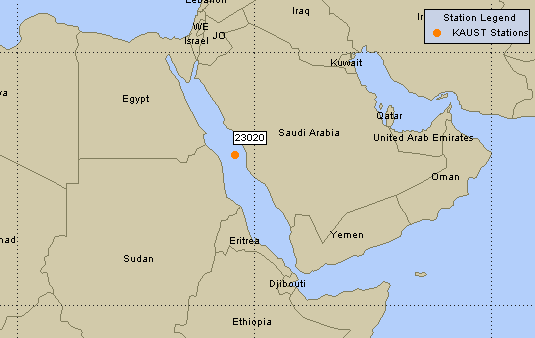
What body of water is shown on the map? It is narrow and separates Africa from the Arabian peninsula (Asia).
a)
Straits of Comoros
b)
Red Sea
c)
Dead Sea
d)
Mediterranean Sea
75.
What is located at number 14 (click on the words to see the map and ZOOM IN!)?
a)
Madagascar
b)
Indian Ocean
c)
Atlantic Ocean
d)
Pacific Ocean
76.
What physical feature is highlighted?
a)
the Atlas Mountains
b)
the Great Rift Valley
c)
the Congo Rainforest
d)
the Horn of Africa
77.
Which part of Africa are you most likely to find the Sahara desert?
a)
East
b)
South
c)
Central
d)
North
78.
Where in Africa are you most likely to find elephants, lions, and giraffes? 
a)
In the steppes
b)
In the mountains
c)
In the rain forest
d)
In the savanna 
79.
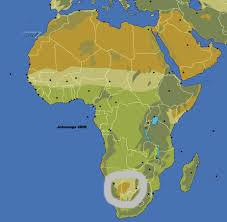
What is the name of the desert represented by the red oval?
a)
Sahara Desert
b)
Namib Desert
c)
Kalahari Desert
d)
Mohave Desert
80.
What is the name of the country that is colored orange?
a)
Namibia
b)
Zambia
c)
Botswana
d)
South Africa
81.

This African ethnic group has more than 600 different languages.

a)

Ashanti

b)

Bantu

c)

Arab

d)

Swahili

82.

This ethnic group has a main religion of Sunni Islam and they mainly live in Northern Africa.

a)

Arab

b)

Ashanti

c)

Bantu

d)

Swahili

83.

Why does the Sahara Desert have a low population?

a)

Lack of arable land

b)

Harsh climate

c)

Lack of fresh water

d)

All answers are correct

84.

Where does most of Africa's population live?

a)

Near rivers, lakes, and coastlines.

b)

In mud huts

c)

In crowded cities

d)

Near the equator

85.

Water pollution in Africa is caused by _____________.

a)

Human waste

b)

Oil spills

c)

Fertilizer

d)

All options are correct

86.

The Sahara Desert is taking over other neighboring regions. This is known as ________________.

a)

Deforestation

b)

Slash and Burn

c)

Desertification

d)

Crop Rotation

87.

About 90% of Western African coastal rain forests have been lost due to ___, or the loss of forests due to cutting down too many trees.

a)

Deforestation

b)

Desertification

c)

Slash and Burn

d)

Crop Rotation

88.

While the Pan-Africanism movement didn't bring together all African nations, it did help lead to the __________ of most African countries.

a)

Better Education

b)

Better Healthcare

c)

Independence

d)

Solving environmental issues

89.

What was the name of the rebel group in Kenya that fought against colonial rule?

a)

Mew Mew

b)

Mau Mau

c)

Zou Zou

d)

KNAU

90.

The name of the South African president that freed Nelson Mandela was ___________________.

a)

Jomo Kenyatta

b)

P.W. Botha

c)

Abubakar Balewa

d)

F.W. de Klerk

91.

_____________________ was the first black South African president.

a)

F. W. de Klerk

b)

Nelson Mandela

c)

Abubakar Balewa

d)

Jomo Kenyatta

92.

The Bantu Authorities Act of South Africa __________________.

a)

ended the Apartheid.

b)

moved black South Africans to "homelands".

c)

allowed non-white South Africans the right to vote.

d)

the law that started the Apartheid.

93.

The ___________ ethnic group has an important object called the Golden Stool.

a)

Ashanti

b)

Swahili

c)

Arab

d)

Bantu

94.

This ethnic group lives on the southeast coast of Africa (around Kenya) and mainly practices Sunni Islam.

a)

Bantu

b)

Arab

c)

Ashanti

d)

Swahili

95.

14 European nations gathered at the ___________________ to divide Africa.

a)

Geneva Conference

b)

Berlin Conference

c)

Colony Conference

d)

Artificial Boundary Conference

96.

A territory controlled by another country for natural resources is known as a __________.

a)

Second home

b)

Partition

c)

Political home

d)

Colony

97.

A territory controlled by another country for natural resources is known as a __________.

a)

Second home

b)

Partition

c)

Political home

d)

Colony

98.

These were created when Africa was divided up among the 14 European nations.

a)

Political Boundaries

b)

Colony Boundaries

c)

Artificial Political Boundaries

d)

Buffer Zones

99.

As a direct result of the dividing of Africa by Europeans, the Hutus and Tutsi were placed together in the same nation. Growing tensions between these groups led to Hutus slaughtering hundreds of thousands of Tutsis in 100 days in 1994. This event was known as the ______

a)

Geneva Genocide

b)

Rwandan Genocide

c)

Berlin Conference

d)

Apartheid

100.

_____ is a feeling of strong pride for one’s country, and it fed the desire for independence from foreign rule.

a)

Imperialism

b)

Genocide

c)

Nationalism

d)

Colonialism

101.

The political policy of racial segregation is known as ____________.

a)

Genocide

b)

Imperialism

c)

Nationalism

d)

Apartheid

102.

Which of these describe a pure market economy?

a)

extensive government planning

b)

excessive taxation

c)

traditional farming methods

d)

limited government regulations

103.

Which country is the closest to a pure command economy?

a)

North Korea

b)

South Korea

c)

India

d)

Japan

104.

In a ________ economy, a farmer grows enough food to feed his family and usually has a little extra to trade with others.

a)

Command

b)

Market

c)

Mixed

d)

Traditional

105.

Which country's economy is closest to a pure market economy?

a)

India

b)

Japan

c)

North Korea

106.

The South Korean economy can BEST be described as

a)

a command economy.

b)

a traditional economy.

c)

a market economy.

d)

a government-controlled economy.

107.

Compared to market economies, command economies are usually

a)

less efficient.

b)

more efficient.

c)

less government driven.

d)

more consumer driven.

108.

What form of economy do MOST countries in Asia have?

a)

Mixed

b)

Market

c)

Command

d)

Traditional

109.

Typically, the term "mixed economy" refers to an economy with both

a)

agricultural and industrial sectors.

b)

private and public sectors.

c)

human and capital investments.

d)

market and command elements.

110.

A country without a quality public education system will MOST LIKELY experience a lack of

a)

specialization.

b)

consumer choice.

c)

unskilled workers.

d)

entrepreneurship

111.

Only 20 percent of land in Japan is good for farming, making the opportunity cost of commercial agriculture much higher than in countries with more land. How did the government create economic growth despite its lack of land?

a)

Its economic policies banned the export of any agricultural goods produced in the country.

b)

Its economic policies encouraged businesses to specialize in manufacturing and technology.

c)

It adopted laissez-faire policies so that the market could determine which goods should be produced.

d)

It adopted a common currency with its largest trading partners to reduce the transaction costs of trade.

112.

Both tariffs and quotas are used to

a)

lower prices for consumers.

b)

increase the volume of foreign trade.

c)

protect domestic industries.

d)

improve the quality of goods available.

113.

China refused to trade with North Korea unless Kim Jong Un promised to denuclearize his country. The actions of China in this situation could be considered an _____.

a)

Embargo

b)

Tariff

c)

Quota

114.

Why do businesses invest in capital goods?

a)

to improve productive efficiency

b)

to improve their employees' skills

c)

to encourage entrepreneurship

d)

to encourage competition

115.

The Green Revolution was a series of technological advances in India, beginning in the 1950s, that significantly accelerated the country's economic growth. What did this revolution aim to do?

a)

increase agricultural production

b)

print paper money instead of coins

c)

reduce the country's reliance on oil

d)

create environmentally sustainable technology

116.

What was the purpose of US and European involvement in Southeast Asia during the mid-twentieth century?

a)

to enter into an defense agreement with China

b)

to limit the economic and political growth of communism

c)

to limit emigration from Southeast Asia to the United States

d)

to ensure a lasting economic partnership with the Soviet Union

117.

What motivated Mahatma Gandhi to encourage people to use only nonviolent methods to pursue Indian independence?

a)

his belief that violence produced only negative reactions

b)

his fear of being imprisoned for criminal acts

c)

his experiences as a soldier during the First World War

d)

his devotion to the teachings of Christianity

118.

The time he spent in South Africa during apartheid played a significant role in Mahatma Gandhi's decision, upon returning to India, to dedicate himself to

a)

fighting for the equality of all Indians.

b)

speaking out against the evils of communism.

c)

teaching people about the peaceful nature of Jesus Christ.

d)

building up militias to protect average Indians from the government.

119.

The domino theory was a policy that suggested a ________ government in one nation would quickly lead to __________ takeovers in neighboring states.

a)

Capitalist

b)

Communist

c)

Anarchist

d)

Democratic

120.

Why was the United States interested in rebuilding the Japanese economy after World War II?

a)

The United States feared the influence of communist countries in Japan.

b)

The United States and Japan had a shared history of colonial oppression.

c)

The United States wanted to extract reparation payments from Japan.

d)

The United States planned to occupy Japan for many years to come.

121.

What was one of the key goals of the communes organized under China's Great Leap Forward program?

a)

to politically indoctrinate people

b)

to advance scientific knowledge

c)

to instill religious beliefs in people

d)

to develop new markets for goods