
 Worksheets
Category 1 Review
Total questions: 100
Worksheet time: 7hrs 34mins
A scientist spilled a few drops of diluted hydrochloric acid (HCl) on a lab table. For safety purposes, the scientist sprinkled some baking soda (NaHCO3) onto the spill. Which observation would provide the best evidence that a chemical reaction occurred?
The baking soda and hydrochloric acid combined, and bubbles formed.
The baking soda absorbed the hydrochloric acid.
Some of the baking soda dissolved in the hydrochloric acid.
The hydrochloric acid evaporated, leaving only the baking soda.

The student observed that the temperature changed from 25°C to 23°C when the solutions were combined and that a white substance rapidly formed and settled to the bottom of the container. What most likely happened to produce these results?
One of the original compounds came out of solution.
The solutions reacted chemically.
Some of the water froze into ice crystals.
Rapid evaporation of water occurred, leaving a solid.

If this reaction occurs in a sealed container, will the mass of the container and everything in it increase, decrease, or stay the same and why?

For a laboratory investigation some students put a strip of shiny metal into a beaker of blue solution and then stored the beaker on a shelf overnight. The next morning, the students recorded observations about the metal and the solution in the box below.
Based on their obsevations, can the students correctly conclude that a chemical reaction occurred?
No, because the metal strip was still visible
Yes, because a new material of a different color formed on part of the metal strip
No, because the solution stayed blue
Yes, because the volume of the blue solution stayed the same
CO + H2O ---> CO2 + H2
Which of these represents an element?
Which of the following represents a chemical reaction?
a sugar cube dissolving in water
a cake baking in an oven
ice cubes forming in a freezer
ice cream melting in a bowl

A student performs the above reaction during a lab. The student masses the reactants and then performs the reaction. What is the mass (the amount of grams) of the products?
19
300.23
20
21

The student inferred that a chemical reaction occurred. What evidence supports this inference?
The zinc metal remained silver-colored and shiny

A silver ring reacts with compounds containing sulfur in the air to form silver sulfide, a black substance that makes up the tarnish on the surface of silver objects. To remove the tarnish from the ring, students placed it in a pan lined with aluminum foil and added hot water. Baking soda was added to the hot water and stirred. Students made observations about the process.
Which observation of this process provides evidence of a chemical reaction?
Hot water heated the aluminum foil.
The liquid solution changed color.
The pan was lined with aluminum foil.
The hot water cooled.

A student obtains two strips of magnesium, Mg, ribbon that are each 3 cm long. One strip of magnesium is placed in a test tube containing 5 mL of water, and the other strip is placed in a test tube containing 5 mL of hydrochloric acid, HCl. Both liquids are at room temperature. The student's observatioins are recorded in the table.
Which statement is not supported by the student's observations.
A chemical reaction takes place between magnesium and hydrochloric acid.
A gas is released in Test Tube 2.
The substances in both test tubes are reactive only at high temperatures.
Energy is released in the reaction involving hydrochloric acid.

Nitrogen dioxide is a gas that can be generated by emissioins from vehicles and factories. It can also be generated by natural sources, such as forest fires, lightning, and microbial activity in soil. The equation for producing nitrogen dioxide is shown.
Which of these provides evidence that a chemical reaction occurs?
A gas is present.
The total number of atoms remains the same.
The state of matter remains the same.
A brown gas is produced.

Some students in a chemistry lab conducted an investigation in which they added four different solid substances to seperate beakers of water. They stirred the mixtures for one minute and then recorded their observations in the table.
Which substance most likely caused a new substance to be formed when mixed with water?
Substance 1
Substance 2
Substance 3
Substance 4

No, because the metal strip was still visible
Yes, because a new material of a different color formed on part of the metal strip
No, because the solution stayed blue
Yes, because the volume of the blue solution stayed the same

Procedure 1: All the reactants were liquids that evaporated.
Procedure 2: A gas was formed as one product, and it escaped into the air.
Procedure 1: One of the reactants was converted to thermal energy.
Procedure 2: All the products were liquids.
Procedure 1: The reactants were liquid with difference densities.
Procedure 2: The reactants were combined into only one product.
Procedure 1: One of the products was a gas that escaped into the air.
Procedure 2: A gas from the air reacted with one of the other reactants.

A chemcial reaction in which calcium carbonate, CaCO3, is decomposed results in the production of two simpler compounds.
What mass of calcium carbonate, to the nearest hundredth of a gram, is decomposed in this reaction?
49.97
28.00
6.03
21.97

An atom of an element has 36 protons, 36 electrons, and a mass number of 84? How many neutrons?
36
72
48
8
What types of particles are found in the cloud surrounding the atom's nucleus?
positively and negatively charged particles
negatively charged particles only
neutral and positively charged particles
positively charged particles only
6 CO2 + 6 H2O → C6H12O6 + 6 O2
How many carbon atoms in total are present in the reaction?
6
18
12
10


three hydrogen (H)
one sulfur (S)
four oxygen (O)

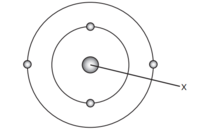
Identify the element using the Bohr model.
He
Li
Be
Na

Identify each category below as Metals, Nonmetals, or Metalloids based on the information shown on the data table.
A. Metals B. Nonmetals C. Metalloids
A. Metals B. Metalliods C. Nonmetals
A. Nonmetals B. Metalloids C. Metals
A. Metalloids B. Metals C Nonmetals

If an atom has 17 protons, 18 neutrons, and 17 electrons, what is the mass of this atom?
17
18
32
52


If an atom were to LOSE (give up) electrons, then it would become -
negatively charged
postively charged
remain neutral, no charge
losers
If an atom were to GAIN (add) electrons, it would become -
negatively charged
positively charged
remain neutrally charged
21
What would the charge of an atom that has LOST ONE electron be?
1-
2-
1+
2+
Since atoms have the same number of protons as electrons, an atoms overall charge is _____.
Positive
Depends on its mood
Neutral
Negative
H2SO4

Looking at the reactants, there is _____ molecule(s) of CH4 and _______ molecule(s) of O2.
1, 1
1, 2
2, 2
2, 4
Looking at the products , there is _____ atom(s) of Oxygen in CO2 and _______ atom(s) of Oxygen in 2H2O.
1, 1
1, 2
2, 2
2, 4
Elements in the same period/row have the same--
# of valence electrons
# of protons
# of energy shells
# of neutrons
How many periods are on the Periodic Table?
6
7
8
9
The mass of the atom is located ---
in the Nucleus
in the Electron Cloud
protons only
neutrons only
Which element is NOT in Period 3 on the Periodic Table?
Na
Ar
P
Ne
The volume of the atom is located in the --
in the Nucleus
in the Electron Cloud
The atoms of a certain element each contain 18 protons and 8 valence electrons.
What is the element's name?
Argon
Krypton
Neon
Sodium
How many protons will the element in Group 7A, Period 4 have?
9
16
34
35
What element has similar properties of Cesium (Cs), but a larger atomic mass?
Magnesium (Mg)
Barium (Ba)
Rubidium (Rb)
Francium (Fr)
Elements in the same group/family--
have the same # of valence
behave the same
have the same # of energy shells
are in the same period
These types of elements are BRITTLE and DO NOT conduct electricity.
Metals
Nonmetals
Metalloids
Which elements have 3 valence electrons?
Scandium
Boron
Aluminum
Lithium
Hydrogen (H) is a --
Metal
Nonmetal
Metalloid
Scandium (Sc) and Calcium (Ca) are both in the same group/family.
True
False
An element is shiny, solid at room temperature, and has two valence electrons. Which of these elements could be in this group?
Lithium (Li)
Strontium (Sr)
Aluminum (Al)
Silicon (Si)
Which of the following is the best description of an atom?
A core of protons surrounded by electrons
Protons and neutrons grouped in loose arrangements
A core of protons and neutrons surrounded by electrons
Protons, neutrons, and electrons grouped in a solid core
What statement about a proton is correct?
A proton has no electrical charge
A proton has a positive electrical charge
A proton has a negative electrical charge
A proton can have either a positive or a negative electrical charge
Valence electrons determine an atom's--
proton number
chemical reactivity
atomic mass
atomic number
Most elements in the Periodic Table are classified as --
Metals
Noble gases
Nonmetals
Reactants
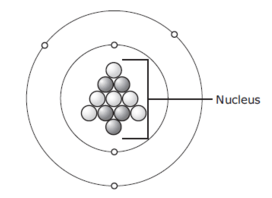

Which two atoms are of elements in the same group in the periodic table?
C10H12N2O
How may atoms in all are in a molecule of serotonin?

Based on the model, which consumers would receive the greatest amount of energy captured by the producers in their food chains?
In the chemical reaction shown above, the products are best classified as-- (6.5C)

Which student’s responses are correct?
2C2H2 + 5O2 ---> 4CO2 + 2H2O
2C2H2 + 5O2 ---> 4CO2 + 2H2O
2C2H2 + 5O2 ---> 4CO2 + 2H2O
Which of the following examples shows that a chemical reaction has occurred?
A rock breaks into smaller pieces when it is struck with a hammer.
Bubbles form when baking soda is added to vinegar and mixed.
A cup of water turns pink when a few drops of red food coloring are added.
A solid is formed when heat is removed from a sample of water.
Evidence of a chemical reaction includes anything that shows -
a new substance has been formed
a solid has dissolved in a liquid.
an interaction between two gases.
a change in the state of matter.
A clear liquid from a flask is poured into another clear liquid in a beaker. Which of the following results of this procedure would indicate a new substance was formed?
The level of the substance in the beaker is higher after the other liquid is added.
A yellow solid forms and then settles to the bottom of the beaker.
Small white crystals are left behind in the flask that held the first liquid.
The mass of the combined liquids is greater than either original liquid.

Based on the data, which periodic table or tables shows the correct location of Element I?


Which pair of properties describes the elements in Group 18?
They are chemically stable and liquid at room temperature.
They have eight valence electrons and are flammable.
They are magnetic and boil at low temperature
They are gaseous at room temperature and chemically stable.

Based on this information, which of these statements is not true?
A molecule of sorbitol contains three more oxygen atoms than a molecule of glutamine
A molecule of lactose contains twice as many atoms as a molecule of fructose does.
A molecule of fructose contains four more atoms than a molecule of glutamine does.
A molecule of lactose contains twice as many carbon atoms as a molecule of sorbitol does.

Which of these provides evidence that a chemical reaction occurs?
A gas is present.
The total number of atoms remains unchanged.
The state of matter remains the same.
A brown gas is produced.

Some students conducted a lab investigation to learn more about the physical properties of different elements. They observed four samples and recorded their observations in the table shown. Which sample is most likely a non metal?
6.6BA balance and a graduated cylinder are used to detemine the density of a mineral sample. The sample has a mass of 14.7g and a volume of 2.2cm3. What is the density of the mineral sample? (Hint: Use the resource sheet and a calculator)
0.15 g/cm3
32 g/cm3
13 g/cm3
6.7 g/cm3
Which statement accurately describes the atoms of a specific element?
An indium, In, atom contains 115 protons inside the nucleus and 49 neutrons outside the nucleus.
A scandium Sc, atom contains 45 electrons outside the nucleus and 21 neutrons inside the nucleus.
An aluminium, Al, atom contains 27 electrons and 27 protons inside the nucleus.
A zinc, Zn, atom contains 30 protons inside the nucleus and 30 electrons outside the nucleus.
A Calcium, Ca, atom contains 29 protons inside the nucleus and 29 outside the nucleus

