wayground logo

Free Printable Worksheets

Font size

S
M
L
XL
Worksheets

BIO.6,7,8 - Final Review

Total questions: 85

Worksheet time: 3hrs 31mins

Name
Class
Date
1.
A producer?
a)
Eats other plants and animals
b)
Makes its own food
c)
Eats dead plants or animals
d)
Makes toys for kids
2.
A consumer?
a)
Makes its own food
b)
Eats dead plants and animals
c)
Eats plants and other animals for energy
d)
Buys toys for kids
3.
A decomposer?
a)
Eats dead plants or animals and breaks down to put nutrients in the soil
b)
Eats plants or other animals for food
c)
Makes its own food
d)
Machine that gathers trash
4.
This organism draws its water from the ground, traps sunlight in its chlorophyll, and makes glucose (sugar) in broad green parts of its body. Is it a...
a)
Producer
b)
Consumer
c)
Decomposer
5.
This organism draws its nutrients from dead organisms as it releases enzymes to cause the organisms to break down and break apart. Is it a...
a)
Producer
b)
Consumer
c)
Decomposer
6.
Cactus. Is it a.....
a)
Producer
b)
Consumer
c)
Decomposer
7.
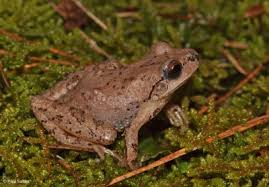
Frog. Is it a....
a)
Producer
b)
Conusmer
c)
Decomposer
8.
Earthworm. Is it a...
a)
Producer
b)
Consumer
c)
Decomposer
9.
Fungi. Is it a...
a)
Producer
b)
Consumer
c)
Decomposer
10.
Pine Tree. Is it a...
a)
Producer
b)
Consumer
c)
Decomposer
11.
Coral 
a)
Producer
b)
Consumer 
c)
Decomposer 
12.
An ________ eats both plants and animals.
a)
carnivore
b)
omnivore
c)
herbivore
d)
producer
13.
A ______________ eats mainly other animals.
a)
carnivore
b)
omnivore
c)
herbivore
d)
decomposer
14.
A(n) ________________ eats mainly plants.
a)
producer
b)
carnivore
c)
herbivore
d)
omnivore
15.
All organisms need energy to survive.  How do scavengers and decomposers get the energy they need?
a)
Scavengers break their food down into chemical nutrients, and decomposers take their energy from those chemicals.
b)
Scavengers make their own food.  Decomposers eat some nutrients that scavengers produce.  Decomposers then return chemical nutrients to the soil.
c)
When scavengers kill and eat animals, decomposers eat some of the food they leave behind.  The decomposers then return chemical nutrients to the soil.
d)
Scavengers feed on dead animals or plants. The food the scavengers leave behind is broken down by decomposers into chemical nutrients and returned to the soil.
16.
Carnivores that eat freshly dead organisms are
a)
herbivores
b)
decomposers
c)
omnivores
d)
scavengers
17.
These organisms break down decaying biotic wastes and then return the materials to the ecosystem.
a)
decomposers
b)
scavengers
c)
carnivores
d)
producers
18.
Earthworms eat decaying living material in the soil, and then return that energy to the ecosystem. This energy role is
a)
decomposer
b)
autotroph
c)
herbivore
d)
omnivore
19.
Vultures use their excellent sense of smell to find newly dead organisms to eat. This energy role is 
a)
scavenger
b)
decomposer
c)
carnivore
d)
herbivore
20.
_____ is a series of events in which one organism eats another and obtains energy.
a)
food chain
b)
food web
c)
energy pyramid
d)
ecosystem
21.
A ________ shows the amount of energy that moves from one feeding level to another.
a)
energy pyramid
b)
food chain
c)
food web
d)
biosphere
22.
Organisms that break down wastes and dead organisms and return the raw materials to the earth
a)
decomposers
b)
producers
c)
scavengers
d)
consumers
23.
Mushrooms and Bacteria are common 
a)
decomposers
b)
scavengers
c)
producers
d)
consumers
24.
____________ moves through an ecosystem when one organism eats another
a)
energy
b)
food
c)
sugar
d)
organisms
25.
As energy moves up the pyramid, each level has _______ energy available than the level below 
a)
less
b)
more
c)
moderate
d)
the majority
26.
Carbon and oxygen are both __________ in an ecosystem.
a)
recycled
b)
absorbed
c)
rented
d)
sold
27.
The processes of evaporation, condensation, and precipitation make up
a)
the water cycle
b)
the nitrogen cycle
c)
the carbon and oxygen cycle
d)
the bicycle
28.
The process of changing free nitrogen into a usable form of nitrogen is called ____________
a)
nitrogen fixation
b)
evaporation
c)
photosynthesis
d)
condensation
29.
What are animals called in a food chain?
a)
Producers
b)
Consumers
c)
Decomposers
d)
Plants
30.
Where does the energy start in this food chain?
a)
Plant
b)
Sun
c)
Deer
d)
Wolf
31.

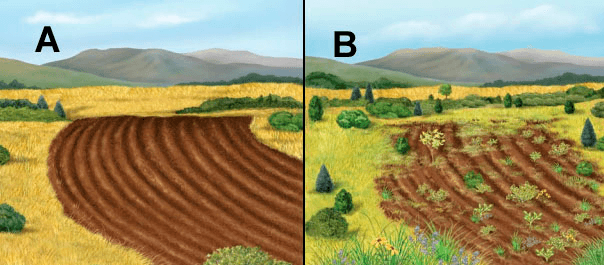
What type of succession is shown going from figure A to figure B?

a)

primary succession

b)

ecological succession

c)

secondary succession

d)

intermediate species

32.

What is the role of the pioneer species in Primary Succession?

a)

To kill any remaining organisms from before the disturbance

b)

To break down rock and rebuild soil

c)

To provide food for large animals

d)

To put fresh oxygen into the air

33.

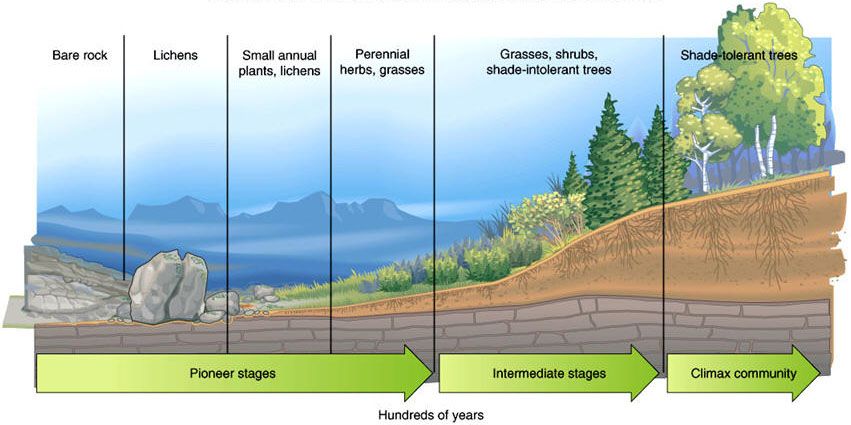
The picture shows what type of succession?

a)

primary

b)

secondary

c)

tertiary

d)

quadanary

34.
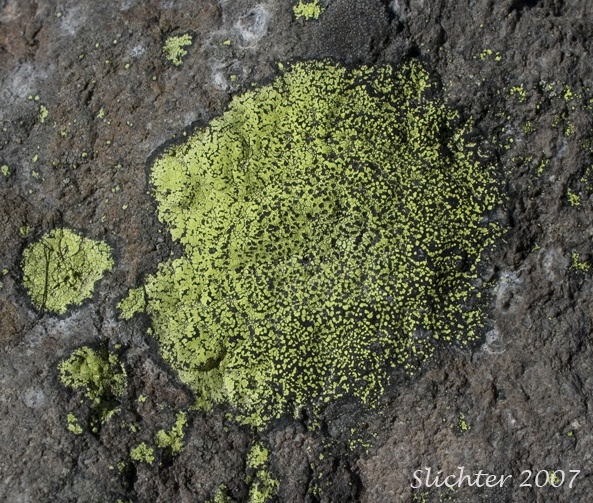
What is the name given to lichen or algae after a primary succession?
a)
pioneer species
b)
volunteer species
c)
founder species
d)
conqueror species
35.

After a volcanic eruption, lava covers the land. What is the order that plants grow to repopulate the area?

a)

Lichens → Shrubs → Grasses → Trees

b)

Lichens → tree → shrubs→Grasses

c)

Grasses → Lichens → Shrubs → Trees

d)

Lichens → Grasses → Shrubs → Trees

36.

The forest in panel #8 is a...

a)

pioneer species

b)

climax community

c)

tertiary community

d)

intermediate species

37.

Succession type?

a)

primary succession

b)

secondary succession

c)

tertiary succession

d)

variable succession

38.

What type of species/community is a redwood forest?

a)

Climax Community

b)

Pioneer Species

c)

Intermediate Species

d)

Tertiary Community

39.

What does "organic matter" refer to in biology?

a)

Living and/or dead organisms

b)

Crops that don't use pesticides

c)

Carbon based chemicals

d)

Food that isn't genetically modified

40.

Which of the following best describes primary succession?

a)

Volcano wipes out ecosystem that gradually grows back from ash covered soil

b)

Volcano creates a new island of rock that must break down to form an ecosystem

c)

Forest fire burns down forest that must bounce back over time

d)

Tornado destroys a crop that must slowly grow back over time.

41.

What term best relates to equilibrium?

a)

pioneer species

b)

primary succession

c)

secondary succession

d)

climax community

42.

Which progression best explains secondary succession?

a)

lichens>grass>shrubs>small trees> big trees

b)

mosses>creates soil>grasses>small trees> big trees

c)

Volcano destroys ecosystem>grasses>shrubs>small trees>big trees

d)

Volcano forms new island> lichens>grasses>shrubs>small trees>big trees

43.

What best describes the term succession?

a)

rapid changes that create an ecosystem overnight

b)

gradual changes over time to fully create or restore and ecosystem

c)

forest with the tallest trees

d)

the rate species produce offspring

44.
How much energy is passed on to each trophic level in an energy pyramid?
a)
10%
b)
90%
c)
50%
d)
80%
45.
Where do crickets get their energy?
a)
Cattails
b)
Marsh Grass
c)
Grasshoppers
d)
Shrews
46.
Which organisms in the diagram have the largest total energy to give to other organisms?
a)
Cattails and Marsh Grass
b)
Hawks and Snakes
c)
Crickets and Grasshoppers
d)
Shrews and Frogs
47.
Which organism is likely to be at the beginning of a food chain for a pond?
a)
Sunfish
b)
Freshwater shrimp
c)
Paramecium
d)
Green Algae
48.
What is the 10% rule?
a)
If you start with 3000 units of energy at the bottom you will have 30000 units at the top
b)
as you go up the pyramid 10% of the energy is left behind at each level
c)
the higher you go the more energy is present
d)
as you go from one level to the next, only 10% of the energy is transferred to the next level
49.
Biodiversity refers to
a)
extinct species
b)
the variety of species on Earth
c)
nonrenewable resources
d)
the rate of species decline
50.
When taken to a new habitat, non-native plants often threaten native plants of the new habitat.  Why do they do this?
a)
Non-native plants are able to mutate rapidly
b)
Non-native  plants cause native animals to relocate
c)
Non-native plants are able to be used for medicine
d)
Non-native plants compete with native plants for resources
51.
What effect will an invasive species have on the carrying capacity of an ecosystem?
a)
The carrying capacity will increase
b)
The carrying capacity for everyone will decrease
c)
The carrying capacity will only decrease for those in competition for same resource
d)
The carrying capacity for all animals will stay the same
52.
Kudzu has overgrown many parts of southern Missouri and native ground plants have disappeared from the area. This is an example of:
a)
Parasitism between kudzu and the native plants
b)
A predator prey relationship between ground plants and kudzu
c)
Competition occurring between the native and invasive species
d)
Commesalism occurring between the kudzo and native plants
53.
1. What makes a species invasive?
a)
Moving to a new ecosystem and taking resources from natives 
b)
Not having papers
c)
Species that can't adapt
d)
Plants that take up too much space
54.
A population of an organism will only grow exponentially if:
a)
The resources are unlimited
b)
They want to
c)
The resources are limited
d)
They do not like to compete
55.
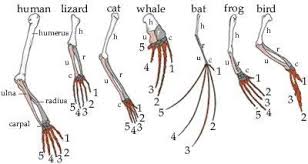
What is this an example of?
a)
vestigial structures
b)
embryology
c)
homologous structures
d)
fossil record
56.

Some organisms that share a common ancestor have features that have different functions, but similar structures. These are known as

a)

vestigial structures

b)

analogous structures

c)

homologous structures

d)

embryology

57.

What is this an example of?

a)

Homologous structure

b)

Analogous structure

c)

Vestigial organs

d)

Functional adaption

58.
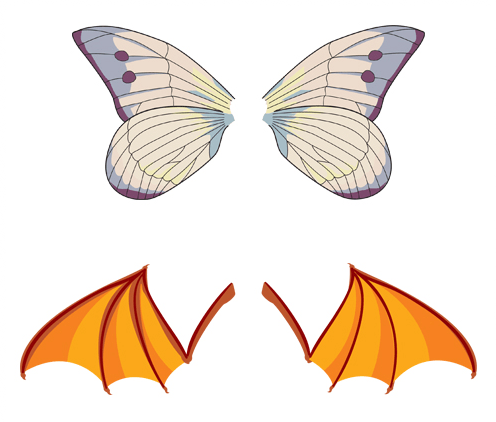
Structures that are very different in structure or anatomy but have similar functions such as the wings of a bird and a butterfly.
a)
Vestigial Structures
b)
Homologous Structures
c)
Analogous Structures
d)
Cladogram
59.

Two species living in similar environments, but a very long distance away look very similar. However, that are not closely related (analogous). Their resemblance is most likely an example of.

a)

sexual selection

b)

temporal isolation

c)

convergent evolution

d)

divergent evolution

60.

Sharks and dolphins look very much alike-- both have streamlined bodies, fins, and sharp teeth. Sharks and dolphins, however, show every few similarities in protein and DNA structures implying that they are not closely related. The body structures have evolved independently. Which term is used by evolutionary biologists to describe the process by which two separate species may evolve in a similar way and come to resemble one another, but have no relation.

a)

Adaptive Radiation

b)

Convergent Evolution

c)

Divergent Evolution

d)

Coordinated Development

61.
a)
The image shows convergent evolution.
b)
The image shows divergent evolution.
c)
The image shows adaptive radiation.
d)
The image shows homologous structures.
62.
In recent years "SuperBugs" (bacteria that aren't effected by antibiotics) are becoming more and more common. How could natural selection explain this?
a)
Superbugs survive antibiotics and reproduce
b)
Antibiotics cause bacteria to become superbugs
c)
We have always had the same amount of superbugs; modern media just discusses them more.
d)
There is no reliable data on the origin of super bugs.
63.
Which of these is an example of natural selection?
a)
The largest animal in a population will have more opportunities for reproduction.
b)
Several species of organisms work together so that they all succeed.
c)
One species takes all the resources in an environment leaving none for others.
d)
Organism that are best suited to an environment tend to survive and reproduce more often.
64.
Which of the following explains adaptation.
a)
An individual organism changes to meet its needs in the environment. These changes pass down to their offspring.
b)
The species as a whole changes their characteristics.
c)
Beneficial traits allow organism to survive and pass on those traits
d)
New characteristics arise in a species as needed.  If these traits are helpful, they are passed down.
65.
Darwin studied which of these species on Galapagos?
a)
Pigeons and tortoises
b)
Tortoises and finches
c)
Finches and Pigeons
d)
Zebras and Mockingbirds
66.
The clear wing moth and the wasp look similar to each other. Why? 
a)
The wasp mimics the moth to attract prey.
b)
The moth and the wasp are closely related
c)
The moth mimics the wasp to repel predators
d)
The moth had one wasp parent
67.
Evolution works by 
a)
individuals changing to suit their environment
b)
Individuals learned new traits and pass them on
c)
sudden change in the environment cause a species change 
d)
small changes pass down through many generations
68.
Define homologous structures.
a)
Structures that appear the same, but have different ancestral origins.
b)
Structures that appear the different, but have the same ancestral origins.
c)
Any two body parts from the same organism
d)
Parts that no longer appear to have a function
69.
Define analogous structures.
a)
Structures that appear the same, but have different ancestral origins.
b)
Structures that appear the different, but have the same ancestral origins.
c)
Any two body parts from the same organism
d)
Parts that no longer appear to have a function
70.
Some people use similarities in embryos to support the the theory that 
a)
The organisms have the same ancestors 
b)
The organisms have similar numbers of offspring
c)
Cells naturally develop along similar line 
d)
There are no connections 
71.

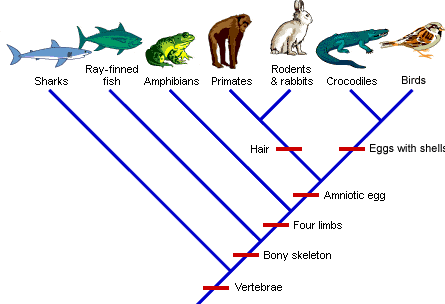
According to this cladogram, primates are most closely related to....

a)

Amphibians

b)

Rodents & rabbits

c)

Crocodiles

d)

Birds

72.

Which trait do only humans have, according to the cladogram?

a)

jaws

b)

mammary glands & hair

c)

terrestrial during all life stages

d)

bipedal & opposable thumbs

73.
Kangaroos and opossums both incubate their immature in pouches. This means they -
a)
share a common ancestor
b)
possess vestigial organs
c)
have similar skeleltal structures
d)
belong to the same species
74.
Individuals that are well adapted to their environment will survive and produce:
a)
Fewer mutations
b)
Stronger genes
c)
More offspring
d)
Better traits
75.
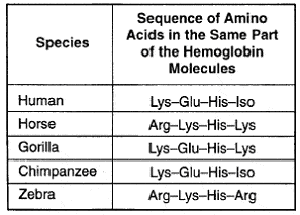
You look at two species and see very similar amino acid sequences. What does this likely tell you?
a)
These are the same animal.
b)
These animals have a common ancestor.
c)
These animals are not likely related.
d)
These animals are likely becoming one species.
76.
Breeding dogs for specific desired traits is an example of which type of evolutionary evidence?
a)
Artificial selection
b)
Embryology
c)
Fossils
d)
Biochemical molecules
77.
What genus does Bird X belong to?
a)
Certhidea
b)
Geospiza
c)
Camarhynchus
d)
Platyspiza
78.
Which of these is a characteristic shared between Fungi and Plantae?
a)
Heterotrophic
b)
Mobile
c)
Prokaryotic
d)
Multicellular
79.
Based on the phylogenic tree, which of these shows a correct ancestral lineage?
a)
E is an ancestor to F and G
b)
C is an ancestor to D and E
c)
B is an ancestor to A
d)
E is an ancestor to H and I
80.
A dichotomous key for trees is provided. Hikers found a tree that has large brown cones and single sharp needles. What species of tree have the hikers found?
a)
Juniper
b)
Pine
c)
Spruce
d)
Fir
81.

Some female peacocks prefer males with large, colorful tales while other female peacocks prefer males with no tail at all. Females are now mating only with the tail they prefer. What type of reproductive barrier is this?

a)

behavioral isolation

b)

hybrid sterility

c)

temporal isolation

d)

mechanical isolation

82.
A flash flood carried a raft of Amazon ants away from their original population. There is enough distance between the two groups, that they will never meet in nature again. What type of reproductive barrier is this?
a)
behavioral isolation
b)
temporal isolation 
c)
gametic isolation
d)
geographic isolation 
83.
Which of the following must occur for speciation to happen?
a)
geographic isolation
b)
reproductive isolation
c)
temporal isolation
d)
behavioral isolation
84.
Gentoo penguins will present a mate with a pebble that they find to attract a mate. Emperor penguins have a specific call and movement that they make to attract a mate. Which type of isolation do these penguins demonstrate?
a)
temporal isolation 
b)
behavioral isolation
c)
geographical isolation
d)
anatomical isolation
85.
Which is the best definition of an adaptation?
a)
a mutation that creates a new species
b)
a trait that improves an individual's fitness
c)
a trait that is passed on to the next generation
d)
a trait that has no effect on an individual's fitness