wayground logo

Free Printable Worksheets

NEW

Font size

S
M
L
XL
Worksheets

plate tectonics, volcanoes, earthquakes study guide

Total questions: 75

Worksheet time: 54mins

Name
Class
Date
1.

What is pangea?

a)

When the plates move

b)

One large continent also known as "supercontinent"

c)

Two continents together as one.

2.

What is continental drift?

a)

The movement of continents over a long period of time.

b)

One large supercontinent.

c)

When continents form mountains over a long period of time.

3.

What evidence proves continental drift?

a)

Shape of landforms

b)

Fossils

c)

Climate change over time

d)

All of the above

4.

What is a fault line?

a)

The ocean that moves because of a tsunami.

b)

The line that causes a hurricane.

c)

Locations on the Earth where plate tectonics interact.

5.

What is the theory of plate tectonics?

a)

The theory that the Earth once had dinosaurs.

b)

The theory that Earth's outer shell is divided into a bunch of plates.

c)

The theory that the continents were all once together.

6.

Which boundary does this picture show?

a)

Convergent boundary

b)

Divergent boundary

c)

Transform plate boundary

7.

Which boundary does this picture show?

a)

Convergent boundary

b)

Divergent boundary

c)

Transform plate boundary

8.

Which boundary does this picture show?

a)

Convergent boundary

b)

Divergent boundary

c)

Transform plate boundary

9.

At which type of plate boundary do mountains form at?

a)

Convergent boundary

b)

Divergent boundary

c)

Transform plate boundary

10.

What is the richter scale?

a)

A scale that measures volcanoes erupting

b)

A scale that uses numbers from 1-10 to measure the magnitude of an earthquake

c)

A scale that measures a divergent boundary.

11.

Which earthquake has the strongest magnitude?

a)

2

b)

5

c)

8

12.

Which part of this reading on the richter scale has a stronger earthquake?

a)

Reading A

b)

Reading B

13.

Non-explosive, gently sloping volcano made of flat layers of lava

a)

Cinder cone

b)

Shield

c)

Composite

d)

Transform

14.

Shaking of the ground caused by sudden movement of large blocks of rocks along a fault

a)

Earthquake

b)

Volcano

c)

Tsunami

d)

Surface waves

15.

In an earthquake, the point underground where the rocks first begin to move

a)

Epicenter

b)

Normal fault

c)

Focus

d)

Reverse fault

16.

These waves move along Earth's surface & cause the most damage

a)

Surface waves

b)

Primary waves

c)

Secondary waves

d)

D waves

17.

The point on Earth's surface directly above the focus of an earthquake

a)

Juan de fuca plate

b)

Focus

c)

Seismic wave

d)

Epicenter

18.

Fastest seismic waves, first to reach a location after an earthquake, also called P waves

a)

Secondary waves

b)

Seismic waves

c)

Primary waves

d)

Surface waves

19.

Small, steep-sided volcanoes made of loosely packed layers of tephra, very explosive eruptions

a)

Cinder cone volcano

b)

Shield volcano

c)

Composite volcano

d)

Mauna Loa volcano

20.

The 2nd seismic waves to arrive at any particular location after an earthquake, also called S waves

a)

Surface waves

b)

Primary waves

c)

Secondary waves

d)

Tidal waves

21.
What are the Earth's landmasses called?
a)
Pangea
b)
Oceans
c)
Continents
22.
When magma reaches the surface, what is it called?
a)
lava
b)
explosive
c)
rocks
23.
What is the crust that makes up the ocean floor called?
a)
oceanic crust
b)
crust
c)
continental crust
24.
Scientists think that the movement of Earth's tectonic plates are caused by convection currents, that are located in the _________?
a)
outer core
b)
inner core
c)
mantle
25.
What is an area where material from deep within the mantle rises and then melts, forming magma?
a)
hot spot
b)
lithosphere
c)
transform boundary
26.
What is the record of an earthquake's seismic waves produced by a seismograph?
a)
Richter
b)
magnitude
c)
seismogram
27.
What is the definition of dormant?
a)
sleeping
b)
extinct
c)
active
d)
invisible
28.
What are scientists that study volcanoes called?
a)
doctor
b)
vet
c)
volcanologist
d)
volcano scientist
29.
What is the opening that extends from the magma chamber to the top of the volcano called?
a)
magma
b)
lava
c)
vent 
d)
crater
30.
A volcano that has gentle sloping sides and is formed from runny lava
a)
Shield volcano
b)
Cinder cone
c)
Composite
d)
None of these
31.
When an explosive eruption  forms a mixture of hot rock, ash, and gas, this material is called a...?
a)
Land slide
b)
Lava
c)
Eruption trail
d)
Pyroclastic flow
32.
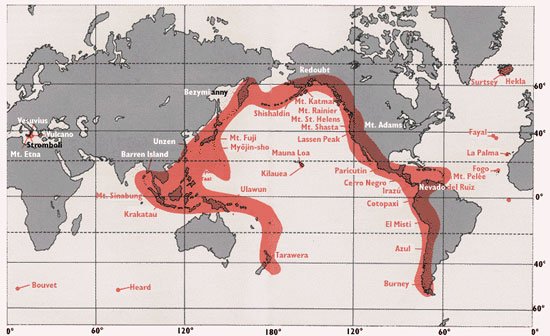
This is the name for the chain of volcanos around the edge of the Pacific Plate.
a)
Circle of Fire
b)
Ring of Lava
c)
Ring of Fire
d)
Circle of Magma
33.
A volcano that has steep sides and is formed from lava chunks is called
a)
a shield volcano
b)
a cinder cone volcano
c)
a composite volcano
34.
Where is Mt. St Helens located?
a)
New Jersey
b)
Nebraska
c)
Washington state
d)
I didn't learn this so I give up 
35.
This city was destroyed in 79 A.D. by the eruption of Mt. Vesuvius.
a)
Rome
b)
Munich
c)
Pompeii
d)
Naples
36.
Volcanoes are found...
a)
on land
b)
under water
c)
on islands
d)
all of the above
37.
A live volcano
a)
Dormant volcano
b)
Active volcano
c)
Extinct volcano
d)
Shield volcano
38.
A dead volcano, one that is unlikely to erupt again
a)
Dormant volcano
b)
Extinct volcano
c)
Shield volcano
d)
Caldera
39.
A type of eruption where magma flows easily, thin runny lava oozes quietly from the vent
a)
Quiet eruption
b)
Explosive eruption
c)
Rock eruption
d)
Vent
40.
Energy from water or steam that has been heated by magma
a)
Geothermal energy
b)
Thermal energy
c)
Kinetic energy
d)
Potential energy
41.
What is a huge hole left behind When a volcano has an enormous eruption and empties the magma chamber and the main vent.  The volcano becomes hollow and collapses leaving this hole behind
a)
Central vent
b)
Caldera
c)
Side vent
d)
Magma
42.

What is a primary earthquake wave that travels through the body of the earth; so named because it is the first wave to reach a seismograph station during an earthquake.

a)

P-wave

b)

S-wave

c)

Surface wave

d)

body wave

43.

What is an earthquake wave that follows the main shock of an earthquake?

a)

body wave

b)

P wave

c)

aftershock

d)

S wave

44.

What is an earthquake wave that travels through the body of the earth?

a)

P wave

b)

body wave

c)

surface wave

d)

S wave

45.

The vibrations in the earth caused by the sudden release of energy is called an ______________.

a)

epicenter

b)

aftershock

c)

earthquake

d)

tsunami

46.

The vibrations in the earth caused by the sudden release of energy is called an ______________.

a)

epicenter

b)

aftershock

c)

earthquake

d)

tsunami

47.

What is a measure of the damage done by an earthquake called?

a)

epicenter

b)

magnitude

c)

intensity

d)

focus

48.

What is a measure of the total amount of energy released at the focus of an earthquake called?

a)

intensity

b)

magnitude

c)

seismic wave

d)

epicenter

49.

What is a series of sea waves caused by underwater earthquakes called?

a)

storm surge

b)

rip current

c)

tsunami

d)

massive flooding

50.

What is the zone of intense earthquake and volcanic activity called?

a)

Circle of Fire

b)

Oval of Fire

c)

Ring of Fire

d)

Earthquake Central

51.

A zone of intense earthquake and volcanic activity encircles the _________ Ocean.

a)

Arctic

b)

Indian

c)

Atlantic

d)

Pacific

52.
Which Hemisphere are both North America and South America found in?
a)
Western Hemisphere
b)
Eastern Hemisphere
c)
Southern Hemisphere
d)
Northern Hemisphere
53.
Which Hemisphere are both South America and Antarctica found in?
a)
Western Hemisphere
b)
Eastern Hemisphere
c)
Southern Hemisphere
d)
Northern Hemisphere
54.
Which letter would you find at 15oS, 60oW?
a)
A
b)
C
c)
L
d)
H
55.
Which letter would you find at 15oS, 60oW?
a)
A
b)
C
c)
L
d)
H
56.
Which letter would you find at 30oS, 30oE?
a)
A
b)
D
c)
K
d)
E
57.
Which way does latitude go on a map?
a)
Up and down
b)
Side to side
c)
In a circle
d)
To infinity and beyond
58.
Which way does longitude go on a map?
a)
Up and down
b)
Side to side
c)
In a circle
d)
To infinity and beyond
59.
What is the name of the line at 0 degrees latitude?
a)
Equator
b)
Prime Meridian
c)
International Date Line
d)
Arctic Circle
60.
What is the name of the line at 0 degrees longitude?
a)
Equator
b)
Prime Meridian
c)
International Date Line
d)
Arctic Circle
61.
What is the name of the line at 0 degrees longitude?
a)
Equator
b)
Prime Meridian
c)
International Date Line
d)
Arctic Circle
62.
Which of these continents does the equator go through?
a)
North America
b)
Europe
c)
Australia
d)
Africa
63.
What is the reason why latitude lines NEVER intersect? 
a)
They converge at the poles
b)
They are cool
c)
They are vertical lines 
d)
They are parallel
64.
What is this object known as?
a)
Map symbol
b)
Map key
c)
Map scale
d)
Compass rose
65.
What is the name of the line at about 23.5⁰ South?
a)
Equator
b)
Prime Meridian
c)
Tropic of Capricorn
d)
Tropic of Cancer
66.

What is an Ocean?

a)

small body of water

b)

large body of water

67.

What % of the world is water?

a)

20%

b)

50%

c)

70%

d)

97%

68.
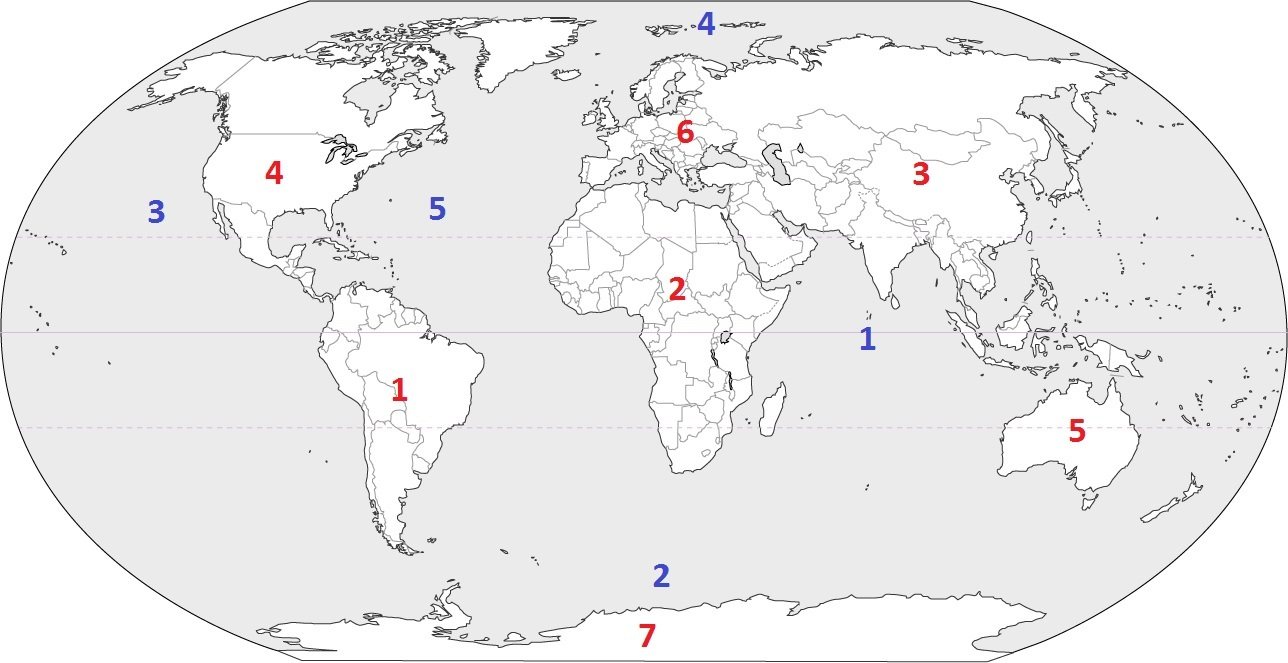
Name Continent A!
a)
North America
b)
Africa
69.
Name Continent C!
a)
Antarctica
b)
Europe
70.
Name Ocean #1!
a)
Indian
b)
Pacific
71.
Name Ocean #2!
a)
Arctic
b)
Atlantic
72.
How many oceans are there in the world?
a)
7
b)
6
c)
5
d)
4
73.
How many continents are there in the world?
a)
4
b)
5
c)
6
d)
7
74.
Which is the largest continent in the world?
a)
Asia
b)
Africa
c)
North America
d)
Antarctica
75.
Identify the ocean at location #4
a)
Indian Ocean
b)
Pacific Ocean
c)
Arctic Ocean
d)
Atlantic Ocean