wayground logo

Free Printable Worksheets

Font size

S
M
L
XL
Worksheets

Exam Review

Total questions: 125

Worksheet time: 10hrs 25mins

Name
Class
Date
1.

There are 3 types of RNA. What are they? (Select all that apply)

a)

tRNA

b)

rRNA

c)

mRNA

d)

xRNA

2.
RNA contains the sugar
a)
ribose
b)
deoxyribose
c)
glucose
d)
lactose
3.
Which of the following statements is true?
a)
DNA is single-stranded
b)
RNA is single-stranded
c)
DNA contains uracil
d)
RNA contains deoxyribose
4.
What is the product of translation?
a)
DNA
b)
mRNA
c)
tRNA
d)
proteins
5.

The Process of creating RNA from DNA

a)

Transcription

b)

Translation

c)

Replication

6.

In RNA the base T is replaced with

a)

U

b)

G

c)

C

d)

A

7.

What combines together to make a protein?

a)

Amino Acid

b)

RNA

c)

Ribosome

d)

DNA

8.

What organelle is the site of translation?

a)

Nucleus

b)

Ribosome

c)

Mitochondria

d)

Chloroplast

9.

What is the order for Protein Synthesis?

a)

Transcription -> Translation -> Protein

b)

Translation - > Transcription -> Protein

c)

Protein -> Transcription -> Translation

d)

Translation -> Protein -> Transcription

10.
Which type of RNA takes the instructions from the nucleus to the cytoplasm?
a)
mRNA
b)
tRNA
c)
rRNA
d)
RNA polymerase
11.
What is the product of transcription?
a)
DNA
b)
mRNA
c)
tRNA
d)
proteins
12.

Carries the amino acid used to make a protein

a)

mRNA

b)

rRNA

c)

tRNA

13.

What type of RNA is shown in this image?

a)

rRNA

b)

mRNA

c)

tRNA

14.

What type of RNA is shown in this image?

a)

rRNA

b)

mRNA

c)

tRNA

15.

This image shows a picture of a ribosome - what type of RNA is this?

a)

rRNA

b)

mRNA

c)

tRNA

16.
Within the eukaryotic cell, where does transcription occur?
a)
Nucleus
b)
Cytoplasm
c)
Ribosome
17.
Which scientist(s) built the 3D model of the DNA double helix?
a)
Watson and Crick
b)
Hershey and Chase
c)
Franklin
d)
Char gaff
18.
Which scientist(s) discovered that in any sample of DNA, the amount of A = T and the amount of C = G?
a)
Griffith
b)
Avery
c)
Chargaff
d)
Franklin
19.
Which of the following terms means that in each molecule of DNA made during replication there is one original strand and one new strand?
a)
Antiparallel
b)
Semi-conservative
c)
Complementary base-pairing
20.
During which phase of the cell cycle is DNA replicated?
a)
G1 Phase
b)
S Phase
c)
M Phase
d)
G2 Phase
21.
Which of the following best describes a DNA molecule?
a)
double helix
b)
contains ribose
c)
made of amino acids
d)
contains Uracil
22.
Which sequence of DNA bases would pair with this partial strand
ATG TGA CAG
a)
ATG TGA CAG
b)
TAC ACT GTC
c)
GTA AGT GAC
d)
CAT TCA CTG
23.
Which of the following units are repeatedly joined together to form a strand of DNA?
a)
amino acids
b)
nucleotides
c)
fatty acids
d)
polysaccharides
24.
Why is DNA important?
a)
it is very small and very complicated
b)
it's in everything
c)
it serves as the blueprint for traits of all living things
d)
because we eat it every day for energy
25.
Which 2 molecules form the sides (backbone) of the DNA ladder?
a)
deoxyribose sugar and adenine
b)
deoxyribose sugar and a hydrogen bond
c)
deoxyribose sugar and the nucleus
d)
deoxyribose sugar and phosphate
26.
What are the three components of a nucleotide?
a)
sugar, hydrogen, nitrogen base
b)
sugar, oxygen, nitrogen base
c)
sugar, phosphate, nitrogen base
d)
sugar, phosphate, protein
27.
What mutation has occurred here? 
T-G-A-C-C-A
T-G-A-G-C-A
a)
Substitution
b)
Deletion
c)
Insertion
d)
Frameshift 
28.
Are all mutations bad?
a)
Yes
b)
No
29.
ATTTGAGCC- Original
ATTGAGCC - Mutated
The example above is an example of a 
a)
Insertion- Frameshift
b)
Deletion- Substitution
c)
Deletion -Frameshift
d)
All of the above
30.
Would a mutation in the DNA of a skin cell be passed on to an organism's offspring?
a)
Yes, because any change to the DNA is passed on to the offspring
b)
Maybe. Sex cells only use half of the body's genetic code. It might get the copy of a gene that wasn't mutated.
c)
No. Only mutations that occur in the gametes (sex cells) are passed on to the offspring
d)
Without knowing the animal, it would be hard to tell whether or not the mutation would be passed on.
31.
RNA is read in sections called:
a)
Triplets
b)
Genes
c)
Codons
d)
Genes
32.
Which of the following sequences of processes correctly reflects the central dogma?
a)
protein synthesis, transcription, translation
b)
protein synthesis, translation, transcription
c)
transcription, translation, protein synthesis
d)
translation, transcription, protein synthesis
33.
Which do DNA and RNA have in common?
a)
Both are double stranded.
b)
Both contain ribose molecules.
c)
Both contain phosphate groups.
d)
Both contain uracil.
34.
What is the complimentary mRNA sequence to the DNA sequence A-T-T-G-C-A.
a)
T-A-A-C-G-T
b)
U-A-A-C-G-T
c)
U-A-A-C-G-U
d)
T-A-A-G-C-U
35.
What is the most basic unit of life?
a)
cell
b)
tissue
c)
organ
d)
organ system
36.

Reproduction that only involves one parent and all offspring are identical; for example, binary fission of bacteria or amoebas.

a)

Asexual

b)

Sexual

c)

Division

d)

Addition

37.

How do heterotrophs get the energy they need to survive?

a)

photosynthesis

b)

eating other organisms

c)

decomposing dead materials

d)

chemosynthesis

38.
A _____ is something in the environment that causes an organism to respond.
a)
stimulus
b)
response
c)
cause
d)
effect
39.
When a baby kitten becomes an adult cat, this is an example of...
a)
energy metabolism
b)
growth and development
c)
response to stimuli
d)
having cells
40.

Reproduction that involves two cells from different parents unite to produce the first cell of a new organism.

a)

Asexual

b)

Sexual

c)

Budding

d)

Division

41.

Living things are based on a universal genetic

code. What molecule is responsible for that code?

a)

RNA

b)

Lipid

c)

Protein

d)

DNA

42.

The combination of chemical reactions through

which an organism builds up or breaks down

materials as it carries out its life processes is called ...

a)

absorption

b)

metabolism

c)

digestion

d)

consumption

43.

Maintaining a stable internal

environment is called

a)

homeostasis

b)

equilibrium

c)

balance

d)

evenness

44.
The dismissal bell rings and you pack up your belongings. In this scenario, what is the stimulus?
a)
The bell ringing
b)
You packing up your belongings
c)
More information is needed
45.
Which of the following is NOT a characteristic shared by all living organisms?
a)
Ability to move
b)
Ability to grow and develop
c)
Made up of one or more cells
d)
Responds to stimuli
46.
In order for something to be considered a living organism, it must display _____ of the eight characteristics of living things.
a)
all
b)
some
c)
one
d)
more than half
47.
Organisms, such as bacteria, are ______________ which means they consist of only a single cell.
a)
unicellular
b)
multicellular
c)
autotrophic
d)
heterotrophic
48.
Energy is required for all life processes. How do AUTOTROPHIC organisms obtain energy?
a)
They make their own food through the process of photosynthesis.
b)
They consume other organisms for energy.
c)
They break down dead and decaying materials.
d)
They absorb energy through osmosis.
49.
When you step out into the cold, your body shivers in order to keep its temperature at 98.6oF.
a)
All living things use energy
b)
All living things contain cells
c)
All living things maintain homeostasis
d)
All living things grow and develop
50.
A pill bug (roly poly) eats a carrot.
a)
All living things contain cells
b)
All living things use energy
c)
All living things maintain homeostasis
d)
All living things grow and develop
51.
A camel has eyelashes that work to keep the dust and sand out of its eyes.
a)
All living things adapt to their environment
b)
All living things grow and develop
c)
All living things have cells
d)
All living things display organization
52.
A caterpillar hibernates in a cocoon and emerges as a butterfly.
a)
All living things adapt to their environment
b)
All living things use energy
c)
All living things respond to their environment
d)
All living things grow and develop
53.
A tulip opens in the morning at sunrise and closes in the evening at sunset.
a)
All living things have cells
b)
All living things use energy
c)
All living things respond to their environment
d)
All living things grow and develop
54.
Over many hundreds of years, a population of rabbits living in the woods adapts to its surrounding with brown fur.
a)
All living things adapt to their environment
b)
All living things grow and develop
c)
All living things use energy
d)
All living things maintain homeostasis
55.
YOU are a multi-celled organism, but an amoeba is a single celled organism.
a)
All living things have cells
b)
All living things grow
c)
All living things use energy
d)
All living things respond to their environment
56.
The cells that are older, smaller, less complex, and do not contain a nucleus are _______________________.
a)
eukaryotic
b)
proeukaryotic
c)
prokaryotic
d)
all cells
57.
Define BIOLOGY.
a)
The study of life and living organisms.
b)
The study of animals.
c)
They study of matter.
d)
The study of earth and its atmosphere.
58.

A group of organisms that can breed with one another is known as a

a)

species

b)

reproduction

c)

organization

d)

development

59.

ORGANISM

a)

a living thing that shares six characteristics of life: cellular organization, similar chemicals, uses energy, responds to their surroundings, grows and develops, and reproduces

b)

basic unit of structure and function in an organism

60.

CELL

a)

basic unit of structure and function in an organism

b)

a living thing that shares six characteristics of life: cellular organization, similar chemicals, uses energy, responds to their surroundings, grows and develops, and reproduces

61.

UNICELLULAR

a)

consisting of a single cell

b)

consisting of many cells

62.

MULTICELLULAR

a)

consisting of a single cell

b)

consisting of many cells

63.

HOMEOSTASIS

a)

maintenance of stable internal conditions despite changes in surroundings

b)

a mistaken idea that living things can arise from nonliving things

64.

AUTOTROPH

a)

an organism that makes their own food

b)

an organism that cannot make their own food

65.

HETEROTROPH

a)

an organism that makes their own food

b)

an organism that cannot make their own food

66.

RESPONSE

a)

a change in an organism's surroundings that causes the organism to react

b)

an action or change in behavior

67.

PROKARYOTE

a)

organisms whose cells lack a nucleus

b)

organisms with cells that contain nuclei

68.

EUKARYOTE

a)

organisms whose cells lack a nucleus

b)

organisms with cells that contain nuclei

69.

SEXUAL REPRODUCTION

a)

a reproductive process that involves two parents that combine their genetic material to produce a new organism which differs from both parents

b)

a reproductive process that involves only one parent and produces offspring that are identical to the parent

70.

ASEXUAL REPRODUCTION

a)

a reproductive process that involves two parents that combine their genetic material to produce a new organism which differs from both parents

b)

a reproductive process that involves only one parent and produces offspring that are identical to the parent

71.
Which of the following is a phenotype?
a)
Aa
b)
red hair
c)
heterozygous
d)
DNA
72.
Dominant alleles are represented by a:
a)
Male gene
b)
lowercase letter
c)
recessive trait
d)
capital letter
73.
How many boxes would say BB?
a)
1
b)
2
c)
4
d)
0
74.
G = green, g = yellow
The genotype for a yellow plant is...
a)
GG
b)
Gg
c)
gg
d)
all of the choices result in yellow
75.
In a certain species of rabbits, black coat color is dominant over brown coat color. What is the probability of producing a rabbit with brown coat color from two rabbits that are both heterozygous for black coat color?
a)
0%
b)
25%
c)
75%
d)
100%
76.
Tay-Sachs disease is a lethal, autosomal recessive genetic disorder. If both parents are heterozygous carriers of the disease, what are the chances of them having a child who is also a heterozygous carrier for Tay-Sachs?
a)
0%
b)
25%
c)
50%
d)
75%
77.

What does a punnet square show us?

a)

The age of the offspring

b)

The chance of a genotype (trait) showing up in offspring

c)

Numbers

d)

Blue eyes

78.

Father of genetics; 1st person to use probability to explain heredity.

a)

Mendeleev

b)

Mendel

c)

Darwin

d)

Currie

79.

Lower case letter; this represents what is hidden when a dominant allele is present

a)

recessive

b)

homozygous

c)

dominant

d)

heterozygous

80.

Which is homozygous recessive?

a)

AA

b)

Aa

c)

aa

d)

None of them

81.

Which is homozygous dominant?

a)

AA

b)

Aa

c)

aa

d)

None of them

82.
Two genes for flower color in snapdragons are red and white. When a red flower is mated with a white flower, all of the offspring have pink flowers. What kind of inheritance must this be?
a)
sex-linked inheritance
b)
recessive
c)
incomplete dominance
d)
dominant
83.
What pattern of inheritance is shown in this image?
a)
Codominance
b)
Incomplete dominance
c)
Polygenic traits
84.
Gary Goldfish is heterozygous for dark orange color.  Ginny Goldfish is homozygous dominant.  Their baby has light orange color.  Is Gary the father?
a)
Yes, because the light orange color is dominant
b)
No, because there is no way they could produce a homozygous recessive baby
c)
Yes, because Ginny has two alleles for light orange color, so their baby could be light orange
d)
No, because Gary does not have the allele for light color.
85.
How many alleles (letters) do each person carry for a trait?
a)
1
b)
2
c)
3
d)
4
86.
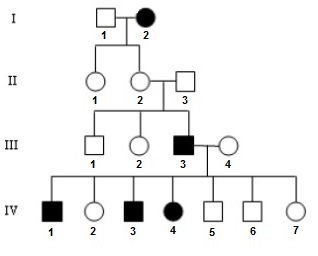
How many generations are shown in this pedigree?
a)
1
b)
2
c)
3
d)
4
87.
How many kids did the mother and father from the first generation have?
a)
2
b)
4
c)
5
d)
6
88.
This pedigree represents the inheritance of hemophilia in this family. How many of the females have the hemophilia trait?
a)
8
b)
5
c)
2
d)
3
89.
What do half colored symbols represent?
a)
The individual is a carrier (heterozygous).
b)
The individual expresses the trait.
c)
The individual has both recessive alleles.
d)
The individual has both dominant alleles.
90.
What does an open circle represent?
a)
Not Affected Male
b)
Not Affected Female
c)
Affected Male
d)
Affected Female
91.
Is this trait (the shaded individuals) dominant or recessive?
a)
dominant
b)
recessive
92.
How many people in this whole pedigree have the trait/disease?
a)
2
b)
3
c)
4
d)
6
93.
How many females are in this pedigree?
a)
3
b)
4
c)
6
d)
7
94.
Which gender can be carriers of colorblindness and not have it?
a)
Just males
b)
Just females
c)
Both genders
95.
What is the mode of inheritance shown here?
a)
Autosomal Dominant
b)
Autosomal Recessive
c)
Sex Linked Recessive
96.
What is the mode of inheritance shown here?
a)
Autosomal Recessive
b)
Sex Linked
c)
Autosomal Dominant
97.
What is the mode of inheritance shown here?
a)
Autosomal Recessive
b)
Autosomal Dominant
c)
Sex Linked
98.
What is the mode of inheritance shown here?
a)
Autosomal Dominant
b)
Sex Linked
c)
Autosomal Recessive
99.
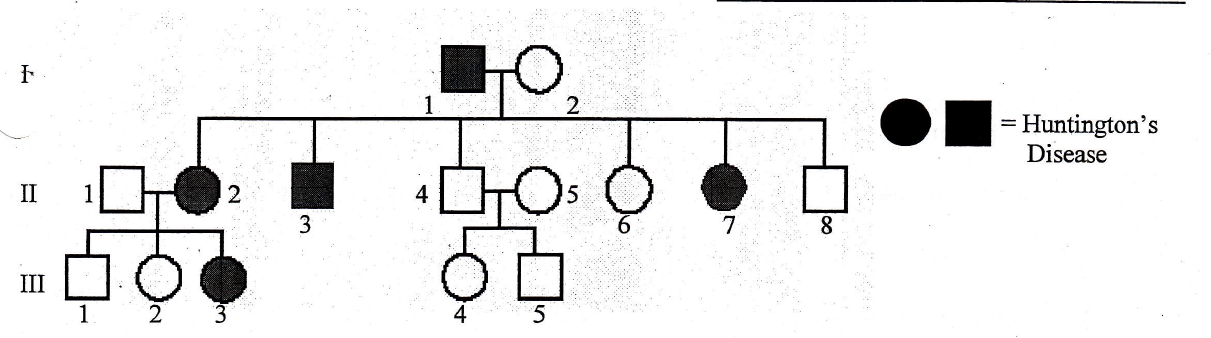
What is the relationship between person I 1 and III 2?
a)
Father and Son
b)
Father and Daughter
c)
Grandfather and Granddaughter
d)
Uncle and Niece 
100.
Which of the following combinations of sex chromosomes represent a female?
a)
XY
b)
XXY
c)
XX
101.
There are no carriers for Huntington's Disease- you either have it or you don't. Is Huntington's disease caused by a dominant or recessive trait?
a)
Dominant
b)
Recessive
102.
What you see, or the physical appearance.
a)
Genotype
b)
Phenotype
c)
Homozygous
d)
Heterozygous
103.

Which of the following genotypes is Purebred? Select 2 answers.

a)

aA

b)

Aa

c)

AA

d)

aa

104.

Which of the following are genotypes for blood type B?

a)

IA IA and IA IB

b)

IB IB and ii

c)

IB IB and IB i

d)

IA IB and IA IB

105.

____________ occurs when the dominant and recessive traits are blended in the heterozygous genotype.

a)

Codominance

b)

Punnett squares

c)

Complete dominance

d)

Incomplete dominance

106.

___________ is when both the dominant trait and recessive trait are seen in the phenotype.

a)

Codominance

b)

Punnett squares

c)

Complete dominance

d)

Incomplete dominance

107.

In the image above, what is the percentage of the offspring has the possibility of inheriting blood type O?

a)

0%

b)

25%

c)

50%

d)

100%

108.

In the image above, the trait for flower color is controlled by codominance. R codes for red flowers and W codes for white flowers. Which of the following correctly reports the phenotypes?

a)

100% red flowers

b)

50% white flowers and 50% pink flowers

c)

50% red flowers and 50% red and white flowers

d)

50% white flowers and 50% red flowers

109.

Which of the following genotypes code for the blood type AB?

a)

IA IA and IA IB

b)

IA IB only

c)

IA IB and IB i

d)

ii only

110.

The image above shows the incomplete dominant cross where D codes for straight hair in dogs and d codes for curly hair in dogs. The incomplete dominant trait is wavy hair. Which of the following statements is true about the offspring?

a)

Only the heterozygous genotype can code for wavy hair.

b)

Only the homozygous dominant genotype can code for wavy hair.

c)

Only the homozygous recessive genotype can code for wavy hair.

d)

The homozygous recessive and homozygous dominant genotypes can code for wavy hair.

111.
If this image were real, it would represent what type of inheritance?
a)
incomplete dominance
b)
codominance
c)
polygenic inheritance
d)
compete dominance
112.
How many PAIRS of chromosomes do humans have?
a)
23
b)
46
c)
1
d)
2
113.
Snap dragon color is a incomplete dominant trait.  A red flower (RR) is crossed with white flower (rr)? What color are flowers that are Rr?
a)
Red
b)
Red and White
c)
White
d)
Pink
114.
This is an example of ___________?
a)
Incomplete dominance
b)
Co-Dominance
115.
How are Incomplete Dominance and Co Dominance different than a normal Mendelian cross?
a)
There is no difference
b)
The heterozygous genotype has a unique phenotype
c)
There is no heterozygous genotype
d)
There is only one phenotype regardless of genotype.
116.
What type of inheritance is shown?
a)
complete
b)
incomplete
c)
codominance
d)
sex-linked
117.
In butterfly bushes, dark purple and pink parents will produce offspring with lavender flowers. This is a result of 
a)
codominance
b)
incomplete dominance
c)
complete dominance
d)
recessive dominance
118.
What percentage of the female offspring will be a carrier for this recessive disease?
a)
0%
b)
50%
c)
100%
d)
25%
119.
Alternative forms of a gene are called
a)
Alleles
b)
Homozygous
c)
DNA
d)
Genetics
120.
When we say that a woman is a carrier for a genetic disease or disorder it means that
a)
she has 1 gene, but not the disorder
b)
she has 2 genes for the disorder
c)
she can pass the gene only to male children
d)
she can pass the gene only to female children
121.
Hemophilia is a recessive x-linked disorder.
Which genotype represents a female who is a carrier for hemophilia?
a)
XHXh
b)
XhXh
c)
XHXH
d)
XhY
122.
Hemophilia is a recessive x-linked disorder.
Which genotype represents a male with hemophilia?
a)
XHXh
b)
XhXh
c)
XHY
d)
XhY
123.

Colorblindness is a sex-linked recessive trait. A colorblind woman marries a male with normal color vision. What is the percent chance of them having a color blind son?

a)

0%

b)

25%

c)

50%

d)

75%

124.

Muscular dystrophy is a sex-linked recessive disorder. A man with muscular dystrophy marries a woman who doesn’t have this disease. Half of their daughters and half of their sons develop this disease. What is the genotype of the mother?

a)

XNXN

b)

XNXn

c)

Xn

d)

XN

125.

A X-linked gene in fruit flies controls the patterns of the wings. XB has a barred pattern and Xb doesn’t have bars. A male with barred wings is mated to a non-barred female. What would be the genotype(s) of their female offspring?

a)

XBXB

b)

XbXb

c)

XBXb

d)

XBb