wayground logo

Free Printable Worksheets

Font size

S
M
L
XL
Worksheets

Biology Final Exam 2024

Total questions: 125

Worksheet time: 6hrs 15mins

Name
Class
Date
1.
A series of steps used by scientists to solve a problem or answer a question. 
a)
scientific method
b)
recipe
c)
data collection
d)
metric system
2.
This variable in an experiment is the one being changed by the scientist. 
a)
dependent variable
b)
independent variable
c)
data
d)
control group
3.
If you increase the amount of spinach you eat, then you will increase the iron in your blood. 
What's the dependent variable?
a)
increase the amount of iron in your blood
b)
spinach you eat
4.
This is the group that we will compare our experimental group to. This group stays "normal."
a)
Control Group
b)
Experimental Group
c)
 Normal Group
d)
Weird Group
5.
This is the group that is affected by the independent variable or the group that is changed.
a)
Control Group
b)
Experimental Group
c)
Changed Group
d)
Cool Group
6.
Which of the following organic compounds is the main source of energy for living things?
a)
carbohydrates
b)
lipids
c)
nucleic acids
d)
proteins
7.
Which macromolecule stores energy, insulates us, and makes up the cell membrane?
a)
lipids
b)
proteins
c)
carbohydrates
d)
nucleic acids
8.

Enzymes belong to which class of macromolecules?

a)

lipids

b)

carbohydrates

c)

proteins

d)

nucleic acids

9.
What is the function of nucleic acids?
a)
store genetic information
b)
store energy (long-term)
c)
store energy (short-term)
d)
build skin, hair, nails, muscles
10.
What are the monomers of DNA?
a)
glycerols
b)
amino acids
c)
fatty acids
d)
nucleotides
11.

_____ are the basic units of matter and the defining structure of elements.

a)

Atoms

b)

Compounds

c)

Elements

d)

Molecules

12.
The central region of an atom where its neutrons and protons are is its _______.
a)
Nucleus 
b)
Electron cloud
c)
Core 
d)
Center 
13.
Where are electrons of an atom found?
a)
Nucleus
b)
Electron Cloud
c)
Some are in the nucleus and some in the electron cloud.
d)
They are moving everywhere.
14.

In the carbon cycle, the only process that removes CO2 from the atmosphere is

a)

combustion

b)

cellular respiration

c)

decomposition

d)

photosynthesis

15.

What is the process (equation) for photosynthesis?

a)

6CO2 + C6H12O6 --> 6H2O + 6O2

b)

6H2O + 6CO2 --> C6H12O6 + 6O2

c)

6CO2 + C6H12O6 --> 6H2O + Energy

d)

6O2 + C6H12O6 --> 6CO2 + 6H2O

16.

What is the primary source of energy for all food chains or webs?

a)

decomposers

b)

producers

c)

consumers

d)

the sun

17.
What is the energy molecule?
a)
DNA
b)
ATP
c)
RNA
d)
AAA
18.

Cellular respiration is the process that our cells use to ….

a)

convert sugar (glucose) into energy (ATP)

b)

break food down into smaller molecules (sugars)

c)

makes acid

d)

breathe

19.

Where do animals get the glucose that is needed for cellular respiration?

a)

from the exercise they get

b)

from the water they drink

c)

from the food they eat

d)

from the sunlight they get

20.
What is the correct equation for cellular respiration?
a)
6O2 + C6H12O6 -> 6CO2 + 6H2O + Energy
b)
6O2 + C6H12O6 + Energy -> 6CO2 + 6H2O
c)
6CO2 + 6H2O -> 6O2 + C6H12O6 + Energy
d)
6CO2 + 6H2O + Energy -> 6O2 + C6H12O6
21.
What does it mean for something to be anaerobic?
a)
It requires CO2
b)
It does not require CO2
c)
It requires oxygen
d)
It does not require oxygen
22.
Where in the cell does aerobic respiration take place?
a)
Nucleus
b)
Cytoplasm
c)
Mitochondria
d)
Cell membrane
23.

Which type of respiration is more efficient?

a)

Aerobic

b)

Anaerobic

24.

Which statement describes ALL living things?

a)

They are composed of one or more cells.

b)

They must reproduce sexually.

c)

They have organ systems to carry out the processes of life.

d)

They are capable of making their own food.

25.
The basic unit of structure and function in the human body is the....
a)
organ
b)
organ system
c)
cell
d)
tissue
26.

A camel has eyelashes that work to keep the dust and sand out of its eyes. Which characteristic of life does this represent?

a)

All living things adapt to their environment

b)

All living things grow

c)

All living things have cells

d)

All living things use energy

27.
Are prokaryotes multicellular or unicellular? 
a)
Multicellular
b)
Unicellular
28.
Eukaryotes have true nucleus? True or False?
a)
True
b)
False
29.
Plants and animal cells are examples of ___ cells 
a)
prokaryotic cells 
b)
eukaryotic cells 
30.

Which of the following have ribosomes?

a)
Prokaryote
b)
Eukaryote
c)

Both

31.
Eukaryotes have a cell membrane?
a)
True 
b)
False
32.
______ make protein for the cell.  
a)
Nuclei
b)
Ribosomes
c)
Endoplasmic reticulum
d)
Vacuoles 
33.
Which type of cell is bigger?
a)
Prokaryotic
b)
Eukaryotic 
34.
The _____ is sometimes called "the brains" of the cell.
a)
brain
b)
lysosome
c)
vacuole 
d)
nucleus
35.
_____ convert light energy into food through photosynthesis.
a)
Vacuoles 
b)
Ribosomes
c)
The Golgi apparatus
d)
Chloroplasts
36.

What provides external support to the cell in plants?

a)

Cell membrane

b)

Cell wall

c)

Chloroplast

d)

Nucleus

37.

What is number 5 ?

a)

Lysosome

b)

Rough ER

c)

Nucleolus

d)

Mitochondria

38.
DNA is copied during a process called ______________ which results in an identical copy of itself.
a)
Photosynthesis
b)
Transcription
c)
Replication
d)
Translation
39.
Genes contain instructions for assembling _______________.
a)
Nucleosomes
b)
Proteins
c)
Purines
d)
Pyrimidines
40.
Unlike DNA, RNA contains...
a)
a phosphate group
b)
thymine
c)
guanine
d)
uracil
41.
What is produced during transcription?
a)
Protein
b)
tRNA
c)
mRNA
d)
DNA
42.
What happens during the process of translation?
a)
The cell uses information from messenger RNA to produce proteins.
b)
Messenger RNA is made from DNA.
c)
Copies of DNA molecules are made.
d)
Transfer RNA is made from messenger RNA.
43.
DNA has a ______ strand; RNA has a ______ strand.
a)
double/double
b)
double/triple
c)
double/single
d)
single/single
44.
What is the transcribed mRNA strand for CATTAA
a)
GUAAUU
b)
GTAATT
c)
AUGGUU
d)
CATTAA
45.
Which best describes the shape of a DNA molecule? 
a)
single helix 
b)
double helix
c)
single strand
d)
t-shaped strand
46.
Which 2 molecules forms the sides (backbone) of the DNA ladder?
a)
deoxyribose and adenine
b)
deoxyribose and a hydrogen bond
c)
sugar and the nucleus
d)
deoxyribose (sugar) and phosphate
47.
In DNA, Adenine bonds with ______________.
a)
Guanine
b)
Thymine
c)
Cytosine
d)
Adenine
48.
Guanine bonds with ______________.
a)
Adenine
b)
Guanine
c)
Cytosine
d)
Thymine
49.
What does DNA stand for?
a)
Deoxyribonucleic acid
b)
Denitrogenous acid
c)
Deribonucleic acid
d)
Diribonucleic acid
50.
The genetic code is always read
a)
3 bases at a time in the same direction.
b)
4 bases at a time in the same direction.
c)
3 bases at a time and the direction varies.
d)
4 bases at a time and the direction varies.
51.
Which of the following carries amino acids to the site of protein synthesis? 
a)
mRNA
b)
rRNA
c)
tRNA
d)
nRNA
52.

What is the order for Protein Synthesis?

a)

Transcription -> Translation -> Protein

b)

Translation - > Transcription -> Protein

c)

Protein -> Transcription -> Translation

d)

Translation -> Protein -> Transcription
53.
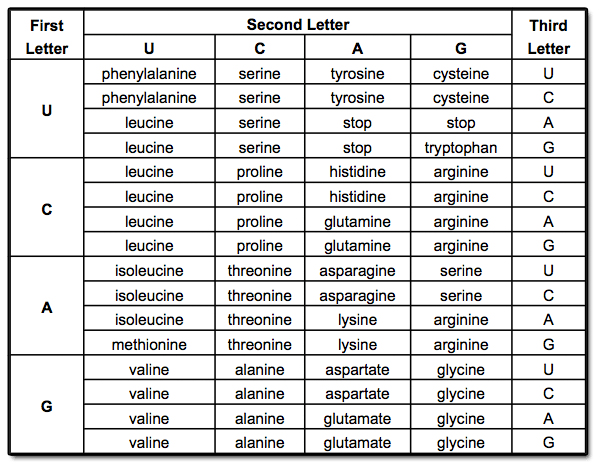
What amino acid is represented by the codon UUA?
a)
Phenylalanine
b)
Tyrosine
c)
Leucine
d)
Stop codon
54.
The codon CCU codes for what amino acid?
a)
Isoleucine
b)
Stop
c)
Methionine
d)
Proline
55.

The picture below shows the steps of DNA replication beginning with step one and ending with step three.


​Because you are reusing the old, or parent, DNA strand DNA replication is said to be

a)

Semi- Conservative

b)

Semi-discontinuous

c)

Continuous

d)

Fully-Conserveative

56.
During which phase of the cell cycle does the cell spend the most time?
a)
Mitosis
b)
Cytokinesis
c)
Interphase
57.
During which part of the cell cycle is DNA copied?
a)
Mitosis
b)
Cytokinesis
c)
S phase
58.
During which part of the cell cycle does the cell divide?
a)
Interphase
b)
Mitosis
c)
S phase
59.
During which parts of the cell cycle does the cell grow?
a)
G1 and G2
b)
G1 and S
c)
M phase and cytokinesis
60.
Which phase of mitosis is shown in the picture?
a)
Prophase
b)
Anaphase
c)
Telophase
61.
Which phase of mitosis is shown in the picture?
a)
Interphase
b)
Metaphase
c)
Telophase
62.
Which phase of mitosis is shown in the picture?
a)
Prophase
b)
Metaphase
c)
Anaphase
63.
Which phase of mitosis is shown in the picture?
a)
Prophase
b)
Telophase
c)
Metaphase
64.
What is shown in the picture?
a)
Mitosis
b)
Interphase
c)
Cytokinesis
65.
What is the purpose of the cell cycle?
a)
To create new daughter cells
b)
To prevent cancer from developing
c)
To help the body fight viruses and bacteria
66.

A supercoiled/tightly packaged DNA molecule is called a ___.

a)

nucleus

b)

histones

c)

chromosome

d)

cytokinesis

67.

Two identical chromosomes/copies of DNA are called sister chromatids, and they are held together by a molecule called a centromere, until they are ready to be separated during mitosis.

Identify the sister chromatids in the image shown.

a)

A

b)

B

68.
How does cytokinesis differ in plant and animal cells?
a)
Cytokinesis only takes place in animal cells.
b)
Cytokinesis only takes place in plant cells.
c)
Plant cells form a cell plate, animal cells form a cleavage furrow.
d)
Animal cells form a cell plate, plant cells form a cleavage furrow.
69.

Which of the following best represents a replicated chromosome?

a)
b)
c)
d)
70.

_____ is a region of condensed chromosomes that looks pinched; where spindle fibers attach during mitosis and meiosis.

a)

Telomere

b)

Centromere

c)

Histone

d)

Growth factor

71.

In which process are Gametes produced?

a)

Mitosis

b)

Meiosis

72.

How many pairs of chromosomes do humans have in a cell?

a)

92

b)

46

c)

23

d)

12

73.

How many daughter cells is made at the end of Meiosis?

a)

4

b)

3

c)

2

d)

1

74.

What is happening during crossing over in Meiosis?

a)

chromatids are replicating

b)

chromatids are exchanging genetic information

c)

chromatids are changing color

d)

chromatids are being deleted

75.

In what phase of Meiosis 1 is crossing over occurring?

a)

Prophase

b)

Anaphase

c)

Metaphase

d)

Telophase

76.

Which of the following is the best definition for MEIOSIS?

a)

the process of two haploid cells uniting

b)

the counting of chromosomes within a diploid cell

c)

a two-step process that reduces the number of chromosomes in half such that there is only one copy of all the chromosomes

d)

the equational division of a cell into two identical copies

77.

In humans, the haploid number of chromosomes is ____.

a)

23

b)

46

c)

69

d)

92

78.

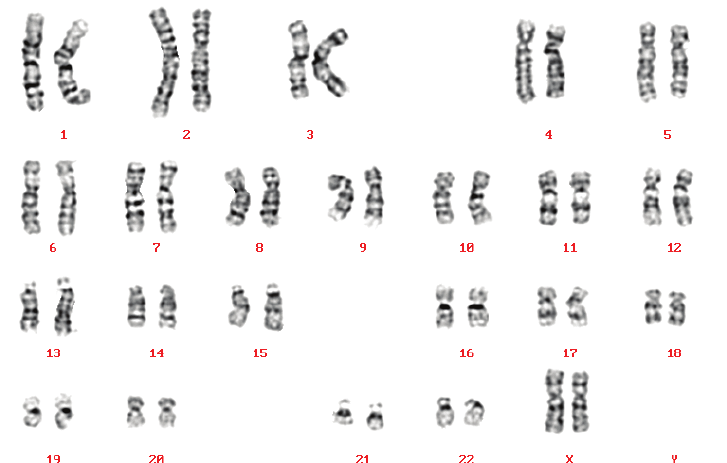
The karyotype diagram below represents a human female with the genetic disorder known as Turner syndrome. Chromosomal analysis of this karyotype reveals the mutation is a result of

a)

a missing X chromosome

b)

a missing Y chromosome

c)

an extra 21 chromosome

d)

missing chromosome #9

79.

The karyotype diagram below represents a human male. Chromosomal analysis of this karyotype reveals the abnormality in this karyotype is:

a)

a missing X chromosome

b)

a missing Y chromosome

c)

an extra 21 chromosome

d)

missing chromosome #9

80.

By looking at the chromosomes how can you tell that this person is biologically female?

a)

Because there are two X chromosomes

b)

Because there are more chromosomes than in a male

81.
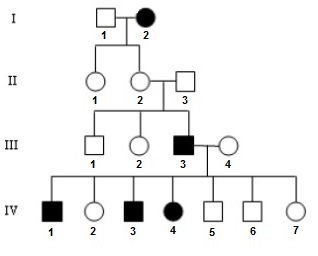
How many generations are shown in this pedigree?
a)
1
b)
2
c)
3
d)
4
82.
This pedigree represents the inheritance of hemophilia in this family. How many of the females have the hemophilia trait?
a)
8
b)
5
c)
2
d)
3
83.
What do half colored symbols represent?
a)
The individual is a carrier (heterozygous).
b)
The individual expresses the trait.
c)
The individual has both recessive alleles.
d)
The individual has both dominant alleles.
84.

The study of how different traits are passed from parents to offspring.

a)

genetics

b)

geology

c)

nuclear physics

d)

chemistry

85.

The characteristics that make one individual different from another such as eye color and hair color.

a)

traits

b)

personality

c)

genealogy

d)

fraternal twin

86.

Which is a GENOTYPE?

a)

black hair

b)

BB

87.

The physical (observable) traits a person has is their...

a)

Genotype

b)

Phenotype

c)

Chromosome

d)

Punnett Square

88.

If A = red fur and a = white fur, what is the probability of red fur?

a)

25%

b)

50%

c)

75%

d)

100%

89.
What allele combination should go in the missing box?
a)
AA
b)
Aa
c)
aa
d)
none of these
90.

If a parent is homozygous for the dominant trait tall, what are his/her alleles?

a)

tt

b)

Tt

c)

TT

91.
Heterozygous is when...
a)
the alleles are the same
b)
the alleles are different
c)
the alleles are absent
d)
the alleles are present
92.
If this image were real, it would represent what type of inheritance?
a)
incomplete dominance
b)
codominance
c)
polygenic inheritance
d)
compete dominance
93.

INCOMPLETE DOMINANCE: The image above shows the incomplete dominant cross where B codes for red flowers and b codes for white flowers. What are the phenotypes of the parents?

a)

50% red and 50% white

b)

50% red and 50% pink

c)

50% white and 50% pink

d)

100% red

94.

The only way for a recessive trait to appear is for an organism to have

a)

two dominant alleles

b)

two recessive alleles

c)

one dominant allele and one recessive allele

95.

Which of the following genotypes shows a CARRIER for an X-linked trait?

a)

XBXb

b)

XbXb

c)

XBXB

d)

XbY

96.
Different variations of a gene are called?
a)
Alleles
b)
DNA
c)
Chromosome
d)
Gene
97.

Colorblindness is more common in males than in females because......

a)

fathers pass the allele for colorblindness to their sons only

b)

the allele for colorblindness is located on the Y chromosome

c)

the allele for colorblindness is recessive and located on the X chromosome

d)

males who are colorblind have two copies of the allele for colorblindness

98.
The sex of a child is determined by
a)

whether the father's sperm contains an x or y chromosome

b)

whether the mother's egg contains an x or y chromosome

c)

the age of the parents

d)

whether the mother's egg contains an xx or xy

99.
What is the correct order (starting from the surface) of Earth's layers?
a)
crust, outer core, inner core, mantle
b)
mantle, outer core, inner core, crust
c)
crust, mantle, outer core, inner core
d)
outer core, inner core, crust, mantle
100.

Which crust is thicker

a)

oceanic

b)

continental

c)

bread

d)

pizza

101.

What is the main idea Alfred Wegener proposed in the

“Theory of Continental Drift” that he published in 1915?

a)

The continents were once a single landmass that drifted apart.

b)

The continents float on a liquid layer that allows them to move.

c)

The seafloor has spread the continents into separate landmasses.

d)

The fossils found on Earth are evidence of change over time.

102.

What is the name of the Mesozoic supercontinent that consisted of all of the present continents?

a)

Gondwanaland

b)

Laurasia

c)

Pangaea

d)

Eurasia

103.
What are the 3 major types of rocks?
a)
Igneous, Metamorphic, Sedimentary
b)
Metamorphic, Igneous, Cementation
c)
magma, lava, crystals
104.

This is the continuous process of rock changing from one type to another.

a)

Igneous rocks

b)

Sedimentary rocks

c)

Metamorphic rocks

d)

Rock Cycle

105.

What type of rock might contain evidence of past life?

a)

Sedimentary Rock

b)

Igneous Rock

c)

Metamorphic Rock

106.

The process by which rocks are broken down

a)

Weathering

b)

Deposition

c)

Erosion

d)

Sedimentation

107.

The process in which wind, water, ice or gravity transport rock fragments from one location to another

a)

Weathering

b)

Sedimentation

c)

Erosion

d)

Deposition

108.

The process in which sediment settles out (drops to the bottom) of the water or wind that is carrying it

a)

Weathering

b)

Erosion

c)

Sedimentation

d)

Deposition

109.

Analyze the seashell found in the white layer. Which statement is true of the rock layer that contains this fossil?

a)

It could also contain a fossil from the bottom layer.

b)

It is older than the layers below it.

c)

It is younger than the layers above it.

d)

It is older than the layers above it.

110.

According to the law of superposition, which layer is the youngest?

a)

F

b)

B

c)

E

d)

A

111.

Length of time for half the atoms of an isotope to decay

a)

Isotope

b)

Half-Life

c)

Radiometric Dating

d)

Absolute Dating

112.
If an organism can't adapt fast enough, this might happen.
a)
hibernate
b)
stay the same
c)
live longer
d)
become extinct
113.

Species that are in danger of becoming extinct are called __________.

a)

endangered

b)

not lucky

c)

extinct

d)

in a jam

114.
Humans are causing extiction in which ways?
a)
By over hunting animals for food or products.
b)
By destroying the natural habitat of species.
c)
By polluting the environments of the world.
d)
All of the above.
115.

There have been 5 mass extinctions in Earth's history. Which of the following answer choices was a cause of these extinctions? You may select more than one answer. Check all that apply.

a)

increased carbon dioxide (CO2) levels in the atmosphere

b)

an asteroid impact

c)

melting of glaciers and rising sea levels

d)

widespread volcanic activity

e)

All of them

116.
A slight difference in an inherited trait between individual members of the same species.
a)
variations
b)
adapatations
c)
homologous structures
d)
analogous structures
117.
When an organism of a species has an adaptation, it will compete for resources better, survive longer and pass that adaptation on to it's offspring. This process is called
a)
evolution by natural selection
b)
artificial selection
c)
inbreeding
d)
outbreeding
118.
The English naturalist that developed the theory of how evolution works.
a)
Charles Darwin
b)
Charles M. Schulz
c)
Charles Dickens
d)
Charles Norris
119.
Bird's beaks evolve mainly due to the type of ___________________ available.
a)
food
b)
water
c)
shrubs
d)
mates
120.

Body parts that have similar structure components but different functions

a)

Homologous structure

b)

Vestigial structure

c)

Analogous structure

d)

Adaptation

121.

Body parts that have similar functions but different structures (bones, etc.)

a)

Homologous structure

b)

Vestigial structure

c)

Analogous structure

d)

Adaptation

122.

Structures that seemed to once have a purpose but for evolutionary reasons no longer serve a role even though we are still born with that structure

a)

Homologous structure

b)

Vestigial structure

c)

Analogous structure

d)

Adaptation

123.

The theory that populations change over long periods of time

a)

overpopulation

b)

fitness

c)

evolution

d)

metabolism

124.

Similar embryological development in different organisms indicating a common ancestry or evolutionary origin.

a)

Molecular Homology

b)

Morphology

c)

Adaptation

d)

Embryology

125.

Color in peppered moths is controlled by genes. A light-colored variety and a dark colored variety of a peppered moth species exist in nature. The moths often rest on tree trunks, and several different species of birds are predators of this moth. Before industrialization in England, the light-colored variety was much more abundant than the dark-colored variety and evidence indicates that many tree trunks at that time were covered with light-colored lichens. Later, industrialization developed and brought pollution which killed the lichens leaving the tree trunks covered with dark-colored soot. The results of a study made in England are shown.


Which conclusion can best be drawn from the information given?

a)

The trait for dark coloration better suits the peppered moth for survival in non-polluted environments.

b)

The trait for dark coloration better suits the peppered moth for survival in polluted environments.

c)

The variation of color in the peppered moth has no influence on survival of the moth.

d)

A given characteristic may be a favorable adaptation in one environment, but not in another environment.