wayground logo

Free Printable Worksheets

NEW

Font size

S
M
L
XL
Worksheets

anatomy first semester review

Total questions: 75

Worksheet time: 41mins

Name
Class
Date
1.

What plane divides the brain into superior and inferior parts as seen in the middle brain image?

a)

coronal

b)

frontal

c)

sagittal

d)

transverse

2.

A frontal plane divides the body or an organ into . . .

a)

anterior & posterior parts

b)

medial & lateral parts

c)

proximal & distal parts

d)

superior & inferior parts

3.

The lungs are in the _____ cavity.

a)

abdominal

b)

cranial

c)

pelvic

d)

thoracic

4.

Your frontal is _____ in relation to your nasal.

a)

lateral

b)

medial

c)

inferior

d)

superior

5.

Maintaining a stable internal environment is called

a)

absorption

b)

assimiliation

c)

excretion

d)

homeostasis

6.

What two body systems are mainly responsible for maintaining homeostasis?

a)

digestive & respiratory

b)

endocrine & nervous

c)

nervous & circulatory

d)

reproductive & integumentary

7.

Homeostasis refers to:

a)

changing internal conditions

b)

stable external conditions

c)

stable internal conditions

d)

changing external conditions

e)

none of these is correct

8.

Which of the following is the most complex level of organization?

a)

cell

b)

organ

c)

organ system

d)

organelle

9.
The study of structure is called ___________.
a)
homeostasis
b)
anatomy
c)
physiology
d)
interrelation
10.

The heart is _________ to the lungs.

a)

superior

b)

lateral

c)

medial

d)

inferior

11.

The knee is _____________ when compared to the ankle.

a)

distal

b)

proximal

c)

inferior

d)

lateral

12.
Which is the correct structural order?
a)
tissue-cells-organ-organ system
b)
cells-tissue-organ system-organ
c)
tissue-cells-organ system-organs
d)
cells-tissue-organ-organ system
13.
Which system absorbs oxygen and releases carbon dioxide?
a)
respiratory
b)
urinary
c)
endocrine
d)
lymphatic
14.

What is the function of stratified squamous epithelium?

a)

secretion

b)

movement

c)

absorption

d)

protection

15.

the presence of intercalated discs indicate which tissue?

a)

skeletal muscle

b)

cardiac muscle

c)

smooth muscle

16.
This type of epithelium has only one layer of cells
a)
Stratified epithelium
b)
Simple epithelium
17.
Which type of muscle is striated?
a)
Skeletal 
b)
Muscles in your throat 
c)
Nervous tissue 
d)
Smooth
18.
The layer of the epidermis that is constantly undergoing cell division is the:
a)
stratum granulosum
b)
stratum lucidum
c)
stratum basale
d)
stratum spinosum
19.
Which of the following epidermal layers is found on the palms of hands and soles of your feet?
a)
stratum granulosum
b)
stratum lucidum
c)
stratum basale
d)
stratum spinosum
20.
Melanocytes are found in the:
a)
stratum corneum
b)
stratum basale
c)
stratum granulosum
d)
stratum lucidum
21.
Which of the following is an indication of melanoma?
a)
pigmented spot that has smooth borders
b)
symmetrical mole
c)
spot that is smaller than the size of a pencil eraser
d)
spot that contains areas of different colors
22.
The upper layer of the dermis:
a)
papillary
b)
reticular
c)
apocrine
d)
eccrine
23.
Sebaceous glands are important for:
a)
body heat regulation
b)
production of sweat
c)
keeping skin and hair cells soft
d)
production of keratin
24.
The most external skin region is composed of:
a)
areolar tissue
b)
stratified squamous epithelium
c)
simple columnar epithelium
d)
adipose tissue
25.
What gives your skin color
a)
Epidermis
b)
follicles
c)
dermis
d)
melanin
26.
The dermis layer is made up of two layers, which are the:
a)
papillary and reticular
b)
papillary and dermal
c)
dermal and tactile
d)
tactile and reticular
27.
Fatty tissue found below the dermis is:
a)
papillae
b)
papillary layer
c)
tactile 
d)
subcutaneous tissue
28.

Bone formed by needlelike pieces of bone and lots of space are called

a)

Spongy bone

b)

Cartilage

c)

Compact bone

29.
The shaft of the bone
a)
diaphysis
b)
epiphysis
c)
medullary cavity
d)
matrix
30.

Consists of bones of the upper and lower limbs and the bones that anchor the limbs to the axial skeleton

a)

axial skeleton

b)

thoracic vertebrae

c)

appendicular skeleton

d)

carpals

31.

A bone, like the femur or humerus, is classified as a(n):

a)

ossified bone

b)

intramembranous bone

c)

compact bone

d)

long bone

32.

Articular cartilage is found:

a)

at the ends of bones

b)

between sutures

c)

surrounding long bones

d)

at the growth plate

33.
What are the three jobs of your bones?
a)
movement, structure, joints
b)
movement, structure, protection
c)
structure, digestion and breathing
d)
movement, digestion and breathing
34.

Hematopoeisis is

a)

bone formation

b)

bone break down

c)

blood cell production

d)

tissue production

35.
attaches muscle to bone 
a)
tendon
b)
ligament 
c)
cartilage
d)
bone
36.
Which one of the following is an irregular bone?
a)
humerus
b)
tibia
c)
temporal
d)
vertebrae
37.
Where are blood cells made? 
a)
Yellow marrow 
b)
Red marrow
c)
Spongy Bone 
d)
Periosteum
38.

What is yellow bone marrow?

a)

the soft tissue in the bone that makes blood cells

b)

the soft tissue in the bone that stores energy as fat

c)

the hard dense layer of bone

d)

the layer of bone that makes the bones lightweight

39.

What is compact bone?

a)

the soft tissue in the bone that makes blood cells

b)

the soft tissue in the bone that stores energy as fat

c)

the hard dense layer of bone

d)

the layer of bone that makes the bones lightweight

40.

skull, vertebral column, and thorax are all part of the

a)

axial skeleton

b)

appendicular skeleton

c)

skeleton

d)

compact bones

41.

A cell that builds bone tissue

a)

osteoclast

b)

osteoblast

c)

fibroblast

d)

red bone marrow

42.
Structure #1 is the 
a)
osteon
b)
lamellae
c)
lacunae
d)
periosteum
43.

Structure #3 is a/n

a)

osteon

b)

perforating canal

c)

Central canal

d)

canaliculi

44.
Structures #8, the cavities surrounding structures #5, are the
a)
osteons
b)
lamellae
c)
lacunae
d)
osteocytes
45.
Osteoclasts build new bone
a)
That's True!
b)
That's not True!
46.
The bone building process is called?
a)
collagen
b)
ossification
c)
hypertrophy
d)
getting stronger
47.
What type of bone is the scapula?
a)
long bone
b)
short bone
c)
flat bone
d)
sesamoid bone
48.

Anaerobic exercises performed over prolonged periods without adequate rest will cause a/an:

a)

buildup of lactic acid.

b)

increase in blood sugar.

c)

increase in muscle atrophy.

d)

loss of minerals in bones.

49.
Which muscle type is found in your stomach, bladder, and intestines?
a)
Skeletal
b)
Smooth
c)
Cardiac
d)
Straight
50.
Which type of muscle is found in your heart?
a)
Skeletal
b)
Smooth
c)
Cardiac
d)
Straight
51.
Which muscles are involuntary?
a)
skeletal
b)
cardiac
c)
smooth
d)
smooth and cardiac
52.
Which types of muscle tissue are voluntary?
a)
Cardiac
b)
Skeletal
c)
Smooth
d)
Cardiac and Smooth
53.

The neurotransmitter that is released by the neuromuscular junction of the skeletal/voluntary muscles

a)

epinephrine

b)

dopamin

c)

acetylcholine

d)

norepinephrine

54.

Name this muscle tissue (note the striations and branched cells)

a)

Skeletal

b)

Cardiac

c)

Smooth

55.

What two chemicals are necessary for muscle contraction to occur?

a)

Niacin and Potassium

b)

Calcium and ATP

c)

Actin and Myosin

d)

Ach and Potassium

56.
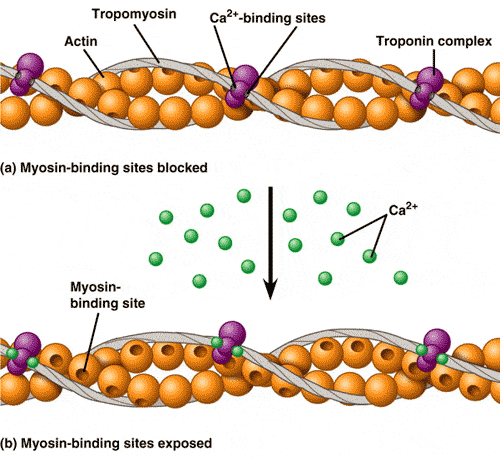
___ and ___ are regulatory proteins bound to actin. 
a)
Troponin and tropomyosin
b)
Myosin and actin
c)
Calcium and Oxygen
d)
Glycogen and hemoglobin
57.

Calcium:

a)

causes ATP binding to actin

b)

increases the action potential along the sarcolemma

c)

binds to proteins which are found on the myosin

d)

enables the binding of myosin to actin

58.
What does the myosin do to the actin?
a)
Nothing
b)
Pulls on it
c)
Pushes on it
d)
Breaks it into pieces
59.
A bundle of muscle fibers is called __________.
a)
Sarcomere
b)
Fascicle
c)
Tendon
d)
Muscle body
60.

List the structures of a muscle from smallest to largest

a)

myofibril, muscle fiber, fascicle, muscle

b)

muscle, fascicle, myofibril, muscle fiber

c)

fascicle, sarcomere, muscle, muscle fiber

d)

myofibril, muscle, fascicle, sarcomere

61.
Ability of muscle to contract, produces movement:
a)
Elasticity
b)
Contractility
c)
Insertion
d)
Torticollis
62.
Which of the following molecules allows your body to store energy?
a)
ATP
b)
Creatine Phosphate
63.
During muscle fatigue levels of lactic acid ________, while levels of ATP _______.
a)
Goes up; goes up
b)
Goes up; goes down
c)
Goes down; goes down
d)
Goes down; goes up
64.
What is a bundle of muscle cells called?
a)
Muscle fiber
b)
Fascicle
c)
Epimysium
d)
Sarcomere
65.
What chemical is released by the SR?
a)
ATP
b)
Sodium
c)
Calcium
d)
Acetylcholine
66.
Which of the following has striations and one nuclei?
a)
Cardiac Muscle
b)
Skeletal Muscle
c)
Smooth Muscle
67.

The I band within a skeletal muscle fiber is indicated by ________.

a)

A

b)

B

c)

C

d)

D

68.

The A band within a myofibril is indicated by ________.

a)

A

b)

B

c)

C

d)

D

69.

The H zone, located within the A band, lacks thin filaments and is represented by ________.

a)

A

b)

B

c)

C

d)

D

70.

The myofilament composed of actin is indicated by ________.

a)

A

b)

B

c)

C

d)

D

71.

The epimysium is represented by ________.

a)

A

b)

B

c)

C

d)

D

72.

The muscle fiber (cell) is indicated by ________.

a)

A

b)

B

c)

C

d)

D

73.

The endomysium that wraps individual muscle fibers is indicated by ________.

a)

A

b)

B

c)

C

d)

D

74.

The plasma membrane of a skeletal muscle cell is called the ________.

a)

sarcolemma

b)

sarcomere

c)

myofilament

d)

sarcoplasm

e)

sarcoplasmic reticulum

75.

Which type of muscle tissue contracts most quickly upon stimulation?

a)

skeletal

b)

visceral

c)

cardiac

d)

smooth