Wayground logo

Free Printable Worksheets

Font size

S
M
L
XL
Worksheets

Compacted Science Semester Review Pt 2

Total questions: 50

Worksheet time: 2hrs 40mins

Name
Class
Date
1.

Which of the following is not a benefit of asexual reproduction?

a)

Offspring will be successful in an unchanged environment.

b)

Good at adapting to changing environments.

c)

Only requires one parent to produce offspring.

d)

Can reproduce rapidly.

2.

An organism that has been reproduced by asexual means receives ______________ of its chromosomes from its one parent.

a)

3

b)

25%

c)

50%

d)

100%

3.

In asexual reproduction, all of the offspring are:

a)

Physically Identical

b)

Genetically Identical

c)

Physically and Genetically Identical

d)

Not Identical

4.

What is the big advantage of sexual reproduction?

a)

Can quickly grow the population

b)

Offspring are guaranteed to be successful in an unchanged environment.

c)

Only one parent is required to reproduce.

d)

Can adapt to changing environments

5.

An organism that has been reproduced by sexual reproduction received ____________ of its chromosomes from the male parent.

a)

4

b)

25%

c)

50%

d)

100%

6.
Both parents in this Punnet square
a)
are homozygous dominant
b)
are homozygous recessive
c)
are heterozygous
d)
have blue eyes
7.
The genotypic ratio here is
a)
25% blue eye 75 % brown eye 
b)
BB = 25% Bb = 50% bb = 25%
c)
BB= 50 % bb = 50%
d)
All brown eye
8.
How many boxes would say BB?
a)
1
b)
2
c)
4
d)
0
9.
The dominant trait is
a)
yellow pea seeds
b)
green pea seeds
c)
there is no dominant seed
d)
Jolly green giant
10.
To express the recessive trait you must be
a)
homozygous dominant
b)
heterozygous
c)
alleleerific
d)
homozygous recessive
11.
What allele combination should go in the missing box?
a)
AA
b)
Aa
c)
aa
d)
none of these
12.
G = green, g = yellow
The genotype for a yellow plant is...
a)
GG
b)
Gg
c)
gg
d)
all of the choices result in yellow
13.
What is a phenotype
a)
The genetic make up (code)
b)
The physical trait
14.

What is a genotype

a)

The genetic make up (code)

b)

The physical trait

15.
Heredity is the passing of traits from _____________________ to _____________________
a)
predators to prey
b)
water to rain
c)
parents to offspring
d)
fungi to protists
16.
Chromosomes are found in the ____________ of the cell
a)
Chloroplast
b)
Nucleus
c)
Cytoplasm
d)
Mitochondria
17.
What is a recessive allele?
a)
A trait that is always shown (capital letter)
b)
A trait that can be hidden (lower case letter)
c)
Alleles that are the same
d)
Alleles that are different
18.
What is a dominant allele?
a)
A trait that is always shown (capital letter)
b)
A trait that can be hidden (lower case letter)
c)
Alleles that are the same
d)
Alleles that are different
19.
This means Same Gene
a)
Dominant
b)
Recessive
c)
Heterozygous
d)
Homozygous
20.
This means Different Gene
a)
Dominant
b)
Recessive
c)
Homozygous
d)
Heterozygous
21.
Movement from one area to another
a)
extinction
b)
hibernation
c)
migration
d)
physical adaptation
22.
An inactive state during which normal body activities slow. 
a)
instinct
b)
camouflage
c)
migration
d)
hibernation
23.
An adaptation that helps an animal hide from predators
a)
migration
b)
camouflage
c)
hibernation
d)
extinction
24.
Cactus have a thick, hard surface (cuticle) that prevent ______________ from evaporating.
a)
Water
b)
Air
c)
Sugar
d)
light
25.
What adaptation most likely helps this bird fly?
a)
A strong beak
b)
Small feet
c)
Hollow bones 
d)
The color of the bird
26.
Xylem is a plant adaptation that allows plants to transport ______________ up the stem.
a)
Salt 
b)
Sugar
c)
Water
d)
Coffee
27.
Some plants such as beets, onions and tulips have physical adaptations that allows them to store energy for the next season. What are these types of roots called?
a)
Dubs
b)
Bulbs
c)
Xylem
d)
Phloem 
28.
A giraffe has a long neck in order to better reach leaves to eat.  This is an example of _____. 
a)
an adaptation
b)
environment
c)
response
d)
stimulus
29.
How do adaptations help animals?
a)
To escape animals
b)
to hunt for food
c)
to survive in their habitats
d)
All of these are correct
30.
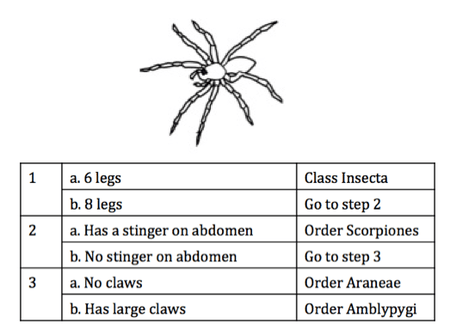
An illustration and a dichotomous key are given. What is the correct classification for this organism?
a)
Class Insecta
b)
Order Amblygygi
c)
Order Araneae
d)
Order Scorpiones
31.
A table of arachnid and insect characteristics is shown. Which characteristic could be used to distinguish between
arachnids and insects?
a)
Jointed legs
b)
Body segments
c)
Presence of eyes
d)
Presence of antennae
32.
A botanist discovers a new plant in the jungle. Which of the
following observations of the plant’s characteristics would be useful in determining its identity with a dichotomous key?
a)
It was discovered in the summertime
b)
It is wet from a recent rain storm.
c)
Its leaves curl up on the edges.
d)
It is eaten by native jungle ants.
33.
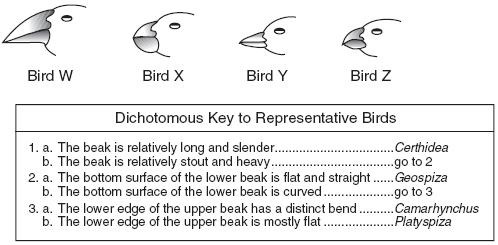
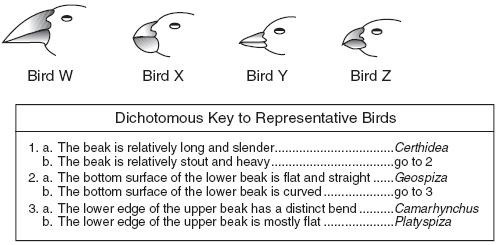
What is the name of bird W?
a)
Certhidea
b)
Geospiza
c)
Camarhynchus
d)
Platyspiza
34.
What is the name of bird Z?
a)
Certhidea
b)
Geospiza
c)
Camarhynchus
d)
Platyspiza
35.

in an experiment, the thing that is being changed is the...

a)

dependent variable

b)

controlled variable

c)

independent variable

d)

constant variable

36.

In a graph, the independent variable is plotted on the horizontal axis (x), and the dependent variable on the vertical axis (y)

a)

True

b)

False

37.

The dependent, or responding, variable is...

a)

what's being changed

b)

what's staying constant

c)

what's being eaten

d)

what's being measured

38.
What is the reading?
a)
20.5 g
b)
222 g
c)
221.5 g
d)
220.1 g
39.
What is the reading?
a)
25 mL
b)
2.4 mL
c)
24 mL
d)
24 g
40.
Which point is D?
a)
5.3 cm
b)
5.3 mm
c)
5 1/2 mm
d)
54 mm
41.
What year had the greatest number of sea otters?
a)
1983
b)
1989
c)
1995
d)
2001
42.
When measuring the mass of sheet of paper which units should be used
a)
kilometer
b)
degrees Celsius
c)
grams
d)
Milliliters
43.
Which question is best testable by an experiment?
a)
How do robots work
b)
Which type of ball will bounce the highest
c)
What is the groups favorite song
d)
Where do kola bears naturally live
44.
a)
There is no control group
b)
Time is the control group
c)
Drinking the juice is the control group
d)
Not drinking the juice is the control group
45.
Mr. McNiece wanted to see how different types of music affected students' pulse rates. She played different types of music: heavy metal, rap, R&B, alternative, pop, country, and classical music. Identify the independent variable.
a)
pulse rate
b)
types of music
c)
classical music resulted in the highest pulse rate
d)
Mr. McNiece
46.
What is the reading?
a)
244 grams
b)
244 mL
c)
240.4 grams
d)
200 ounces
47.
When working in the laboratory, what pieces of safety equipment should a scientist always use?
a)
Fire Blanket and Eye Wash
b)
Goggles and Lab Apron
c)
Fire Extinguisher and Safety Shower
d)
Gloves and Eye Wash
48.
If a laboratory fire erupts, immediately
a)
notify your teacher
b)
run for the fire extinguisher
c)
throw water on the fire
d)
open a window
49.
If you do not understand a direction or part of a lab procedure, you should
a)
figure it out as you do the lab
b)
try several methods until something works
c)
skip it and go to the next part
d)
ask your teacher
50.
You are heating a substance in a test tube. Always point the open end of the tube
a)
towards your body
b)
toward your lab partner
c)
towards another classmate
d)
away from all people