wayground logo

Free Printable Worksheets

Font size

S
M
L
XL
Worksheets

Chapter 9 Plate Tectonics

Total questions: 48

Worksheet time: 1hrs 17mins
Name
Class
Date
1.
Early observers thought continents may have been joined based on what observations
a)
rocks and fossils
b)
earthquakes.
c)
magnetism.
d)
coastline
2.
A German scientist Alfred Wegener was the first to hypothesize that ...........
a)
Continents were once joined
b)
The sea floor is spreading
c)
Continents are moving
d)
The Earth's magnetic pole flips
3.
Evidence used by Wegener to supported his idea of continental drift included
a)
Ocean rocks and sediments
b)
Ocean floor topography
c)
Magnetic isochron patterns
d)
Climatic data
4.
One of the fossils Wegener used to support his hypothesis of continental drift was
a)
Glossopteris
b)
Trilobite
c)
insects in tree amber
d)
ammonite molds
5.
Peer scientists reviewing Wegener’s hypothesis of continental drift rejected his notion because
a)
His evidence was too few to make a valid conclusion 
b)
He did not explain how continents move and what moves them
c)
His evidence was not clear in showing  how continents were joined
d)
He lied by including false evidence
6.
The Himalayan mountains have some of the highest peaks like Mt. Everest, on which type of convergent boundary are they located?
a)
Oceanic/Continental
b)
Oceanic/Oceanic
c)
Continental/Continental
d)
None of the above
7.
What type of features are associated with a divergent boundary?
a)
Rift valleys
b)
Volcanic mountains
c)
Fold mountains
d)
Fault block mountains
8.
The mechanism that moves continents is based on heat energy moving by
a)
Radiation in the core
b)
Conduction in the lithosphere
c)
Convection in the Asthenosphere
d)
None of these options is true
9.
The San Andréa fault in California is one example of a...  
a)
Divergent boundary
b)
Convergent boundary
c)
Transform boundary
d)
All of the above
10.

In sea-floor spreading, molten material rises from the mantle and erupts

a)

along the edges of all the continents.

b)

along mid-ocean ridges.

c)

in deep-ocean trenches.

d)

at the north and south poles.

11.

The process by which the ocean floor sinks beneath a deep-ocean trench and back into the mantle is known as _______

a)

convection.

b)

continental drift.

c)

subduction.

d)

conduction.

12.

Most geologists think that the movement of Earth’s plates is caused by _______

a)

convection.

b)

continental drift.

c)

subduction.

d)

conduction.

13.

The geological theory of _______ states that pieces of Earth’s lithosphere are in constant, slow motion.

a)

subduction

b)

plate tectonics

c)

deep-ocean trenches

d)

sea-floor spreading

14.

A place where two plates slip past each other, moving in opposite directions, is known as a _______

a)

transform boundary

b)

divergent boundary.

c)

convergent boundary.

d)

rift valley.

15.

The place where two plates come together is known as a _______

a)

transform boundary.

b)

divergent boundary.

c)

convergent boundary.

d)

rift valley.

16.

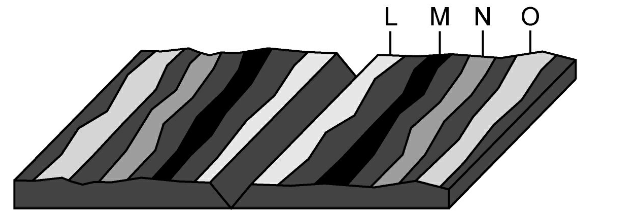
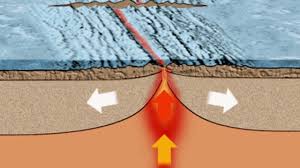
Below is a picture of sea-floor spreading. How are the ocean crusts moving?

a)

Converging

b)

Diverging

c)

Sliding

d)

No movement

17.

The San Andreas Fault in California is known as an active earthquake area. What type of

boundary is it?

a)

Converging

b)

Diverging

c)

Transform

d)

Sea Floor Spreading

18.
Where would the oldest rock be found?
a)
L
b)
M
c)
N
d)
O
19.
What are the two types of crust
a)
continental and oceanic
b)
ocean and upper
c)
lower and upper
d)
pizza and subway
20.
The Himalayas in Asia are an example of what type of plate boundary?
a)
divergent
b)
continent-to-continent convergent
c)
ocean-to-continent convergent
d)
transform
21.
What type of boundary is the SAN ANDREAS FAULT on?
a)
Covergent
b)
Transformers
c)
Divergent
d)
Transform
22.
What is Pangaea?
a)
the name of a German scientist
b)
the name of the super-continent that existed millions of years ago
c)
another name for continental drift
d)
the name of an ancient fossil
23.

What type of event will occur at this boundary?

a)

Earthquake

b)

Volcano Eruption

c)

Tornado

d)

Mountain Building

24.

Which of these events can ONLY happen on a DIVERGENT BOUNDARY?

a)

Rift Valley

b)

Mountain

c)

A peninsula

d)

An Insanely complex, long answer that you will click out of instinct.

25.

The tectonic plates float on the

a)

lithosphere

b)

lower mantle

c)

outer core

d)

asthenosphere

26.

Most geologists rejected Alfred Wegener's idea of continental drift because...

a)

it did not agree with their current theory

b)

Wegener was interested in what Earth was like millions of years ago

c)

Wegener used several different types of evidence to support his hypothesis

d)

Wegener could not identify the force that moved the continents

27.

What occurs when two plates come together and the denser one is forced under back into the mantle?

a)

reduction

b)

conduction

c)

subduction

d)

convection

28.

What geologic process formed the Himalayas?

a)

two continental plates converging

b)

an earthquake in a subduction zone

c)

a tectonic plate moving over a hot spot

d)

movement at a transform fault boundary
29.
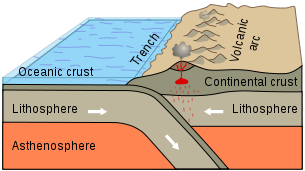
Subduction zones occur on Earth where dense oceanic crust dives under more buoyant continental crust. These boundaries are characterized by a deep ocean trench next to a high continental mountain range, large numbers of earthquakes and volcanoes. All of this is further evidence for the
a)
big bang theory.
b)
theory of plate tectonics.
c)
origin of the species.
d)
theory of natural selection.
30.

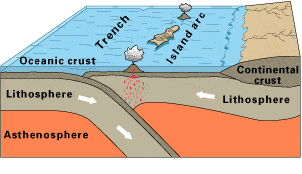
Observe this diagram of a plate boundary. One statement BEST describes what is happening. It is that

a)

the oceanic crust is melting.

b)

the denser ceanic crust is subducting under the less dense oceanic crust

c)

volcanic islands are forming.

d)

the tectonic plates are moving away from each other.
31.
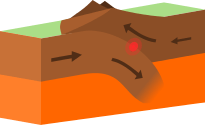
What type of plate boundary is this?
a)
Plate
b)
Divergent
c)
Convergent
d)
Transform
32.
How is it possible for new crust to be formed without increasing the surface area of the Earth?
a)
Crust is destroyed at the same time it is created
b)
New crust is underwater where it sinks
c)
New crust breaks more easily than old crust
33.
Who is the German Scientist that came up with the theory of the Continental Drift? 
a)
Albert Einstein 
b)
Ms. Stukel 
c)
Galileo
d)
Alfred Wegener
34.
What are the three types of Evidence that supports Alfred Wegener's Theory? 
a)
Fossils, Fish, and Land
b)
Sedimentary, Magma, and Climate
c)
Fossils, Land forms, and Climate
d)
Climate, Land forms, and Metamorphic rock 
35.
Where did Wegener find plant fossils that today would not be able to survive on that type of land?
a)
North America
b)
Antarctica
c)
China 
d)
India
36.
When Wegener looked at maps he noticed Africa and South America ____________ lined up. 
a)
Lakes
b)
islands
c)
Hills 
d)
Mountain Ranges 
37.
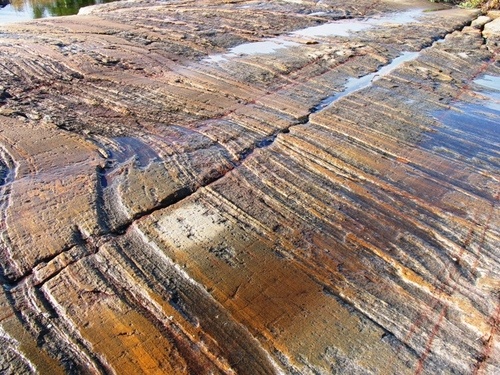
This is a picture of glacier scars found in Africa.  What are these evidence for?
a)
Africa has always been near the equator
b)
Africa was once in an area of the Earth that had a very cold climate
c)
The continents have not moved
d)
sea floor spreading
38.
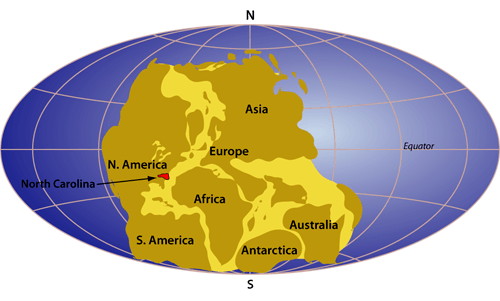
What is this a picture of?
a)
plate tectonics
b)
continental drift
c)
pangea
d)
glacier scaring
39.

What type of evidence was used by Alfred Wegener to support his continental drift hypothesis? (Select 3)

a)

evidence from landforms / geology

b)

evidence from fossils

c)

evidence from human remains

d)

evidence from climate

40.
Who is the scientist who proposed Continental Drift Theory?
a)
Albert Einstein
b)
Alfred Wegener
c)
Isaac Newton
d)
John Dalton
41.
The radiometric dating of an igneous rock provides ____________.
a)
the relative age of the rock
b)
the age of Earth
c)
a date for when the rock formed
d)
a date for when the rock was eroded
42.
What is the most popular hypothesis of the formation of the moon? 
a)
The moon passed very close to the earth and was caught in its gravitational pull.
b)
The moon formed the same time as the earth.
c)
The moon formed when a small planet smashed into the newly formed earth sending debris into space which formed the moon.
43.
Scientist think the Earth is ___ years old.
a)
4,500
b)
45,000
c)
4.5 million
d)
4.5 billion
44.
Meteorites have clues about our planet's past.
a)
true
b)
false
45.

states that younger rock is found above older rock when comparing undisturbed sedimentary rock layers

a)

law of superposition

b)

trace fossil

c)

matter can't be created or destroyed

d)

atoms

46.
Which statement best describes the Law of Superposition?
a)
Each sedimentary layer of rock represents 1,000 years of Earth's age, much like the rings of a tree.
b)
In undisturbed layers of sedimentary rocks, the upper rock layers are older than the lower rock layers.
c)
In undisturbed layers of sedimentary rock, the lowest layers contain the older rocks.
d)
Rocks that form near volcanoes are older than surrounding rock.
47.
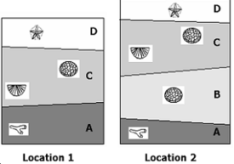
The diagram shows rock layers taken from two different locations that may be far apart from each other.What can be concluded based on the diagram?
a)
Location 1 has terrestrial fossils, and Location 2 has aquatic fossils.
b)
The layers in Location 1 are much older than the layers in Location 2.
c)
The layers in Location 1 are younger than the layers in Location 2.
d)
Layers from both locations with similar fossils are about the same age.
48.

The hypothesis that states the continents once formed a single landmass, broke up, and drifted to their present locations

a)

Subduction

b)

Continental Drift

c)

Plate Tectonics

d)

Pangea