wayground logo

Free Printable Worksheets

NEW

Font size

S
M
L
XL
Worksheets

2019 Final Study Guide: Muscular/Skeletal Systems

Total questions: 55

Worksheet time: 34mins

Name
Class
Date
1.
What attaches bones to other bones at joints?
a)
 Ligaments
b)
 Muscles
c)
Nerve tissue
d)
Tendons
2.
A skeletal muscle is called a(n) ___________ muscle because you can control the way it moves.
a)
 Involuntary
b)
 Voluntary
c)
 Cardiac
d)
Smooth
3.
The muscle that makes up your heart is called __________ muscle.
a)
Smooth
b)
Cardiac
c)
 Skeletal
d)
Voluntary
4.
Muscles are attached to the bones by tissues called _____________.
a)
 Cartilage
b)
Ligaments
c)
Nerve
d)
Tendons
5.
 Which of the following is NOT a job of the skeletal system?
a)
providing shape and support for the body       
b)
 producing oxygen
c)
protecting internal organs
d)
store minerals
6.
The type of involuntary muscle that moves food through the digestive tract is called:
a)
skeletal muscle
b)
 cardiac muscle
c)
smooth muscle
d)
automatic muscle
7.
Which of the following is NOT a function of the muscular system?
a)
To push food through our digestive system
b)
 To allow our heart to beat
c)
To produce blood cells
d)
To allow us to move our arms and legs
8.
Smiling is an action controlled by ____________ muscles, because it is an action that a person can control.
a)
cardiac
b)
voluntary
c)
automatic
d)
smooth
9.
When muscles contract, the length of the muscle
a)
lengthens
b)
extends
c)
shortens
d)
stretches
10.
From which system does the body get the message to move?
a)
Circulatory System
b)
Skeletal System
c)
Muscular System
d)
Nervous System
11.
The first picture of the biceps is showing what types of movement?
a)
Abduction
b)
Adduction
c)
Flexion
d)
Extension
12.
The 3 types of muscles are Cardiac, Smooth & Skeletal. What systems of the body are directly related to smooth muscles?
a)
Skeletal System
b)
Circulatory System
c)
Digestive System
d)
Muscular System
13.
What do tendons attach?
a)
muscles to ligaments
b)
muscles to other muscles
c)
muscles to bones
d)
muscles to organs
14.

Muscles that oppose one another are

a)

synergist

b)

hateful

c)

prime movers

d)

antagonists

15.
Which of the following is defined as the ability of an object to quickly return to the original shape and size?
a)
Elasticity
b)
Excitibility
c)
Flexibility
d)
Extensibility
16.
Which of the following is defined as the ability to change or be changed according to circumstances?
a)
Elasticity
b)
Excitability
c)
Flexibility
d)
Extensibility
17.
Which of the following is NOT a type of muscle?
a)
Rough
b)
Smooth
c)
Cardiac
d)
Skeletal
18.
What are the two classifications of muscles in your body?
a)
Voluntary and Controllable
b)
Flabby and Strong
c)
Involuntary and Voluntary
d)
Hard and soft
19.

______________ is when muscles cannot contract due to injury, or not often used and become weak and shrink.

a)

fracture

b)

dislocation

c)

atrophy

d)

torn ligament

20.

Jenna’s leg has been in a cast for four weeks due to a fracture. Her physician ordered physical therapy after the cast was removed because physical therapy will treat:

a)

muscle atrophy

b)

scoliosis

c)

poor posture

21.
A person who exhibits very large muscles has the condition of 
a)
atrophy
b)
hypertrophy
c)
muscular dysterophy
d)
muscle 
22.

The bones at the end of our fingers and toes are known as _______________.

a)

Tarsals

b)

The phalanges

23.

Examples of a hinge joint are the elbow and knee.

a)

True

b)

False

24.

The cranium, ribs, scapula & pelvis are all classed as short bones.

a)

True

b)

False

25.
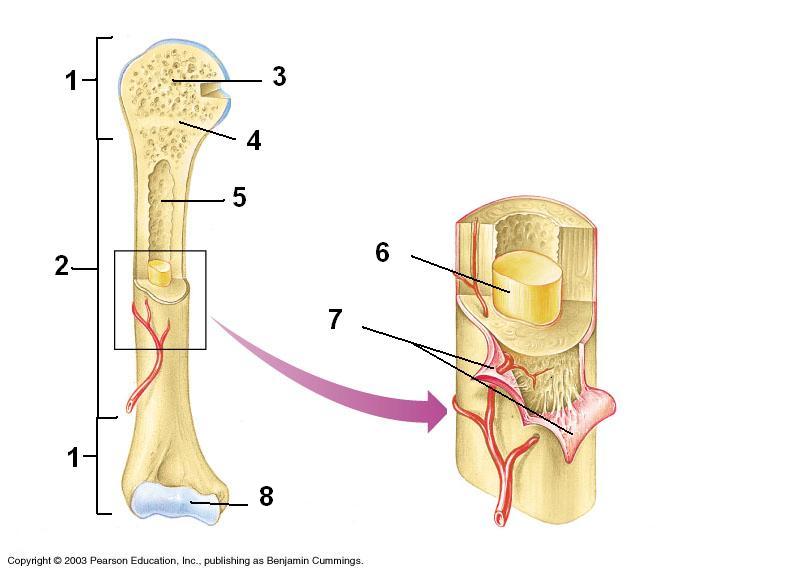
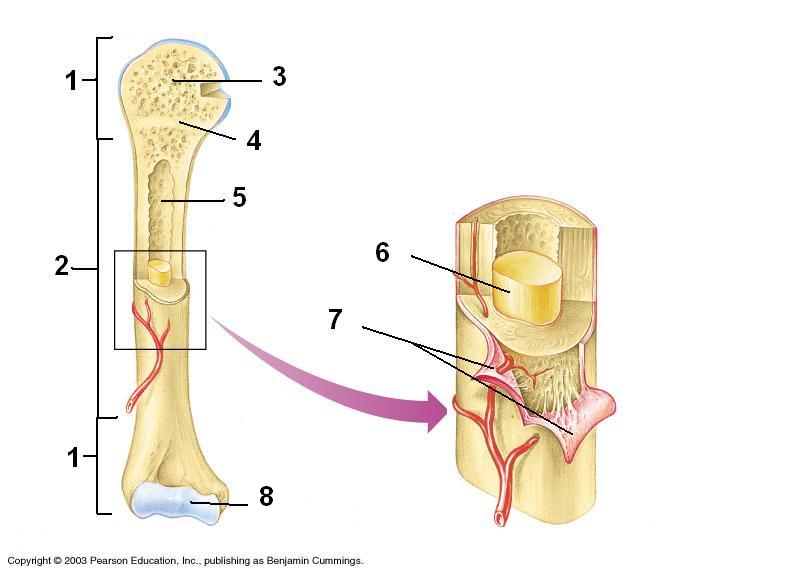
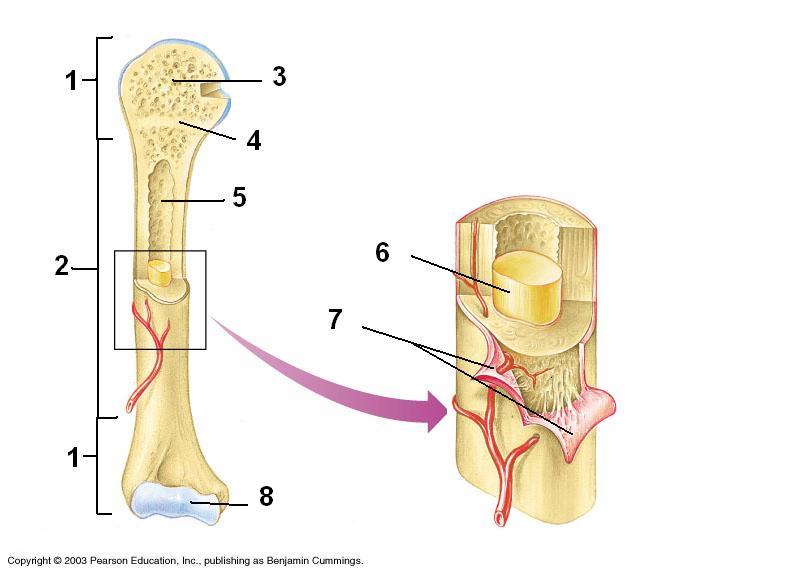
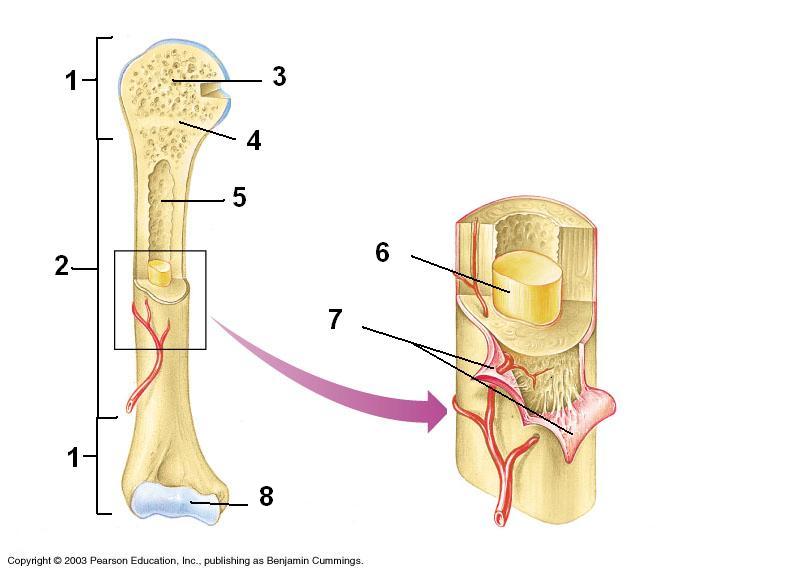
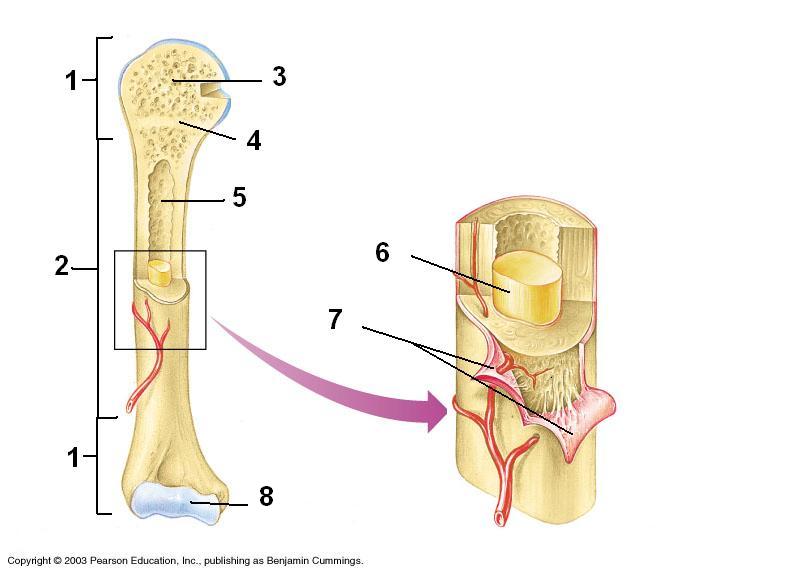
Structure #2 is the 
a)
medullary cavity
b)
periosteum
c)
epiphysis
d)
diaphysis
26.
The shiny white substance at #8 is the 
a)
articular cartilage
b)
periosteum
c)
yellow marrow
d)
diaphysis
27.
Structure #5 is the 
a)
medullary cavity
b)
periosteum
c)
epiphysis
d)
diaphysis
28.
Structure #7 is the 
a)
medullary cavity
b)
periosteum
c)
epiphysis
d)
diaphysis
29.
In adults, the substance at #6 would be 
a)
red marrow
b)
yellow marrow
c)
spongy bone
d)
clotted blood
30.
The epiphysis is 
a)
The shaft of a bone
b)
a bone cell
c)
the end of a long bone
d)
the covering of a bone
31.
Periosteum
a)
the membrane lining the bone cavity
b)
the tough membrane covering the shaft of the bone
c)
the shiny, articulating cartilage on the ends of a bone
d)
the blood vessels inside a bone
32.
Where are blood cells made? 
a)
Yellow marrow 
b)
Red marrow
c)
Spongy Bone 
d)
Periosteum
33.
Spongy bone would primarily be found where in a bone?
a)
diaphysis
b)
epiphysis
c)
periosteum
d)
endosteum
34.
What type of bone makes up the diaphysis?
a)
spongy bone
b)
compact bone
c)
rigid bone
d)
soft bone
35.
The shaft of the bone is also called the
a)
epiphysis
b)
diaphysis
c)
endosteum
d)
periosteum
36.
Myasthenia Gravis is...?
a)
A rare condition caused by the toxins of the Clostridium botulinum bacteria
b)
A crippling, and potentially deadly, infectious disease caused by the poliovirus.
c)
An autoimmune disorder that causes weakness of the voluntary muscles.
d)
A bacterial disease that affects the muscles and nerves.
37.
This disease is caused by antibodies blocking the muscle cells from receiving neurotransmitters from the nerve cells. 
a)
botulism
b)
polio
c)
myasthenia gravis
d)
tetanus
38.
This disease is a genetic X-linked disorder that results in the absence of the dystrophin protein.  Affected males have progressive muscle atrophy and significantly decreased lifespans.
a)
Trichinosis
b)
Fibromyalgia
c)
Duchenne Muscular Dystropy
39.

what type of fracture is this

a)

closed/simple

b)

greenstick

c)

compound

d)

comminuted

40.

what type of fracture is this

a)

closed/simple

b)

greenstick

c)

compound

d)

comminuted

41.

what type of fracture is this

a)

closed/simple

b)

greenstick

c)

compound

d)

comminuted

42.

what type of fracture is this

a)

closed/simple

b)

greenstick

c)

compound

d)

comminuted

43.

Muscular Dystrophy

a)

The lack of voluntary control of muscle movement.

b)

Decrease in size of normal developed muscle tissue

c)

Defective growth of the muscles and skeletal system

d)

Muscle disorder caused by the lack of acetylcholine

e)

extremely sleepy, weak and lack energy

44.

contraction

a)

Tightening of muscles

b)

Lessening of tension

c)

Muscles that move together to produce a movement

d)

Muscle that move or work against each other.

45.

Synergists

a)

Tightening of muscles

b)

Lessening of tension

c)

Muscles that move together to produce a movement

d)

Muscle that move or work against each other.

46.

Antagonistic

a)

Tightening of muscles

b)

Lessening of tension

c)

Muscles that move together to produce a movement

d)

Muscle that move or work against each other.

47.

The disorder the causes widespread pain in the muscles and skeletal system and causes fatigue, not thought to be caused by inflammation.

a)

fibromylagia

b)

dystonia

c)

myositis

d)

myasthenia gravis

48.
stretch or tear in the ligament
a)
sprain
b)
straom
c)
tetanus
d)
cramp
49.
Medial tibial stress syndrome
a)
shin splints
b)
sprain
c)
strain
d)
cramp
50.
When a ligament that connects bones to a bone is wrenched or torn.
a)
Chondrom
b)
Hallux vagus
c)
Rheumatica
d)
Sprain
51.
An inflammation of the bursa around joint.
a)
Bursitis
b)
Arthrosclerosis
c)
Chondroma
d)
Synovitis
52.
The total displacement of a bone from its joint.
a)
Sublaxation
b)
Fracture
c)
Sprain
d)
Dislocation
53.
Wear and tear arthritis, most commonly associated with aging
a)
Gouty Arthritis
b)
Osteoarthritis
c)
Rheumatica
d)
Osteoporosis
54.
Commonly known as a chronic autoimmune disorder in which the joints and some organs are attacked, joints become swollen, painful and immobile.
a)
Osteoarthritis
b)
Osteoporosis
c)
Gouty Arthritis
d)
Rheumatoid Arthritis
55.

A muscular disorder in which a deep bruise calcifies and turns into bone.

a)

myositis ossificans

b)

muscular dystrophy

c)

myasthenia gravis

d)

muscle fracture