wayground logo

Free Printable Worksheets

Font size

S
M
L
XL
Worksheets

weather and climate

Total questions: 112

Worksheet time: 2hrs 56mins

Name
Class
Date
1.
The average temperature in Atlanta in June is 25o C, but the average temperature in December is 7o C. Why is the average temperature in Atlanta higher in June than in December?
a)
The Sun is hotter during June than it is during December.
b)
Earth is closer to the Sun in June than it is during December.
c)
Earth's axis is tilted so that Atlanta gets more direct sunlight in June than in December.
d)
The atmosphere in Atlanta absorbs more heat from sunlight in June than in December.
2.
Which statement describes why the Earth has seasons?
a)
Its axis is titled as it revolves around the sun.
b)
The distance changes as it revolves around the sun.
c)
The moon revolves around it.
d)
The sun's axis is tilted.
3.
An air mass forms over the Gulf of Mexico and moves northeast across Georgia. What weather conditions are likely to prevail in Georgia?
a)
cool and dry
b)
cool and humid
c)
warm and dry
d)
warm and humid
4.
Which is the warmest climate zone?
a)
Arctic Zone
b)
Temperate Zone
c)
Tropical Zone
d)
Intermediate Zone
5.
Cold air masses that form at high latitudes are called
a)
polar air masses.
b)
continental air masses.
c)
warm air masses.
d)
maritime air masses.
6.
At the seashore late in the afternoon on a hot, sunny day, a person often feels a strong breeze coming in from the ocean. Which of the following is the reason for the breeze?
a)
The pounding waves generate air currents.
b)
The warm air over the ocean rushes in to replace the cool air that rises over the land.
c)
The heavy, cool air over the ocean rushes in to replace the warm air that rises over the land.
d)
There are no clouds to block the wind coming in from the ocean.
7.
Most water vapor in the atmosphere comes from 
a)
evaporation from oceans.
b)
evaporation from soil.
c)
transpiration from plants.
d)
the burning of fossil fuels. 
8.
Which of the following is typical of a tropical climate?
a)
cold, dry air
b)
cool, moist air
c)
hot, dry air
d)
warm, moist air
9.
Yvette was looking at a map that showed where hurricanes had formed. She noticed that more hurricanes formed over tropical oceans than over colder ocean areas. Which of these BEST explains why more hurricanes form over tropical oceans than cold oceans?
a)
Air has less moisture over tropical oceans than over cold oceans.
b)
Air has more moisture over tropical oceans than over cold oceans.
c)
Water has more waves in tropical oceans than in colder oceans.
d)
Water has fewer currents in tropical oceans than in colder oceans.
10.
While visiting the beach during summer vacation, a sea breeze keeps you cool and comfortable during the hottest part of the day. Which BEST explains why this happens?
a)
warm air rising over land allows cooler air from the ocean to blow inland
b)
cool air rising over land allows warm air from the ocean to blow inland
c)
there are similarities in temperature between the land and the water
d)
a storm is approaching
11.
At the beach, the water and sand are not absorbing and losing heat equally. Which is MOST LIKELY to occur?
a)
rain
b)
snow
c)
wind
d)
humidity
12.
Warm air rising at the equator and cold air sinking at the poles is one reason for which event?
a)
hurricanes 
b)
Coriolis force
c)
earth's rotation
d)
convection currents
13.
Which of these BEST explains the reason that thunderstorms are likely to form on a hot day?
a)
Warm, humid air rises quickly and then cools.
b)
As air slowly rises it loses humidity and cause rain.
c)
The air is usually calm and allows the clouds to form.
d)
The air rises quickly and form low-level cloud layers. 
14.

This front can cause tornadoes when a warm air mass collides with a cold air mass and is quickly forced upward.

a)

occluded front

b)

stationary front

c)

warm front

d)

cold front

15.
This front occurs when a warm air mass meets a cold air mass and stops.
a)
occluded front
b)
warm front
c)
stationary front
d)
cold front
16.
This front occurs when 3 air masses meet up forcing the warm air upward.
a)
occluded front
b)
stationary front
c)
warm front
d)
cold front
17.
Which air mass is forced upward at a front?
a)
cold air mass
b)
warm air mass
18.
The average yearly weather pattern over many years.
a)
weather
b)
air pressure
c)
climate
d)
zone
19.
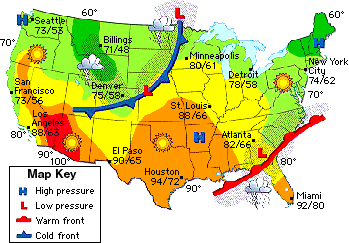
What will the weather be in a couple of days in Minneapolis?
a)
sunny and warmer
b)
sunny and colder
c)
rainy and warmer
d)
rainy and colder
20.
What front is occurring between Denver and St. Louis?
a)
occluded front
b)
warm front
c)
cold front
d)
stationary front
21.
Where would you expect to see nice weather?
a)
low pressure area
b)
high pressure area
22.
In what city is there rain?
a)
Detroit 
b)
Denver
c)
Houston
d)
St. Louis
23.
What is happening in our atmosphere at a certain time and place.
a)
weather 
b)
front
c)
climate
d)
zone
24.

Weather travels across the U.S. in what direction?

a)

north to south

b)

south to north

c)

west to east

d)

east to west

25.
A force applied by the weight of air
a)
cold front
b)
air pressure
c)
barometer
d)
humidity
26.
the amount of water vapor in the air
a)
warm front
b)
precipitation
c)
humidity
d)
air pressure
27.
An instrument used to measure how hot or cold something is
a)
barometer
b)
thermometer
c)
wind sock
d)
rain guage
28.
An instrument that measures air pressure
a)
thermometer
b)
barometer
c)
rain guage
d)
wind sock
29.
Which of these can be used to describe the condition of the atmosphere
a)
temperature
b)
cloud cover
c)
wind speed
d)
All of these
30.
The location where warm air mass is replacing a cooler air mass
a)
cold front
b)
warm front
c)
icy front
d)
storm front
31.
The location where cold air mass is replacing a warm air mass
a)
storm front
b)
hot front
c)
warm front
d)
cold front
32.

The kinds of data that reflect climate are different from the conditions described in weather data. Which of the following is a description of climate?

a)

Today it is hot and sunny in Phoenix, Arizona.

b)

Summers are usually mild in Lansing, Michigan.

c)

Last week it rained every day in San Antonio, Texas.

d)

Yesterday was cold and windy in Anchorage, Alaska.

33.

If a person is describing the daily changes in temperature and precipitation, they are referring to an area's —

a)

Geology

b)

Climate

c)

Geography

d)

Weather

34.

Weather data is different than climate data. Which of the following is an example of weather data?

a)

The average high temperature in May is 21°C in the Midwest of the United States

b)

Central Australia usually receives less than 110 mm of rainfall all year

c)

The relative humidity was 24% at noon on July 23 in Tempe, Arizona

d)

On average, there is 88mm of rain in the Gulf Coast region in July

35.

Students measured the rainfall outside their classroom for five days and recorded their observations. The greatest increase in the amount of rainfall was between -

a)

June 12 and June 13

b)

June 11 and June 12

c)

June 10 and June 11

d)

June 13 and June 14

36.

What question could students answer after reading this map?

a)

What is the temperature in Alaska?

b)

What is the climate for the majority of the U.S.?

c)

What is the difference in population of the Northern hemisphere compared to the Southern hemisphere?

d)

Which city has the most rainfall for the month of September?

37.
_______ affects weather because the further north or south you go from the Equator, the less solar energy (heat).
a)
altitude
b)
latitude
c)
sunlight
d)
atmosphere
38.
Large body of air with the same temperature, pressure, and moisture characteristics is called?
a)
warm front
b)
cold front
c)
air mass
d)
jet stream
39.
______ affects weather and climate because it heats the Earth unevenly.
a)
latitude
b)
altitude
c)
atmosphere
d)
sunlight
40.
The boundary between two air masses that meet is called?
a)
front
b)
back
c)
side
d)
air mass
41.
The layer of the atmosphere where weather occurs is the _.
a)
thermosphere
b)
stratosphere
c)
mesosphere
d)
troposphere
42.
The result of the weight of a column of air pushing down on an area is called _.
a)
altitude
b)
pressure
c)
density
d)
air pressure
43.
What are the two main factors that determine the climate of an area?
a)
precipitation and humidity
b)
temperature and air pressure
c)
wind conditions and humidity
d)
temperature and precipitation
44.
The biggest factor in determining climate is?
a)
elevation
b)
an ocean
c)
latitude
d)
mountain
45.
What is the measure of distance in degrees north and south from the equator?
a)
latitude
b)
longitude
c)
elevation
d)
topography
46.
_____ climate is described as cold all year long and located in high latitudes.
a)
Polar
b)
Continental
c)
Dry
d)
Highland
47.
_______ climate is described as hot and wet, and is located in low latitudes.
a)
Tropical
b)
Dry
c)
Continental
d)
Moderate
48.
Which observation describes a change in climate rather than a change in weather?
a)
The thunderstorm dropped about three centimeters of rain today.
b)
The average summer temperatures have increased over the last ten years.
c)
 The snowfall in this area was more this week than it was last week.
d)
The average wind speed in April was less than it was in March.
49.
Two major factors used to identify climate are?
a)
longitude and latitude
b)
temperature and precipitation
c)
lattitude and temperature
d)
layers in the atmosphere
50.
This is the symbol for a... 
a)
Cold Front
b)
Warm Front
c)
Stationary Front
d)
Occluded Front 
51.
This is the symbol for a... 
a)
Occluded Front
b)
Stationary Front
c)
Warm Front
d)
Cold Front 
52.
Identify the type of front that is shown in the image.
a)
Occluded Front
b)
Cold Front
c)
Stationary Front
d)
Warm Front
53.
Identify the type of front that is shown in the image.
a)
Occluded Front
b)
Cold Front
c)
Stationary Front
d)
Warm Front
54.
Identify the type of front that is shown in the image.
a)
Occluded Front 
b)
Cold Front
c)
Stationary Front
d)
Warm Front
55.
Located at the leading edge of a temperature drop off. Bring heavy thunderstorms, rain, and hail. Cool, fair weather is likely to follow.  
a)
Warm Front
b)
Cold Front
c)
Occluded Front
d)
Stationary Front 
56.
Located at the leading edge of a warm air mass. Brings gentle rain or light snow, followed by warmer, milder weather.  
a)
Warm Front
b)
Cold Front 
c)
Occluded Front 
d)
Stationary Front 
57.
a)
Low Clouds
b)
Low Temperatures
c)
Light Wind
d)
Low Air Pressure
58.
a)
High Air Pressure
b)
High Temperatures
c)
Heavy Rain
d)
Hail
59.
High Pressure is associated with this type of weather...
a)
Cloudy/Overcast Weather
b)
Cold Weather
c)
Warm Weather
d)
Fair Weather
60.
Low Pressure is associated with this type of weather...
a)
Cloudy/Overcast Weather
b)
Cold Weather
c)
Warm Weather
d)
Fair Weather
61.
Our weather generally moves in this direction...
a)
West to East
b)
East to West
c)
North to South
d)
South to North
62.
A cold front moving into an area can bring this type of weather...
a)
Warmer Temperatures, Clear Skies
b)
Colder Temperatures, Clear Skies
c)
Warmer Temperatures, Clouds
d)
Colder Temperatures, Clouds, and Precipitation
63.
A warm front moving into an area can bring this type of weather...
a)
Warmer Temperatures, Clear Skies
b)
Colder Temperatures, Clear Skies
c)
Warmer Temperatures, Clouds, and steady precipitation
d)
Colder Temperatures, Clouds, and Precipitation
64.
Trade winds generally blow in this direction...
a)
West to East
b)
East to West
c)
North to South
d)
South to North
65.
How does a jet stream change from summer to winter in the United States?
a)
It travels slower and rises in elevation
b)
It travels slower and dips down farther south
c)
It travels faster and dips down farther south
d)
It travels faster and moves farther north
66.
This weather tool measures wind speed and direction
a)
thermometer
b)
barometer
c)
anemometer
d)
psychrometer
67.
Which type of cloud is most often observed during a thunderstorm?
a)
cirrus
b)
stratus
c)
cumulus
d)
cumulonimbus
68.
The amount of water vapor present in the air is called ________________.
a)
weather
b)
humidity
c)
air mass
d)
dew point
69.
Air pressure is greatest:
a)
closer to Earth
b)
farther from Earth
70.
What causes warm air to rise?
a)
the fact that it's less dense than cold air 
b)
The fact that it weighs more than cold air 
c)
The fact that it has higher pressure than cold
d)
the fact that its more dense than cold air 
71.
The picture represents the symbol for a _______________________Front.
a)
Cold
b)
Warm
c)
Occluded
d)
Stationary
72.
A cold front is approaching Minneapolis. What will happen to the air temperature?
a)
stay the same
b)
increase
c)
decrease
73.
Clouds form during this phase of the water cycle because water vapor cools and changes back to water droplets.
a)
Evaporation
b)
Precipitation
c)
Condensation
d)
Run Off
74.
Water Vapor rises from the Earth's surface during this phase of the water cycle.
a)
Condensation
b)
Evaporation
c)
Precipitation
d)
Run Off
75.
Stratus clouds look like
a)
thin, wispy featherlike
b)
puffy and white
c)
layers of blankets low to the Earth
76.
These clouds are puffy white clouds with flat bottoms.
a)
Cirrus
b)
Cumulus
c)
Stratus
77.
A low pressure system is located over Georgia. What type of weather will they have?
a)
clear, sunny skies
b)
cloudy and rainy
78.
A high pressure system is located north of New York City. What type of weather will be experienced there?
a)
clear, sunny skies
b)
cloudy and rainy
79.
what are isobars?
a)
lines connecting places of equal temperature
b)
lines drawn connecting places of equal pressure
c)
lines drawn to places of different temperatures
d)
lines drawn to places of different pressures
80.

The movement in the air caused by differences in air pressure ?

a)

Rain

b)

Wind

c)

Air

81.

_______ pressure systems are characterized by sinking air.

a)

High

b)

Low

82.

_______ pressure systems are characterized by rising air.

a)

High

b)

Low

83.

_______ pressure systems are characterized by fair weather.

a)

High

b)

Low

84.

_______ pressure systems are characterized by cloudy, rainy weather.

a)

High

b)

Low

85.

This is when the rotation of the Earth deflects the direction of the wind.

a)

convergent effect

b)

marginal effect

c)

Coriolis effect

d)

Mariolis effect

86.
The main reason land and sea breezes exist is because: 
a)
the earth revolves around the sun
b)
the earth is tilted on an axis
c)
of the temperature difference between land and water
d)
of global warming
87.
What direction is the cold front moving?
a)
Northwest
b)
Southeast
c)
Northeast
d)
Southwest
88.

The _____________ the isobars on a map are to/from one another the ___________ the wind.

a)

closer, slower

b)

closer, faster

c)

farther, faster

89.

Why do you see precipitation near the L? (select 2 answers)

a)

because that is low pressure and that is where air rises, forming clouds

b)

because that is where air is falling and it brings rain with it

c)

because southern Ohio is always rainy this time of year

d)

because the cold front is meeting the warm front which forces warm air to rise rapidly forming clouds

90.

You would expect to see clouds forming and possible precipitation

a)

in Utah (the H)

b)

in Florida

c)

in Nebraska (between the H and the L)

d)

in Indiana

91.

When a cold front moves in

a)

it forces warm air to rise rapidly creating big clouds and likely rain

b)

it pushes against warm air and becomes a stationary front

c)

the cold air goes above the warm air causing a clear sky

d)

it forms a wedge and the warm air slowly rises and may form small clouds

92.
The process by which energy is transferred from a warmer object to a cooler object by means of physical contact
a)
Thermal Energy
b)
Convection
c)
Radiation
d)
Conduction
93.
Energy that travels across distances in the form of electromagnetic waves. 
a)
Convection
b)
Radiation
c)
Conduction
d)
Induction
94.
Conduction is heat transfer by -
a)
Touch
b)
Circles
c)
Waves
95.

A hot air balloon rising is an example of ...

a)

conduction

b)

convection

c)

radiation

d)

connection

96.

Heating a kettle on a hot stove (burner)

a)

convection

b)

conduction

c)

radiation

d)

connection

97.

Warming up near a campfire is an example of ...

a)

conduction

b)

convection

c)

radiation

d)

connection

98.
motion in a gas (as air) or a liquid in which the warmer portions rise and the colder portions sink.
a)
Radiation
b)
Thermal Energy
c)
Weather
d)
Convection
99.
Any type of liquid or solid water that falls to Earth surface, such as rain, snow or hail. 
a)
Heat
b)
Precipitation
c)
Weather
d)
Wind
100.

The top floor of your house always seem to have a higher temperature than the 1st floor. What heat transfer method is responsible for this process?

a)

radiation

b)

convection

c)

conduction

d)

condensation

101.

When barometric pressure is rising, what type of weather can usually be expected?

a)

strong thunderstorms and hail

b)

tornadoes

c)

fair weather

d)

severe weather with storms

102.

The stir crazy warms up the popcorn kernels through the direct contact with the hot plate, what type of heat transfer is responsible for this process?

a)

radiation

b)

convection

c)

conduction

d)

condensation

103.

Land breezes flow from ____ to ____.

a)

east; west

b)

land; water

c)

clouds; jet

d)

water; land

104.

Sea breezes take place during the day because warmer land temperature results in a warmer air mass above the land compared to the cooler air mass over the surface of water.

a)

true

b)

false

105.

What type of air mass would form over the warm waters of the southern Atlantic Ocean?

a)

Maritime polar (mP)

b)

Maritime tropical (mT)

c)

Continental polar (cP)

d)

Continental tropical (cT)

106.

Cold fronts bring _____ temperatures and ______ conditions.

a)

warm; fair

b)

cool; fair

c)

warm; stormy

d)

cool; stormy

107.

What type of conditions are associated with low pressure systems?

a)

cloudy, rainy, or stormy conditions

b)

fair skies with no chance of precipitation

108.

A warm front usually brings what type of weather conditions?

a)

cold temperatures with stormy conditions

b)

warmer temperatures with a slight chance of precipitation

c)

cooler weather all day

d)

warmer temperatures with strong storms

109.

The sea has a higher heat capacity than land.

a)

true

b)

false

110.
What kind of heat transfer happens when the sun is heating your body?
a)
Conduction
b)
Radiation
c)
Convection
d)
Density
111.
Warm air is __________ dense than cold air and rises creating convection currents.
a)
more
b)
less
112.
Transfer of thermal energy through "space"
a)
conduction
b)
convection
c)
radiation