wayground logo

Free Printable Worksheets

Font size

S
M
L
XL
Worksheets

Phys Sci - Midterm REVIEW - Energy, Heat, Waves

Total questions: 120

Worksheet time: 3hrs 59mins

Name
Class
Date
1.

What is energy?

a)

moving energy

b)

stored energy

c)

renewable energy

d)

The ability to do work.

2.

What is potential energy?

a)

moving energy

b)

stored energy

c)

renewable energy

d)

non renewable energy

3.

What is kinetic energy?

a)

moving energy

b)

potential energy

c)

stored energy

d)

renewable energy

4.

What is NOT a renewable energy source?

a)

coal

b)

wind

c)

solar

d)

water

5.

Which of these things is an example of potential energy?

a)

a car motor

b)

firewood

c)

battery

d)

a fan

6.
What kind of energy is represented in this picture?
a)
Thermal
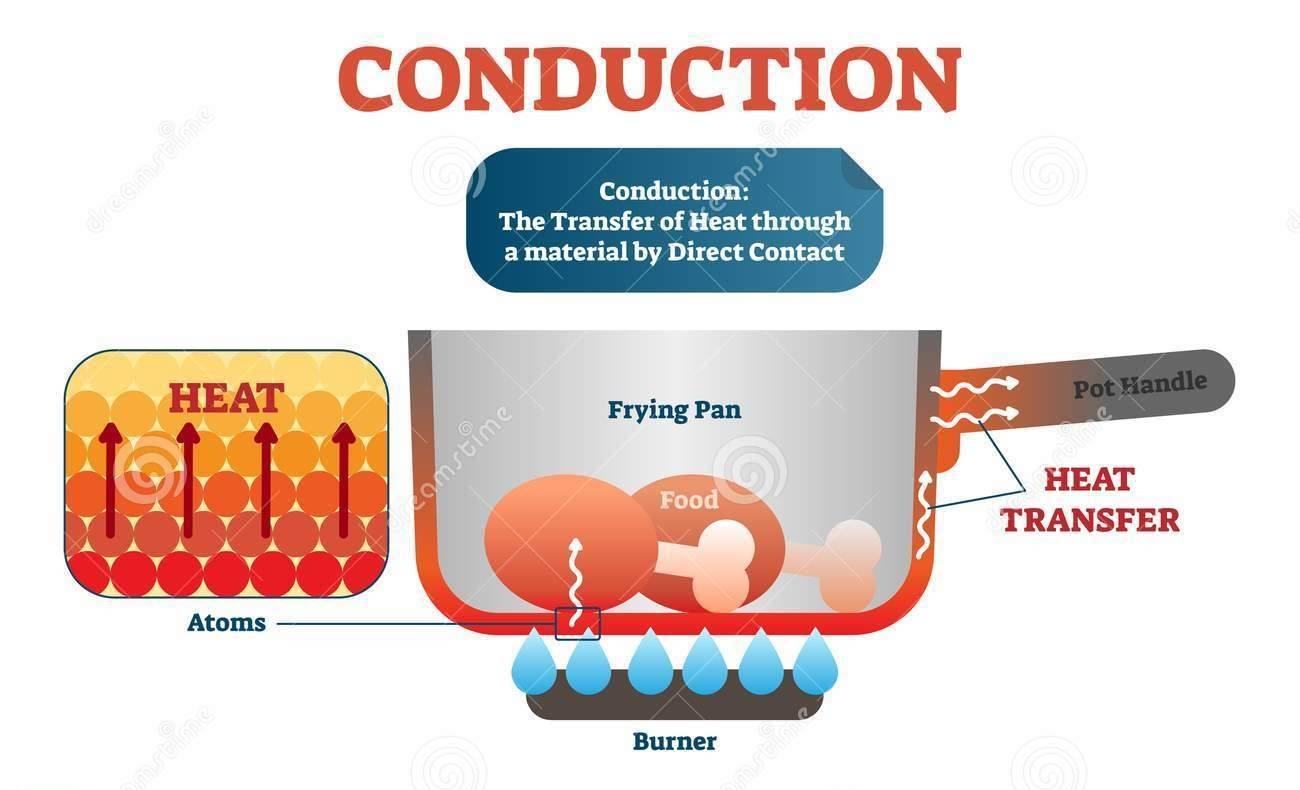
b)
Potential
c)
Nuclear
d)
Mechanical
7.
What kind of energy does this device use?
a)
Chemical
b)
Electrical
c)
Thermal
d)
Chemical
8.
On a roller coaster, where is maximum potential energy?
a)
At the bottom of a big hill
b)
When going around a corner
c)
When going upside down
d)
At the top of a big hill
9.
On a roller coaster, where is maximum kinetic energy?
a)
At the bottom of a big hill
b)
When going around a corner
c)
When going upside down
d)
At the top of a big hill
10.
Energy that is stored in bonds between atoms is:
a)
Mechanical energy
b)
Chemical energy
c)
Kinetic energy
d)
Nuclear energy
11.
Energy that comes from the nucleus of an atom. A form of potential energy.
a)
chemical energy
b)
Nuclear energy
c)
Sound energy
d)
Electrical energy
12.
According to which law of energy, energy can't be created or destroyed?
a)
First law of motion
b)
The law of tacos
c)
Laws of Energy
d)
law of conservation of energy
13.
Heat energy is also called
a)
electrical energy
b)
chemical energy
c)
light energy
d)
thermal energy
14.
Sound energy needs a
a)
medium
b)
vacuum
c)
chemical
d)
light
15.
What type of energy includes both kinetic and potential energy?
a)
mechanical energy
b)
chemical energy
c)
heat energy
d)
sound energy
16.
Stored energy is called ______ energy.
a)
Kinetic
b)
Potential
c)
Pacific
d)
Safe
17.

Potential energy depends on ____________ & ______________.

a)

mass, speed

b)

mass, position

c)

speed, position

d)

mass, weight

18.

Kinetic energy depends on _____________ & _____________.

a)

mass, speed

b)

mass, position

c)

mass, weight

d)

speed, distance

19.

When energy changes from one form to another, we call it a _______________.

a)

transformation

b)

creation

c)

expiration

d)

compilation

20.
The faster an object moves, the ________ kinetic energy it has. 
a)
more
b)
less
c)
none of the above
d)
all of the above 
21.
Elastic potential energy is the ability to stretch or _________
a)
pull
b)
straighten
c)
compress
d)
stretch
22.
What kind of energy is in a rock at the edge of a cliff?
a)
Potential
b)
Kinetic
c)
both
d)
neither
23.
Which is the best example that something has kinetic energy?
a)
a. a car parked on a steep hill 
b)
b. a tennis ball rolling across the court
c)
c. a picture hanging on the wall 
d)
d. a piece of coal before it's burned 
24.
Which point has the most potential energy?
a)
D
b)
F
c)
B
d)
A
25.
Which point has the greatest kinetic energy?
a)
W
b)
X
c)
Y
d)
Z
26.
What is happening to the energy of the girl from point A to point B
a)
kinetic changes to potential
b)
potential changes to kinetic
c)
energy is lost
d)
energy is gained
27.
Why won't the roller coaster reach over the second hill?
a)
because it is going slow
b)
because energy cannot be created
c)
because it is going fast
d)
because energy cannot be destroyed
28.
Why can't the skater reach the same point where he was released when he goes up the other side of the ramp?
a)
because he is heavy
b)
because his mass is slowing him down
c)
because he gets tired
d)
because friction is slowing him down
29.
Which has the greatest gravitational potential energy?
a)
a minicooper
b)
a semi truck
c)
a human
d)
a baby
30.
Which point has greatest kinetic energy?
a)
A
b)
B
c)
C
d)
none
31.
When a pendulum swings, at which point is potential energy at its greatest? (assume there is no friction)
a)
1 and 5
b)
2 and 4
c)
d)
4 and 5
32.

units for work are

a)

newtons

b)

joules

c)

meters

d)

seconds

33.

units of force are

a)

newtons

b)

grams

c)

joules

d)

meters

34.

if you push a cart with a force of 60 N for 2 m... how much work have you done

a)

120 J

b)

30 J

c)

120 N

d)

30 N

35.
Which of the following would produce the most power?
a)
A mass of 10 kilograms lifted 10 meters in 10 seconds 
b)
A mass of 10 kilograms lifted 10 meters in 5 seconds
c)
A mass of 5 kilograms lifted 10 meters in 5 seconds
d)
A mass of 5 kilograms lifted 5 meters in 10 seconds
36.

The faster an object moves, the ________ kinetic energy it has.

a)

more

b)

less

37.

What is an advantage of producing electricity through hydropower?

a)

land is flooded when dams are built

b)

Hydropower is a clean, renewable source of energy for human use

c)

building dams destroys animal habitats

d)

building dams for hydropower uses up lots of land space

38.

Energy is the ability to cause _________.

a)

change

b)

problems

c)

channels

d)

solutions

39.

Energy is measured in _________.

a)

joules

b)

kilometers

c)

newtons

d)

meters per second

40.

__________ energy travels from the Sun to Earth and is transformed into chemical energy by plants.

a)

Chemical

b)

Solar

c)

Mechanical

d)

Kinetic

41.

As mass decreases, kinetic energy ________.

a)

decreases

b)

increases

c)

stays the same

d)

is not related

42.

Lowering an object __________ its potential energy.

a)

decreases

b)

increases

c)

does not change

d)

doubles

43.

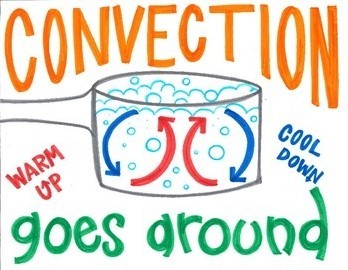
Think about a pan of water sitting on an electric stove. The stove is then turned on to high.

How is heat transferred from the stove to the pan?

a)

conduction

b)

convection

c)

radiation

d)

temperature

44.

Sam placed a glass of water in the refrigerator. After about an hour he took it out and found it to be colder.

What is the most likely thing that happened?

a)

the cold that was in the refrigerator transferred into the water

b)

the particles in the water started to move faster

c)

the cold from the refrigerator radiated into the glass

d)

the heat that was in the water transferred out into the refrigerator

45.

What is the scientific definition of temperature?

a)

Temperature is how hot or cold something is

b)

Temperature in Celsius

c)

Temperature in Fahrenheit

d)

Temperature is the speed of the molecules in an object

46.

Which material would make the best insulator?

a)

rubber

b)

steel

c)

copper

d)

aluminum

47.

Suppose that you are at the beach.

Energy from the Sun reaches you mainly through

a)

conduction

b)

convection

c)

radiation

d)

temperature

48.

We know that wind is energy because wind. . .

a)

is able to work

b)

is a convection current

c)

is caused by uneven heating

d)

is caused by convection

49.

Which material would make the best conductor?

a)

rubber

b)

steel

c)

copper

d)

aluminum

50.

A pan of water is sitting outside during a hot sunny day.

The temperature of the water goes up because heat was transferred to the water by _________________.

a)

radiation

b)

convection

c)

conduction

d)

reflection

51.

Water currents can transfer heat by

a)

conduction

b)

convection

c)

radiation

d)

temperature

52.

Two objects are touching.

How is heat transferred from one object to the other?

a)

conduction

b)

convection

c)

radiation

d)

reflection

53.

George touches a metal spoon is in a hot bowl of soup. It burns his hand.

This is an example of heat transfer by:

a)

convection

b)

radiation

c)

conduction

d)

temperature transfer

54.

What type of energy is heat energy?

a)

potential

b)

kinectic

c)

chemical

d)

mechanical

55.

Most of the energy we use on Earth originally came from _____________________.

a)

the center of the Earth

b)

the equator

c)

the sun

d)

the moon

56.

The Law of __________________ states that energy cannot be created or destroyed, but only changed from one form to another.

a)

Energy Production

b)

First Energy

c)

Conservation of Resources

d)

Conservation of Energy

57.

A boy sits to the side of a campfire. He is 4 feet away, but still feels warm.

What type of heat transfer is the boy experiencing?

a)

conduction

b)

convection

c)

radiation

d)

reflection

58.

Heat energy moves from a __________________ object to a _________________ object.

a)

warmer, cooler

b)

cooler, warmer

c)

bigger, smaller

d)

smaller, bigger

59.

Global winds flow from east to west and west to east. This is an example of ______________.

a)

conduction

b)

convection

c)

radiation

d)

atmosphere

60.
We measure ______ with Celsius or Fahrenheit degrees.
a)
Temperature
b)
Thermometer
c)
Barometer
61.
Heat moves easily through materials called?
a)
Conductors
b)
Insulators
62.
Fur, cotton, wool, and plastic are examples of____________
a)
Conductors
b)
Insulators
63.
A device used to measure temperature
a)
Thermometer
b)
Barometer
c)
Blabometer
d)
hamamamometer
64.
When an object is heated, it)_______
a)
Drops in temperature
b)
Gains Energy
c)
Its particles slow down
65.
What happens to water when it freezes?
a)
It turns to gas
b)
copper is formed
c)
Its particles contract
66.
Which of these has the slowest moving particles
a)
Ice
b)
Lava
c)
Gas
67.

How do molecules react when heat energy is added to them?

a)

They feel warmer but stay in place

b)

They feel warmer and move slower.

c)

They feel warmer and move faster

d)

Molecules do not react with heat energy only solar energy

68.

What is Conduction?

a)

When heat is passed from particle to particle through an object.

b)

When particles get heated, expand, and become less dense.

c)

When heat transfers by waves through empty space.
69.

What is Convection?

a)

When heat is passed from particle to particle through an object.

b)

When particles get heated, expand, and become less dense.

c)

When heat transfers by waves through empty space.

70.

What is Radiation?

a)

When heat is passed from particle to particle through an object.

b)

When particles get heated, expand, and become less dense.

c)

When heat transfers by waves through empty space.

71.

Which of the following is an example of heat transfer by Conduction?

a)

Burning your fingers on a hot iron.

b)

Heat from a heater warming up your whole house

c)

Standing by a campfire and feeling the heat.

d)

All of the above.

72.

Which of the following is an example of heat transfer by Convection?

a)

Burning your fingers on a hot iron.

b)

Heat from a heater warming up your whole house

c)

Standing by a campfire and feeling the heat.

d)

All of the above.

73.

What is heat?

a)

The temperature of hot objects

b)

The energy transferred between hot objects

c)

The fire hot objects give off.

d)

All of the above

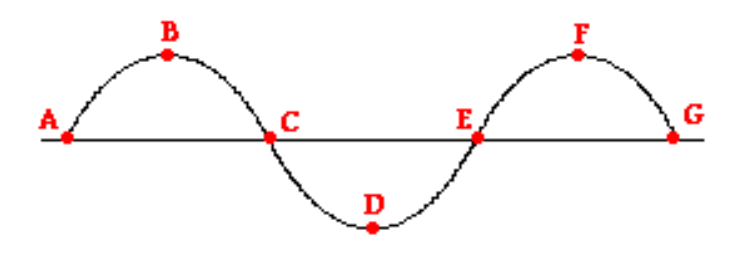
74.
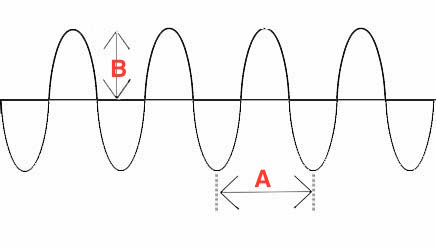
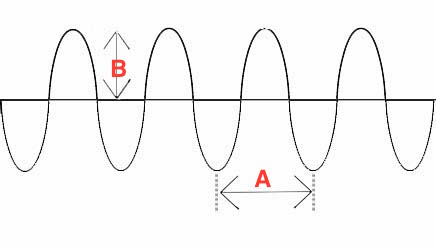
What property of this wave is represented by the letter "A"
a)
amplitude
b)
crest
c)
trough
d)
wavelength
75.
What property of the wave is represented by the letter "B"?
a)
amplitude
b)
crest
c)
trough
d)
wavelength
76.
The highest point on a wave is:
a)
the crest
b)
the trough
c)
the top
d)
the coast 
77.
The lowest point on a wave is the:
a)
Amplitude
b)
Crest
c)
Trough
d)
Wavelength
78.
The number of wavelengths that pass a point each per second is:
a)
frequency
b)
period
c)
longitudinal 
d)
transverse wave 
79.
The type of waves that require medium to pass:
a)
Mechanical Waves
b)
Electromagnetic Waves
80.
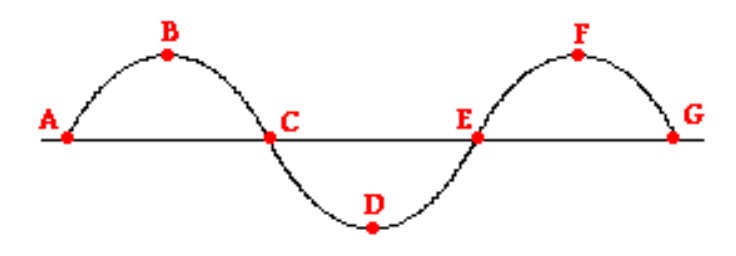
Which vocabulary term is used to identify the distance between points C & G?
a)
Amplitude
b)
Crest
c)
Frequency
d)
Wavelength
81.
When the frequency of a wave increases, what happens to the wavelength?
a)
The wavelength is not directly affected by the frequency of a wave.
b)
The wavelength increases.
c)
The wavelength decreases.
d)
More specific information is needed to form a conclusion about the wavelength.
82.
A mechanical wave cannot travel through...
a)
a vacuum(empty space).
b)
water.
c)
air. 
d)
glass.
83.
Which letter(s) represent the trough of the wave?
a)
A
b)
B & D
c)
D
d)
C & G
84.
Which letter(s) represent the crest of the wave?
a)
A
b)
B & D
c)
B & F
d)
F
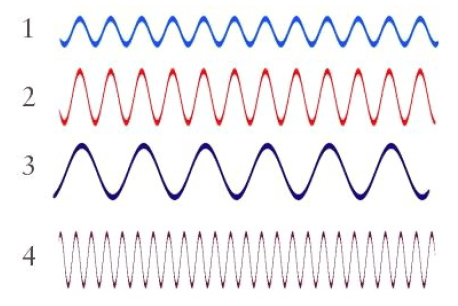
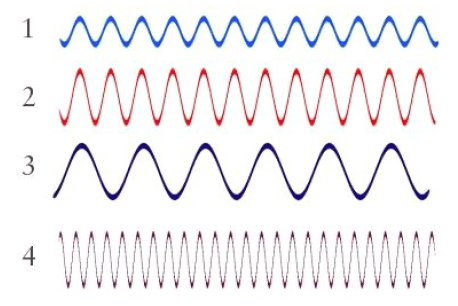
85.
Which wave in the diagram has the greatest frequency?
a)
1
b)
2
c)
3
d)
4
86.
Which wave in the diagram has the greatest wavelength?
a)
1
b)
2
c)
3
d)
4
87.
Which of the following can sound travel through?
a)
solid
b)
liquid
c)
gas
d)
all of the above
88.
crest to crest or trough to trough
a)
crest
b)
trough
c)
amplitude
d)
wavelength
89.
crest to crest or trough to trough
a)
crest
b)
trough
c)
amplitude
d)
wavelength
90.
regular disturbances that carry energy through matter or space
a)
crest
b)
energy
c)
wave
d)
trough
91.
which material does sound travel the fastest?
a)
solid 
b)
liquid 
c)
gases
92.
When a wave strikes and object and bounces off. (example echo)
a)
medium
b)
refraction
c)
reflection
d)
interference
93.
When a wave bends as it passes through at an angle from one medium to another.(example: pencil in a glass of water-)
a)
medium
b)
refraction
c)
reflection
d)
interference
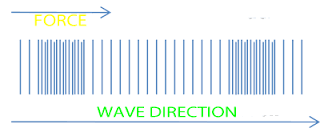
94.
How would a person measure the wavelength on this sound wave?
a)
dense to less dense
b)
trough to crest
c)
compression to compression
d)
beginning of illustration to the end
95.

You can't hear sounds in outer space because there is no

a)

medium

b)

light

c)

energy

d)

heat

96.

All waves carry ________ as they travel from one place to another.

a)

matter

b)

space

c)

energy

d)

water

97.

Which wave in the diagram has the greatest wavelength?

a)

1

b)

2

c)

3

d)

4

98.

Which wave in the diagram has the greatest frequency?

a)

1

b)

2

c)

3

d)

4

99.
When the frequency of a wave increases, what happens to the wavelength?
a)
The wavelength is not directly affected by the frequency of a wave.
b)
The wavelength increases.
c)
The wavelength decreases.
d)
More specific information is needed to form a conclusion about the wavelength.
100.
Velocity= ________
Wavelength= .5m
Frequency= 150 hertz
a)
.75 m/s
b)
75 m/s
c)
300 m/s
101.
What type of waves have compressions and rarefactions?
a)
longitudinal
b)
transverse
102.
What type of wave is this?
a)
Longitudinal
b)
Transverse
103.
Which part of a longitudinal wave is where particles are packed closely together?
a)
compression
b)
rarefaction
c)
crest 
d)
amplitude
104.

Electromagnetic waves vary in

a)

the speed they travel in a vacuum.

b)

wavelength and frequency.

c)

the way they reflect.

d)

the orientation of their electric and magnetic fields.

105.

Infrared rays have a shorter wavelength than

a)

Ultraviolet ray.

b)

X-rays.

c)

radar waves.

d)

gamma rays

106.

The full range of frequencies of electromagnetic radiation is called

a)

visible light.

b)

radio waves.

c)

the electromagnetic spectrum.

d)

invisible radiation.

107.

The waves with the longest wavelengths in the electromagnetic spectrum are

a)

Infrared rays.

b)

radio waves

c)

gamma rays

d)

X-rays

108.

The visible light spectrum ranges between

a)

radar waves and X-rays.

b)

television waves and infrared rays.

c)

infrared rays and ultraviolet rays.

d)

ultraviolet rays and gamma rays.

109.

X-ray photographs show softer tissue

a)

as invisible.

b)

as dark, highly exposed areas.

c)

the same as dense bones.

d)

as bright white areas.

110.

Which of the following occurs as a light wave bends when it passes from one medium into another?

a)

constructive interference

b)

refraction

c)

destructive interference

d)

reflection

111.

Newton’s prism experiments showed that white sunlight is made up of

a)

the full electromagnetic spectrum.

b)

only blue light.

c)

all the colors of the visible spectrum.

d)

only the longest wavelengths.

112.

What is the Order of the Electromagnetic System?

a)

Red,Yellow,Orange,Green,Blue,Indigo,Violet

b)

Red,Orange,Yellow,Green,Blue,Indigo,Violet

c)

Violet,Indigo,Green,Blue,Red,Orange,Yellow

d)

Violet,Blue,Red,Orange,yellow,green,Indigo

113.

Shorter Waves have ____Energy,Longer Waves___Energy?

a)

Lower,Higher

b)

Higher,Lower

114.

Shortest Wavelength and a Higher Frequency on the Electromagnetic System?

a)

X-rays

b)

Infrared

c)

Visible Lights

d)

Gamma Rays

115.

Order Of the Electromagnetic System?

a)

Radio Waves,Microwaves,Infrared,Visible Light,X-rays,Ultra Violet,Gamma.

b)

Radio Waves,Microwaves,Infrared,Visible Light,Ultra Violet,X-rays,Gamma.

116.
Which section of the spectrum is the ONLY one we can see?
a)
X-rays
b)
Visible Light
c)
Gamma Rays
d)
Ultraviolet Rays
117.
How are electromagnetic waves different from other waves? 
a)
They have very short wavelengths 
b)
They transmit energy instead of matter 
c)
They can travel through empty space
d)
They can change direction by reflection 
118.
As the frequency of an electromagnetic wave increases, the amount of energy in that wave...
a)
increases.
b)
decreases.
c)
stays the same.
119.
What are electromagnetic waves?
a)
sound waves
b)
electric & magnetic fields (energy) that travel through empty space very quickly
c)
Someone's name
d)
things like longitudinal waves
120.
Which electromagnetic waves are used in ovens and cell phone communications?
a)
Infrared rays
b)
ultraviolet rays
c)
microwaves