wayground logo

Free Printable Worksheets

Font size

S
M
L
XL
Worksheets

Physics Paper 2 part A

Total questions: 117

Worksheet time: 3hrs 12mins

Name
Class
Date
1.

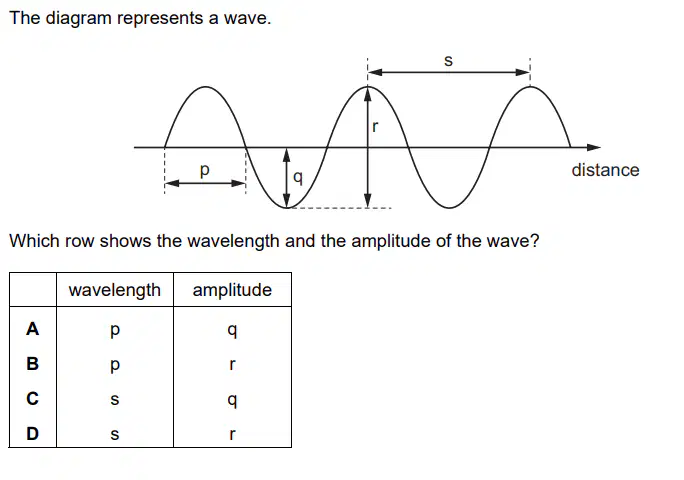
What is the amplitude of a wave?

a)

Where there is no wave movement

b)

The distance the wave oscillates from it's resting position

c)

A disturbance that transfers energy from one place to another

d)

The distance between two corresponding parts of a wave

2.
The number of wavelengths that pass a point each second
a)
frequency
b)
wavelength
c)
pitch
d)
amplitude
3.

If the wavelength of a wave increased, what would happen to the frequency?

a)

decrease

b)

increase

c)

stay the same

4.

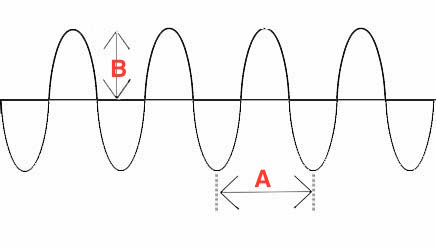
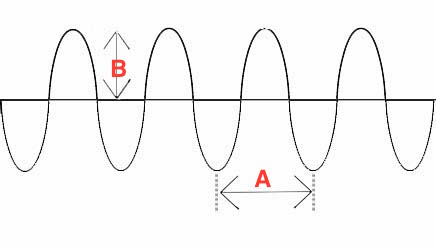
What property of this wave is represented by the letter "A"

a)

amplitude

b)

crest

c)

trough

d)

wavelength

5.
What property of the wave is represented by the letter "B"?
a)
amplitude
b)
crest
c)
trough
d)
wavelength
6.
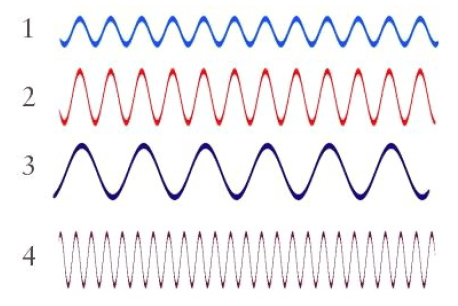
Which wave in the diagram has the greatest frequency?
a)
1
b)
2
c)
3
d)
4
7.

The units of frequency are...

a)

metres

b)

seconds

c)

Hertz

d)

degrees

8.

Light is an example of a transverse wave

a)

True

b)

False

9.

Sound is an example of a transverse wave

a)

True

b)

False

10.

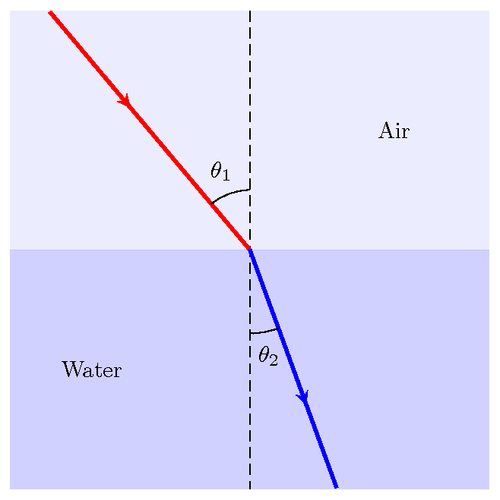
The following image demonstrates...

a)

Reflection

b)

Refraction

c)

Interference

d)

Diffraction

11.
Which is the best description of what is meant by a good thermal insulator?
a)
A.   A material that doesn’t allow thermal energy to move through it easily.
b)
B.   A material that doesn’t allow any thermal energy to move through it easily.
c)
C.   A material that doesn’t allow cold to move through it easily.
d)
D.   A material that does allow cold to move through it easily
12.
In order to do work, energy is
a)
A.  transferred
b)
B.  used up
c)
C.  lost
d)
D.  lost or transferred
13.
When a ball is suspended from a string what forces are acting on the ball:
a)
A.   Weight and string tension.
b)
B.   Weight and uphrust.
c)
C.   Weight and air resistance.
d)
D.   weight and gravity
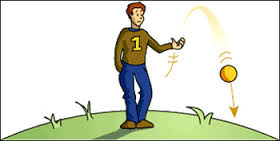
14.
When a melon is dropped onto a pavement which of the following best describes what happens to energy?
a)
A.   The gravitational potential store reduces and the heat store of the surroundings increases.
b)
B.   The melons gains kinetic energy, which is lost when it hits the floor.
c)
C.   The melon’s energy store steadily reduces as it falls.
d)
D.   The gravitational potential store increases and the heat store of the surroundings increases.
15.
Which statement is true about a moving object?
When an object is ....
a)
...accelerating, the resultant force acting on it must be zero
b)
... moving at a steady speed, the air resistance acting on it must equal zero
c)
... moving at a steady speed, the resultant force acting on it must equal zero
d)
... moving, there must be a resultant force acting on it.
16.
A woman lifts 20 bricks, each of weight 6N.
What other information is needed to calculate the useful work done in lifting the bricks?
a)
the distance she lifts the bricks
b)
the mass of the bricks
c)
the time taken to lift the bricks
d)
the volume of the bricks
17.
Which statement is correct about a bottle of water?
a)
its mass at the North Pole is different from its mass at the Equator
b)
its mass is measured in newtons
c)
its weight and mass are the same thing
d)
its weight is one of the forces acting on it
18.
Which statement about mass and weight is correct?
a)
Mass and weight are both forces
b)
Neither mass nor weight is a force
c)
Only mass is a force
d)
Only weight is a force
19.
In a race, a car travels 60 times around a 3.6km track. This takes 2.4 hours. What is the average speed of the car?
a)
1.5 km/h
b)
90 km/h
c)
144 km/h
d)
216 km/h
20.

A spring has a spring constant of 5 N/cm. What is its extension when loaded with 15 N?

a)

3 cm

b)

5 cm

c)

3 m

d)

5 m

21.

Acceleration is defined as the "change in..."

a)

the time it takes to move from one place to another.

b)

velocity of an object.

c)

distance, divided by the time taken.

d)

velocity, divided by the time taken.

22.

Calculate the average speed (in m/s) if a cheetah runs 180 metres in 10 seconds.

a)

198 m/s

b)

170 m/s

c)

12 m/s

d)

18 m/s

23.

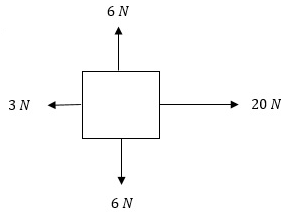
What is the resultant force in this diagram?

a)

17 N, right

b)

17 N, left

c)

23 N, right

d)

12 N, up

24.

What is the unit of work?

a)

Newton

b)

Joule

c)

Watt

d)

meter

25.

Which type of wave is illustrated in the diagram?

a)

Longitudinal

b)

Slinky

c)

Transverse

d)

Water

26.

Max is sitting in his boat observing water waves enter the harbour. He counts 20 waves passing into the harbour in one minute. What is the frequency?

a)

0.33 Hz

b)

3.0 Hz

c)

20 Hz

d)

1200 Hz

27.

A compass needle responds to a magnetic field, because the compass needle is a

a)

A. generator

b)

B. motor

c)

C. magnet

d)

D. transformer

28.

A _______________ is a current-carrying coil of wire with lots of loops.

a)

magnet

b)

electromagnet

c)

solenoid

d)

compass

29.

How can you increase the magnetic field strength in an electromagnet?

a)

Increase the number of coils.

b)

increase the voltage

c)

increase the current by reducing the resistance of the coil

d)

all of the above

30.

Choose what the forefinger represents in Flemings left hand law.

a)

Field (South to North)

b)

Force

c)

Field (North to South)

31.

What causes the motor effect?

a)

A current carrying wire exerting a force on an electromagnet

b)

A current carrying wire exerting a force on a temporary magnet

c)

A current carrying wire exerting a force on a permanent magnet

32.

What force slows objects down and keeps them from moving?

a)

Acceleration

b)

Gravity

c)

Friction

d)

Net Force

33.

Which one of Newton's laws are displayed

a)

2nd law

b)

1st law

c)

3rd law

34.

An object in motion will stay in motion and an object at rest will stay at rest unless acted upon by an outside force. Which law does this describe

a)

2nd law

b)

1st law

c)

3rd law

35.

What Unit do we Measure Force in?

a)

Newtons

b)

Joules

c)

Force

d)

Kilograms

36.

What is Newton's First Law

a)

F=ma

b)

Every action has an equal and opposite reaction

c)

An object at rest stays at rest, an object in motion stays in motion.

d)

Friction

37.

A 20 kg bike accelerates at 10 ms-2. what was the force?

F = m x a

a)

25 Newtons

b)

20 Newtons

c)

200 Newtons

d)

10 Newtons

38.

Newton's third law states that any action will have a(n) _______ and ______ reaction

a)

Equal and similar

b)

Equal and opposite

c)

Equal and different

d)

Greater and opposite

39.
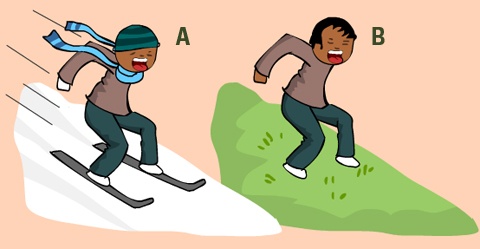
Why is it harder for the boy in Image B to get down the hill?
a)
Motion
b)
Friction
c)
Work
d)
Displacement
40.
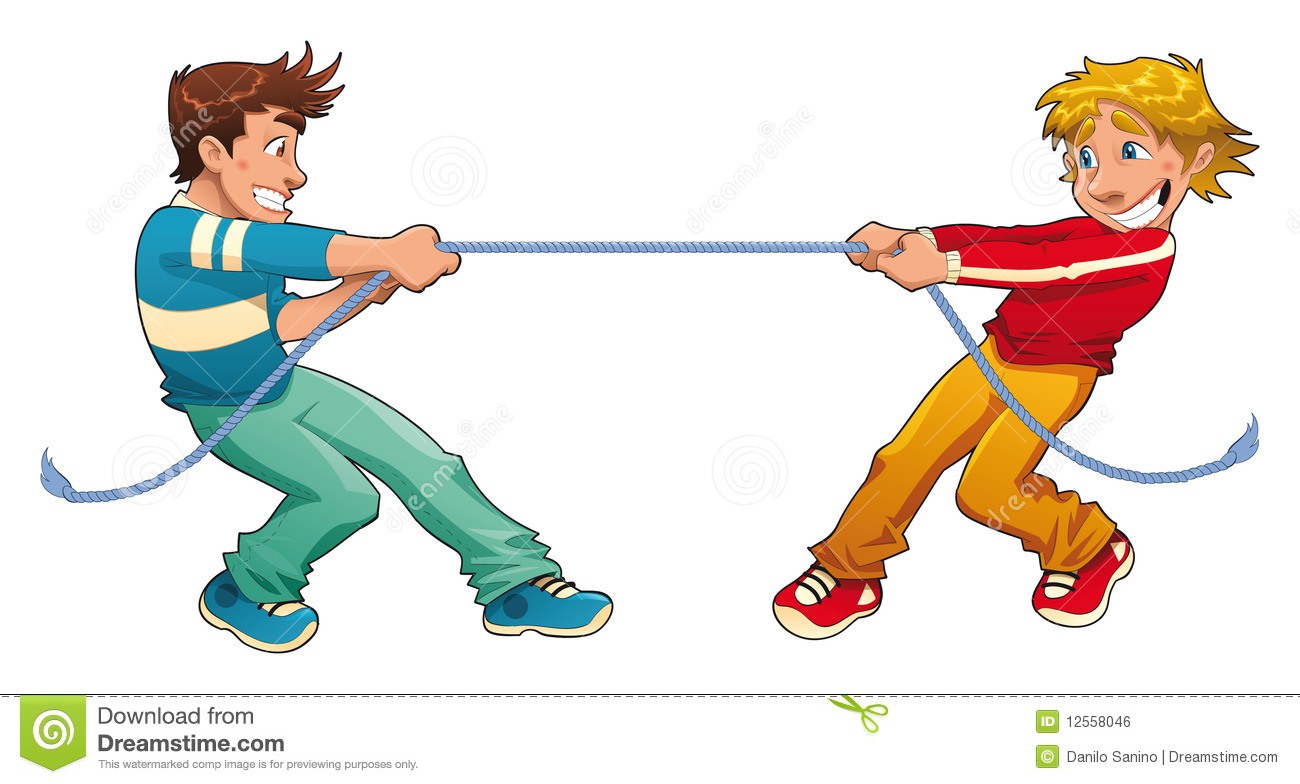
If these boys are pulling with the same amount of force.  What will happen?
a)
The boy in blue will win.
b)
They will not move at all.
c)
The boy in red will win.
d)
Both will fall down.
41.
What is the attractive force that exists between all objects that have mass?
a)
Weight
b)
Mass 
c)
Gravity
d)
Viscosity
42.

What force slows objects down and keeps them from moving?

a)

Acceleration

b)

Gravity

c)

Friction

d)

Net Force

43.

When there is a change in motion?

a)

When forces are balanced

b)

When the forces are unbalanced

c)

Whe forces are equal

d)

Never

44.

An object in motion will stay in motion and an object at rest will stay at rest unless acted upon by an outside force. Which law does this describe

a)

2nd law

b)

1st law

c)

3rd law

45.

Looking at the image. Decide if this is balanced or unbalanced.

a)

Unbalanced

b)

Balanced

46.
Force = Mass x Acceleration
a)
Newton's 1st Law
b)
Newton's 2nd Law
c)
Newton's 3rd Law
d)
Newton's 4th Law
47.

A boat floats on the sea. The boat moves slowly up and down as a wave passes it. The amplitude of the wave is 0.20 m. What is the vertical distance between the highest and lowest positions of the boat as the wave passes it?

a)

0 m

b)

0,20 m

c)

0,40 m

d)

0,80 m

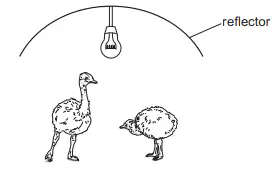
48.

A filament lamp is used in a zoo to keep young animals warm. What are the main types of wave given out by the lamp?

a)

visible light and infra-red

b)

visible light and microwaves

c)

visible light and radio waves

d)

visible light and X-rays

49.
a)

A

b)

B

c)

C

d)

D

50.

Which statement about sound is not correct?

a)

A sound wave of frequency 2000 Hz can be heard by a healthy human ear.

b)

Sound waves can travel through a vacuum.

c)

The loudness of a sound depends on the amplitude of the sound wave

d)

The pitch of a sound depends on the frequency of the sound wave.
51.

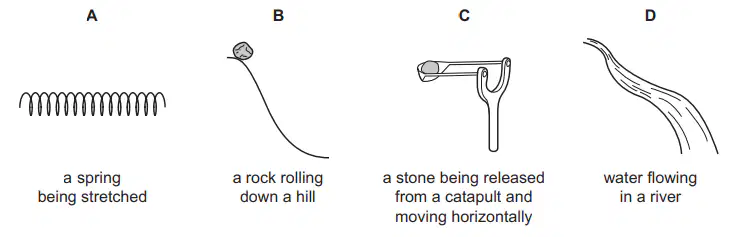
In which situation is potential energy increasing?

a)

A

b)

B

c)

C

d)

D

52.
Displacement is a
a)
Scalar quantity
b)
Vector quantity
c)
Base quantity
d)
Derived quantity
53.
SI unit for force is
a)
Kilograms
b)
Newton
c)
Joules
d)
acceleration
54.
Volume is a
a)
Scalar quantity
b)
Vector quantity
c)
Base quantity
d)
Derived quantity
55.
Type of force that opposes motion and releases thermal energy is termed as
a)
resistance
b)
Tension
c)
Weight
d)
Friction
56.
If two forces of 20 N towards north and 12 N towards south are acting on an object. The resultant force will be
a)
32 N toward north
b)
20 N towards north
c)
32 N towards south
d)
8 N towards north
57.
Weight is a/an
a)
force
b)
base quantity
c)
scalar quantity
d)
SI unit
58.

A person of mass 50 kg flies to moon, his weight at the moon would be (earth's gravity = 10 m/ s2, moon's gravity = 1.6 m/ s2)

a)

31.25 kg

b)

500 kg

c)

51.6 kg

d)

80 kg

59.

diagram that shows magnitude and direction is termed as

a)

Scalar diagram

b)

Force diagram

c)

Dimer diagram

d)

Vector diagram

60.
Force that always opposes motion between two surfaces in contact is termed as
a)
Weight
b)
Friction
c)
resistance
d)
Tension
61.
Density is a
a)
Scalar quantity
b)
Vector quantity
c)
Base quantity
d)
Derived quantity
62.
A box full of bricks weighs 128 N on the moon and has a mass of 80 kg. The gravitational pull of moon is
a)
40 m s-2
b)
1.28 m s-2
c)
50 m s-2
d)
1.6 m s-2
63.
If two forces of 10 N and 5 N are acting on an object in a same direction, what will be the total force acting on the object?
a)
10 N
b)
15 N
c)
50 N
d)
5 N
64.
If an object flies into space, its
a)
mass and weight both would remain same
b)
mass would change but weight would remain same
c)
mass would remain same but weight would change
d)
mass and weight both would change
65.
If an object is stationary which force is still acting on it?
a)
Friction
b)
Tension
c)
Weight
d)
resistance
66.

Which is the scalar quantity?

a)

acceleration

b)

velocity

c)

force

d)

energy

67.
If two forces of 3 N acting on an object in opposite direction. The resultant force will be
a)
6 N
b)
3 N
c)
9 N
d)
Zero
68.
Type of force that opposes motion in fluids (water and air) is termed as
a)
resistance
b)
Tension
c)
Weight
d)
Friction
69.
Velocity is a
a)
Scalar quantity
b)
Vector quantity
c)
Base quantity
d)
Derived quantity
70.

A box of candies weighs 40 N. If the acceleration due to gravity = 10 m s-2, the mass of this box equals

a)

0.4 kg

b)

4 kg

c)

40 kg

d)

None of the above

71.
If no force is applied to a moving object, it will stop due to
a)
gravity
b)
backward force
c)
Magnetic force
d)
Friction
72.
Energy is a
a)
Scalar quantity
b)
Vector quantity
c)
Base quantity
d)
Derived quantity
73.
Two forces of magnitude 5 N and 10 N act on a wooden block of mass 2 kg. If 5 N force acts towards right and 10 N force acts towards left, which of the following statements is correct?
a)
Resultant force is 15 N towards the left
b)
Resultant force is 15 N towards the right
c)
Resultant force is 5 N towards the right
d)
Resultant force is 5N towards the left
74.
Force is a
a)
Scalar quantity
b)
Vector quantity
c)
Base quantity
d)
Derived quantity
75.
On earth the object weighs 57 N and on moon it weighs 9.12 N. Its mass is
a)

35.6 kg

b)

5.7 kg

c)

0.912 kg

d)

7.52 kg

76.
Pull on both ends of an object is termed as
a)
Contact force
b)
Tension
c)
Friction
d)
Weight
77.
Gravitational force on an object is termed as
a)
Contact force
b)
Tension
c)
Weight
d)
resistance
78.
Resultant forces on an object are equal to zero so we say that the forces are
a)
balanced
b)
equal
c)
unbalanced
d)
stable
79.
A cow of mass 250 kg weighs
a)
250 N
b)
25 N
c)
2500 N
d)
125 N
80.
If two forces of 4 N and 7 N towards right are acting on an object in a same direction and two forces of 3 N and 2 N towards left are opposing them. The resultant force is
a)
5 N to left
b)
6 N to right
c)
11 N to right
d)
no resultant force
81.
Formula for weight is
a)
W = mv, where m is mass and v is velocity
b)
W = mg, where m is mass and g is the gravitational pull
c)
W = vg, where v is velocity and g is the gravitational pull
d)
W = da, where d is distance and a is acceleration
82.
What type of force is shown by arrow #1?
a)
Normal force
b)
Applied force
c)
Gravity
d)
Friction
83.
What type of force is shown by arrow #4?
a)
Normal force
b)
Applied force
c)
Gravity
d)
Friction
84.
Forces can cause objects to:
a)
stop moving
b)
change direction
c)
start moving
d)
all of these are correct
85.
When forces acting on an object are balanced, the net force is:
a)
5 N
b)
1 N
c)
10 N
d)
0 N
86.
What is the net force on the box in the picture?
a)
18 N
b)
2 N
c)
8 N
d)
0 N
87.

Find the extension when the force is 2 N

a)

0.1 m

b)

0.2 m

c)

0.1 cm

d)

0.2 cm

88.

Calculate the spring constant from the graph

a)

0.1 Nm

b)

0.1 N/m

c)

10 Nm

d)

10 N/m

89.

Calculate the energy used to stretch the spring 0.4 m.

a)

1.6 J

b)

1.6 N/m

c)

0.8 J

d)

0.8 N/m

90.
Displacement is a
a)
Scalar quantity
b)
Vector quantity
c)
Base quantity
d)
Derived quantity
91.
SI unit for force is
a)
Kilograms
b)
Newton
c)
Joules
d)
acceleration
92.
Formula of force is
a)
F = P/A, where P is pressure and A is area
b)
F = ms, where m is mass and s is speed
c)
F = ma, where m is mass and a is acceleration
d)
F = m/v, where m is mass and v is velocity
93.
Exertion of pull or push on an object is termed as
a)
energy
b)
work done
c)
force
d)
acceleration
94.
If no force is applied to a moving object, it will stop due to
a)
gravity
b)
backward force
c)
Magnetic force
d)
Friction
95.

If an object of mass 20 kg accelerates at the rate of 2 m s-2. The force applied on the object would be

a)

18 N

b)

20 N

c)

10 N

d)

40 N

96.
If acceleration or deceleration is zero, force acting on it are
a)
balanced or add up to zero
b)
unbalanced
c)
balanced but would not add up to zero
d)
unbalanced and add up to zero
97.
Surface irregularities between two surfaces result in
a)
resistance
b)
repulsion
c)
Friction
d)
Attraction
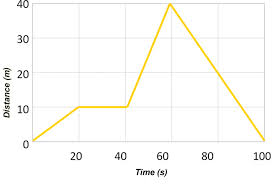
98.
How long did it take this object to travel 10 m?
a)
0 s
b)
10 s
c)
15 s
d)
20 s
99.
How long did it take this object to travel back to its reference/starting point?
a)
20 s
b)
30 s
c)
60 s
d)
100 s
100.
At 60 seconds, how far had this object traveled? 
a)
0 m
b)
10 m
c)
20 m
d)
40 m
101.
What is happening at D?
a)
Stationary
b)
Accelerating
c)
Fast steady speed; moving away from the starting position
d)
Slower steady speed; moving away from the starting position
102.
What is happening at C?
a)
Stationary
b)
Accelerating
c)
Fast steady speed; moving away from the starting position
d)
Slower steady speed; moving away from the starting position
103.

Match the description to the graph:

"The car is stopped."

a)
b)
c)
d)
104.

Match the description to the distance-time graph:

"The speed of the car is decreasing."

a)
b)
c)
d)
105.

Segment O-A The bus is _________________.

a)

at rest

b)

returning (to original position)

c)

moving forward

106.

Segment A-B The bus is _________________.

a)

at rest

b)

returning (to original position)

c)

moving forward

107.

Segment B-C The bus is _________________.

a)

at rest

b)

returning (to original position)

c)

moving forward

108.

Segment B-C The bus is _________________.

a)

at rest

b)

returning (to original position)

c)

moving forward

109.

Segment C-D The bus is _________________.

a)

at rest

b)

returning (to original position)

c)

moving forward

110.

Which runner stopped for a rest?

a)

Albert

b)

Bob

c)

Charlie

111.

Which runner won the race?

a)

Albert

b)

Bob

c)

Charlie

112.
What kind of acceleration is shown here?
a)
positive
b)
negative
c)
none
d)
varies
113.
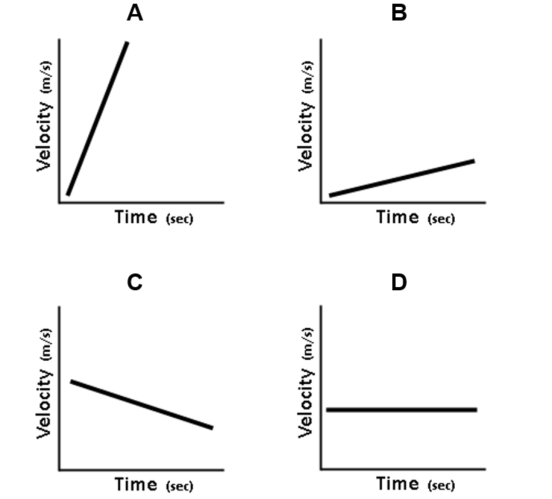
Which graph represents the greatest acceleration?
a)
A
b)
B
c)
C
d)
D
114.
From point A to Point B the velocity is
a)
Increasing
b)
Decreasing 
c)
Constant
115.

What is the typical walking speed of a person?

a)

1.5 m/s

b)

3 m/s

c)

6 m/s

d)

12 m/s

116.

Which TWO factors affect car stopping distance

a)

Thinking distance

b)

Stopping distance

c)

Braking distance

117.

How do a car's brakes work? Converting

a)

potential energy into heat

b)

kinetic energy into heat

c)

potential energy into kinetic energy

d)

By pressing the clutch