wayground logo

Free Printable Worksheets

Font size

S
M
L
XL
Worksheets

2019 Atnip Fall Semester Exam

Total questions: 100

Worksheet time: 1hrs 10mins

Name
Class
Date
1.
The main structural component of the plasma membrane. 
a)
cholesterol
b)
protein
c)
phospholipid
d)
nucleic acids
2.
A shortage of phosphorus in the soil would make it difficult to manufacture __.
a)
DNA
b)
fatty acids
c)
proteins
d)
sucrose
3.
What does A represent?
a)
active site
b)
allosteric site
c)
enzyme
d)
substrate
4.
What does C represent?
a)
substrate
b)
enzyme
c)
allosteric site
d)
active site
5.
What is happening at point B?
a)
the enzyme is denatured
b)
the enzyme is saturated
c)
the substrate is used up
d)
the reaction is occurring at its fastest rate
6.
What do the dotted lines represent?
a)
hydrogen bonds
b)
polar covalent bonds
c)
ionic bonds
d)
nonpolar covalent bonds
7.
Cells within this gland secrete a hormone that in times of emergency, increase the glucose level of the blood and speeds up the actions of the circulatory and respiratory systems.
a)
adrenal
b)
pancreas
c)
thyroid
d)
anterior pituitary
8.
Which of the following are products of the light reaction?
a)
ATP and NADH
b)
glucose and oxygen
c)
oxygen and NADPH
d)
carbon dioxide and water
9.
Which of the following hormones is produced by the thyroid gland to regulate blood calcium levels?
a)
PTH
b)
calcitonin
c)
epinephrine
d)
cortisol
10.
The reactions of the Calvin cycle require all of the following except __.
a)
RuBP
b)
glucose
c)
CO2
d)
NADPH
11.
What type of substances pass most readily into a cell?
a)
ions
b)
large molecules
c)
glucose
d)
lipid soluble molecules
12.
Which of the following organelles is NOT surrounded by a membrane?
a)
mitochondria
b)
chloroplast
c)
Golgi
d)
ribosome
13.
What is the primary function of the light reactions of photosynthesis?
a)
To produce glucose
b)
To produce NADPH and ATP
c)
To use ATP
d)
To produce RuBP
14.
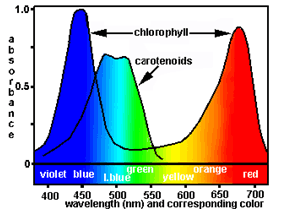
What is one function of the other pigments  besides chlorophyll, in the chloroplast?
a)
to block damaging wavelengths of light
b)
to absorb different wavelengths than the chloroplasts
c)
to provide different colors to the leaves
d)
to transfer energy to a separate photosystem beside the one using chlorophyll a and b.
15.
Which of the following molecules is not needed for the Calvin Cycle?
a)
CO2
b)
ATP
c)
NADPH
d)
H2O
16.
Green plants reflect ________ light.
a)
Red
b)
Green
c)
All
d)
Red and Violet
17.
Where does the carbon come from that is used to form glucose?
a)
The soil
b)
CO2 in the air
c)
From other carbohydrates
d)
Calvin Cycle
18.
What type of macromolecule are enzymes?
a)
Protein
b)
Carbohydrate
c)
Lipid
d)
Nucleic Acid
19.
Enzymes are made up of these repeating monomers.
a)
monosaccharides
b)
amino acids
c)
nucleotides
d)
phospholipids
20.

The secretion of hormone A causes a change in the amount of protein X in an organism. If this mechanism works by positive feedback, which one of the following statements represents that fact?

a)

An increase in A produces an increase in X

b)

An increase in X produces an decrease in A

c)

A decrease in A produces an increase in X

d)

All of these could be correct.

21.

Simple cuboidal epithelial cells line the ducts of

certain human exocrine glands. Various materials

are transported into or out of the cells by

diffusion. (The formula for the surface area of a

cube is 6 x S2, and the formula for the volume of

a cube is S3, where S = the length of a side of the

cube.)

Which of the following cube-shaped cells would

be most efficient in removing waste by diffusion?

a)
b)
c)
d)
22.

A sample of human blood was placed in a test tube containing a physiological saline solution (0.9% sodium

chloride). This type of solution is often used intravenously to quickly rehydrate patients. A drop of the blood

from the test tube was placed on a slide and red blood cells (RBCs) were observed under a microscope. Three

possible outcomes are diagrammed above. Which of the following best predicts which diagrammed microscope view the laboratory worker would see and best explains why?

a)

View 1 because RBC membranes are freely permeable to water

b)

View 2 because the RBCs use energy to allow sodium entry and to pump water out

c)

View 2 because the rate of water movement into the RBCs equals the rate of water movement out of the cells

d)

View 3 because the sodium-potassium pumps in the RBC membranes use energy to keep the sodium out but allow water to freely flow into the cells

23.
What is the total magnification of a microscope with an eyepiece magnification of 10x and an objective lens magnification of 50x ?
a)
500x
b)
50x
c)
5x
d)
5000x
24.
Many groups of tissue work together as a (n) _____.
a)
peticure
b)
organ
c)
oligarchy
d)
olive
25.
Which biomolecule is mainly hydrocarbons and therefore very hydrophobic?
a)
carbohydrate
b)
nucleic acid
c)
protein
d)
lipid
26.
When water is added to split a molecule, the reaction is known as a(n) __ reaction.
a)
dehydration synthesis
b)
condensation
c)
hydrolysis
d)
super magical 
27.
Peptide bonds are formed when _ link to form a polymer.
a)
nucleic acids
b)
amino acids
c)
monosaccharides
d)
polypeptides
28.
If someone is lactose intolerant, they lack the enzyme _____.
a)
lipase
b)
lactose
c)
lactase
d)
milk
29.
What molecule is this?
a)
this is a monosaccharide
b)
this is a polysaccharide
c)
this is a protein
d)
this is a lipid
30.
 What molecule is this?
a)
this is a monosaccharide
b)
this is a polysaccharide
c)
this is a protein
d)
this is a lipid
31.
Which of the following conclusions can be drawn from this graph?
a)
The optimum pH of the enzyme is 6.6.
b)
The optimum pH of the enzyme is 5.8
c)
The enzyme’s activity increases as pH increases 5.0 to 9.0
d)
The enzyme’s activity is greater around pH of 8.0 .
32.
What makes a molecule polar?
a)
Equal sharing of valence electrons
b)
Unequal sharing of valence electrons
c)
Stealing of electrons
d)
Temporary charges that come and go
33.
You dump a Kool-Aid packet into water. What substance is the solute?
a)
water
b)
Kool-Aid
34.
Which of the following properties of water enables molecules to cling together as they move from the roots to the leaves of plants?
a)
Water expands as it freezes.
b)
Water is an excellent solvent.
c)
Water exhibits cohesive behavior.
d)
Water moderates temperature.
35.

Glycolysis occurs in the _____.

a)

mitochondrial matrix

b)

inner membrane

c)

cytoplasm

d)

cell membrane

36.

The final electron acceptor in the electron transport system is _____.

a)

water

b)

NAD+

c)

oxygen

d)

FADH2

37.

In yeast, what product of fermentation is lethal when it builds up?

a)

carbon dioxide

b)

lactate

c)

alcohol

38.
What is the correct equation for cellular respiration?
a)
6O2 + C6H12O6 -> 6CO2 + 6H2O + Energy
b)
6O2 + C6H12O6 + Energy -> 6CO2 + 6H2O
c)
6CO2 + 6H2O -> 6O2 + C6H12O6 + Energy
d)
6CO2 + 6H2O + Energy -> 6O2 + C6H12O6
39.
site of the krebs cycle
a)
1
b)
2
c)
3
d)
4
40.
Use the diagram to answer the question. Between which parts of the molecule must the bonds be broken to form an ADP molecule?
a)
A and B
b)
A and C
c)
B and C
d)
C and D
41.
Which of the following examples is a specific case of active transport?
a)
A carrier protein moves sucrose across the membrane with the concentration gradient.
b)
Water moves from an area of high free-water concentration to an area of low free-water concentration
c)
Cytoplasmic Na+ binds to the sodium-potassium pump, ATP is used, and Na+ is released to the outside.
d)
Aquaporins facilitate the diffusion of water in the red blood cells of mammals.
42.
Plant cells placed in a hypotonic environment
a)
will remain turgid, due to the elastic cell wall.
b)
will lyse without special adaptations to combat water-concentration fluctuations.
c)
will shrivel, due to the loss of water from the large central vacuole.
d)
will remain flaccid, due to an ineffective central vacuole.
43.
Since we're building a carbohydrate in the Calvin Cycle, is the process endergonic or exergonic and why?
a)
Endergonic because carbohydrate production is catabolic
b)
Exergonic because carbohydrate production is anabolic
c)
Endergonic because carbohydrate production is anabolic.
d)
Exergonic because carbohydrate production is catabolic
44.
What type of transport is shown in the picture?
a)
Osmosis
b)
Diffusion
c)
Endocytosis
d)
Exocytosis
45.
after strenuous exercise, a muscle cell would contain decreased amounts of ______ and increased amounts of ______ ____
a)
glucose ATP
b)
ATP glucose
c)
oxygen lactic acid
d)
lactic acid ATP
46.

Means: "programmed cell death"

a)

Natural Killer Cell

b)

Mitosis

c)

Apoptosis

d)

CD4 and CD8

47.

A B cell that is actively making antibodies is called a(n)

a)

memory B cell

b)

plasma cell

c)

Helper T cell

d)

Naive B cell

48.

If a person has already had chicken pox, why do they generally not get sick a second time?

a)

Memory B and T cells activate the immune system before the virus has a chance to make you sick

b)

Natural killer cells recognize the pathogen quicker

c)

Your 1st line of defense does a better job

49.

Which of the following body systems is responsible for "communication?"

a)

Nervous

b)

Excretory

c)

Endocrine

d)

Circulatory

50.

What is an antibody

a)

A protein hormone secreted by pancreatic endocrine cells that raises blood glucose levels; an antagonistic hormone to insulin.

b)

Chemical released by the immune system that must communicate with the brain.

c)

A protein produced by the body that destroys or inactivates an antigen that has entered the body

d)

A protein hormone secreted by the pancreas that is essential for the metabolism of carbohydrates and the regulation of glucose levels in the blood.

51.

Which of the following is an example of positive feedback?

a)

Blood-clotting

b)

Child-birth

c)

Insulin Production

d)

Menstruation

52.

Endocrine glands secrete _

a)

Hormones

b)

Neurotransmitters

c)

A wide range of chemical substances

53.

Hormone regulation operates under which type of feedback mechanism?

a)

positive feedback

b)

negative feedback

c)

zero feedback

d)

Hormones are not regulated

54.
Produces insulin
a)
pancreas
b)
adrenal gland
c)
liver
d)
anterior pituitary
55.
What is the female gland that secretes estrogen and progesterone?
a)
Testes
b)
Pancreas
c)
Thymus
d)
Ovaries
56.
What does the hormone melatonin do?
a)
increases metabolism
b)
decreases metabolism
c)
regulates sleep cycles
d)
makes your skin darker
57.

Why are Henrietta Lacks' cells commonly used in laboratory experiments.

a)

they reproduce very quickly

b)

they were healthy

c)

they didn't reproduce

d)

they were cheap to use

58.
Henrietta died from cancer of the what?
a)
liver
b)
lung
c)
cervical
d)
throat
59.
Relatively stable internal and external conditions is referred to as ______.
a)
homeopathy
b)
homo-sapiens
c)
homogenous
d)
homeostasis
60.
Identify the macromolecule in the image below.
a)
carbohydrate
b)
nucleic acid
c)
protein
d)
lipid
61.
When water freezes the molecules form a matrix by forming hydrogen bonds and
a)
sinking in water
b)
becomes more dense than water
c)
becomes less dense than water
d)
becoming more tightly packed
62.

Enables cell to engulf bulk quantities of specific large molecules is called

a)

pinocytosis

b)

phagocytosis

c)

receptor-mediated endocytosis

d)

exocytosis

63.

Diffusion with the help of transport proteins is called

a)

phagocytosis

b)

Na-K Pump

c)

Facilitated Diffusion

d)

Active Transport

64.

Movement of molecules "up" or "against" the concentration gradient (meaning low to high) is called

a)

passive transport

b)

active transport

c)

diffusion

d)

facilitated diffusion

65.

Animal cells prefer ____ solutions and plant cells prefer _______ solutions for homeostasis.

a)

hypertonic, hypotonic

b)

hypotonic, hypertonic

c)

isotonic, hypotonic

d)

isotonic, hypertonic

66.
Covalently bonded molecules are made of atoms that
a)
share electorns
b)
shoot their electrons out into space
c)
move their electrons to the nucleus of the atom
d)
give electrons to and accept electrons from each other
67.

What are three major disaccharides?

a)

Maltose, Lactose, & Sucrase

b)

Maltase, Lactose, & Sucrose

c)

Maltose, Lactose, & Sucrose

d)

Maltose, Lactase, & Sucrose

68.
The structural level of a protein least affected by hydrogen bonds is
a)
primary level
b)
secondary level
c)
tertiary level
d)
all levels are equally affected
69.
How is a molecule reduced?
a)
electrons are given to the molecule
b)
electrons are taken from the molecule
c)
money is taken from the molecule
d)
protons are given to the molecule
70.
Which of the following correctly describes how enzymes work?  
a)
they lower the energy of the reactants to increase the rxn rate
b)
they supply energy to the reaction to increase the rxn rate
c)
they lower the energy of the products to increase the rxn rate
d)
they lower the activation energy of the reaction to increase the rxn rate
71.

Plants absorb many wavelengths of light to obtain energy. Some of these wavelengths that provide maximum energy transference include

a)

Green and Red

b)

Violet and Red

c)

Blue and Green

d)

Red and Orange

72.

A --> B + C

a)

Anabolic

b)

Catabolic

73.

A + B --> C

a)

Anabolic

b)

Catabolic

74.

The reaction shown is:

a)

endergonic because energy is released

b)

exergonic because energy is released

c)

endergonic because energy is captured

d)

exergonic because energy is captured

75.

Which type of reaction does the graph represent?

a)

anabolic

b)

catabolic

c)

endergonic

d)

ATP phosphorylation

76.
Energy is released from ATP when
a)
a phosphate group is added
b)
adenine bonds to ribose
c)
ATP is exposed to sunlight
d)
a phosphate group is removed
77.
Carbon dioxide and oxygen both enter and leave the leaf at the 
a)
pore
b)
spongy measophyll
c)
guard cells
d)
stomata
78.
All of the chemical reactions that occur within an organism  are referred to as:
a)
Enzymes
b)
Macromolecules
c)
Metabolism
d)
Activation Energy
79.
Which pigment is most efficient at higher energy areas of the electromagnetic spectrum?
a)
Chlorophyll A
b)
Chlorophyll B
c)
Carotenoids
d)
No pigment is efficient at high energies
80.

In our food lab last Friday, gymnema tea binds to taste receptors and blocks _________ from binding.

a)

water

b)

glucose

c)

protein

d)

cellulose

81.
What do second messengers do?
a)
transport a signal through the lipid bilayer
b)
relay a signal from the outside to the inside of the cell
c)
relay message from the inside of the mebrane throughout the cytoplasm
d)
dampen the message
82.
What is a phosphorylation cascade?
a)
travelling of hormones through the air
b)
travelling of hormones through the blood
c)
the removal of a phosphate
d)
a series of molecules that get phosphorylated
83.
Do plant cells communicate using hormones?
a)
yes
b)
no
84.
What is phototropism?
a)
Response to water
b)
Response to touch
c)
Response to gravity
d)
Response to light
85.
What is geotropism?
a)
Response to water
b)
Response to touch
c)
Response to gravity
d)
Response to light
86.
Response to TOUCH is called ________.
a)
Phototropism
b)
Hydrotropism
c)
Thigmotropism
d)
Geotropism
87.
The water pressure inside plant cell vacuoles is called _______.
a)
Wilting
b)
Turgor Pressure
c)
Geotaxi
d)
Phototropism
88.

The role of a control in an experiment is to

a)

provide a basis of comparison to the experimental group.

b)

prove that a hypothesis is correct.

c)

ensure repeatability.

d)

ensure that the experiment is completed with authority.

89.

The four most common elements in living organisms are

a)

C, H, O, Fe.

b)

C, H, O, Na.

c)

C, H, O, N.

d)

C, N, O, Na.

e)

C, H, Na, Cl.

90.

An uncharged atom of boron has an atomic number of 5 and an atomic mass of 11. How many electrons does boron have?

a)

11

b)

15

c)

5

d)

2

e)

16

91.

Compared to a solution of pH 3, a solution of pH 1 is

a)

100 times more acidic.

b)

10 times more acidic.

c)

10 times more basic.

d)

100 times more basic.

e)

3 times more acidic.

92.

The storage form of carbohydrates is ________ in animals and ________ in plants.

a)

starch; glycogen

b)

glycogen; starch

c)

cellulose; glycogen

d)

glycogen; cellulose

e)

cellulose; chitin

93.

The transfer of a phosphate group to a molecule or compound is called

a)

carboxylation.

b)

ionization.

c)

phosphorylation.

d)

hydrogenation.

94.

The light reactions occur in the ________, while the Calvin cycle occurs in the ________.

a)

stroma; thylakoid membranes

b)

stroma; nucleus

c)

cytoplasm; thylakoid membrane

d)

thylakoid membranes; stroma

95.
A signal molecule that binds to a plasma-membrane protein is a
a)
ligand
b)
second messenger
c)
protein kinase
d)
receptor protein
96.
What 3 letters do enzymes typically end in?
a)
-ose
b)
-ase
c)
-ese
d)
-tic
97.
What is cellular respiration?
a)
the breakdown of glucose  to release ATP
b)
the breakdown of glucose to release NADH
c)
the breakdown of glucose to release FADH
d)
the breakdown of glucose to release carbon
98.
Which molecule isn't an energy carrier?
a)
FADH2
b)
NADH
c)
oxygen
d)
ATP
99.

After examining this diagram showing the concentration of water inside and outside of the cell, identify the tonicity of the solution.

a)

hypertonic

b)

hypotonic

c)

isotonic

100.
What is one difference between hibernation and torpor? 
a)
Hibernation is a deeper sleep
b)
Torpor involves deeper breathing
c)
Torpor lasts forever
d)
Hibernation happens in winter