wayground logo

Free Printable Worksheets

NEW

Font size

S
M
L
XL
Worksheets

Quiz 5 - KINE 301

Total questions: 29

Worksheet time: 21mins

Name
Class
Date
1.
Which Lobe?
a)
Frontal
b)
Parietal
c)
Temporal
d)
Occipital
2.

Makes decisions, plans for the future, reasons, and carries out behaviors

a)

Frontal Lobe

b)

Parietal Lobe

c)

Occipital Lobe

d)

Temporal Lobe

3.

Name this structure.

a)

Cerebrum

b)

Cerebellum

c)

Brain Stem

d)

Basal Ganglia

4.
The role of the cerebellum is to 
a)
detect emotions
b)
coordinate posture and balance
c)
process visual information
d)
think symbolically
5.
Which of the following is the most accurate description of the association areas of the cortex?
a)
They are located in the left hemishere and associate input from the right hemisphere
b)
They integrate information from different parts of the brain
c)
They include the motor and sensory areas in each lobe
d)
They are crucial for providing basic survival needs 
6.

When a basketballer shoots for a goal, which part of the brain sends the message instructing her to raise her shooting arm?

a)

the primary somatosensory cortex

b)

the prefrontal lobe

c)

the occipital lobe

d)

the primary motor cortex

7.
Which parts of the body are coordinated by the largest area of the somatosensory cortex?
a)
torso and legs
b)
feet and legs 
c)
feet and hands
d)
hands and face
8.
Which of the following statements about the cerebral cortex is true?
a)
the larger the area on the somatosensory cortex, the more sensitive the perception
b)
the smaller the area on the somatosensory cortex, the more sensitive the perception
c)
the larger area on the parietal cortex, the more sensitive the hearing 
d)
the smaller the area on the partietal cortex, the more sensitive the hearing
9.

The ability of our brain to adapt to damage, where one area may take over the function of the damaged area, is due to

a)

lesioning

b)

aphasia

c)

positron emission testing

d)

plasticity

e)

association

10.

Drinking alcohol can affect many parts of your brain. What part is affected if you are losing your balance and coordination?

a)

Cerebrum

b)

Cerebellum

c)

Reticular formation

d)

Thalamus

e)

Hippocampus

11.
Which of the following is the component of the limbic system that plays an essential role in the processing of new memories?
a)
medulla
b)
hippocampus
c)
thalamus
d)
hypothalamus
12.

What are the two major cell populations of nervous system?

a)

astrocytes and oligodendrocytes

b)

satellite cells and Schwann cells

c)

microglia and ependymal cells

d)

neurons and glial cells

13.

What is the specific neurotransmitter that stimulates the movement of skeletal muscles?

a)

GABA

b)

Acetylcholine

c)

Serotonin

d)

Dopamine

14.

Once the action potential reaches the end of the axon terminal what takes place?

a)

ACh is released into the synaptic cleft.

b)

Calcium is pumped into the sarcolemma.

c)

Calcium is pumped into the AT.

d)

The muscle contracts.

15.

Once calcium is pumped into the axon terminal what happens?

a)

The muscle contracts

b)

ACh is released into the synaptic cleft.

c)

Sodium pumps into the sarcolemma.

d)

The muscle contracts.

16.

What is the name of the component that houses the neurotransmitters?

a)

Synaptic cleft

b)

Acetylcholine

c)

Receptors

d)

Synaptic vesicles

17.
The yellow section of this diagram identifies the 
a)
Soma
b)
Nucleus
c)
Axon
d)
Dendrites
18.

Dopamine is a chemical released by neurons that stimulates the pleasure and reward centers of the brain. This means that dopamine is a

a)

Enzyme

b)

Lymphatic Fluid

c)

Neurotransmitter

d)

Hormone

19.

According to the sliding filament theory, which of the following change in length during isotonic muscle contraction?

I. A band

II. H Zone

III. Sarcomere

a)

I and II only

b)

I and III only

c)

II and III only

d)

I, II and III

20.

Cross bridge formation is terminated when ADP and Pi are resynthesised to ATP?

a)

True

b)

False

21.

T tubules transport acetylcholine across the neuromuscular junction

a)

True

b)

False

22.
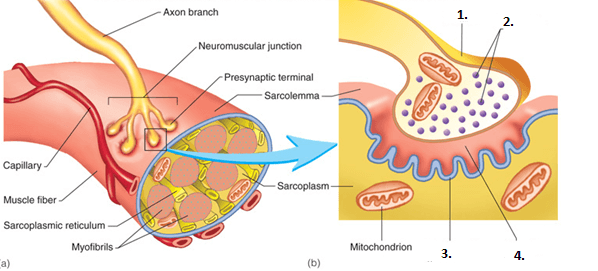
The gap between a neuron and a muscle cell: (#4 in the diagram)
a)
synaptic cleft
b)
sarcolemma
c)
vesicle
d)
Ca2+ ion
23.

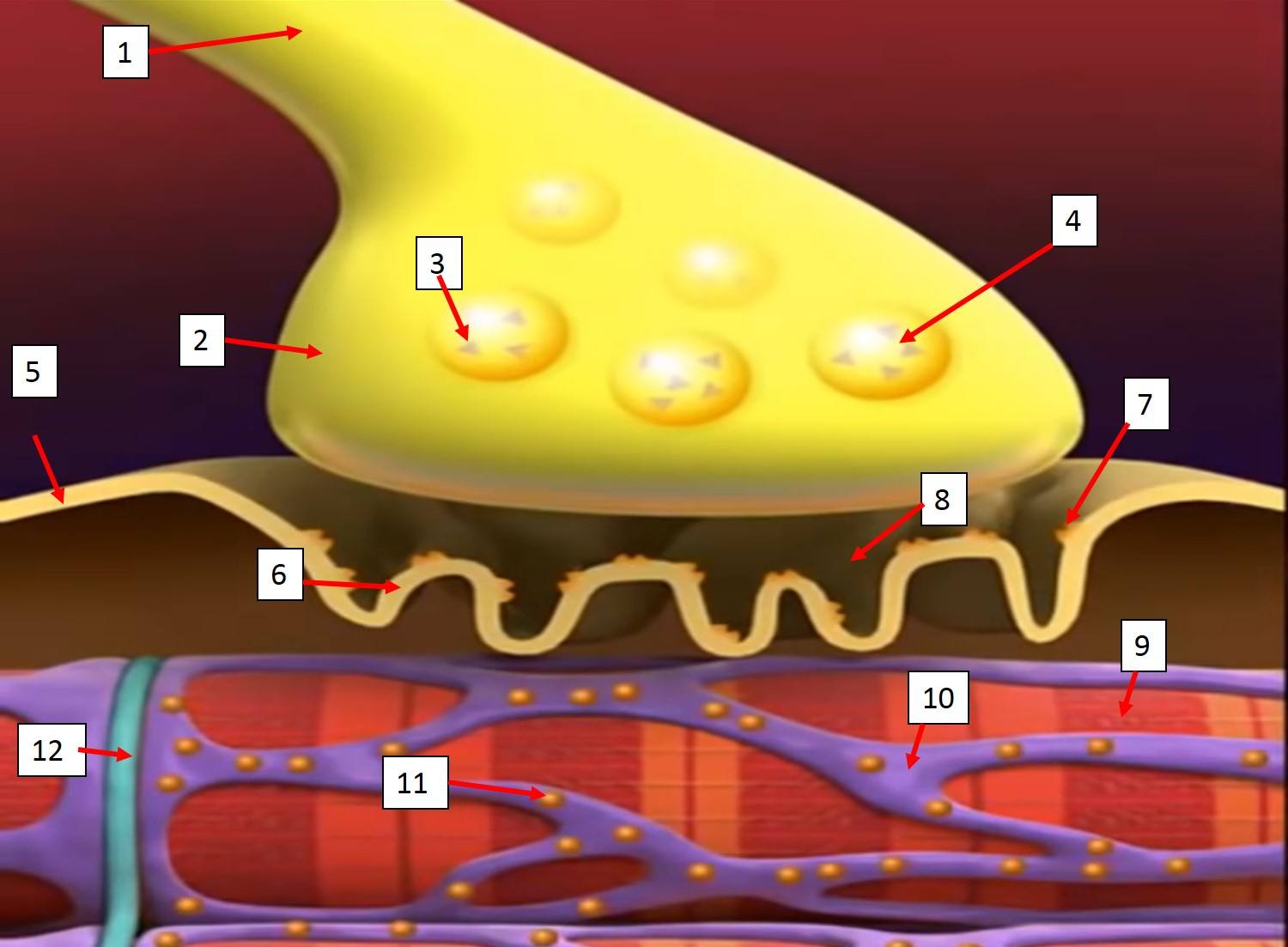
The specialized part of the cell membrane of the muscle fiber identified as #5

a)

Sodium ion (Na+)

b)

Axon Terminal of Motor Neuron

c)

motor end plate

d)

Vesicle

24.
Contractile unit of a muscle.
a)
sarcomere
b)
motor unit
c)
fascicle
d)
myofibril
25.
Thin filaments in a myofibril are
a)
Sarcomeres
b)
Sarcoplasm
c)
Actin
d)
Myosin
26.
What two chemicals are necessary for muscle contraction to occur?
a)
Niacin and Potassium
b)
Calcium and ATP
c)
Sodium and Potassium
d)
Ach and Potassium
27.
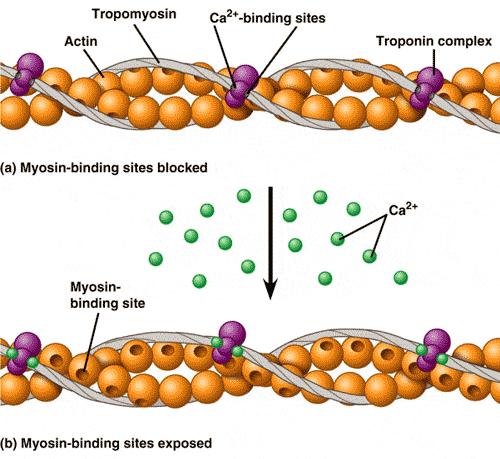
Calcium:
a)
causes ATP binding to actin
b)
increases the action potential along the sarcolemma
c)
binds to proteins on myosin
d)
triggers the binding of myosin to actin
28.
What is a crossbridge?
a)
Where myosin binds to actin
b)
Where the calcium crosses into the cytoplasm
c)
Where calcium binds with troponin
d)
None of the answers are correct.
29.

The property of all muscles that can be defined as the muscle tissue having a electric gradient which can reverse when stimulated is?

a)

Excitability

b)

Contraction

c)

Elongate