wayground logo

Free Printable Worksheets

NEW

Font size

S
M
L
XL
Worksheets

Plants

Total questions: 60

Worksheet time: 45mins

Name
Class
Date
1.
xylem: water transport
phloem : food transport
a)
TRUE
b)
FALSE
2.
Which structure inside the ovary contains egg cells?
a)
Ovules
b)
stigma
c)
peduncle
3.
Flowering: gymnosperms
Non-flowering : angiosperms
a)
TRUE
b)
FALSE
4.
Pine, gingko, cypress and spruce are examples of ________? 
a)
angiosperm
b)
gymnosperm
c)
ppteridophytes
5.
______ contain the sperm and egg cells of a plant which is protected by a tough coat inside a spore capsule.
a)
Conifers
b)
Sponges
c)
Spores
6.

These type of plant grow in moist and swampy environment and on top of old woods and rocks. Mostly they lack true roots and use tiny hairlike stems for absorption of water and nutrients from the soil.

a)

Simple plants

b)

Conifers

c)

Spores

7.
Conifers reproduce using cones. 
a)
TRUE
b)
FALSE
8.
The following are examples of spore-bearing plants except: 
a)
Fern
b)
Mosses
c)
Gingko
9.

What are the needs of plants?

a)

Air

b)

Sunlight

c)

Water

d)

Soil

e)

All of the Above

10.

What is the first stage of the plant life cycle?

a)

seedling

b)

seed

c)

adult plant

d)

germination

11.

When the seed gets the proper amount of sunlight, air, and water the seed is going through _________________.

a)

pollen

b)

watering

c)

germination

d)

metamorphosis

12.

Jenny saw a tree growing red apples. What stage of the plant life cycle is the tree in?

a)

mature plant

b)

seedling

c)

young plant

d)

seed

13.

Seeds can move from one place to another by

a)

wind

b)

water

c)

animals

d)

wind, water, and animals

14.

This part of the plant holds the plant in the ground and gets water and nutrients from the soil.

a)

stem

b)

leaves

c)

flower

d)

roots

15.

This part of the plant produces seeds and creates pollen.

a)

roots

b)

flower

c)

stem

d)

leaves

16.

When the plant has leaves but no flower or fruit, the plant is in the ____________ stage.

a)

seed

b)

mature plant

c)

young plant

d)

germination

17.

What is it called when seeds move from one place to another?

a)

germination

b)

seed dispersal

c)

life cycle

d)

seedling

18.

The ___________ absorb sunlight to help make food for the plant.

a)

seed

b)

stem

c)

roots

d)

leaves

19.

Jeffrey saw a small plant with a green stem sticking out of the soil. What stage in the plant life cycle is the plant in?

a)

seedling

b)

germination

c)

young plant

d)

seed

20.

Plants are __________

a)

non-living

b)

living

21.

The _________ helps hold the plant up and carries water and nutrients to the rest of the plant from the roots.

a)

leaves

b)

roots

c)

stem

d)

seed

22.
Which is a function of the roots?
a)
absorb sunlight
b)
start photosynthesis
c)
pull nutrients from the soil
d)
turn gray when they get old
23.
Which is a function of the stem?
a)
to be green
b)
to support the plant
c)
to absorb nutrients from the soil
d)
to talk about science, technology, engineering, and math
24.
Which is a function of the leaves?
a)
to provide shade
b)
to attract pollinators
c)
to make food through photosynthesis
d)
to absorb nutrients
25.
Which is a function of the flower?
a)
attract pollinators and produce seeds for reproduction
b)
to make food through photosynthesis
c)
to be pretty
d)
to absorb nutrients from the soil
26.
Which order of a plant life cycle is correct?
a)
seed -> seedling -> flower -> seed release
b)
seed -> seedling -> seed release -> flower
c)
flower -> seedling -> seed release ->seed
d)
seedling -> seed release -> flower -> seed
27.
What is plant germination?
a)
a place where plants get sick
b)
planting a seed
c)
When  a seed grows into a plant
d)
the way a plant makes food
28.
What is a seedling?
a)
a noisy seed
b)
a plant that is just starting to grow
c)
a flower seed
d)
a leaf
29.
What is one way to  know if a plant is an adult?
a)
it has a flower
b)
it’s green
c)
it’s big
d)
it has a deep voice
30.
What are three things plants need to survive?
a)
soil, dirt, sun
b)
water, sun, rich soil
c)
pizza, fries, ice cream
d)
water, fertilizer, shade
31.
What happens in the phloem?
a)
water moves up from the roots
b)
food moves down from the leaves
c)
food moves up from the roots
d)
water moves down to the roots
32.
Germination will not happen unless a seed
a)
is dispersed far from the plant that produced it
b)
absorbs water
c)
uses its stored food
d)
grows stamens and a pistil
33.
The energy that powers photosynthesis comes from
a)
water
b)
chemicals
c)
oxygen
d)
the sun
34.
What part of a plant transports water and nutrients from the root to the plant's stem and leaves?
a)
root hairs
b)
phloem
c)
xylem
d)
cuticle
35.
All of the following is a root function, except
a)
water absorption
b)
food storage
c)
plant anchoring
d)
food production
36.
Root hairs help a plant
a)
transport food to the root
b)
absorb water and nutrients
c)
protect the root
d)
store food
37.
_________________ are scientists who study plants.
a)
botanists
b)
ecologists
c)
zoologists
d)
chemists
38.
Plants need the following:
a)
air, water, space, sunlight
b)
air, water, oxygen, space
39.
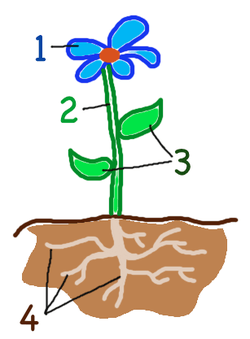
What part of the plant is #1?
a)
flower
b)
stem
c)
root
d)
leaf
40.
who uses photosynthesis 
a)
us
b)
no body
c)
i dont know 
d)
plants
41.
This part of the plant acts like an "elevator" carrying nutrients to the plant.
a)
roots
b)
stem
c)
leaves
d)
flower
42.
Plants have ways of getting their seeds to travel away from them because ______.
a)
they want to help animals.
b)
seeds that travel away from the parent are more likely to get light.
c)
seeds need water to grow.
43.
Should you water a cactus?
a)
Yes, but not every day.
b)
No because a cactus does not need water.
c)
Yes, every day.
d)
It does not matter how much you water a cactus because it will store the water.
44.
What part of a plant transports water and nutrients?
a)
flower
b)
leaf
c)
seed
d)
stem
45.
Where do angiosperms produce their seeds?
a)
pollen
b)
cones
c)
flowers
46.
What is the male reproductive part of the flower?
a)
carpel
b)
stamen
c)
ovary
47.

What part of the flower produces eggs?

a)

ovary

b)

petal

c)

anther

d)

stamen

48.

Why are flower petals colored?

a)

They attract different kinds of animals.

b)

The colors attract different pollen.

c)

The colors show which flowers are poisonous to bugs.

d)

They attract seeds.

49.

What does a fleshy fruit protect?

a)

cones

b)

petals

c)

seeds

d)

stamens

50.

What do seeds need to germinate?

a)

warm temperature and water

b)

oxygen and nutrients

c)

water and carbon dioxide

d)

oxygen and carbon dioxide

51.

During which part of the life cycle does the angiosperm embryo sprout?

a)

fertilization

b)

pollination

c)

germination

d)

reproduction

52.
What is the name for the outermost layer of a seed that helps to protect it?
a)
angiosperm
b)
radicle
c)
cotyledon
d)
seed coat
53.
The three parts of a seed are the:  
a)
seed coat, cotyledon, embryo
b)
roots, stem, flower
c)
seed coat, flower, cotyledon
d)
radicle, coleoptile, fibrous
54.

All statements below is true about Gymnosperm except

a)

heterosporous

b)

seed

does not enclosed within ovary

c)

non-vascular

plants

d)

less

dependent on water for fertilization

55.

What is the similarity between a gymnosperm and an angiosperm?

a)

angiosperms and gymnosperms both produce seeds

b)

angiosperms and gymnosperms both DO NOT produce seeds

c)

angiosperms are only found in the Wakanda

d)

all of the above

56.

What is the difference between angiosperms and gymnosperms?

a)

angiosperms produce seeds inside of a fruit or flowers

b)

gymnosperms produce seeds inside of a cone

c)

they both produce seeds

d)

all of the above

57.

What type of tree is a peach tree?

a)

angiosperm

b)

gymnosperm

c)

fern

d)

non-seed producing

58.

What type of tree is a Pine tree?

a)

angiosperm

b)

gymnosperm

c)

non-seed producing

d)

unicorn glitter

59.

Can non-seed producing plants reproduce?

a)

yes

b)

no

60.

How do non-seed producing plants reproduce?

a)

asexually

b)

by producing spores

c)

by growing new plants from rhizomes or tubers

d)

all of the above