
 Worksheets
Local/Global Winds and Heat Transfer
Total questions: 56
Worksheet time: 1hrs 16mins
low pressure area
warm, less dense air rises
cool, dense air sinks
large, circular patterns of moving air
movement of air caused by differences in air pressure
Coriolis Effect
bands of high and low pressure found about every 30 degrees of latitude
the curving of a path of a moving object from an otherwise straight path due to Earths rotation
winds that blow from east to west between 60 and 90 degrees latitude in both hemispheres
narrow belts of strong winds that blow in the upper troposphere
sea breeze
cool air moves down a mountain slope towards a valley
warm air rises up a mountain slope from a valley
cool land air flows to the ocean at night, causing warm ocean air to rise
cool ocean air flows to land during the day, causing warm land air to rise
land breeze
cool air moves down a mountain slope toward a valley
warm air rises up a mountain slope from a valley
cool land air flows to the ocean at night, causing warm ocean air to rise
cool ocean air flows to land during the day, causing warm land air to rise

Cool air moving across land and warm air rising up from the ocean will result in:
land breeze
sea breeze
warm breeze
no breeze
What causes wind?
differences in temperature and air pressure
differences in gravity
differences in oxygen content
differences in location on the globe
Sea breezes occur?
during the day
during the night
during both the day and night
only during a full moon
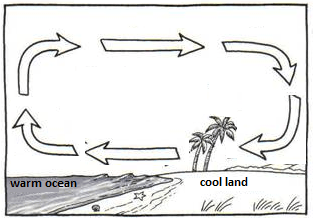
Which best describes why winds at the beach change direction between day and night? **
because the land heats and cools faster than water
because the direction of Earth's rotation changes
because warm air is more dense than cool air
because water is always colder than land
Why is the equator warmer than the north and south poles?
Because the equator receives less direct sunlight.
Because the equator receives more direct sunlight
Because gravity is stronger at the equator
Because gravity is stronger at the poles
Land breezes occur?
during the day
during the night
during both day and night
only during a full moon

Winds occur because hot air rises and cool air sinks in a process called...
conduction
convection
radiation
magnetism
Local winds blow over:
short distances
long distances
the poles
the equator


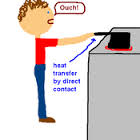

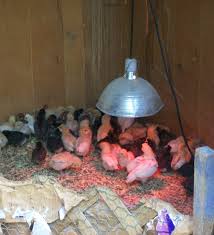
Energy transfer as electromagnetic waves is called
Thermal Conduction
Radiation
Convection
Cooking


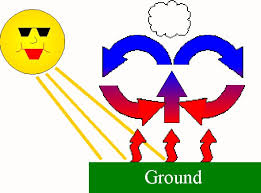


Warm air moving from the valley up the mountain during the day is called a________________.
Mountain breeze
Valley breeze
Land breeze
Sea breeze
What is heavy, cool air that blows down the side of a mountain into the valley at night called?
Sea breezes
Valley breezes
Land breezes
Mountain breezes

when denser air flows down the slopes of mountains into the valleys
mountain breeze
land breeze
sea breeze
valley breeze
when less dense mountain air rises and is replaced by cooler, denser valley air
mountain breeze
land breeze
sea breeze
valley breeze

Weather patterns in the US move from west to east because
the tradewinds move them
the prevailing westerlies move them
the polar easterlies move them
sea breezes move them
Winds occur because hot air rises and cool air sinks in a process called...
conduction
convection
radiation
magnetism
At the equator and at 600 latitude, warm air rises creating a windless area known as the...
doldrums
horse latitudes
westerlies
polar easterlies

Winds that blow from 300 latitude to the equator are called...
westerlies
polar easterlies
trade winds
horse latitudes

The rotation of the Earth causes winds to bend due to the...
coriolis effect
doldrums
trade winds
westerlies

Winds that blow from 300 latitude to 600 latitude are called...
polar easterlies
westerlies
trade winds
doldrums

Cooler air sinks at 300 latitude causing a windless area known as...
doldrums
horse latitudes
polar easterlies
westerlies

Winds that blow from the North and South pole toward 600 latitude are called...
trade winds
westerlies
polar easterlies
horse latitudes
Winds always blow from areas of _________ pressure to areas of _________ pressure.
high, high
low, low
low, high
high, low
What is the general pattern of winds at the equator?
Winds are generally strong because the equator is a region of mostly low air pressure
Winds are generally weak because the equator is a region of mostly low air pressure
Winds are generally strong because the equator is a region of mostly high air pressure
Winds are generally weak because the equator is a region of mostly high air pressure
Which heats up and cools more quickly?
Land
Sea
They heat and cool equally
What causes the Coriolis Effect?
Rotation of the Earth
Rotation of the Moon
Earth tilt
Rotation of the Sun
Where does the initial source of energy come from that creates winds?
the moon
the sun
the rotation of the Earth
Why does warm air rise?
Warm air is more dense than cooler air.
Warm air is less dense than cooler air.
Warm air has more pressure than cooler air.
Warm air has a higher dew point than cooler air.
What direction do winds in the Northern Hemisphere blow?
right
left
straight
What direction do winds in the Southern Hemisphere blow?
right
left
straight
wind
warm, less dense air rises
cool, dense air sinks
large circular patterns of moving air
movement of air cause by differences in air pressure
jet stream
bands of high and low pressure found about every 30 degrees of latitude
the curving of a path of a moving object from an otherwise straight path due to Earth's rotation
winds that blow from east to west between 60 and 90 degrees latitude in both hemispheres
narrow belts of strong winds that blow in the upper troposphere
Due to the Coriolis effect, global winds in the northern hemisphere deflect:
clockwise
counter-clockwise
Due to the Coriolis effect, global winds in the southern hemisphere deflect:
Clockwise
Counter-clockwise

