wayground logo

Free Printable Worksheets

Font size

S
M
L
XL
Worksheets

Semester End - Medical Detectives

Total questions: 39

Worksheet time: 28mins

Name
Class
Date
1.

A person is running a race. Which of the following will happen to their vital signs as they’re running?

a)

Blood pressure will decrease

Pulse will increase

Respiratory rate will increase

b)

Blood pressure will increase

Pulse will increase

Respiratory rate will increase

c)

Blood pressure will increase

Pulse will decrease

Respiratory rate will increase

d)

Blood pressure will decrease

Pulse will decrease

Respiratory rate will decrease

2.

What does the heart pump to the body along with blood?

a)

Oxygen

b)

Germs

c)

Viruses

d)

Plaque

3.

Which is an example of 4 important vital signs we've learned about?

a)

blood sugar

b)

respiration rate

c)

glucose level

d)

blood level

4.

Javier's heart beats 15 times in 20 seconds. What is his beats per minute?

a)

45 bpm

b)

40 bpm

c)

30 bpm

d)

60 bpm

5.

The units for pulse are

a)

beats per minute

b)

inches

c)

mmHg

d)

heart rate

6.
Factors that affect body temperature
a)
Exercise
b)
Humidity
c)
Emotion
d)
All of the above
7.
Which is most often used to destroy bacteria?
a)
fungus
b)
vitamin
c)
vaccine
d)
antibiotics
8.
Why are viruses considered to be nonliving organisms?
a)
They do not have genetic information.
b)
They are not able to move on their own.
c)
They do not interact with their environment.
d)
They are not able to reproduce without a host cell.
9.
Normal blood pressure measures below
a)
145/90
b)
130/90
c)
120/80
d)
150/70
10.
a)
Frontal Lobe
b)
Brain Stem
c)
Cerebellum
d)
Occipital Lobe
11.
a)
Cerebellum
b)
Brain Stem
c)
Occipital Lobe
d)
Temporal Lobe
12.
Which of the TWO nervous systems contains motor and sensory neurons?
a)
central nervous system
b)
peripheral
c)
motor
d)
sensory
13.
What two things are found in the central nervous system?
a)
brain/spinal cord
b)
spinal cord/motor neurons
c)
motor/sensory neurons
d)
only brain
14.
The nerves in your legs are part of the ____ nervous system.
a)
Central 
b)
Peripheral
15.

Neurons that pass sensory information from the peripheral nervous system to the brain are called

a)

sensory neurons

b)

motor neurons

c)

interneurons

d)

reflex arc neurons

16.
If I step on a nail...what type of neurons take the response to my muscles?
a)
motor
b)
interneurons
c)
sensory
d)
not neurons, muscle tissue sends the response
17.
part of a neuron that receives information from other neurons
a)
axon
b)
dendrites
c)
myelin sheath
d)
synapse
18.

What contains the nucleus of the neuron?

a)

Terminal Bouton

b)

Cell Body

c)

Axon Hillock

d)

Myelin Sheath

19.
A nerve cell that is the basic working unit of the brain and nervous system which processes and transmits information
a)
axon
b)
neuron
c)
dendrite
d)
neurotransmitter
20.

What part of the brain monitors higher-order thinking, directs problem solving, and regulates the excesses of the emotional system?

a)

Amygdala

b)

brain stem

c)

cerebellum

d)

frontal lobe

21.

If you damaged your cerebellum, you would have difficulty with:

a)

forming sentences

b)

recognizing faces

c)

chewing

d)

balance

22.

Which of the following would an epidemiologist NOT study?

a)

food poisoning

b)

mental illness

c)

low blood sugar

d)

cancer

23.
The branch of medical science concerned with the incidence, distribution, and control of diseases that affect large numbers of people is _____________.
a)
Cardiology
b)
Radiology
c)
Epidemiology
d)
Respirology
24.
Research question: does the distance a person kicks a soccer ball effect how well they will do on their math test.  What is the dependent variable?
a)
How far they kick the soccer ball
b)
who the person is
c)
how well they do on the math test
d)
Type of soccer ball.
25.
When experimenting with the growth of a plant, a scientist uses three (of the same type of) plants, two different fertilizers, equal light, and equal water. What type of variable is the fertilizer?
a)
Dependent
b)
Independent
c)
Control
d)
Compound
26.
This part of the experiment serves as a basis of comparison; the one variable being tested has been omitted. 
a)
experimental group
b)
control group
c)
data
d)
variables
27.

What is the last thing you should do for aseptic technique?

a)
take off your gloves
b)
wash your hands
c)
sterilize your workspace
28.

Before incubation the plate should be...

a)

Sealed completely with tape

b)

Sealed with four pieces of tape

c)

Sealed with two pieces of tape

d)

Doesn't need sealing

29.

How should agar plates be incubated

a)

Right side up

b)

Upside down

c)

Sideways

d)

All of the above

30.

The part of the neuron that receives messages from adjacent neurons

a)

axon

b)

axon terminal

c)

dendrite

d)

neuron

31.

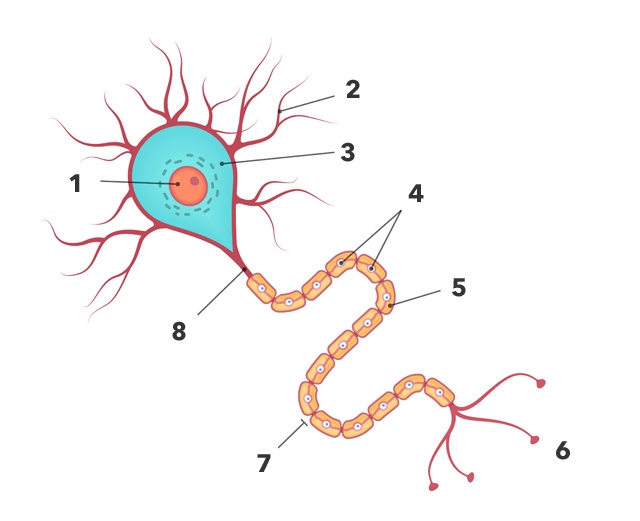
Identify #2

a)

axon

b)

cell body

c)

dendrite

d)

myelin sheath

32.

Identify #3

a)

axon

b)

cell body

c)

dendrite

d)

myelin sheath

33.

Which is represented by the letter G?

a)

axon

b)

myelin sheath

c)

schwan cell

d)

terminal branches

34.
_____ neurons carry messages to the central nervous system
a)
Motor
b)
Inter
c)
Sensory
d)
Fun
35.

Which system has Motor and Sensory Neurons

(a)  

36.

Which system takes in information about the environment around you

(a)  

37.
Which lobe allows us to judge the consequences of our behaviors?
a)
Frontal
b)
Occipital
c)
Temporal
d)
Insula
38.
Which lobe allows us to process what we are hearing?
a)
Frontal
b)
Parietal
c)
Temporal
d)
Occipital
39.
Which lobe allows us to process what we are seeing?
a)
Occipital
b)
Parietal
c)
Temporal
d)
Insula