Wayground logo

Free Printable Worksheets

Font size

S
M
L
XL
Worksheets

AP Bio Full Genetics Exam

Total questions: 65

Worksheet time: 1hrs 11mins

Name
Class
Date
1.

Which term refers to an organism's physical appearance

a)

recessive allele

b)

dominant

c)

genotype

d)

phenotype

2.

Which term refers to an organism's genetic traits?

a)

offspring

b)

genotype

c)

phenotype

d)

behavior

3.

Mendel concluded that alleles for tall pea plants is dominant. If you cross a TT with a Tt, how many plants would be tall?

a)

50%

b)

100%

c)

25%

d)

75%

4.
Each parent contributes one of the genes for a particular trait. The genes of the pair are called:
a)
variables
b)
gametes
c)
hybrids
d)
alleles
5.
Chromosomes that carry genes that code for the same products, such as hemoglobin or eye pigment, are said to be:
a)
homologous
b)
heterozygous
c)
heterogeneous
d)
homozygous
6.
In snapdragons, Tallness (T) is dominant to dwarfness (t). In a cross between two plants that are heterozygous for this trait, the percent of offspring expected to exhibit dwarfness is
a)
 25%
b)
100%
c)
50%
d)
0%
7.
In dragons, large scales (S) are dominant and small scales (s) are recessive. A dragon that is heterozygous for the trait is crossed with a dragon that has small scales. What should be the ratio of large-scaled dragons to small-scaled dragons among the offspring?
a)
1:2
b)
1:1
c)
2:1
d)
3:1
8.
Cystic Fibrosis (CF) is a genetic disorder that is controlled by a recessive allele. If a person suffering from CF were to marry an individual who is heterozygous for the trait, what % of their children could be expected to unaffected carriers of the trait? Ignore issues of sterility in persons with CF.
a)
0%
b)
25%
c)
75%
d)
50%
9.
A __________ is a segment of DNA that codes for a particular protein, which leads to a particular trait.
a)
Gene
b)
Allele
c)
Codon
d)
Nucleotide
10.
Which of the following is an example of a heterozygous genotype?
a)
RR
b)
Rr
c)
rr
11.
The letters on the TOP AND SIDE of a punnett square represent ______________.
a)
The combination of alleles in offspring.
b)
The possible alleles given by the parents following meiosis.
c)
The genotype and phenotype of offspring.
d)
The results of genetic mutations in offspring.
12.
The dominant trait in this punnett square is
a)
yellow pea seeds
b)
green pea seeds
c)
there is no dominant seed
13.
_______ is made during transcription and ________ is made during translation.
a)
mRNA / a protein
b)
a protein / mRNA
c)
Ribosome / Nucleus
d)
mRNA / tRNA
14.
Which RNA bases would pair with TAC  in transcription? 
a)
AUG
b)
ATG
c)
GCA
d)
GCA
15.
A triplet (3 bases)  of mRNA is called a
a)
codon
b)
anticodon
c)
amino acid
d)
peptide bond
16.
What amino acid is represented by the codon CAG?
a)
Aspartic Acid
b)
Histidine
c)
Glutamine
d)
Methionine
17.
Which enzyme is responsible for making RNA?
a)
DNA polymerase
b)
RNA enzymase
c)
RNA polymerase
d)
RNA proliferase
18.
Translation happens in the - 
a)
Nucleus
b)
Ribosome
c)
Chloroplast
d)
Smooth Endoplasmic Reticulum
19.
Does the order of amino acids in a protein matter?
a)
YES!
b)
NO!
20.
tRNA is involved in
a)
carrying amino acids 
b)
carrying ribosomes
c)
carrying glucose
d)
carrying lipids
21.
What do we call the process of turning DNA into mRNA?
a)
Translation
b)
Transcription 
c)
Replication
22.
What mutation has occurred here? 
T-G-A-C-C-A
T-G-A-G-C-A
a)
Substitution
b)
Deletion
c)
Insertion
d)
Frameshift 
23.

A mutation in which only one nucleotide is altered is called a:

a)

Frameshift Mutation

b)

Deletion Mutation

c)

Point Mutation

d)

Insertion Mutation

24.

A mutation is defined as:

a)

A change in the cell's structure

b)

Anything that changes in an embryo

c)

Any change in the physical features of a human

d)

A change in the genetic code

25.

Genetic mutations can be...

a)

beneficial, harmful, or neutral

b)

beneficial only

c)

harmful only

d)

neutral only

26.

What type of mutation is shown in the diagram?

a)

Point mutation - missense

b)

Frameshift Mutation - deletion

c)

Frameshift Mutation - addition

d)

Point mutation - nonsense

27.
If a segment of double-stranded DNA has 40 percent A, how much of it is C?
a)
40
b)
10
c)
15
d)
20
28.
What are the nucleotides made of?
a)
Sugar, Phosphate, nitrogen base
b)
Phosphate, Adenine, nitrogen base
c)
Thymine, Adenine, Cytomine
d)
Phosphate, Nitrogen, Adenine
29.
Where does transcription occur in eukaryotic cells?
a)
Nucleus
b)
Ribosome
c)
Cytoplasm
d)
Rough E.R.
30.
The genetic code is essentially the same for all organisms. From this, one can logically assume which of the following?
a)
The same codons in different organisms translate into the different amino acids.
b)
A gene from an organism can theoretically be expressed by any other organism.
c)
All organisms have experienced convergent evolution.
d)
DNA was the first genetic material.
31.
Each amino acid is different from the other due to....
a)
The R group
b)
The amino group
c)
The carboxyl group
d)
The central carbon
32.
Which of these is correct?
a)
DNA --> mRNA --> polypeptide chain
b)
DNA --> polypeptide chain --> mRNA
c)
mRNA --> DNA --> polypeptide chain
d)
polypeptide chain --> DNA --> mRNA
33.

Where does transcription in prokaryotes occur?

a)

nucleus

b)

cytosol

c)

ribosome

d)

nucleolus

34.

Protein 1, 2 and 3 all were translated from Gene A. This is an example of....

a)

mutations

b)

alternative splicing

c)

transcription

d)

cancer

35.

Which of the following proteins is correctly matched to the process it is involved in?

a)

ribosome: RNA processing

b)

ribosome: transcription

c)

RNA poly. II: translation

d)

snRPs: splicing

36.

A substance that causes mutations in DNA is called a/an

a)

substitution

b)

frameshift mutation

c)

mutagen

d)

spliceosome

37.
Which of the following does not occur in prokaryotic gene expression but does occur in eukaryotic gene expression?
a)
mRNA, tRNA, and rRNA are transcribed
b)
RNA polymerase binds to the promotor
c)
a poly-A tail is added to the ends of the mRNA
d)
Transcription can begin as soon as translation has begun even alittle
38.
What is the function of the poly-A tail in mRNA?
a)
to add modified guanin to the 3' end of the mRNA
b)
to indicate the site of translational termination
c)
to code for the binding of RNA polymerase to the DNA
d)
to help protect the mRNA from degradation by hydrolytic enzymes 
39.
Accuracy in the translation of mRNA into the sequence of amino acids in a polypeptide depends on specificity in which of the following?
a)
binding of ribosomes to mRNA
b)
shape of the A and P sites of ribosomes
c)
attachment of amino acids to tRNAs
d)
bonding of the anticodon the codon and the attachment of amino acids to tRNAs
40.
Which of the following events in translation is the first to occur in eukaryotes?
a)
elongation of the polypeptide
b)
base pairing of activated methionine-tRNA to AUG of the messenger RNA
c)
binding of the larger ribosomal subunit to smaller ribosomal subunits
d)
the small subunit of the ribosome recognizing and attaching to the 5'cap
41.
What is the function of the release factor in translation?
a)
it separates tRNA in the A site from the growing polypeptide
b)
it binds to the stop codon in the A site in place of a tRNA
c)
it releases the amino acid from its tRNA to allow the amino acid to form a polypeptide
d)
it releases the ribosome from the ER to allow polypeptides into the cytosol
42.
A tRNA (#1) attached to the amino acid lysine enters the ribosome.  The lysine binds to the growing polypeptide on the other tRNA (#2) already in the ribosome. Where does tRNA (#2 move to next?
a)
A site
b)
P site
c)
E site
d)
exit tunnel
43.

How do the leading and the lagging strands differ?

a)

The leading strand is synthesized in the same direction as the movement of the replication fork, and the lagging strand is synthesized in the opposite direction.

b)

The leading strand is synthesized at twice the rate of the lagging strand.

c)

The leading strand is synthesized in short fragments that are ultimately stitched together, whereas the lagging strand is synthesized continuously.

d)

The leading strand is synthesized by adding nucleotides to the 3' end of the growing strand, and the lagging strand is synthesized by adding nucleotides to the 5? end.
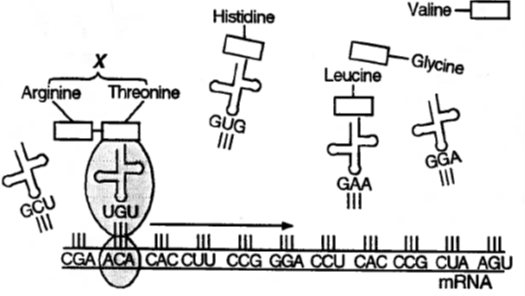
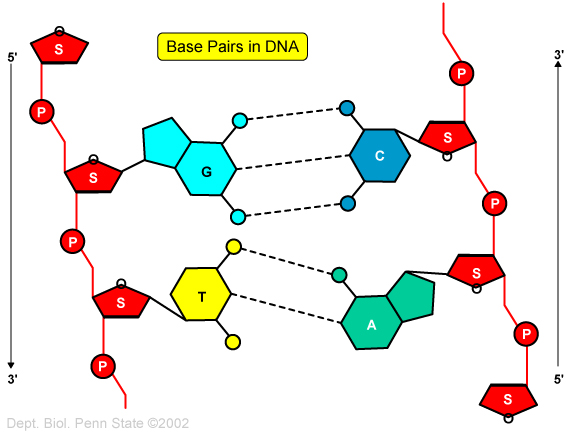
44.
Enyzmes are a very important type of protein used to
a)
Build bones in skeleton
b)
Send hormonal signals throughout body
c)
Speed up chemical reactions
d)
Photosynthesize glucose in plants
45.
In his work with pneumonia-causing bacteria & mice, Griffith found that 
a)
the protein coat from pathogenic cells was able to transform nonpathogenic cells.
b)
heat-killed pathogenic cells caused pneumonia.
c)
some substance from pathogenic cells was transferred to nonpathogenic cells, making them pathogenic.
d)
the polysaccharide coat of bacteria caused pneumonia.
46.
Experiment that radioactively labeled the proteins and DNA of bacteriophages to determine if DNA or protein was the transforming agent
a)
Avery
b)
Watson & Crick
c)
Messelson & Stahl
d)
Hershey & Chase
47.
What process is going on in this photo? 
a)
Transcription 
b)
Translation 
c)
Replication 
d)
All the above 
48.
Nitrogenous bases are joined by which type of bond?
a)
polar bonds
b)
ionic bonds
c)
covalent bonds
d)
hydrogen bonds
49.
The enzyme that unzips the DNA to prepare for replication
a)
helicase
b)
replicase
c)
polymerase
d)
synthase
50.
order of replication
a)
3, 2, 1, 4
b)
2, 1, 4, 3
c)
2, 3, 1, 4
d)
3, 4, 1, 2
51.
Seals the Okazaki fragments together
a)
DNA Polymerase
b)
ligase
c)
helicase
d)
primase
52.
Which enzyme is responsible for adding nucleotides?
a)
Topoisomerase
b)
DNA Polymerase
c)
Ligase
d)
Primase
53.
DNA is replicated using the _______________ model
a)
conservative
b)
dispersive
c)
semiconservative
54.

Which two bases are pyrimidines?

a)

A & C

b)

G & C

c)

C & T

d)

A & G

55.
Notice the two arrows in the image.  These arrows are emphasizing the antiparallel (going in opposite directions) nature of DNA.  The arrows are also pointing to the ______ end of DNA.
a)
5 prime
b)
3 prime
c)
wrong
d)
right
56.

During DNA replication, which protein keeps the two strands of DNA from reannealing (sticking back together?)

a)

Single Stranded Binding Proteins (SSBP)

b)

Helicase

c)

DNA polymerase

d)

Ligase

57.

Which of the following acts like a tiny pair of scissors and, when it recognizes a specific sequence, it cuts?

a)

Ligase

b)

Restriction Enzyme

c)

DNA Polymerase

d)

Helicase

58.
There are many variations in skin color that can be inherited based on the combination of alleles that you inherit from your mom and dad.  This bell curve distribution is an example of
a)
incomplete dominance
b)
codominance
c)
blocked traits
d)
polygenic inheritance
59.
If you cross a black chicken with a white chicken, only checkered chickens would be produced.  What kind of inheritance pattern does this follow?
a)
incomplete Dominance
b)
Co-Dominance
c)
polygenic trait
d)
blocked trait
60.
Which type of inheritance is this?
a)
co-dominance
b)
incomplete dominance
c)
simple dominant/recessive
d)
environmental trait
61.
This type of inheritance pattern is a MIXTURE of both traits.
a)
incomplete dominance
b)
co-dominance
c)
complete dominance
d)
recessive pattern
62.
What percentage of the female offspring will be a carrier for this recessive disease?
a)
0%
b)
50%
c)
100%
d)
25%
63.
Looking at this pedigree, how many female family members are carriers?
a)
1
b)
3
c)
10
d)
7
64.
What gender of offspring are most often affected by sex-linked inheritance?  What gender are usually carriers of the trait?
a)
males, males
b)
females, males
c)
males, females
d)
females, females
65.
The visual representation of an individual's chromosomes is a 
a)
phenotype
b)
genotype
c)
karyotype
d)
stereotype