
 Worksheets
Newton's Laws
Total questions: 50
Worksheet time: 40mins
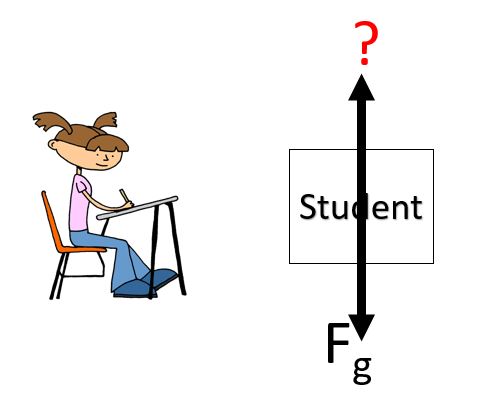
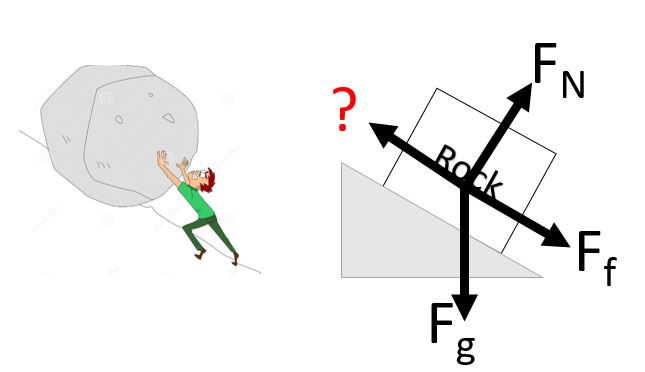

In a force diagram, or free-body diagram, the size/length of the arrow tells you this about the force:
magnitude of force
direction of force
objects speed
When determining the NET force on an object you should (TWO correct answers)
subtract forces in opposite directions
add forces in the same direction
divide by velocity
multiply by acceleration
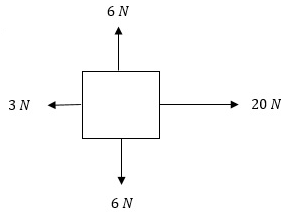
What is the NET FORCE of this diagram?
17 N, right
17 N, left
23 N, right
12 N, up

This diagram can be used to indicate which of the following? (TWO correct answers)
a object at rest
an object moving at a constant velocity (speed)
an object accelerating
(Trick question -- there is only one correct answer)
an object decelerating

The coffee cup in the picture is at rest on the table. What is true about the Normal force?
The normal force is exactly 15
The normal force is less than 15
The normal force is more than 15
The normal force is -10

The hockey puck is moving at a constant velocity across the ice. What forces does the puck experience at this moment?
None
Gravity
Gravity and Normal
Gravity, Normal, and Friction
Gravity, Normal, Friction, and Applied

The forces on this chandelier are...
Gravity
Gravity and Normal
Gravity and Tension
Gravity, Tension, Friction, and Applied

How much is Fnet on the system?
50 N
30 N
5 N
3 N

What is the weight of the 25 kg block?
2.5 N
25 N
250 N
.25 N

What is the force of the 12 kg hanging mass?
.12 N
1.2 N
12 N
120 N

What is the acceleration of the system of the two blocks?
10 m/s/s
.32 m/s/s
3.2 m/s/s
.1 m/s/s
What is Newton's First Law
F=ma
Every action has an equal and opposite reaction
Friction
An object at rest stays at rest, an object in motion stays in motion.
True or False. Acceleration of an object is directly proportional to the net force acting on it?
True
False
An evil ewok threw a rock with a force of 24.6N and an acceleration of 6m/s2 at an innocent stormtrooper. What was the rocks mass?
4Kg
41kg
4.1kg
46kg
Your car has a mass of 2500 kg and a force of 5000 N. How fast will it accelerate?
20 m/s2
2 m/s2
0.5 m/s2
120 N

What happens when unbalanced forces act on an object at rest?
the object remains at rest
the object begins moving in an unpredictable direction
the object begins moving in the direction of the net force
the object begins moving opposite to the direction of net force
A 20 kg bike accelerates at 10 m/s2. What was the force?
25 Newtons
20 Newtons
200 Newtons
10 Newtons

What is the net force?
40 N left
400 N right
0 N Balanced
40 N right
What Unit do we Measure Force in?
Newtons
Joules
Kilogram
Work
Jenny applies a 60 N force to a 20 Kg cart, what is the acceleration of the cart if friction can be neglected?
1200 m/s/s
0.33 m/s/s
20 m/s/s
3 m/s/s
You push on a tree with 20 N of force. If the tree doesn't move, the tree is pushing back on you with _____of force.
20N
10N
40N
70N
What is Newton's 2nd Law?
F=ma
Every action has an equal and opposite reaction
An object at rest stays at rest, an object in motion stays in motion.
Friction
Newton's 1st Law is also called the Law of ...
Friction
Inertia
Unbalanced forces
Newtons
Because of inertia, a moving object will keep ________ unless acted on by an unbalanced force.
at rest
moving
in one spot
inertia

What is the net force acting on this mass?
2 N SE
8.2 N SE
68 N SE
10.2 N SE

Can this object be going at a constant velocity?
No, there is a net force acting on the object
No, there is not a net force acting on the object
Yes, there is a net force acting on the object
Yes, there is not a net force acting on the object
What explains why objects resist changes in their state of motion?
gravity
inertia
force
friction
What would happen if a ball was kicked is space?
It continues in the same direction, speeding up as it goes.
It continues in the same direction, speeding up as it goes.
It continues to move in the same direction unless it hits something or is affected by gravity or another force.
Newton’s law states that for every action, there is an ________ reaction.
unequal and opposite
equal and similar
stronger and opposite
equal and opposite

When a small car pushes a big truck, the truck applies an equal and opposite force on the car.
False
True

A book pushes down on a table with a force of 5N, the table..
Pushes back with a force of 5N
Pushes back with a force less than 5N
Pushes back with a forcec greater than 5N
Does nothing. A table has no force.

When a cannon fires a cannonball we observe the action of the cannonball pushing forwards off of the cannon. Which is the reaction force?
The cannon pushing up on the ground
The cannon pushing backwards off of the cannonball
The cannonball pulling backwards
The cannonball falling forward

