wayground logo

Free Printable Worksheets

Font size

S
M
L
XL
Worksheets

Biology 30S Course Review

Total questions: 147

Worksheet time: 7hrs 21mins

Name
Class
Date
1.
The movement of particles from an area of high concentration to an area of low concentration is called:
a)
Diffusion
b)
Osmosis
c)
Plasmolysis
d)
Homeostasis
2.
Which of the following statements about facilitated diffucsion is NOT true?
a)
It moves substances with the concentration gradient
b)
It is a form of active transport
c)
It utilizes channel proteins in the cell membrane
d)
It does not require cellular energy
3.
Which of the following is a form of active transport?
a)
Osmosis
b)
Diffusion
c)
Facilitate diffusion
d)
Endocytosis
4.
A fish is placed in a tank of water and it's cells soon begin to swell up with water. This means the water was a __________ solution compared to the fish.
a)
Hypertonic
b)
Isotonic
c)
Hypotonic
d)
Catatonic
5.
Consider our dialysis tubing demo. Iodine could pass through the tubing, but starch could not. What property of cell membranes does this demonstrate?
a)
That membranes are made of lipid
b)
That membranes are semipermeable
c)
That membranes are electrically neutral
d)
That membranes are permeable
6.
Consider our dialysis tubing demo. Iodine could pass through the tubing, but starch could not. What property of cell membranes does this demonstrate?
a)
That membranes are made of lipid
b)
That membranes are semipermeable
c)
That membranes are electrically neutral
d)
That membranes are permeable
7.
What is the final component of a reflex arc?
a)
Effector
b)
Receptor
c)
Integrating Centre
d)
Afferent Pathway
8.
Which of the following is NOT an example of a reflex?
a)
Catching a ball
b)
Blinking when an object flies at your face
c)
Jumping at a loud nosie
d)
Coughing when something irritates your throat
9.
Which of the following is an example of a receptor?
a)
Salivary glands
b)
Eyes
c)
Heart
d)
Patella
10.
In which direction does the afferent pathway conduct impulses?
a)
From the brain to the spinal cord
b)
From receptors to the brain/spinal cord
c)
From the brain/spinal cord to the receptors
d)
From the brain/spinal cord to the effectors
11.
The integrating centre is primarily made up of these kinds of neurons.
a)
Sensory neurons
b)
Interneurons
c)
Motor neurons
d)
Sensory and motor neurons
12.
What are the four most common elements present in organic molecules?
a)
C, H, O, N
b)
C, H, O, P
c)
C, H, I, N
d)
C, H, O, K
13.
Foods like milk, cheese, yogurt, and green leafy vegetables are especially good sources of which mineral?
a)
Calcium
b)
Iodine
c)
Nitrogen
d)
Magnesium
14.
What type of biomolecule is represented in this image?
a)
A protein
b)
A lipid
c)
A monosaccharide
d)
A disaccharide
15.
Burning 1 gram of carbohydrate releases approximately ___ Calories of energy
a)
4
b)
9
c)
1
d)
2
16.
What are the "ingredients" for building one molecule of lipid?
a)
One glycerol and three fatty acids
b)
One fatty acid and three glycerols
c)
One glycerol and three amino acids
d)
Three amino acids and one glycerol
17.
What type of molecule is shown in this image?
a)
A lipid
b)
A protein
c)
A carbohydrate
d)
An amino acid
18.
What type of molecule is shown in this image?
a)
A saturated fatty acid
b)
An unsaturated fatty acid
c)
An amino acid
d)
Glycerol
19.
The formula C12H24O2 represents what type of biomolecule?
a)
A lipid
b)
A carbohydrate
c)
A protein
d)
A vitamin
20.
Which of the following is NOT a part of the structure of an amino acid?
a)
An amino group
b)
A carboxyl group
c)
A hydroxyl group
d)
A variable side chain
21.
This is a dipeptide. Glycine and alanine were joined together using what process?
a)
Dehydration synthesis
b)
Hydrolysis
c)
Digestion
d)
Adhesion
22.
Lactose and lactase form an enzyme-substrate complex. In this complex, which is the substrate?
a)
Lactose
b)
Lactase
c)
The one with the highest concentration
d)
The one with the lowest concentration
23.
Scurvy is cause by a deficiency in what vitamin?
a)
Vitamin B12
b)
Vitamin C
c)
Vitamin D
d)
Vitamin B3 (niacin)
24.

How many generations are shown in this pedigree?

a)

1

b)

2

c)

3

d)

4

25.

How many kids did the mother and father from the first generation have?

a)

2

b)

4

c)

5

d)

6

26.
How many boys did the mother and father from the first generation have?
a)
2
b)
4
c)
5
d)
6
27.
How many individuals are there in the 3rd generation?
a)
2
b)
3
c)
4
d)
6
28.
In a pedigree, what shape represents a male?
a)
circle
b)
square
c)
triangle
d)
diamond
29.
How are individuals III-2 and II-4 related?
a)
Cousins
b)
Dad and Daughter
c)
Uncle and Niece
d)
Grandpa and Granddaughter
30.
Which of the following structures is a piece of anatomy that is shared with the digestive system?
a)
Trachea
b)
Pharynx
c)
Bronchioles
d)
Pleural membrane
31.
What do the trachea and the bronchioles have in common?
a)
Both contain cartilage
b)
Both display dichotomous branching
c)
Both transport air
d)
All of the above
32.
The volume of the thoracic cavity is determined by the position of which structures?
a)
Ribcage, diaphragm, abdominal muscles
b)
Ribcage, pleural membrane, abdominal muscles
c)
Diaphragm, abdominal muscles, lungs
d)
Ribcage, lungs, abdominal muscles
33.
The two types of respiration that occur in the body are:
a)
Cellular and physical
b)
Cellular and atmospheric
c)
Physical and atmospheric
d)
Physical and mechanical
34.
Internal respiration refers to the exchange of gases between the blood and:
a)
Cell contents
b)
Atmosphere
c)
Plasma
d)
Diffusion
35.
Oxygen and carbon dioxide move between the alveoli and capillaries as a result of:
a)
Diffusion
b)
Active transport
c)
Facilitated diffusion
d)
Membrane-bound vesicles
36.
These structures line the trachea to help remove dirt and foreign bodies from the air stream.
a)
Cilia
b)
Flagella
c)
Hair
d)
Valves
37.
The actual site of gas exchange between the blood and the atmosphere is/are:
a)
Alveoli
b)
Bronchioles
c)
Bronchi
d)
Pleural membrane
38.
The fact that you breathe heavily after strenuous exercise is a sign that your body is in:
a)
Oxygen debt
b)
Homeostasis
c)
Hypoglycemia
d)
Hyperglycemia
39.
What molecule is responsible for transporting oxygen and carbon dioxide around the body?
a)
Hemoglobin
b)
Mitochondria
c)
Lactic acid
d)
Carbonic acid
40.
The extra air you can force out of your lungs after a normal expiration is called:
a)
Reserve air
b)
Tidal air
c)
Complemental air
d)
Vital capacity
41.
A loss of lung elasticity is called:
a)
Emphysema
b)
Chronic bronchitis
c)
Smoker's cough
d)
Barrel chest
42.
Which of the following is NOT a major component of blood?
a)
Erythrocytes
b)
Leukocytes
c)
Platelets
d)
Villicytes
43.
Which plasma protein plays a role in blood clotting?
a)
Fibrinogen
b)
Albumin
c)
Globulin
d)
Hemoglobin
44.
Which blood components are made in the bone marrow?
a)
White blood cells
b)
Platelets
c)
Red blood cells
d)
All of the above
45.
Which of the following substances is responsible for dissolving blood clots?
a)
Plasmin
b)
Thrombin
c)
Thromboplastin
d)
Fibrin
46.
Swelling, redness, heat, and pain are signs of the inflammatory response. This is part of the body's _______ line of defense.
a)
First
b)
Second
c)
Third
d)
Immunity
47.
A substance that can trigger an immune response is called a(n):
a)
Antibody
b)
Antigen
c)
Leukocyte
d)
Corpuscle
48.
Name the structure indicated by the arrow.
a)
Superior vena cava
b)
Aorta
c)
Right pulmonary artery
d)
Left pulmonary vein
49.
A healthy blood pressure reading for an adult may be 120/80. In this reading, the "120" represents:
a)
Systole
b)
Diastole
c)
Atrioventricular pressure
d)
Pericardicular force
50.
Lymphocytes are:
a)
T cells and B cells
b)
Antigens and antibodies
c)
Red blood cells and white blood cells
d)
Viruses and bacteria
51.
A vaccination provides one with ________ immunity.
a)
Active
b)
Passive
c)
First line
d)
Second line
52.
To whom may an A+ individual donate blood?
a)
AB+
b)
A-
c)
O+
d)
O-
53.
What is HIV?
a)
Human Immunodeficiency Virus
b)
Human Immunosuppresancy Virus
c)
Human Immunoidentifaction Virus
d)
Hyper Intentionality Virus
54.
What hormone regulates sugar level?
a)
insulin
b)
histamine
c)
estrogen
d)
thyroxin
55.
What are the symptoms of hyperthyroidism? 
a)
Weight gain, fatigue 
b)
Weight loss, nervousness, excessive sweating 
c)
Constipation 
d)
Dry skin
56.
What does the endocrine system do?
a)
Responsible for digestion 
b)
Regulate bone growth
c)
Release homrones into the blooodstream
d)
Maintains immmun system
57.
Which hormone regulates calcium levels in the blood?
a)
ACTH
b)
FSH
c)
PTH
d)
Calctonin 
58.
Which gland is considered the master gland?
a)
Pitutiary Gland
b)
Pineal Gland
c)
Adrenal Gland
d)
Parathyroid 
59.
Which of the following are functions of the thyroid gland?
a)
Sleep Cycle
b)
Growth 
c)
Blood Glucose Levels 
d)
Metabolism and Energy 
60.

The endocrine system uses this system of turning hormones on and off to maintain homeostasis.

a)

Hypothalamus

b)

Thymus

c)

Negative Feedback

d)

Target Cells

61.
What is gland #3?
a)
Adrenal Gland
b)
Pancreas
c)
Ovaries
d)
Testes
62.
Letter H is pointing to
a)
Thymus
b)
Pancreas
c)
Pituitary
d)
Pineal
63.
When levels go above or below a set point a hormone is released to return the body to set point. When the body is restored to set point no more hormone is released. This is an example of...
a)
a positive feedback loop
b)
a negative feedback loop
c)
a neutral feedback loop
64.

Which gland influences sleep-wakefulness cycles?

a)

adrenals

b)

pancreatic islets

c)

parathyroids

d)

thymus

e)

pineal

65.

Which hormone stimulates uterine contractions during childbirth?

a)

estrogen

b)

follicle-stimulating hormone

c)

luteinizing hormone

d)

oxytocin

e)

progesterone

66.

Which hormone stimulates secretion of thyroid hormones?

a)

Thyroid stimulating hormone (TSH)

b)

Adrenocorticotropic hormone (ACTH)

c)

Antidiuretic hormone (ADH

d)

Growth hormone (GH)

e)

Human Chorionic Gonadrotropin hormone (HCG)

67.

Which hormone regulates the growth of body tissues?

a)

Thyroid stimulating hormone (TSH)

b)

Adrenocorticotropic hormone (ACTH)

c)

Antidiuretic hormone (ADH

d)

Growth hormone (GH)

e)

Human Chorionic Gonadrotropin hormone (HCG)

68.
There are _____parathyroid glands that are located around the dorsal and lower aspects of the thyroid gland
a)
2
b)
3
c)
4
d)
5
69.
Cushing’s disease is a rare disorder that develops when there is a hypersecretion of cortisol
a)
TRUE
b)
FALSE
70.
These organs are responsible for what?
a)
storing urine
b)
storing water
c)
filtering blood
d)
they don't have a particular job 
71.
Where is urine stored?
a)
kidneys
b)
urinary bladder
c)
urethra
d)
ureters
72.
Which are the tubes that carry urine from the kidney to the bladder?
a)
Adrenal tubes
b)
Kidneys
c)
Ureters
d)
Urethras
73.
What is #4?
a)
Kidney
b)
Ureter
c)
Bladder
d)
Urethra
74.
Identify Letter D
a)
Bowman's Capsule
b)
Proximal Tubule
c)
Distal Tubule
d)
Glomerulus
75.
The functional unit of a kidney that filters the blood is called
a)
neuron
b)
nephron
c)
ureter
d)
bladder
76.
What is the main function of the urinary system?
a)
Keep your body hydrated
b)
Expelling water from your body
c)
Removing poisons from your body
d)
Removing solid wastes from your body
77.
Place the following events in sequence:
A)  Urine passes through the ureters
B)  Urea enters the kidneys
C)  Urine enters the urethra
a)
B, A, C
b)
C, B, A
c)
B, C, A
d)
A, C, B
78.
What C-shaped structure in the nephron surrounds the glomerulus?
a)
Bowman's capsule
b)
bladder
c)
renal pelvis
d)
hilum
79.
Tube that carries swallowed food to the stomach
a)
esophagus
b)
liver
c)
pancreas
d)
rectum
80.
The organ in orange represents the:
a)
Liver
b)
Lung
c)
Stomach
d)
Pancreas
81.
Breaking food down with the use of enzymes is known as:
a)
Chemical Digestion
b)
Physical Digestion
82.
The red organ is
a)
stomach
b)
small intestine
c)
large intestine
d)
liver
83.
The highlighted organ is the
a)
liver
b)
large intestine
c)
small intestine
d)
stomach
84.
Chewing food is an example of _____________.
a)
chemical digestion
b)
mechanical digestion
85.
Saliva contains this enzyme to start the digestive process.
a)
spit
b)
amylase
c)
hydrochloric acid
d)
sodium bicarbonate
86.
The acid in your stomach used for digestion.
a)
sodium bicarbonate
b)
insulin
c)
hydrochloric
d)
amylase
87.
The main purpose of the large intestine.
a)
absorb hormones
b)
absorb protein
c)
absorb nutrients
d)
absorb water
88.
The organ that stores bile.
a)
gall bladder
b)
stomach
c)
liver
d)
appendix
89.
Bile is made by which digestive organ?
a)
Gallbladder
b)
Stomach
c)
Rectum
d)
Liver
90.
Where digestion begins, teeth and tongue help break food into smaller pieces.
a)
mouth
b)
pharynx
c)
esophagus
d)
salivary glands
91.
What happens when the food goes to the small intestine?
a)
nutrients gets into the blood
b)
the food keeps on going
c)
nothing
92.
Which is NOT a function of the Digestive System?
a)
To rid the body of solid waste
b)
Absorb nutrients for energy & growth
c)
Break down nutrients from food
d)
Pump blood around the body
93.
The opening at the end of the digestive system where solid waste comes out is the...
a)
rectum
b)
anus
c)
mouth
d)
large intestine
94.

This organ does not actually touch the food but it secretes enzymes to help break down foods.

a)

Esophagus

b)

Pancreas

c)

Large Intestine

d)

Rectum

95.
The lining of the small intestine that absorbs the nutrients from digested foods.
a)
Ureters
b)
Villi
c)
Gallbladder
d)
Pancreas
96.
Another name for the Large Intestine.
a)
Colon
b)
Bobo
c)
Dabbin
d)
Villi
97.
Nutrients from digested food are absorbed in which digestive organ?
a)
Small Intestine
b)
Stomach
c)
Large Intestine
d)
Gallbladder
98.
What is D?
a)
pancreas
b)
gall bladder
c)
liver
d)
large intestine
99.
What is I?
a)
pancreas
b)
rectum
c)
gall bladder
d)
anus
100.
What are the structures of the meninges?
a)
Dura mater
b)
Arachnoid membrane
c)
Pia mater
d)
All of the above
101.
Dendrites receive the impulse and conduct them to the_____.
a)
Cell body
b)
Cerebellum
c)
Cerebrum
d)
Spinal cord
102.
What does the Myelin Sheath cover?
a)
Covers the glial cells
b)
Covers axons and some parts of spinal cord
c)
Covers the synapse
d)
None of the above
103.
How does the sympathetic nervous system prepare the body for emergencies and stress?
a)
By receiving impulses and conducting them to the cell body.
b)
By increasing breathing rate, heart rate and blood flow to the muscles.
c)
By maintaining normal body functions during ordinary circumstances.
d)
By carrying instructions to and from the autonomic nervous system.
104.
Which part of the nervous system receives external stimuli & transmits to brain where it's interpreted?
a)
somatic nerves
b)
peripheral nerves
c)
sensory nerves
d)
cerebellum
105.
Which is a function of the Central Nervous System?
a)
Recieve and process information.
b)
Receive external stimuli and transmits to brain where it is intercepted.
c)
Brain and spinal cord.
d)
Anything that excites or activates a nerve and causes an impulse.
106.
Sites in the sensory organs that receive external stimulation to be sent to the brain for interpretation is____.
a)
Ganglion
b)
Innervations
c)
Plexus
d)
Receptors
107.
What returns the body to normal after a response to stress,and maintains normal bodily functions during normal activities?
a)
Autonomic nervous system
b)
Central nervous system
c)
Parasympathetic nervous system
d)
Peripheral nervous system
108.
What are terminal end fibers?
a)
Root like processes that receive the impulse and conduct them to the cell body
b)
Branching fibers at the end of the axon
c)
Substances that make it possible for messages to cross from the synapse of a neuron to the target receptor
d)
The space between 2 neurons
109.
Neurotransmitters are ?
a)
A.process that extends away from the cell body
b)
Branching fibers at the end of the axon
c)
Space between 2 neurons or between a neuron and a receptor organ
d)
Substances that make it posssible for messages to cross from the synapse of a neuron to the target receptor
110.
What is the Myelin Sheath?
a)
One of the cerebral lobes
b)
The White protective covering made up of Glial cells
c)
A system of membranes that enclose the brain and spinal cord
d)
Part of the peripheral spinal nerves
111.
What are dendrites?
a)
Branching fibers at the end of axon
b)
Space between 2 neurons
c)
Root like processes that receive the impulse and conduct them to the cell body
d)
Process that extends away from the cell body and conducts the impulse away the nerve cell
112.
What is the correct definition of synapses?
a)
Root like processes that receive the impulse and conduct them to the cell body
b)
Space between 2 neurons or between a neuron and a receptor organ
c)
Branching fibers at the end of the axon
d)
Provide support and protection for neurons
113.
What is the function of PNS?
a)
Recevive and process in formation
b)
To carry nerve impulses towards the brain
c)
Transmit nerve signals to and from the Central Nervous System
d)
Receives and interprets nerve impulses from sensory receptors
114.
What is the second largest part of the brain?
a)
cerebellum
b)
brainstem
c)
cerebrum
d)
thalamus
115.
The _____ is responsible for thought, judgement, memory, emotion, controlling and integrating motor and sensory functions
a)
Cerebral hemisphere
b)
Frontal lobe
c)
Brain
d)
Cerebrum
116.
What is the purpose of the autonomic nervous system?
a)
Receive external stimuli, transmits it to the brain where it is interpreted
b)
Controlling involuntary actions of internal organs
c)
Carry instructions to and from the autonomic nervous system
d)
Gives brain messages on how to control autoness functions like working a car
117.

Processes that carry nerve impulses away from the cell body.

a)

Dendrite

b)

Axon

c)

Nucleus

d)

Cell Body

118.

A message that is passed through the nervous system is known as a/an

a)

Axon

b)

Dendrite

c)

Impulse

d)

Synapse

119.

Which of the following is an involuntary, automatic response to a stimulus?

a)

Senses

b)

Impulse

c)

Reflex

d)

Homeostasis

120.

An internal or external change that brings about a response is called a/an

a)

Impulse

b)

Reflex

c)

Stimuli

d)

Homeostasis

121.

The central nervous system is made up of the:

a)

brain and nerves

b)

spinal cord and nerves

c)

brain and spinal cord

d)

only the nerves

122.

The peripheral nervous system is made up of the:

a)

brain and nerves

b)

spinal cord and nerves

c)

brain and spinal cord

d)

only the nerves

123.

What is the name of structure 5?

a)

Dendrite

b)

Axon

c)

Cell Body

d)

Nucleus

124.

What is the name of structure A?

a)

Brain

b)

Spinal Cord

c)

Nerves

125.

What is the name of structure B?

a)

Brain

b)

Spinal Cord

c)

Nerves

126.

What is the function of # 4? (You need to know the function of all of them)

a)

Insulate the axon

b)

Allow impulse to "hop" along axon and move faster

c)

receive impulse from the next neuron

d)

send impulse on to next neurons

127.

What are the two main branches of the nervous system?

a)

CNS and PNS

b)

brain and spine

c)

autonomic and somatic

d)

sympathetic and parasympathetic

128.

What does afferent neuron do?

a)

carry info towards CNS

b)

carry info away from CNS

c)

transmit commands

d)

motor neuron

129.

Frontal lobe does what:

a)

vision

b)

hearing

c)

spacial and sense processing

d)

decision making and thoughts

130.

occipital lobe does what:

a)

vision

b)

hearing

c)

spacial and sense processing

d)

decision making and thoughts

131.

What is B?

a)

epithalamus

b)

hypothalamus

c)

thalamus

132.

What controls balance?

a)

cerebrum

b)

diencephalon

c)

medulla oblongata

d)

cerebellum

133.

What cushions brain from trauma?

a)

cerebrospinal fluid

b)

blood brain barrier

c)

cerebellum

d)

afferent neurons

134.

What is the order of the reflex arc?

a)

receptor, motor neuron, integration center, sensory neuron, effector

b)

effector, motor neuron, integration center, sensory neuron, receptor

c)

receptor, afferent pathway, integration center, efferent pathway, effector

135.

Which part is #3?

a)

sclera

b)

cornea

c)

retina

d)

lens

136.

Which part is #4?

a)

pupil

b)

iris

c)

cornea

d)

lens

137.

What does the retina do?

a)

transmit impulses from retina to brain

b)

helps the eye focus

c)

receives light and sends it to brain

d)

transmits light rays to retina

138.

Which part of the eye is this?

a)

Pupil

b)

Retina

c)

Cornea

d)

Lens

139.
Which part of the eye is the outer white part of the eye?
a)
cornea
b)
iris
c)
ciliary body
d)
sclera
140.
What part of the eye is a clear protective structure that allows light to enter the eye?
a)
iris
b)
retina
c)
cornea
d)
choroid
141.
Type of photoreceptor that functions in low light and creates shades of gray
a)
retina
b)
rod
c)
cone
d)
choroid
142.
What is the space inside the iris called?
a)
pupil
b)
ciliary body
c)
lens
d)
choroid
143.
When sound waves cause the eardrum to vibrate, these vibrations are immediately passed on to the_________.
a)
outer ear and ear canal
b)
inner ear
c)
tiny hairs
d)
three small bones in the middle ear
144.
What is #13?
a)
Eardrum
b)
Anvil
c)
Hammer
d)
Cochlea
145.

What happens in the eardrum?

a)

Sound waves vibrate the skin and delivers vibrations

b)

Sound waves make the tiny hairs in your ear move

c)

Carries the message to the brain

146.

What is in the Semi-Circular canals?

a)

Cilia (Tiny Hairs)

b)

Liquid filled tubes

c)

Thin Skin

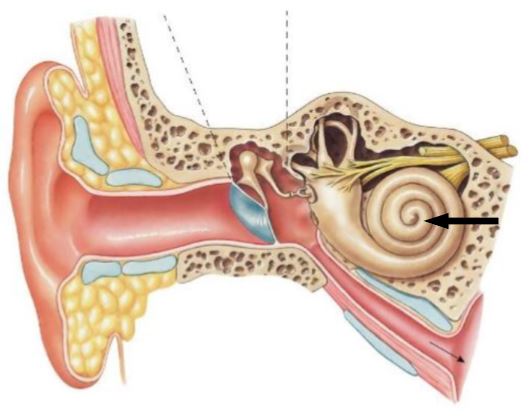
147.

What is this?

a)

Pinna

b)

Hearing Nerve

c)

Cochlea

d)

Ear Drum

e)

Anvil