wayground logo

Free Printable Worksheets

Font size

S
M
L
XL
Worksheets

Biology EOC Review

Total questions: 177

Worksheet time: 3hrs 59mins
Name
Class
Date
1.
Enzymes catalyze reactions by ___________ Activation Energy.
a)
Increasing
b)
Decreasing
2.
The amount of energy that usually transfers from one trophic level to the next...
a)
10%
b)
20%
c)
80%
d)
50%
3.

Which of the following converts food into energy for the cell?

a)

vacuole

b)

mitochondria

c)

cytoplasm

d)

cell membrane

4.
What is something that prokaryotic and eukaryotic cells have in common?
a)
They have a nucleus. 
b)
They are multi-cellular. 
c)
They have DNA. 
d)
They have organelles that are membrane-bound.
5.
Active transport does not require energy.
a)
True 
b)
False 
6.
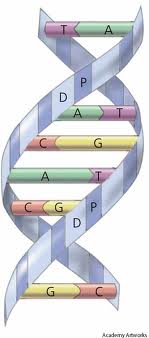
Which 2 molecules forms the sides (backbone) of the DNA ladder?
a)
deoxyribose and adenine
b)
deoxyribose and a hydrogen bond
c)
sugar and the nucleus
d)
deoxyribose (sugar) and phosphate
7.
These molecules represent which organic molecule?
a)
proteins
b)
lipids
c)
nucleic acids
d)
carbohydrates
8.

The light independent reactions (Calvin Cycle) of photosynthesis happen where?

a)

stroma of chloroplast

b)

mitochondrial matrix

c)

stem

d)

thylakoid membrane

9.
In this image, the cell is using which type of molecular transport?
a)
Osmosis
b)
Diffusion 
c)
Endocytosis
d)
Exocytosis 
10.
What are the two reactants of cellular respiration?
a)
C6H12O6 & 6CO2
b)
6 CO2 & 6H2O
c)
C6H12O& 6O2
d)
6CO2 & 6O2
11.
Name structure #5.
a)
rough ER
b)
nucleus
c)
vesicle
d)
cytoplasm
12.
How do enzymes increase the speed of chemical reactions?
a)
reducing the number of products   
b)
reducing the activation energy
c)
increasing the temperature of the cell
d)
increasing the concentration of reactants 
13.
Which of these is NOT true?
a)
Enzymes can denature (change shape) when the temperature gets too high.
b)
Enzymes can only be used once in a chemical reaction. 
c)
Extreme pH can denature enzymes.
d)
Enzymes speed up chemical reactions. 
14.
What molecule is this
a)
sucrose
b)
protein
c)
glucose
d)
cellulose
15.
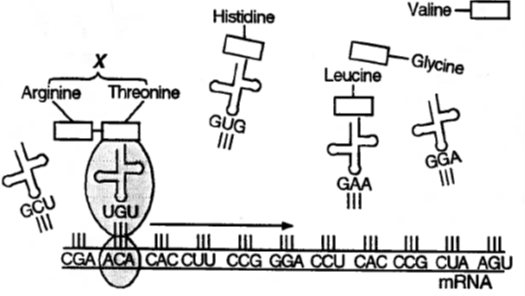
What process is going on in this photo? 
a)
Transcription 
b)
Translation 
c)
Replication 
d)
All the above 
16.
This picture represents which type of cellular transport?
a)
passive transport
b)
endocytosis
c)
exocytosis
d)
osmosis
17.
The cell below is in a _________ solution.
a)
Hypotonic
b)
Hypertonic
c)
Isotonic
18.
Which of these is not a way in which biotechnology can benefit agriculture?
a)
increase crop population
b)
reducing the loss of crops to insects
c)
producing better-tasting fruits
d)
improving farm machinery
19.
What two products does a plant make during photosynthesis?
a)
Water and Glucose
b)
Oxygen and Glucose
c)
Oxygen and Water
d)
CO2 and Glucose
20.

What is the role of the pioneer species in Primary Succession?

a)

To kill any remaining organisms from before the disturbance

b)

To break down rock and rebuild soil

c)

To provide food for large animals

d)

To put fresh oxygen into the air

21.

What are some abiotic factors that could be limiting factors in the Iowa River ecosystem?

a)

Temperature, fertilizer runoff from fields, drought or flood

b)

Invasive species, floods

c)

Temperature, predators, droughts, floods, over fishing

22.
The diagram below represents a cell. Which organelle is the site where amino acids are synthesized into proteins? 
a)
1
b)
2
c)
3
d)
4
23.
An offspring will receive how many alleles from each parent to determine a specific trait?
a)
one
b)
two
c)
three
d)
five
24.
G = green, g = yellow
The genotype for a yellow plant is...
a)
GG
b)
Gg
c)
gg
d)
all of the choices result in yellow
25.
All of the living and nonliving things in an area that interact with each other are called a/an ______.
a)
community
b)
habitat
c)
population
d)
ecosystem
26.

In the graph to the right, what is the population of deer at the carrying capacity of the environment?

a)

3

b)

7

c)

70

d)

40

27.
What does the graph represent?
a)
Emigration
b)
Exponential growth
c)
Immigration
d)
Logistic Growth
28.
Provides support and protection for the cell, while also controlling the movement of materials in and out of the cell.
a)
Cellular Membrane
b)
Nucleus
c)
Ribosomes
d)
Vacuole
29.
What type of transport is illustrated?
a)
facilitated diffusion
b)
active transport
c)
diffusion
d)
osmosis
30.
What will most likely be the result if all of the mitochondria are removed from a plant cell? 
a)
It will be unable to carry out respiration. 
b)
It will lose water through osmosis. 
c)
It will break down the ribosomes in the cell. 
d)
It will be unable to photosynthesize
31.
Fruit fly body cells have 8 chromosomes. After mitosis, you would expect a resulting fruit fly daughter cell to have ...
a)
16 chromosomes.
b)
46 chromosomes.
c)
8 chromosomes.
d)
4 chromosomes.
32.
Structure B is pointing to the _____. 
a)
chromosome
b)
centromere
c)
DNA
d)
chromatid
33.

In which cell below would a student likely observe a cell plate during mitosis?

a)

rat muscle cell

b)

alligator stomach cell

c)

onion root cell

d)

human lung cell

34.

Is the following cell diploid or haploid?

a)

Diploid

b)

Haploid

35.

What is the purpose of strand "A"?

a)

To carry amino acids to the ribosome

b)

To carry the genetic information to the cytoplasm

c)

To serve as a template for the synthesis of mRNA

36.
Replicate the following strand of DNA: 
AATCATGGA
a)
AATCATGGA
b)
TTAGTACCT
c)
UUAGUACCU
d)
GGATAUCUA
37.
An animal cell placed in a sugar solution is shown in the diagram. Which statement best describes how osmosis will affect this animal cell?  
a)
Water will move out of the cell and the cell will shrink
b)
Water will move into the cell and the cell will expand 
c)
Sugar will move out of the cell and the cell will expand 
d)
Sugar will move into the cell and the cell will expand
38.
The stages of the cell cycle are shown in random order below.  Starting with prophase, sequence the diagrams to show the stages of mitosis.  
                       
a)
5-3-1-2-4
b)
3-1-4-2-5
c)
4-1-2-5-3
d)
2-3-1-5-4
39.
Carbohydrates are made of... 
a)
C H O
b)
C H O N
c)
C H O N P
d)
C H O N S
40.
Phospholipids have a _________ head and a __________ tail.
a)
hydrophilic, hydrophobic
b)
hydrophobic, hydrophilic 
41.
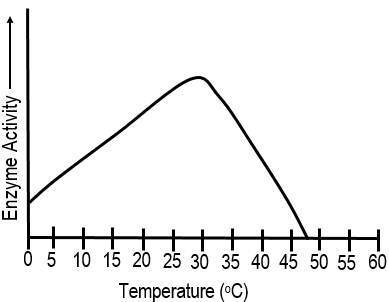
Based on the graph, what temperature does this enzyme work best? 
a)
15 C
b)
40 C
c)
30 C
42.
What is the correct order for protein synthesis? 
a)
PROTEIN --> DNA --> RNA
b)
DNA-->PROTEIN-->RNA
c)
DNA-->RNA-->PROTEIN 
43.
What process best explains how a nerve cell and a muscle cell can both develop from the same fertilized egg?
a)
differentiation
b)
natural selection
c)
selective breeding
d)
genetic engineering
44.
During strenuous exercise, body temperature increases. The body responds to the increase in temperature by sweating, which helps to reduce the body temperature. Which is demonstrated in this situation?
a)
excretion
b)
metabolism
c)
homeostasis 
d)
synthesis
45.
Before mitosis begins, which happens before the nucleus starts dividing?
a)
The cytoplasm separates.
b)
The DNA replicates. 
c)
The sister chromatids separate. 
d)
The homologous chromosomes cross over. 
46.
What is the function of autotrophs in the carbon cycle?
a)
to use oxygen to produce glucose 
b)
to take in excess water
c)
to use carbon dioxide to produce glucose
d)
to feed on herbivores 
47.
Two different populations of birds live in the same area and eat the same types of food. Which most likely describes the relationship between these two populations of birds? 
a)
competition
b)
mutualism
c)
parasitism
d)
predator-prey
48.
Two different populations of birds live in the same area and eat the same types of food. Which most likely describes the relationship between these two populations of birds? 
a)
competition
b)
mutualism
c)
parasitism
d)
predator-prey
49.
What will most likely happen if the human population continues to grow at current rates?
a)
There will be fewer natural resources available for future generations.
b)
There will be an increase in nitrogen levels in the atmosphere. 
c)
There will be a decrease in water pollution. 
d)
There will be an increase in the number of strong hurricanes. 
50.
A sea turtle has washed up on a remote section of a beach. This is known as a “stranding.” Stranding occurs when a dead, sick or injured sea turtle washes up on the shoreline. Which statement best explains why “stranding” should be reported immediately to local authorities? 
a)
The information can be very useful to biologists and managers who are trying to protect the species.
b)
The information can be very useful to protect sea turtles from predators. 
c)
The information can be very useful to local fishermen who try to catch fish that sea turtles eat. 
d)
The information can be very useful to tourists who may want to keep sea turtles as pets.
51.
A strand of DNA has these bases:
 AGC CAT GTA TAC What is the complementary DNA strand?
a)
ACG GAT CTA TAG
b)
TCG GTA CAT ATG
c)
TGC CTA GAT ATC
d)
UCG CUA CAU AUG
52.
Which statement best describes the relationship that exists among proteins, DNA, and cells?
a)
Proteins combine to produce cells, which produce DNA
b)
Proteins are made up of DNA, which determines the cells that are produced. 
c)
DNA is made up of proteins, which tell a cell how to function. 
d)
Cells contain DNA, which controls the production of proteins.
53.
Why is meiosis important for sexual reproduction?
a)
It allows the zygote formed from fertilization to have triple the chromosome number of the organism. 
b)
It allows gametes to have twice the original number of chromosomes of the organism.
c)
It allows gametes to have half the original number of chromosomes of the organism. 
d)
It allows the zygote formed from fertilization to have half the original number of chromosomes of the organism. 
54.
Which process produces the most variation within a species? 
a)
Asexual reproduction
b)
Sexual reproduction
c)
mitosis
d)
cloning
55.
Which technique would most likely be used by forensic scientists?
a)
gene cloning
b)
gene therapy
c)
DNA fingerprinting
d)
karyotyping
56.
Which is one reason scientists produce transgenic organisms?
a)
to create new species of organisms 
b)
to control microorganisms in the soil
c)
to prevent habitats from being destroyed
d)
to treat certain types of diseases
57.
What are the subunits of DNA and their function? 
a)
nucleotides that store information 
b)
monosaccharides that provide quick energy for the cell
c)
lipids that store energy and provide insulation 
d)
proteins that provide the building blocks for the structural components of organisms 
58.
The use of pesticides on crops has been a common farming practice for decades. What has been the greatest effect of natural selection through the use of pesticides on certain insect populations? 
a)
Natural selection has been altered because the insects and their predators are killed. 
b)
The rate of selection is increased because the pesticides do not kill the insects that are naturally resistant to it. 
c)
The rate of selection has decreased because the pesticides kill only young insects. 
d)
The pesticides have altered natural selection by causing the insect DNA to spontaneously mutate.
59.
What is the difference between the full classification of organisms and their scientific names?
a)
The full classification of organisms and their scientific names vary in different countries. 
b)
The scientific names of organisms include the order and family of the organisms, but the full classification includes only the species name
c)
The full classification of organisms will include more categories of organisms than their scientific names. 
d)
The scientific names of organisms include a single nomenclature, but the full classification includes various nomenclatures.
60.
What type of organic molecules are enzymes? 
a)
carbohydrates
b)
lipids 
c)
nucleic acids
d)
proteins
61.
A freshwater plant is placed in a container of saltwater. What will most likely happen to the cells of the plant?
a)
They will swell because water will move into them.
b)
They will swell because salt will move into them
c)
They will shrink because water will move out of them.
d)
They will shrink because salt will move out of them.
62.
How does the amount of energy resulting from fermentation compare with that of aerobic respiration? 
a)
Aerobic respiration results in less energy.
b)
Aerobic respiration results in more energy.
c)
Each process results in equal amounts of energy.
d)
Each process results in variable amounts of energy.
63.
This diagram shows a plant cell. Which structure is found in a plant cell but is absent in an animal cell? 
a)
1
b)
2
c)
3
d)
4
64.
Which best explains why muscle cells are different from blood cells? 
a)
A mutation occurs during the development of muscle cells but not in blood cells.
b)
Different genes are activated in muscle cells than in blood cells. 
c)
Muscles cells experience different environmental influences than blood cells. 
d)
Muscle cells are produced by the brain, but blood cells are produced by the heart.
65.
During which phase of the cell cycle is the cell growing and preparing for cellular division? 
a)
cytokinesis
b)
anaphase
c)
prophase
d)
interphase
66.
The males of a bird species do a “dance” and “sing a song” each spring. What is the main purpose of these behaviors? 
a)
to scare off young birds
b)
to imprint young birds
c)
to clean their feathers
d)
to attract female birds
67.
The yucca plant releases a strong scent at night when the yucca moth is active. The yucca moth, attracted by the scent, gathers pollen from the yucca flower. The yucca moth then deposits her eggs and the pollen on another plant. This ensures that the plant will be cross-pollinated and that the yucca moth larvae have a steady food supply. Which relationship does this BEST illustrate?
a)
commensalism
b)
mutualism
c)
parasitism
d)
predation
68.
What will most likely be the result if all of the mitochondria are removed from a plant cell? 
a)
It will be unable to carry out respiration. 
b)
It will lose water through osmosis.  
c)
It will break down ribosomes in the cell
d)
It will be unable to photosynthesize.
69.
Which of the following uses a karyotype?
a)
chromosomal analysis
b)
modifying an organism's genes
c)
determining a genome
d)
DNA fingerprinting
70.
Which of these controls the differentiation of cells in a multi cellular organism?
a)
the production of gametes during meiosis
b)
cell reproduction by binary fission
c)
the locations of the cells within the developing embryo
d)
the concentration of maternal hormones
71.
The ability to taste a bitter chemical called PTC is a dominant trait in humans.  The Punnett square below shows a cross between two parents who are heterozygous for the ability to taste this chemical.  What is the probability, expressed as a percentage, that these parents will produce an offspring who is homozygous recessive for the tasting trait?
a)
0%
b)
25%
c)
50%
d)
75%
72.
Which of the following is most likely to alter the DNA in an individual's gametes before it is passed to offspring?
a)
poor nutrition
b)
bright lights
c)
ultraviolet (UV) radiation
d)
cool temperatures
73.
Which of these substances stores and transmits the information that specifies the traits of an organism?
a)
DNA
b)
RNA
c)
enzymes
d)
carbohydrates
74.
A strand of DNA with the sequence A-C-T-T-G serves as a template to form a strand of mRNA with the sequence U-G-A-A-C.  During which process would this happen?
a)
replication
b)
transcription
c)
translation
d)
meiosis
75.
Which statement describes the components that make up the genetic code of all organisms?
a)
The components are unique in every kind of organisms
b)
the components are the same for all organisms
c)
the components are the same only for unicellular organisms
d)
the components are unique in all kinds of organisms that reproduce sexually
76.
The diagram summarizes two stages in the production of the specialized cells used for sexual reproduction.
What happens in the stage labeled "process 2"?
a)
The chromosomes cross over.
b)
Th chromosomes number is reduced by half.
c)
The chromosomes move to opposite end of the cell.
d)
Four identical gametes form.
77.
Proteins are formed in the cytoplasm of cell using genetic instructions from DNA, which is located in the cells nucleus.  Which of the following best explains how the genetic information gets to the site of protein synthesis?
a)
DNA is divided during mitosis, and one strand travels outside the nucleus to bind with RNA and form a protein
b)
DNA is copied to make mRNA. The mRNA leaves the nucleus and goes to the ribosomes, where the information is used to guide protein synthesis.
c)
Genetic information travels from DNA in the nucleus along a strand of mRNA that is connected to ribosomes in the cytoplasm where proteins are made.
d)
The genetic code is transferred to ribosomes on tRNA molecules, which can pass through the nuclear membrane.
78.
The diagram shows the base sequence of a strand of DNA.
From left to right, what is the sequence of the complementary strand of DNA in this molecule?
a)
T G A A C
b)
A C T  T G
c)
T G U U C
d)
U C T T G
79.
Which of these is the key idea of the endosymbiont theory?
a)
Eukaryotes evolved from early prokaryotic cell that developed internal cell membranes.
b)
Prokaryotic cells evolved from early eukaryotes that were enclosed by cell walls.
c)
Early prokaryotic cells evolved from chloroplasts.
d)
Early prokaryotic cells evolved from chemicals that became joined together using the heat given off by deep ocean vents.
80.
The table shows several DNA codons and their corresponding amino acids.
If a sequence of DNA reads AGTGGGTCT, for what sequence of amino acids does it code?
a)
arginine-glycine-serine
b)
serine-arginine-arginine
c)
serine-arginine-glycine
d)
serine-glycine-serine
81.
What type of cell is shown?
a)
eukaryotic
b)
prokaryotic
c)
bacterial
d)
protist
82.
Proteins are assembled within this cell organelle.
a)
nucleus
b)
Golgi apparatus
c)
lysosome
d)
ribosome
83.
What is the movement of molecules or solutes from an area of high concentration to an area of low concentration?
a)
osmosis
b)
active transport
c)
merging
d)
diffusion
84.
Which of these requires ATP?
a)
osmosis
b)
diffusion
c)
active transport
d)
stasis
85.
Which class of biomolecules include monosaccharides, disaccharides, and polysaccharides?
a)
carbohydrates
b)
lipids
c)
proteins
d)
nucleic acids
86.
Which biomolecule's monomer (or building block) is nucleotides?
a)
Lipids
b)
Proteins
c)
Carbohydrate
d)
Nucleic Acid
87.
Which biomolecule's monomer (or building block) are monosaccharides?
a)
Lipids
b)
Proteins
c)
Carbohydrate
d)
Nucleic Acid
88.
What is the carrying capacity of the following graph?
a)
10
b)
30
c)
40
d)
45
89.
Natural selection is sometimes described as survival of the fittest. In this sence, what is meant by the fitness of an organism>
a)
The strength of the organism
b)
the intelligence of an organism
c)
the ability to survive and reproduce 
d)
the tendency to grow larger than others
90.
What reactants are there in cellular respiration?
a)
Water and Glucose
b)
Oxygen and Glucose
c)
Carbon Dioxide and Water
d)
Twenty Jelly beans
91.
What are the products of cellular respiration?
a)
Energy (ATP), Water, and Carbon DIoxide.
b)
Water and Oxygen
c)
Oxygen and Carbon Dioxide
d)
Water, Oxygen and Energy (ATP)
92.
6CO2 + 6H20 + light energy    -> C6H12O6 + 6O2
In this chemcial equation, the highlight red is called the ______. 
a)
product
b)
reactant
c)
yields
d)
production
93.
Cross Two Homozygous plants
(
RRYY x rryy)
R = round seeds, r  = wrinkled seeds Y = yellow seeds, y = green seeds
What percent will have Round and Yellow seeds? 
a)
0%
b)
25%
c)
50%
d)
100%
94.
What are the possible genotypes for this cross?
a)
TT = 25% Tt= 50% tt=25%
b)
all tall
c)
TT= 75% tt = 25%
d)
Tt = 100%
95.
The legs of crocodiles and mice have similar bone structures and develop in a similar way.  What type of structures are the leg bones?
a)
homologous structures
b)
analogous structures
c)
fossilized structures
d)
vestigial structures
96.
Which best describes an ecosystem?
a)
A group of species that inhabits a particular area
b)
a group of popultions as well as the abiotic environment
c)
All the organisms of one species that inhabit a particular area
d)
All the zones of Earth's land, water, and air where living organisms are found
97.
Which statement describes a main difference between primary and secondary succession?
a)
Primary succession is always followed by secondary succession
b)
Secondary succession always ends in a climax community while primary does not
c)
Primary succession always starts with barren rock; secondary does not
d)
Secondary succession always reaches a climax community of trees while primary succession ends with pioneer species.
98.
What is the name and importance of the molecule shown in the picture?
a)
fatty acid tail; makes up the fat found in butter
b)
phospholipid; makes up cellular membranes
c)
triglyceride; makes up animal lard
d)
cellulose; makes up the cell walls of plants
99.
The cell theory was first proposed in 1838. Evidence obtained through additional scientific investigations resulted in the current cell theory. Which statement describes a component of the original cell theory that was removed because of the new scientific knowledge?
a)
All living things are made of cells. 
b)
All cells come from other preexisting cells. 
c)
Cells form through spontaneous generation. 
d)
Cells are the basic structural and functional units of life. 
100.
An osmosis investigation was conducted using 20 chicken eggs to represent cells with semipermeable membranes. The eggs were first soaked in vinegar to dissolve the shell. The eggs were then transferred to corn syrup for 24 hours and then to distilled water for 24 hours. The mass of each egg was measured before and after each soaking to determine how much water diffused into or out of the eggs. The table below shows the average mass of the eggs at each step of the investigation.
Based on this experiment, which of the following should be inferred about cells with semipermeable membranes? 
a)
Substances other than water may also cross the cell membrane. 
b)
Substances other than water may block pores in the cell membrane. 
c)
Water enters the cell when placed in environments of high water concentration. 
d)
Water leaves the cell when placed in environments with a low concentration of solutes. 
101.
Hemophilia is a sex-linked, recessive trait. Which of the following describes the probability of hemophilia in the offspring of a man who does not have hemophilia and a woman who is a heterozygous carrier?
a)
There is a 25% chance that their sons will have hemophilia. 
b)
There is a 100% chance that their sons will have hemophilia. 
c)
There is a 0% chance that their daughters will have hemophilia. 
d)
There is a 50% chance that their daughters will have hemophilia. 
102.
A team of ecologists observed feeding patterns of several populations in the desert. The energy pyramid shown below depicts the feeding patterns the ecologists observed. Which of the following best explains the difference in the amount of available energy in the trophic levels of the desert ecosystem?
a)
There is less energy available in the producers because their tissues are less dense than those at higher trophic levels. 
b)
There is more energy available in the second trophic level because less energy is needed for hunting compared to the higher trophic levels. 
c)
There is less available energy in the fourth trophic level because of the loss of energy through metabolism in each of the lower trophic levels. 
d)
There is more available energy in the birds of prey because they have greater muscle mass for storing energy than organisms in lower trophic levels have. 
103.
The synthesis of a protein from an mRNA template is called ____________.
a)
transcription
b)
replication
c)
translation
d)
synthesis
104.
The synthesis of an RNA strand from a DNA template is called __________.
a)
transcription
b)
replication
c)
translation
d)
synthesis
105.
Which of the following causes people to have different traits, like blue eyes instead of red eyes?
a)
Different nucleotide sequences
b)
Different number of chromosomes
c)
Severe mutations
d)
None of the above
106.
True or False: DNA is the universal code
a)
True
b)
False
107.
True or False: The same DNA base pairs are found in ALL living things
a)
True
b)
False
108.
True or False: "A" pairs with "T"
a)
True
b)
False
109.
True or False: "C" pairs with "G"
a)
True
b)
False
110.
True or False: DNA replication is when DNA is used to make RNA
a)
True
b)
False
111.
True or False: RNA is double stranded.
a)
True
b)
False
112.
True or False: DNA can't leave the nucleus.
a)
True
b)
False
113.
This strand is DNA or RNA? AATAACGTT
a)
DNA
b)
RNA
114.
A type of nucleic acid
a)
DNA
b)
RNA
c)
Both
d)
None of the above
115.
True or False: DNA has uracil.
a)
True
b)
False
116.
True or False: DNA has thymine.
a)
True
b)
False
117.
Transcription is when _____ is used to make _____. It happens in the _______.
a)
RNA, DNA, Cytoplasm
b)
DNA, RNA, Nucleus
c)
DNA, RNA, Cytoplasm
d)
RNA, DNA, Nucleus
118.
Translation is when ____ is used to make _____. It happens at the ______.
a)
RNA; Proteins; Nucleus
b)
RNA; Proteins; Cytoplasm
c)
DNA; Proteins; Nucleus
d)
DNA; Proteins; Cytoplasm
119.
A codon is how many letters?
a)
1
b)
2
c)
3
d)
4
120.
A type of RNA that carries amino acids and adds them to the polypeptide chain during translation.
a)
mRNA
b)
tRNA
c)
rRNA
d)
None of the above
121.
A type of RNA that carries information from the DNA to the ribosome.
a)
mRNA
b)
tRNA
c)
rRNA
d)
None of the above
122.
The building blocks of a protein
a)
Amino Acid
b)
Polypeptide
c)
Frameshift
d)
Codon
123.
A long chain of amino acids
a)
Polypeptide
b)
Base
c)
Frameshift
d)
Codon
124.
A mutation that changes all the amino acids after it
a)
Amino Acid
b)
Polypeptide
c)
Frameshift
d)
Codon
125.
AATTAGCAT --> AAGTAGCAT
a)
Deletion
b)
Substitution
c)
Insertion
d)
None of the above
126.
Which will cause more changes: inserting 2 bases in the middle or adding a stop codon to the end?
a)
Inserting 2 bases in the middle
b)
Adding a stop codon to the end
127.
Trisomy means you have __ copies of a chromosome.
a)
1
b)
2
c)
3
d)
4
128.
Monosomy means you have ___ copy(ies) of a chromosome.
a)
1
b)
2
c)
3
d)
4
129.
A person with an X and a Y chromosome is a ____.
a)
Male
b)
Female
c)
SheMan
d)
HeShe
130.
A person with two X chromosomes is a _____.
a)
Male
b)
Female
c)
HeShe
d)
SheMan
131.
True or False: If you have 23 pairs of chromosomes, you are human.
a)
True
b)
False
132.
True or False: Meiosis makes 4 cells.
a)
True
b)
False
133.
True or False: Mitosis makes 2 cells.
a)
True
b)
False
134.
True or False: Meiosis makes haploid cells.
a)
True
b)
False
135.
True or False: Mitosis makes somatic cells.
a)
True
b)
False
136.
True or False: Meiosis makes gametes.
a)
True
b)
False
137.
True or False: Meiosis - the cell divides twice.
a)
True
b)
False
138.
True or False: Mitosis produces cells that are identical to the original and each other
a)
True
b)
False
139.
True or False: Meiosis produces cells that are genetically unique
a)
True
b)
False
140.
You cut your finger, and over the next few days, new cells replace the cells that were damaged. Is this an example of mitosis or meiosis?
a)
Mitosis
b)
Meiosis
141.
Gametes are haploid or diploid?
a)
Haploid
b)
Diploid
142.
Is a cheek cell a haploid cell or a diploid cell?
a)
Diploid cell
b)
Haploid cell
143.
A sex cell is a...?
a)
Gamete
b)
Haploid
c)
Diploid
d)
Somatic cell
144.
Any cell that is NOT a gamete; normal body cells.
a)
Gamete
b)
Somatic cell
c)
Haploid
d)
Diploid
145.
When two gametes join together and form a zygote.
a)
Gamete
b)
Fertilization
c)
Diploid
d)
Homologous chromosomes
146.
A cell with ONE set of chromosomes.
a)
Haploid
b)
Diploid
c)
Homologous chromosomes
d)
Fertilization
147.
A cell with TWO sets of chromosomes
a)
Haploid
b)
Diploid
c)
Fertilization
d)
Gamete
148.
If haploid = 6 chromosomes, how many diploid chromosomes will there be?
a)
3
b)
12
c)
15
d)
2
149.
Which of the following genotypes is considered heterozygous?
a)
AA
b)
Aa
c)
aa
d)
None of the above
150.
Which of the following genotypes is considered homozygous dominant?
a)
AA
b)
Aa
c)
aa
d)
None of the above
151.
Which of the following genotypes is considered homozygous recessive?
a)
AA
b)
Aa
c)
aa
d)
None of the above
152.
True or False: An allele is a version of a gene.
a)
True
b)
False
153.
If B = brown eyes and b = blue eyes. A boy with Bb is: _______________ and he will have _______ eyes.
a)
Homozygous recessive; blue
b)
Homozygous dominant; brown
c)
Heterozygous; blue
d)
Heterozygous; brown
154.
When both phenotypes show up together, it is called?
a)
Codominance
b)
Incomplete dominance
155.
Which term has this definition: A new "blended phenotype" appears.
a)
Incomplete Dominance
b)
Codominance
156.
Which term has this definition: A new "blended phenotype" appears.
a)
Incomplete Dominance
b)
Codominance
157.
GG = green scales
GP = blue scales
PP = purple scales
Is this an example of codominance or incomplete dominance?
a)
Incomplete Dominance
b)
Codominance
158.
CC = curly hair
CS = curly hair & straight hair
SS = straight hair
Is this an example of codominance or incomplete dominance?

a)
Codominance
b)
Incomplete Dominance
159.
Is black hair considered a phenotype or a genotype?
a)
Phenotype
b)
Genotype
160.
Is heterozygous considered a phenotype or a genotype?
a)
Genotype
b)
Phenotype
161.
If you see a 1:1 ratio, what are the parents' genotypes?
a)
Aa x Aa
b)
Aa x aa
c)
AA x Aa
d)
AA x aa
162.
If you see a 1:3 ratio, what are the parents' genotypes?
a)
Aa x Aa
b)
AA x Aa
c)
Aa x aa
d)
aa x aa
163.
A pattern that you see in sex-linked inheritance is...
a)
All carries are female
b)
All carries are male
164.
Most individuals with the recessive trait are _____.
a)
Male
b)
Female
165.
What shape are females on a pedigree?
a)
Circle
b)
Square
c)
Triangle
d)
Rhombus
166.
Humans are Homo sapiens. What is our genus name?
a)
Homo
b)
sapiens
c)
homo
d)
Sapiens
167.
Bald eagles are Haliaeetus leucocephalus. What is their species name?
a)
Haliaeetus
b)
leucocephalus
c)
haliaeetus
d)
Leucocephalus
168.
Which are more closely related: organisms that share the same kingdom, or that share the same phylum?
a)
Share the same kingdom
b)
Share the same phylum
169.
Which are more closely related: organisms that share the same order, or that share the same class?
a)
Share the same order
b)
Share the same class
170.
Organisms that start out the same and become more different are which kind of evolution?
a)
Adaptive Radiation
b)
Convergent Evolution
c)
Divergent Evolution
171.
Organisms that start out different and become more similar is what kind of evolution?
a)
Adaptive Radiation
b)
Convergent Evolution
c)
Divergent Evolution
172.
Organisms that start out as one species, and branch into many species is what kind of evolution?
a)
Adaptive Radiation
b)
Convergent Evolution
c)
Divergent Evolution
173.
Bats and insects both have wings, but they did not inherit them from the same common ancestor. Instead, both groups developed wings independently. What kind of evolution of this?
a)
Adaptive Radiation
b)
Convergent Evolution
c)
Divergent Evolution
174.
Two species of butterflies both developed wings from the same common ancestor. However, in one species, the wings become blue, whereas in the other species, they became orange. What type of evolution is this?
a)
Adaptive Radiation
b)
Convergent Evolution
c)
Divergent Evolution
175.
The Galapagos islands were originally colonized by just one species of finch. However, over time, that ancestral species evolved into many different species. What kind of evolution of this?
a)
Adaptive Radiation
b)
Convergentn Evolution
c)
Divergent Evolution
176.
Which process makes 4 cells?
a)
Mitosis
b)
Meiosis
177.
Which process makes 2 cells?
a)
Mitosis
b)
Meiosis