wayground logo

Free Printable Worksheets

Font size

S
M
L
XL
Worksheets

Chemistry midterm 8th 19-20

Total questions: 150

Worksheet time: 2hrs 17mins
Name
Class
Date
1.
True or False:  The density of a specific type of material never changes.  
a)
True
b)
False
2.
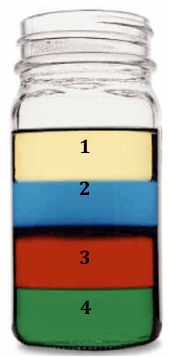
Put the liquids in order from most dense to least dense?
a)
4, 3, 2, 1
b)
1, 2, 3, 4
c)
3, 4, 2, 1, 
d)
4, 3, 1, 2
3.
What do we know about the density of lamp oil, rubbing alcohol, and vegetable oil?  
a)
The density is greater than 1.0 g/mL
b)
The density is less than 1.0 g/mL
c)
The density is equal to 1.0 g/mL
d)
The density can not be determined
4.
In general what is the most dense form of matter?
a)
solid
b)
liquid
c)
gas
d)
plasmas
5.
If an object has a density of .6 g/cm^3 and you put it into water, will it sink or float?  
a)
sink
b)
float
6.
If an object has a density of 3.6 g/cm^3 and you put it into water, will it sink or float?  
a)
sink
b)
float
7.
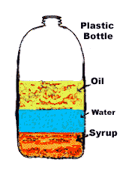
Which liquid is the least dense?
a)
oil
b)
water
c)
syrup 
d)
plastic bottle
8.
What is the formula for density?
a)
density = mass x volume
b)
density = mass / volume
c)
density = mass + volume
d)
density = mass - volume
9.
Jack has a rock. The rock has a mass of 14 g and a volume of 2 cm3. What is the density of the rock?
a)
7 mL
b)
7 g/cm3
c)
28 g/cm3
d)
1/7 g/cm3
10.
Frank has an eraser. It has a mass of 4 g, and a volume of 2 cm3. What is its density?
a)
8 g/cm3
b)
2 g/cm3
c)
1/2 g/cm3
d)
24 g/cm3
11.
Which substance is the MOST dense?  ** Use the key
a)
A
b)
B
c)
C
d)
Cannot be determined by the data provided.
12.
Why do objects sink or float in H2O
a)
Because their densities are higher or lower than compared to water
b)
Because their densities are using gravity to pull down
c)
Because their densities are heavier or lighter
d)
Because their mass and volumes are equal 
13.
Where can matter be found?
a)
Everywhere
b)
On Earth only
c)
In a solid and liquid only
14.
How does the mass of a bowling ball on Earth compare to its mass on the moon?
a)
The mass will be greater on the moon
b)
The mass will be less on the moon
c)
The mass will stay the same
15.
Adding or removing ______ will change the state of matter
a)
Mass
b)
Energy
c)
Density
16.
Which box has a greater density?  
a)
Box A
b)
Box B
17.
What is the volume of Object X?
a)
10.0 cm3
b)
15.0 cm3
c)
20.0 cm3
d)
25.0 cm3
18.
Temperature is a measure of average [blank] energy of individual atoms.
a)
heat
b)
potential
c)
mechanical
d)
kinetic
19.
Which phase of matter has the greatest motion and least orderly arrangement?
a)
solid
b)
liquid
c)
gas
20.

A reaction that gives out energy to the surroundings causes the surroundings ....

a)

temperature to drop

b)

temperature to rise

c)

temperature to remain constant

d)

temperature to vary

21.
Endothermic reactions feel
a)
warm
b)
cold
22.

A reaction that gives out energy to the surroundings causes the

a)

temperature to drop

b)

temperature to rise

c)

temperature to remain constant

d)

temperature to vary

23.

A reaction that causes the temperature of the surrounding to drop is

a)

endothermic

b)

exothermic

c)

displacement

d)

oxidation

24.
Energy in exothermic reactions are
a)
released
b)
absorbed
25.
The pH scale is a range from:
a)
1-7
b)
0-14
c)
1-5
d)
1-20
26.
A(n) ______ is a substance with a pH less than 7
a)
Acid
b)
Alkaline
c)
Base
d)
Buffer
27.
A(n) _______ is a substance with a pH greater than 7.
a)
Base
b)
Acid
c)
Buffer
d)
Water
28.
What is the only substance with a neutral pH of 7?
a)
Milk
b)
Orange Juice
c)
Water
d)
Blood
29.
Complete the sentence.
A substance that is more basic has a _____ pH than a substance that is acidic.
a)
lower
b)
higher
c)
the same
d)
none of the above
30.

In a test of pH levels, a baking soda has a pH of 9 and bleach has a pH of 12. What is true about there relationship?

a)

Both of the solution are Bases

b)

Both of the solution are Acids

c)

The Baking soda is an acid and the Bleach is a base

d)

The baking soda is a base and the Bleach is an Acid.

31.

A base is a substance

a)

That releases OH- ions when dissolved in water

b)

That releases H+ ions when dissolved in water

c)

Does not release any ions when dissolved in water

d)

None of the above

32.
On the pH scale higher numbers indicate
a)
acids
b)
bases
33.
If you have a substance with a pH of 7.1 it is a(n).....
a)
Acid
b)
base
34.
According to the pH range which substance is more acidic than lemon juice
a)
Hydrochloric acid
b)
cabbage
c)
milk
35.
Bleach is a strong base, what is the pH level of bleach?
a)
13
b)
14
c)
1
d)
2
36.

An acid’s pH is between :

a)

0 to 6

b)

7

c)

8-14

d)

6-14

37.

Vinegar is an example of:

a)

Strong Acid

b)

Weak Acid

c)

Strong Base

d)

Weak Base

38.
What happens when my glass of water is sitting in the sun and disappears into a gas?
a)
evaporation
b)
burning
c)
melting
d)
freezing
39.
What term describes a solid changing to a gas?
a)
Deposition
b)
Sublimation
c)
Evaporation
d)
Freezing
40.
What term describes a liquid changing to a solid?
a)
Deposition
b)
Sublimation
c)
Evaporation
d)
Freezing
41.
______________________ takes place when a liquid changes to a solid.
a)
freezing
b)
melting
c)
boiling
d)
sublimation
42.
At higher temperatures
a)
particles in an object have less energy
b)
particles in an object move faster
c)
a gas contracts
43.
A gas
a)
has a definite shape but no definite volume
b)
has a definite volume but no definite shape
c)
has fast-moving particles
44.
The speed of the molecules determines the _____.
a)
volume
b)
density
c)
pressure
d)
temperature
45.

Particles in a ______________________ move quickly and are far apart.

a)

gas

b)

solid

c)

liquid

46.

Particles of a liquid

a)

are tightly packed together and stay in a fixed position.

b)

are free to move around one another but still touch.

47.
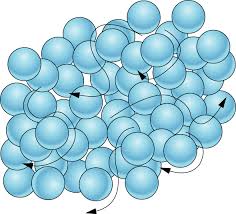
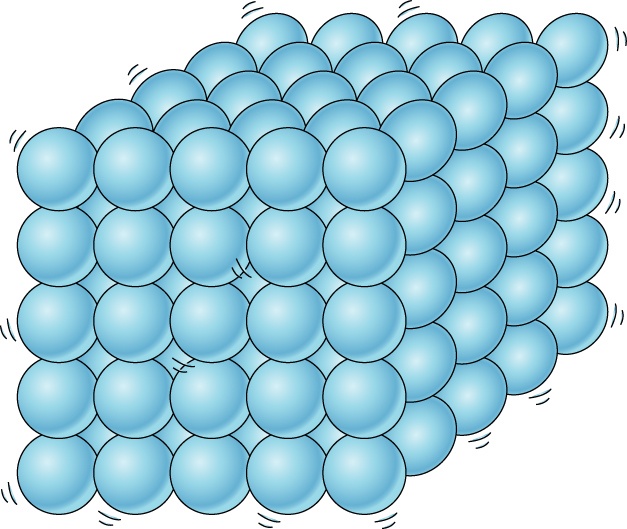
The molecules in the picture are tightly held together with little movement. They have shape and energy.  Therefore, the picture represents _________.
a)
solid
b)
liquid
c)
gas
d)
plasma
48.

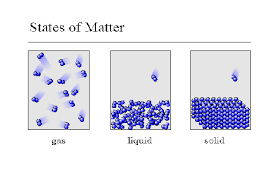
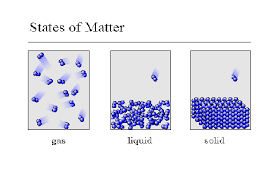
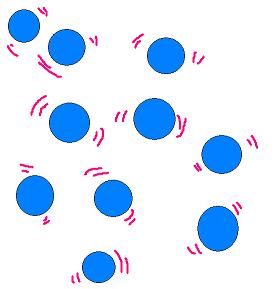
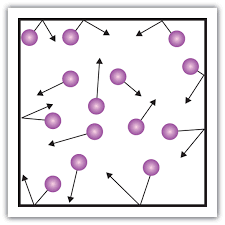
Which state of matter does this picture show?

a)

Solid

b)

Liquid

c)

Gas

49.
What is the correct order of the states of matter?
a)
Solid, Liquid, Gas
b)
Gas, Liquid, Solid
c)
Liquid, Gas, Solid
d)
Solid, Gas, Liquid
50.
Rank these in order from least dense to most dense.
a)
Solid, Liquid, Gas
b)
Liquid, Gas, Solid
c)
Gas, Solid, Liquid
d)
Gas, Liquid, Solid
51.

Which is not true about the liquid state of matter?

a)

The liquid state has a definite volume and a definite shape.

b)

The liquid state takes on the shape of its container.

c)

The liquid state has a definite volume and an indefinite shape.

d)

The particles in a liquid can easily move past each other.
52.

What state of matter?

a)

Solid

b)

Liquid

c)

Gas

d)

Plasma!!!

53.

What state of matter?

a)

Solid

b)

Liquid

c)

Gas

54.

Particles are closely spaced.

a)

solid

b)

liquid

c)

gas

55.

Basic state of matter with the greatest amount of energy.

a)

solid

b)

liquid

c)

gas

56.

What happens to particles when their temperature increases?

a)

The particles move slower

b)

The particles move faster

c)

The particles lose mass

d)

The particles gain mass

57.
What is a pure substance made of two or more elements that are chemically combined called?
a)
A. element
b)
B. compound     
c)
C. mixture
d)
D. solution
58.
When elements form mixtures, the elements
a)
A. keep their original properties.
b)
B. react to form a new substance with new properties.
c)
C. combine in a specific mass ratio.
d)
D. always change their physical state.
59.
This type of substance is made up of one type of atom. 
a)
Element
b)
Compound
c)
Mixture
60.
Salt water
a)
Homogenous Mixture
b)
Heterogeneous Mixture
61.
How do gases behave in a container?
a)
Cluster together
b)
form a solid
c)
They take the shape of their container
d)
leak out 
62.
Which states allow easy flow of particles
a)
Gas and Solid
b)
Gas and Liquid
c)
Solid and Liquid
d)
Gas only
63.

which of the following would be most solid?

a)

Ice

b)

Jelly

c)

Honey

d)

Tomato Sauce

64.
How do materials change from one state of matter to another?
a)
They gain or lose energy
b)
They break appart
c)
The particles get stickyer
d)
They are magnetised to themselves
65.
What sorts of things are made of particles?
a)
Everything in the universe
b)
Anything solid
c)
Water 
d)
Most solids, liquids and gases. 
66.
Can Solids be compressed?
a)
No
b)
Yes
c)
Sometimes (it depends what it's made of)
d)
Generally no
67.
Which description best matches this particle model?
a)
Closely packed and can't move a lot. 
b)
Particles are close together but can move a little. 
c)
Particles have lots of energy and can move around. 
68.
The element Tellurium has the atomic mass of 127.60 and its atomic number is 52. How many neutrons are in the element Tellurium?
a)
179.60
b)
127.60
c)
52
d)
76
69.
The characteristics or properties of metals include
a)
shiny and solid
b)
ductile and malleable
c)
lose electrons
d)
all of the above
70.
Which particle does not contribute mass to the atom?
a)
Proton
b)
Neutron
c)
Electron
d)
Nucleus
71.
Which particle contributes the negative charge to the atom?
a)
proton
b)
electron
c)
neutron
d)
nucleus
72.
Water is an element?
a)
true
b)
false
73.
Most of the mass in an atom is made up of _____________________?
a)
protons and electrons
b)
protons and neutrons
c)
neutrons and electrons
d)
electrons and quarks
74.

What quantity is the same among atoms of the same element?

a)

mass number

b)

atomic number

c)

number of neutrons

d)

number of nucleons

75.

Which elements have the most similar chemical properties?

a)

Ge, As, and Sb

b)

Mn, Fe, and Co

c)

S, Se, and Te

d)

P, S, and Cl

76.

what is an atom

a)

smallest part of the universe

b)

smallest part of a substance

c)

smallest part of anything

d)

smallest part of water

77.

An atom is mostly

a)

positrons

b)

empty space

c)

trons

d)

negatrons

78.

An atom that has 8 protons and 10 neutrons is an isotope of the element

a)

nitrogen

b)

oxygen

c)

fluorine

d)

neon

79.

protons

a)

negative charge, nucleus

b)

positive charge, shells

c)

positive charge , nucleus

d)

neutral charge, nucleus

80.

neutrons

a)

no charge, shells

b)

positive charge, nucleus

c)

neutral, no charge, nucleus

d)

negative charge, shells

81.

atomic number

a)

number of protons/stands for an element

b)

number of neutrons

c)

number of electrons

d)

number of protons and neutrons

82.

electrons

a)

no charge, nucleus

b)

positive charge, nucleus

c)

negative charge, shells

d)

negative charge, nucleus

83.

atomic symbol

a)

capital letter

b)

lowercase letter

c)

2 capital letters

d)

2 lowercase leters

84.

mass number

a)

number of protons

b)

number of electrons

c)

number of protons and electrons

d)

number of protons and neutrons

85.

same number of protons, different number of neutrons

a)

atomic number

b)

mass number

c)

isotope

d)

ion

86.

a charged atom

a)

neutral

b)

isotope

c)

ion

d)

nucleus

87.

How many electrons does the 1st shell hold in an atom?

a)

2

b)

8

c)

18

d)

32

88.

2nd shell holds

a)

2

b)

8

c)

18

d)

32

89.
True or False - An energy level has to be full before moving on to the next energy level?
a)
true
b)
false
90.
What is a reactant?
a)
The starting substance
b)
The ending substance
91.
Using the following chemical reaction
Hydrogen + Oxygen --> water
Identify the reactant(s).
a)
Hydrogen and Oxygen
b)
water
92.
Using the following chemical reaction
Hydrogen + Oxygen --> water
Identify the product(s).
a)
Hydrogen and oxygen
b)
water
93.
Angelina mixes 2 substances together in a beaker. The beaker becomes hot and the liquid changes color.
Did a chemical reaction occur?
a)
yes, because the properties changed and a new substance was made.
b)
no, because the properties did not change.
94.
Which of the following are NOT signs that a chemical reaction occured?
a)
the properties changed
b)
bubbles of gas formed
c)
color stays the same
d)
smells different
95.
a student mixes  apple juice, water, and cinnamon together. Did a chemical reaction occur?
a)
Yes, because the apple juice changed the color of the water.
b)
yes, because the temperature stayed the sam
c)
no, because the properties stayed the same.
d)
yes, because dissolving is always a chemical reaction.
96.
Burning is always a chemical reaction.
a)
True
b)
false
97.
Sandra was burning a vanilla candle. Was there a chemical reaction?
a)
no, because burning is never a chemical reaction.
b)
Yes, because the properties of the wick changed.
c)
yes, because heat was added.
d)
no, because the ash formed was a different substance.
98.
Which of the following is NOT a chemical reaction?
a)
burning a marshmallow in a campfire.
b)
a campfire
c)
acid rain turning a copper roof green.
d)
Dissolving red Koolaid in water.
99.
Which of the following is a chemical reaction?
a)
Burning bread in the toaster.
b)
melting wax in a microwave.
c)
dissolving salt in water
d)
boiling water to make steam.
100.

Atomic Mass is the number of

a)

protons and neutrons in the nucleus of an atom

b)

protons and electrons in the nucleus of an atom

c)

neutrons and electrons in the nucleus of an atom

101.

Conservation of mass means

a)

all the atoms present before a chemical reaction are not present after

b)

atoms present before chemical reactions are present after

c)

new substances and new elements are formed in a chemical reaction

102.

An elements is

a)

a substance that cannot be split into simpler substances

b)

a substance that can be split into simpler substances

103.

A pure substance that is a compound is made out of

a)

particles of more than one type of atom

b)

particles of the same type of atom

c)

a mixture of two or more substances that can be physically separated

104.

A pure substance that is a compound is made out of

a)

particles of more than one type of atom

b)

particles of the same type of atom

c)

a mixture of two or more substances that can be physically separated

105.

A molecule is

a)

a singular particle of a particular element

b)

another name for an element

c)

2 or more atoms that are combined

106.

which of the statements on physical changes are correct

a)

A physical change cannot be reversed

b)

A physical change is a change in state

c)

A physical change is a change in form

d)

A physical change is where new substances are formed

107.

In a chemical reaction, reactants contact each other, bonds between atoms in the reactants

are broken, and

a)

atoms rearrange and form new bonds to make the products.

b)

atoms remain the same and do not form new bonds to make the proudcts

108.

The type of reaction that releases energy as heat is called

a)

endothermic

b)

exothermic

c)

respiration

d)

photosynthesis

109.

bases are the same as an acid

a)

true

b)

false

110.

A Ph scale of7/8 is

a)

acidic

b)

neutral

c)

basic

111.

To neutralise an acid you add a

a)

acid

b)

base

c)

Ph indicator

d)

equal amount of water

112.

The 'conservation of mass' theory tells us when a chemical reaction occurs in a closed system

a)

there will be no change in mass

b)

there will be a change in mass as it cannot be directly weighed and may dissipate

113.

Which is a chemical change?

a)

Melting ice

b)

A candle burning

c)

Boiling water

d)

frost forming inside the freezer

114.

Which occurs when atoms link together in news ways to create a substance different from the original substances?

a)

A physical change

b)

A nuclear reaction

c)

a chemical change

d)

an inversion

115.

Which of the following indicate that a chemical reaction has occurred?

a)

The formation of gas bubbles

b)

An odor

c)

a change in color

d)

all of these indicate a chemical reaction

116.

When reactants form products, a(n) ______ has occurred.

a)

Base

b)

Acid

c)

Chemical Reaction

d)

Mixture

117.

Which mixture is a solution?

a)

Muddy water

b)

potting soil

c)

cranberry juice

d)

milk

118.

Mixing food coloring with water is an example of a chemical change.

a)

True

b)

False

119.

What is a physical combination of two or more substances that are blended together without forming a new substance?

a)

Distillation

b)

Mixture

c)

Solute

d)

Solvent

120.
What is a factor that is measured for change in an experiment?
a)
control
b)
constant
c)
independent variable
d)
dependent variable
121.

What part of an experiment contains the data tables and graphs?

a)

Analysis

b)

Conclusion

c)

Hypothesis

d)

Materials

122.
What is the factor that an experimenter changes on purpose?
a)
Dependent Variable
b)
Independent Variable
c)
Constant
d)
Control
123.

What is the affect of salt water on the the height of blades of grass?

The above question is an example of:

a)

Hypothesis

b)

Conclusion

c)

Procedures

d)

Testable Question

124.

What is the affect of salt water on the the height of blades of grass?

What is the independent variable in the above question?

a)

salt water

b)

height

c)

average

d)

affect

125.
What is an if....then statement that predicts the outcome of an experiment or how the Independent variable effects the dependent variable?
a)
Conclusion
b)
Materials
c)
Hypothesis
d)
Problem
126.

What is it called when you test an independent variable multiple times?

a)

constants

b)

control

c)

trials

d)

dependent variable

127.

Students used various temperatures of water to see which one dissolved candy faster.

What was the Independent Variable?

a)

Amount of Candy

b)

Amount of Water

c)

Temperature of Water

d)

Time for Candy to Dissolve

128.
You will want your experiment to have ____ independent variable(s) in it for the experiment to be valid.
a)
1
b)
2
c)
3
d)
4
129.
A series of steps used by scientists to solve a problem or answer a question. 
a)
scientific method
b)
recipe
c)
data collection
d)
metric system
130.
A testable explanation to a problem that has not yet been tested. 
a)
data
b)
theory
c)
hypothesis
d)
fact
131.
The name of the information that you get from your experiment (you organize it into charts and graphs).
a)
observations
conclusion
b)
data
c)
variables
d)
hypothesis
132.
Dependent variable means
a)
the scientist controls what to test
b)
educated guess
c)
ask a question
d)
what is being measured
133.
If you increase the amount of spinach you eat, then you will increase the iron in your blood. 
What's the dependent variable?
a)
increase the amount of iron in your blood
b)
spinach you eat
134.
If I study for my scientific method test, then I will have a better test score. What is the dependent variable?
a)
Scientific Method
b)
Studying
c)
Independent variable
d)
Test score
135.
Which of the following would be considered quantitative data?
a)
Color
b)
Smell
c)
6.84 cm
d)
texture
136.
Explaining the color of a chemical would be what kind of observation?
a)
Qualitative 
b)
Quanitative
137.
What is the part of the experiment that is left alone or “natural", and is used to compare back to?
a)
Independent Variable
b)
Dependent Variable
c)
Control Group
d)
Experimental Group 
138.

What is the center of an atom called?

a)

The headquarters

b)

The centrometer

c)

The hypothesis

d)

The nucleus

139.

The nucleus of an atom contains which subatomic particles?

a)

protons and electrons

b)

protons and neutrons

c)

electrons and neutrons

d)

protons, electrons, and neutrons

140.

Which subatomic particle does the RED(+) circle represent?

a)

proton

b)

neutron

c)

electron

d)

nucleus

141.

Which subatomic particle does the GREEN( ) circle represent?

a)

proton

b)

neutron

c)

electron

d)

nucleus

142.

Typically in an atom, which two subatomic particles are equal in number?

a)

protons and neutrons

b)

all subatomic particles are equal in number

c)

neutrons and electrons

d)

protons and electrons

143.

Which subatomic particles is counted to determine the type of element the atom represents?

a)

proton

b)

neutron

c)

electron

d)

boron

144.

What composes an element?

a)

atoms of the same structure

b)

compounds of the same structure

c)

mixtures of different substances

d)

molecules of different structures

145.

A key for elements is represented by colored circles. Which diagram would best represent water?

a)

P

b)

Q

c)

R

d)

S

146.

A student is examining three diagrams that show particle arrangements in a solid, liquid, and gas. Which sequence of particle diagrams represents decreasing kinetic energy of particles?

a)

Q--R--S

b)

S--Q--R

c)

R--S--Q

d)

R--Q--S

147.

A substance changed from one state to another. The image shows its particle motion in the first state and the second state. How is the transition between State 1 and State 2 best described?

a)

solid state to liquid state

b)

liquid state to solid state

c)

liquid state to gaseous state

d)

gaseous state to solid state

148.

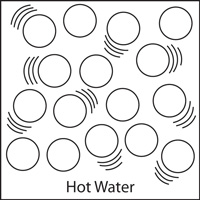
The diagram shows the particle vibration of an unknown substance in a container. Which substance can likely be represented by the motion of the particles in the diagram?

a)

ice

b)

oil

c)

water

d)

water vapor

149.

A student sketches the particles of a particular substance in the three states of matter. Which state of matter is shown by each sketch.

a)

A is solid, B is liquid, and C is gas

b)

A is gas, B is solid, and C is liquid

c)

A is liquid, B is gas, and C is solid

d)

A is liquid, B is solid, and C is gas

150.

Which statement best describes a gas?

a)

a gas has particles that are close together but can slide past one another

b)

a gas has particles that have large distances between them and move freely

c)

a gas has particles that are close together but move freely

d)

a gas has particles that have not space between them and do not move