Wayground logo

Free Printable Worksheets

Font size

S
M
L
XL
Worksheets

honors skeletal system

Total questions: 75

Worksheet time: 43mins

Name
Class
Date
1.
a)

Cervical Vertebrae

b)

Thoracic Vertebrae

c)

Lumbar Vertebrae

d)

Sacrum

2.
a)

Radius

b)

Humerus

c)

Ulna

d)

Clavicle

3.
a)
Scaphoid
b)
Lunate
c)
Hamate
d)
Pisiform
4.
a)

medial condyle

b)

medial epicondyle

c)

lateral condyle

d)

lateral epicondyle

5.
a)

olecranon fossa

b)

humeral head

c)

greater tubercle

d)

trochlea

6.
a)

transverse process

b)

spinous process

c)

vertebral foramen

7.
a)

talus

b)

calcaneus

c)

cuboid

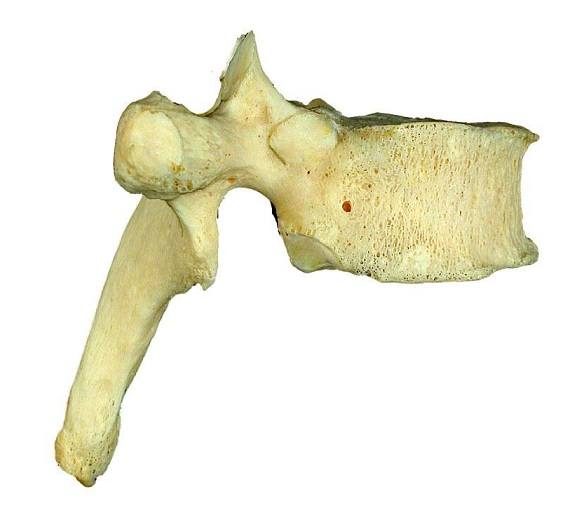
d)

navicular

8.

What is the upper jaw called?

a)

maxilla

b)

mandible

c)

clavicle

d)

tarsal

9.

Identify this bone. Hint: lower jaw

a)

maxilla

b)

mandible

c)

femur

d)

humerus

10.

Identify the name of the finger and toe bones.

a)

ribs

b)

phalanges

c)

tarsals

d)

carpals

11.

The section of this picture highlighted in green is called the _______________?

a)

Tibia

b)

Patella

c)

Ilium

d)

Fibula

12.

Identify the bone highlighted in green.

a)

Zygomatic

b)

Patella

c)

Tibia

d)

Phalanges

13.
a)

Clavicle

b)

Scapula

c)

Sternum

d)

Radius

14.
a)

Humerus

b)

Radius

c)

Ulna

d)

Clavicle

15.
a)

Radius

b)

Ulna

c)

Humerus

d)

Clavicle

16.

Identify the bone highlighted in red.

a)

Coccyx

b)

Pelvis

c)

Sacrum

d)

Ilium

17.

Identify this bone.

a)

Femur

b)

Tibia

c)

Fibula

d)

Patella

18.

What is the name of the ribs that have costal cartilage that individually attach to the sternum?

a)

true

b)

false

c)

floating

d)

costal

19.

The mastoid process belongs to which bone?

a)

the parietal

b)

the temporal

c)

the nasal

d)

the mandible

20.
a)

frontal

b)

zygomatic

c)

nasal

d)

maxilla

21.
a)

styloid process

b)

mastoid process

c)

external auditory meatus

d)

zygomatic arch

22.
a)

temporal

b)

parietal

c)

zygomatic

d)

occipital

23.

The large pink bone anterior to the parietal bones is called

a)

the nasal bone

b)

the temporal bone

c)

the vomer

d)

the frontal bone

24.
a)

Zygomatic

b)

Temporal

c)

Parietal

d)

Occipital

25.
thin, flat bones that form the back of the nasal septum 
a)
ethmoid 
b)
lacrimal 
c)
inferior nasal conchae 
d)
vomer
26.

Identify cranial bone "B"

a)

Lacrimal

b)

Ethmoid

c)

Parietal

d)

Sphenoid

27.

Identify cranial bone "A"

a)

Ethmoid

b)

Sphenoid

c)

Lacrimal

d)

Temporal

28.
a)
Zygomatic
b)
Frontal
c)
Nasal
d)
Lacrimal
29.
a)
Occipital Condyle
b)
Vomer
c)
Occipital
d)
Frontal
30.
a)
Zygomatic process
b)
Styloid process
c)
Parietal
d)
Mastoid process
31.
What suture is shown by arrow A?
a)
Coronal suture
b)
Squamous suture
c)
Lambdoidal suture
d)
Temporo-mandibular joint 
32.
What suture is shown by arrow C?
a)
Coronal suture
b)
Squamous suture
c)
Lambdoidal suture
d)
Temporo-mandibular joint 
33.
What suture is shown by arrow B?
a)
Coronal suture
b)
Squamous suture
c)
Lambdoidal suture
d)
Temporo-mandibular joint 
34.
What process is labeled C?
a)
Zygomatic process
b)
Styloid process
c)
Parietal
d)
Mastoid process
35.
What feature is this?
a)
Optic Canal
b)
Carotid Canal
c)
Foramen Magnum
d)
Jugular Foramen
36.
Structure C
a)
head
b)
greater trochanter
c)
lesser trochanter
d)
lateral epicondyle
37.
Structure A
a)
iliac crest
b)
iliac fossa
c)
acetabulum
d)
anterior superior iliac spine
38.
Which marking is this?
a)
iliac crest
b)
pubis
c)
ilium
d)
ischium
39.
Which marking is this?
a)
obturator foramen
b)
ischial spine
c)
ischial tuberosity
d)
acetabulum
40.
Which marking is this?
a)
iliac crest
b)
pubis
c)
ilium
d)
ischium
41.
Which marking is this?
a)
olecranon fossa
b)
olecranon process
c)
coronoid process
d)
coronoid fossa
42.

The arrow is pointing to this, where the spinal cord traverses through.

a)

Vertebral Foramen

b)

Foramen

c)

Intervertebral Foramen

d)

Hole in vertebra

43.
a)

Subscapular fossa

b)

Glenoid cavity

c)

infraspinous fossa

d)

Root of the spine of the scapula

44.
This is the smaller bone behind the Tibia
a)
Tibia
b)
Femur
c)
Fibula
d)
Pelvis
45.
a)

Calcaneous

b)

Navicular

c)

Cuniform

d)

Cuboid

46.
a)

Calcaneous

b)

Talus

c)

Navicular

d)

Cuboid

47.
a)
Zygomatic
b)
Vomer
c)
Ethmoid
d)
Lacrimal
48.
a)
Occipital Condyle
b)
Vomer
c)
Occipital
d)
Frontal
49.
What feature is this?
a)
External Aditory Meatus
b)
Superior Orbital Fissure
c)
Optic Canal 
d)
Styloid Process
50.

The section of the leg in this picture highlighted in green is the what?

a)

Zygomatic

b)

Patella

c)

Cranium

d)

Phalanges

51.
a)

maxilla

b)

mandible

c)

zygomatic

d)

parietal

52.
a)
Sternum
b)
Sacrum
c)
Radius
d)
Cervical Vertebrae
53.
a)
Lumbar Vertebrae
b)
Sacrum
c)
Thoracic Vertebrae
d)
Cervical Vertebrae
54.

Which bone is being indicated by the arrow?

a)

Cribriform plate

b)

Crista galli

c)

Sella Turcica

d)

Mental foramen

55.

What bone is being indicated by the arrow?

a)

Crista galli

b)

Cribriform plate

c)

Jugular foramen

d)

Carotid canal

56.

What is being indicated by the arrow?

a)

Infraorbital foramen

b)

Supraorbital foramen

c)

Mandibular foramen

d)

Mental foramen

57.

Which bone is part of the spinal cord?

a)

Patella

b)

Stapes

c)

Clavicle

d)

Atlas

58.
On the distal lateral end of the humerus is a rounded structure that articulates with the radius.  It is called the
a)
trochlea
b)
capitulum
c)
olecranon
d)
coranoid
59.
Just superior to the trochlea of the humerus is an indented region on the posterior humerus.  This structure is called the
a)
glenoid fossa
b)
olecranon fossa
c)
coronoid fossa
d)
trochlear notch
60.
The bony bump on the lateral bone of the forearm is called the ___________.  It serves as the attachment site for the biceps brachii muscle.
a)
radial tuberosity
b)
ulnar tuberosity
c)
styloid process of the ulna
d)
styloid process of the radius
61.
The thumb, compared to the other fingers, lacks a(n)
a)
proximal phalange
b)
distal phalange
c)
intermediate phalange
d)
metacarpal
62.
a)
ulna
b)
humerus
c)
radius
d)
vertebrae
63.
a)

Olecranon fossa

b)

Trochlea

c)

Capitulum

d)

Deltoid tuberocity

64.
What is this?
a)
Head of Radius
b)
Head of Humerus
c)
Head of Ulna
d)
Deltoid Tuberosity
65.
What is this?
a)
Styloid Process of Radius
b)
Styloid Process of Ulna
c)
Capitulum
d)
Olecranon Process
66.
1
a)
True Ribs
b)
False Ribs
c)
Floating Ribs
d)
BBQ Ribs
67.
4
a)
Manubrium
b)
Sternum Body
c)
Xiphoid Process
d)
Floating Ribs
68.

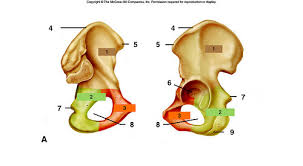
What is #8?

a)

Pubic Symphysis

b)

Obturator Foramen

c)

Posterior Superior Iliac Spine

d)

Ischial Spine

69.

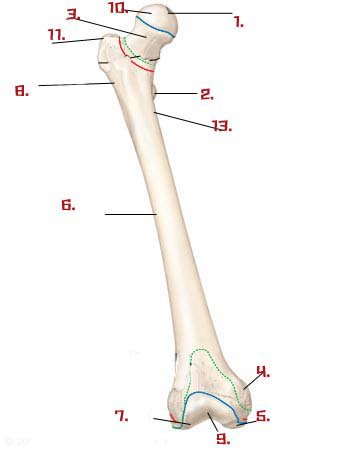
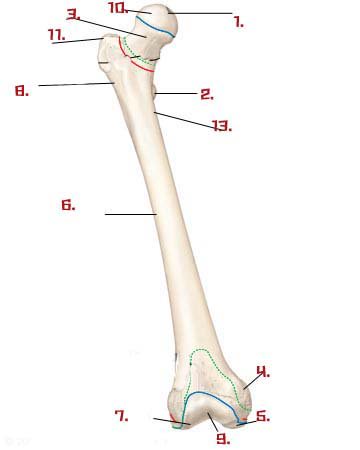
What is #3?

a)

head of femur

b)

neck of femur

c)

lesser trochanter

d)

lateral condyle of femur

70.
2
a)
Sacrum
b)
Ischial
c)
Pubic Sympysis
d)
Iliac
71.

What is #4?

a)

medial epicondyle of femur

b)

lateral condyle of femur

c)

head of femur

d)

lesser trochanter

72.
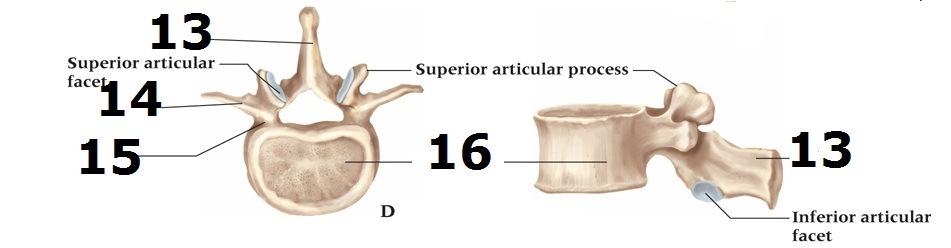
WHAT IS #15
a)
SPINOUS PROCESS
b)
BODY
c)
TRANSVERSE PROCESS
d)
PEDICLE
73.
The function of the vertebra is to articulate with ribs.
a)
thoracic
b)
lumbar
74.
This cervical vertebrae known as C1 is called
a)
axis
b)
atlas
c)
zygomatic vertebrae
d)
styloid process
75.
What bone is this?
a)
axis
b)
atlas