wayground logo

Free Printable Worksheets

NEW

Font size

S
M
L
XL
Worksheets

Finals Review Part II

Total questions: 58

Worksheet time: 49mins

Name
Class
Date
1.

What is the layer of air around the Earth called?

a)

hydrosphere

b)

atmosphere

c)

geosphere

2.
The layers of Earth's atmosphere are determined by changes in _________.
a)
temperature
b)
density
c)
pressure
d)
color
3.
In which two layers does temperature decrease with altitude?
a)
mesosphere and troposphere
b)
troposphere and stratosphere
c)
stratosphere and thermosphere
d)
thermosphere and exosphere
4.

The most abundant gas in Earth's atmosphere is what?

a)

Oxygen

b)

Nitrogen

c)

Troposphere

d)

Helium

5.

What gas makes up 21% of Earth's Atmosphere?

a)

Nitrogen

b)

Oxygen

c)

Ozone

d)

None of the Above

6.
Which layer of the atmosphere has the highest density of gas molecules and highest atmospheric pressure?
a)
troposphere
b)
mesosphere
c)
stratosphere
d)
thermosphere
7.

Which layer of the atmosphere contains the ozone?

a)

Troposphere

b)

Mesosphere

c)

Stratosphere

d)

Exosphere

8.

The layer where most meteorites vaporize?

a)

Stratosphere

b)

Thermosphere

c)

Troposphere

d)

Mesosphere

9.

Weather occurs in the thermosphere?

a)

True

b)

False

10.

What is the hottest layer of the atmosphere?

a)

Troposphere

b)

Mesosphere

c)

Exosphere

d)

Thermosphere

11.

The _____ protects us from the sun's harmful UV rays.

a)

Ozone

b)

Troposphere

c)

Clouds

d)

Exosphere

12.

Where do satellites orbit?

a)

Thermosphere

b)

Stratosphere

c)

Exosphere

d)

Mesosphere

13.

What happens to air pressure the higher up in space you go?

a)

air pressure stays constant

b)

air pressure increases

c)

air pressure deceases

d)

there is no air pressure

14.

The exosphere is the coldest layer?

a)

True

b)

False

15.

What is the correct order of layers for the atmosphere?

a)

Thermosphere

Stratosphere

Mesosphere

Troposphere

Exosphere

b)

Thermosphere

Exosphere

Troposphere

Mesosphere

Stratosphere

c)

Troposphere

Stratosphere

Mesosphere

Thermosphere

Exosphere

d)

Troposphere

Stratosphere

Exosphere

Thermosphere

Mesosphere

16.

The layer where tornadoes and hurricanes occur.

a)

Stratosphere

b)

Troposphere

c)

Mesosphere

d)

Exosphere

17.

Due to lack of trubulence in this layer this is where planes like to fly.

a)

Troposphere

b)

Mesosphere

c)

Stratosphere

d)

Exosphere

18.
What is going on with the atmosphere at any particular time.
a)
Weather
b)
Climate
19.
Daily temperature, daily rainfall, daily amount of sunshine
a)
Weather
b)
Climate
20.
The North and South Poles are usually cold and dry.
a)
Weather
b)
Climate
21.

The average wind speed of Richland is 0 mph to 15 mph.

a)

Weather

b)

Climate

22.

Which of the following is a description of climate?

a)

Today it is hot and sunny in Phoenix, Arizona.

b)

Summers are usually mild in Seattle, Washington.

c)

Last week it rained every day in San Antonio, Texas.

d)

Yesterday was cold and windy in Anchorage, Alaska.

23.
______ is the average pattern for weather over a long period of time.
a)
climate
b)
weather
c)
forecast
d)
sunlight
24.
It is raining.
a)
weather
b)
climate
25.
Over the last decade we have had an increase in the amount of rain in our area.
a)
weather
b)
climate
26.
The high temperature today will be near 75 C.
a)
weather
b)
climate
27.
The average winter temperature is 45 C.
a)
weather
b)
climate
28.

Has permafrost; in the Arctic or Antarctic

a)

taiga

b)

savanna

c)

desert

d)

tundra

29.

Has clumps of trees and seasonal rains

a)

temperate deciduous forest

b)

coniferous forest

c)

savanna

d)

grassland

30.

Has many trees that lose all their leaves to save water

a)

coniferous forest

b)

tundra

c)

grassland

d)

temperate deciduous forest

31.

Has many trees that do not change much seasonally

a)

desert

b)

taiga

c)

temperate deciduous forest

d)

savanna

32.
Has organisms with special adaptations to a hot, dry climate
a)
desert
b)
savanna
c)
tundra
d)
taiga
33.

This biomes gets very little rainfall.

a)

temperate forest

b)

rainforest

c)

grassland

d)

desert

34.

This biome is much like a cold desert.

a)

tundra

b)

taiga

c)

boreal forest

d)

grassland

35.

Which biome listed has the most energy available for cycling?

a)

tundra

b)

rainforest

c)

boreal forest

d)

desert

36.

This biome gets very cold in the winter, but not quite as cold as the tundra.

a)

grassland

b)

taiga

c)

temperate forest

d)

rainforest

37.
Biome with plants and grasses, but no trees.
a)
grassland
b)
savannah
c)
taiga
d)
tundra
38.
Biome with many scattered shrubs, tall grasses and small trees.
a)
Savannah
b)
Grassland
c)
Desert
d)
Taiga
39.
Cold, dry biome where the soil stays frozen the entire year. Very little precipitation.
a)
savannah
b)
taiga
c)
tundra
d)
desert
40.
A group of ecosystems with similar organisms and climates.
a)
desert
b)
deciduous
c)
canopy
d)
Biome
41.
Type of forest biome near the equator; receives a lot of rain; temperatures are warm all year.
a)
desert
b)
tropical rain forest
c)
arctic
d)
temperate rain forest
42.

what is greenhouse effect

a)

the process of reflecting the heat from the back to the outer space.

b)

it is the process of trapping of heat from the sun by the greenhouse gases.

43.

How would Earth be different without greenhouse gases in its atmosphere?

a)

More heat from solar radiation would escape into space

b)

More solar radiation would be reflected back into space

c)

More solar radiatio would penetrate Earth's crust and mantle

d)

More heat from solar radiation would be stored in Earth's crust

44.

What gas is known for increasing the amount of "trapped" heat in the atmosphere?

a)

Oxygen

b)

Nitrogen

c)

Methane

d)

Carbon Dioxide

45.
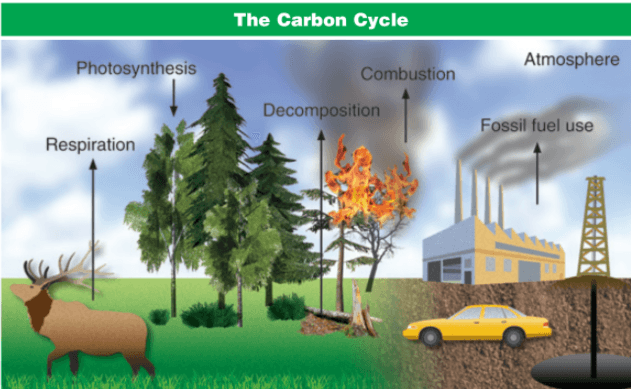
Combustion is another word for __________.
a)
Transportation
b)
Respiration
c)
Fossil Fuels
d)
Burning
46.
TRUE or FALSE?
All of the carbon in existence is continually recycled in the carbon cycle.
a)
True
b)
False
47.
Carbon can be found in...
a)
The atmosphere
b)
Soil
c)
Fossil fuels
d)
All of the above
48.
Which of the following removes carbon from the atmosphere?
a)
Combustion
b)
Respiration
c)
Photosynthesis
d)
Death
49.
Respiration is the process by which animals take in _____ and release _____. 
a)
photosynthesis, air
b)
carbon, oxygen
c)
oxygen
d)
oxygen, carbon dioxide
50.

When animals eat plants, the carbon that the plant contains is absorbed by the animals.

a)

True

b)

False

51.

What are fossil fuels made from?

a)

Plants and animals that are buried underground for millions of years.

b)

They absorb it from the atmosphere.

c)

Water

d)

Wind

52.
When humans burn fossil fuels, most of the carbon quickly enters the                       as carbon dioxide.
a)
Water
b)
Atmosphere
c)
Sun
d)
Air
53.

Which of the following is an example of human impact on the carbon cycle?

a)

The increased production of methane gases from cattle farms

b)

The burning of fossil fuels

c)

The cutting down of trees for lumber

d)

Driving automobiles

e)

All of the above

54.

If a forest fire occurs, what will happen to the carbon in the forest?

a)

It will go into the soil

b)

It will go into the atmosphere

c)

It will runoff into nearby streams and rivers

d)

It will be destroyed

55.
Which process takes carbon dioxide out of the atmosphere?
a)
respiration
b)
combustion
c)
decomposition
d)
photosynthesis
56.
Burning fossil fuel has which effect in the carbon cycle?
a)
It removes carbon dioxide from the atmosphere.
b)
It puts carbon dioxide under the ground.
c)
It adds carbon dioxide to the atmosphere.
d)
It has no effect in the carbon cycle.
57.
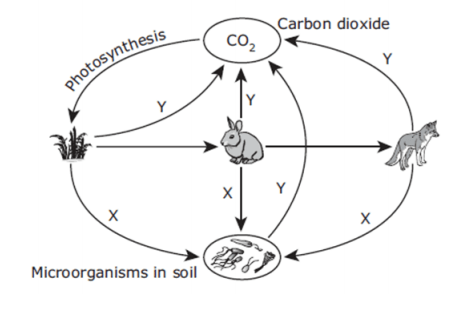
The diagram shows the flow of organic molecules through an ecosystem. What two processes are identified by the labels X and Y?
a)
X : Respiration
Y : Predation
b)
X : Adaptation
Y : Decomposition
c)
X : Fermentation
Y : Nitrogen Fixation
d)
X : Decomposition
Y : Respiration
58.
The average temperature of the surface of Earth has increased approximately 1°C in the past century. Which reason best explains this increase in temperature?
a)
lower levels of ozone in the atmosphere
b)
lower levels of nitrogen in the atmosphere
c)
higher levels of carbon dioxide and other greenhouse gases in the atmosphere
d)
higher levels of oxygen in the atmosphere