wayground logo

Free Printable Worksheets

Font size

S
M
L
XL
Worksheets

bio101 final review

Total questions: 58

Worksheet time: 41mins

Name
Class
Date
1.
Which of the following would provide the most energy in an ecosystem?
a)
Producers
b)
Herbivore
c)
Omnivore
d)
Carnivore
2.
Which of the following is an accurate food chain?
a)
Owl, Grasshopper, Grain
b)
Bird, Fox, Rabbit
c)
Carrot, Rabbit, Fox
d)
Grass, Mice, Bird
3.
The leaf's cuticle
a)
stores water
b)
reduces evaporation
c)
transports water in the leaf
d)
absorbs water for the leaf
4.
What produces egg and sperm cells during the life cycle of a plant?
a)
gamete
b)
gametophyte
c)
sporophyte
d)
zygote
5.
What happens in the phloem?
a)
water moves up from the roots
b)
food moves down from the leaves
c)
food moves up from the roots
d)
water moves down to the roots
6.
Germination will not happen unless a seed
a)
is dispersed far from the plant that produced it
b)
absorbs water
c)
uses its stored food
d)
grows stamens and a pistil
7.
Gases pass in and out of a leaf through the 
a)
stomata
b)
phloem
c)
xylem
d)
cuticle
8.
What part of a plant transports water and nutrients from the root to the plant's stem and leaves?
a)
root hairs
b)
phloem
c)
xylem
d)
cuticle
9.
All of the following is a root function, except
a)
water absorption
b)
food storage
c)
plant anchoring
d)
food production
10.
Root hairs help a plant
a)
transport food to the root
b)
absorb water and nutrients
c)
protect the root
d)
store food
11.

Seeds can move from one place to another by

a)

wind

b)

water

c)

animals

d)

wind, water, and animals

12.

This part of the plant produces seeds and creates pollen.

a)

roots

b)

flower

c)

stem

d)

leaves

13.

The ___________ absorb sunlight to help make food for the plant.

a)

seed

b)

stem

c)

roots

d)

leaves

14.
The sporophyte makes spores
a)
TRUE
b)
FALSE
15.
The gametophyte makes eggs and sperm
a)
TRUE
b)
FALSE
16.
Eggs and sperm cells must be:
a)
haploid
b)
diploid
17.
These are tiny packets of cells for asexual reproduction
a)
Spores
b)
Sperm
c)
Eggs
d)
Diploid
18.

___________ occurs when the life cycle of an organism alternates between diploid and haploid stages

a)

Alternation of Generations

b)

Pollination

c)

Alternation of Flowers

d)

Generation

19.

___________________forms from an ovary and sometimes other parts of the flower and contains one or more seeds?

a)

Fruit

b)

Pollen Grains

c)

Seeds

d)

Spores

20.

____________ is the female reproductive organ of a flower?

a)

pistil

b)

fruit

c)

spore

d)

ovule

21.

______________ are the structures made up of an embryo, its food supply, and a protective covering?

a)

Ovaries

b)

Spores

c)

Seeds

d)

Stamens

22.

_______________ - male reproductive organ of a flower?

a)

Pistil

b)

Ovule

c)

Ovary

d)

Stamen

23.
What does every food chain start with? (Even if it's not drawn or written there!)
a)
producers
b)
sun
c)
consumer
d)
decomposers
24.
An organism that needs to eat other organisms to obtain energy is known as a:
a)
Autotroph
b)
Producer
c)
Consumer
d)
Mutualist
25.
relationship in which two species live closely together
a)
resource
b)
mutualism
c)
succession
d)
symbiosis
26.
Where an organism lives
a)
habitat
b)
niche 
c)
heterotrogh
d)
biosphere
27.
What is the term for each step in the transfer of energy and matter within a biological community?
a)
energy path
b)
food web
c)
trophic level
d)
food pyramid
28.
The amount of energy that usually transfers from one trophic level to the next...
a)
10%
b)
20%
c)
80%
d)
50%
29.
The nonliving aspects of an ecosystem.
a)
Abiotic factors
b)
Biotic factors
30.
A collection of organisms that make up a community as well as all of the nonliving aspects of the environment.
a)
Population
b)
Community
c)
Habitat
d)
Ecosystem
31.
As you move upward, from level to level, in an energy pyramid, energy _____.
a)
increases
b)
decreases
c)
stays the same
d)
increases exponentially
32.
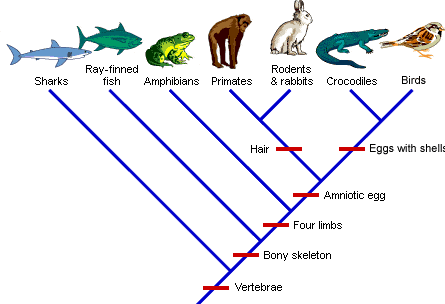
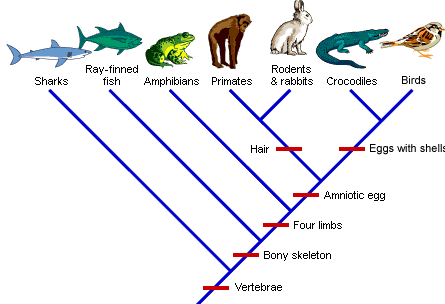
According to this cladogram, sharks are MOST closely related to which organism? 
a)
Amphibians
b)
Ray finned fish
c)
Crocodiles
d)
Birds
33.
According to this cladogram, birds are LEAST related to: 
a)
Amphibians
b)
Sharks
c)
Ray Finned Fish
d)
Crocodiles
34.
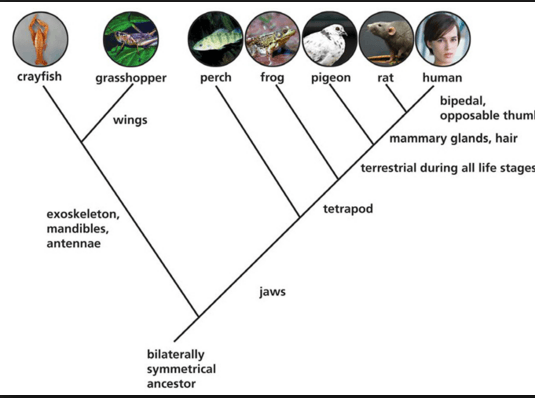
Which trait do only humans have, according to the cladogram?
a)
jaws
b)
mammary glands & hair
c)
terrestrial during all life stages
d)
bipedal & opposable thumbs
35.

Most bryophytes are only a few centimetres tall because they lack

a)

vascular tissues

b)

reproductive organs

c)

stems

d)

leaves

36.

The common name for the organism in the phylum Bryophyta is

a)

horsetail

b)

clubmoss

c)

mosses

d)

fern

37.

Which of the following statements are TRUE about the plants in phylum Bryophyta?

a)

They have true roots

b)

They are non-vascular plants

c)

Gametophyte generation is dominant

d)

Sporogonium is the sporophyte generation

38.

part A

a)

capsule

b)

rhizoid

c)

gametophyte

d)

sporophyte

39.

part C

a)

capsule

b)

rhizoid

c)

gametophyte

d)

sporophyte

40.

A vine plant brushes against a fence and wraps itself around the fence. To what response is the stimulus is the plant responding to?

a)

phototropism

b)

gravitropism

c)

hydrotropism

d)

thigmotropism

41.

When plants grow in towards the light, this is called:

a)

Phototropism

b)

Geotropism

c)

Germination

d)

Thigmotropism

42.

Which part of the plant shows positive phototropism?

a)

The roots

b)

Stems and leaves

43.

Which part of the plant shows negative phototropism?

a)

Leaves and stems

b)

Roots

44.
What is a host?
a)
Organism that lives on the cell and causes it harm 
b)
Something that causes harm to the cell 
c)
Cell that the virus invades and takes over
45.
What is the first step of the virus reproduction cycle?
a)
The viruses genetic material (DNA) starts to take over the functions of the cell
b)
The host cell bursts open, releasing the new viruses
c)
The virus injects its genetic material into the cell
d)
A virus attaches to the surface of a host cell
46.
Which is bigger, a bacteria or a virus?
a)
Bacteria
b)
Virus
47.
A capsid is
a)
a structure that directly causes cell lysis
b)
the type of virus that attacks bacteria
c)
the genetic material of a virus
d)
the protein coat of a virus
48.
Lysis is 
a)
rupture of a cell membrane
b)
replication of a virus
c)
bacterial reproduction
d)
a process that rarely happens
49.
Bacteria are prokaryotes.
a)
True
b)
False
50.
Bacteria are unicellular
a)
True
b)
False
51.
A structure that can help bacteria survive harsh conditions.
a)
capsids
b)
endospores
c)
pili
d)
DNA
52.
Bacteria exchange genetic information during 
a)
asexual reproduction
b)
binary fission
c)
conjugation
d)
photosynthesis
53.
The bacteria seen in the picture is
a)
bacillus
b)
coccus
c)
spirilla
54.
The bacteria seen in the picture is
a)
cocci
b)
bacillus
c)
spirilla
55.
The bacteria seen in the picture is
a)
bacillus
b)
cocci
c)
spirilla
56.
 What amoeba structure is a finger-like projection of the cell membrane used for movement and obtaining food?
a)
Cilia
b)
Pseudopod
c)
Flagella
d)
Hair-like
57.

environments that are unpredictable and rapidly changing tend to support populations of

a)

k-strategists

b)

r-strategists

58.

Populations of k-strategists grow rapidly, while r-strategist populations grow slowly.

a)

true

b)

false