
NEW
Font size
S
M
L
XL
 Worksheets
Pedigrees/Punnet squares
Total questions: 32
Worksheet time: 3hrs 32mins
Name
Class
Date
1.
Which of the following is a phenotype?
a)
Aa
b)
red hair
c)
heterozygous
d)
DNA
2.
Dominant alleles are represented by a:
a)
Male gene
b)
lowercase letter
c)
recessive trait
d)
capital letter
3.

How many boxes would say BB?
a)
1
b)
2
c)
4
d)
0
4.
G = green, g = yellow
The genotype for a yellow plant is...
The genotype for a yellow plant is...
a)
GG
b)
Gg
c)
gg
d)
all of the choices result in yellow
5.
In a certain species of rabbits, black coat color is dominant over brown coat color. What is the probability of producing a rabbit with brown coat color from two rabbits that are both heterozygous for black coat color?
a)
0%
b)
25%
c)
75%
d)
100%
6.
Tay-Sachs disease is a lethal, autosomal recessive genetic disorder. If both parents are heterozygous carriers of the disease, what are the chances of them having a child who is also a heterozygous carrier for Tay-Sachs?
a)
0%
b)
25%
c)
50%
d)
75%
7.
Biologists have found that a form of deafness is a recessive trait in dogs. If a female dog that is heterozygous for the trait mates with a male dog that is deaf, what percent of their offspring will be deaf?
a)
0%
b)
50%
c)
75%
d)
100%
8.
What does a punnet square show us?
a)
The age of the offspring
b)
The chance of a genotype (trait) showing up in offspring
c)
Numbers
d)
Blue eyes
9.

Father of genetics; 1st person to use probability to explain heredity.
a)
Mendeleev
b)
Mendel
c)
Darwin
d)
Currie
10.

The passing of traits from a parent to their offspring.
a)
Traits
b)
Characteristics
c)
Heredity
d)
Genetics
11.
Lower case letter; this represents what is hidden when a dominant allele is present
a)
recessive
b)
homozygous
c)
dominant
d)
heterozygous
12.

Which is homozygous dominant?
a)
AA
b)
Aa
c)
aa
d)
None of them
13.
Gary Goldfish is heterozygous for dark orange color. Ginny Goldfish is homozygous dominant. Their baby has light orange color. Is Gary the father?
a)
Yes, because the light orange color is dominant
b)
No, because there is no way they could produce a homozygous recessive baby
c)
Yes, because Ginny has two alleles for light orange color, so their baby could be light orange
d)
No, because Gary does not have the allele for light color.
14.
How many alleles (letters) do each person carry for a trait?
a)
1
b)
2
c)
3
d)
4
15.
How many alleles (letters) does a child get from each parent for each trait?
a)
1
b)
2
c)
3
d)
4
16.

How many generations are shown in this pedigree?
a)
1
b)
2
c)
3
d)
4
17.

How many kids did the mother and father from the first generation have?
a)
2
b)
4
c)
5
d)
6
18.
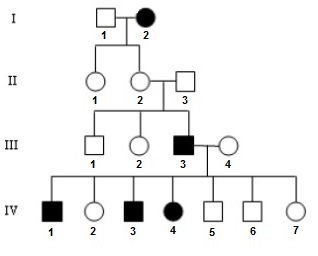
This pedigree represents the inheritance of hemophilia in this family. How many of the females have the hemophilia trait?
a)
8
b)
5
c)
2
d)
3
19.

What do half colored symbols represent?
a)
The individual is a carrier (heterozygous).
b)
The individual expresses the trait.
c)
The individual has both recessive alleles.
d)
The individual has both dominant alleles.
20.

Is this trait (the shaded individuals) dominant or recessive?
a)
dominant
b)
recessive
21.

In the second generation-how many people are carriers of the trait?
a)
2
b)
3
c)
5
d)
6
22.

How many people in this whole pedigree have the trait/disease?
a)
2
b)
3
c)
4
d)
6
23.

How many females are in this pedigree?
a)
3
b)
4
c)
6
d)
7
24.

Which gender can be carriers of colorblindness and not have it?
a)
Just males
b)
Just females
c)
Both genders
25.

What is the relationship between person I 1 and III 2?
a)
Father and Son
b)
Father and Daughter
c)
Grandfather and Granddaughter
d)
Uncle and Niece
26.
Which of the following combinations of sex chromosomes represent a female?
a)
XY
b)
XXY
c)
XX
27.
Phenotype refers to the _________ of an individual
a)
genetic makeup
b)
physical appearance
c)
recessive alleles
d)
dominant alleles
28.
An organism that has two identical genes for a trait is said to be _________.
a)
hybrid for the trait
b)
incompletely dominant for the trait
c)
heterozygous for the trait
d)
homozygous for the trait
29.
Which of these would best be described as a phenotype?
a)
blue eyes
b)
mutation
c)
Bb
d)
Tt
30.
A pea plant is heterozygous for height (Tt) and it is crossed with a homozygous short (tt) plant. Use a Punnett square to determine the probability of one of their offspring being short.
a)
100%
b)
75%%
c)
50%
d)
25%
31.

How many of the males in this pedigree show the trait being studied?
a)
2
b)
3
c)
4
d)
6
32.

Look at the Punnett square. If the two parents represented in the Punnett square have four offspring, what does the Punnett square tells you?
a)
two of the offspring will definitely be heterozygous.
b)
one of the offspring will definitely show the recessive trait.
c)
there is a 50% chance for each of the 4 offspring to have the genotype Rr.
d)
there is a greater chance for the offspring to be RR than rr.
Reset

