wayground logo

Free Printable Worksheets

Font size

S
M
L
XL
Worksheets

SBI 3C Exam Review

Total questions: 65

Worksheet time: 42mins

Name
Class
Date
1.

Which of the following is the largest taxa?

a)

Family

b)

Phylum

c)

Kingdom

d)

Genus

2.

What is a virus made out of? (select all that apply)

a)

Genetic material

b)

Lipids

c)

Protein

d)

Steroids

3.

Prokaryotic cells are found in _______ kingdom(s)?

a)

1

b)

2

c)

3

d)

4

4.

The majority of a population being immune/resistant to a disease is known as...

a)

group protection

b)

herd immunity

c)

population resistance

d)

protection shielding

5.

What type of bacteria is shown here?

a)

Gram positive

b)

Gram negative

6.

What type of bacteria is shown here?

a)

Diplococci

b)

Streptobaccilli

c)

Staphylococci

d)

Streptococci

7.
Which best explains how a virus affects other organisms?
a)
Viruses increase the survival of other organisms.
b)
Viruses immediately destroy all cells they come in contact with.
c)
Viruses live and reproduce in between the cells of other organisms.
d)
Viruses invade the cells of other organisms, using them to reproduce.
8.

How do prokaryotes reproduce?

a)

Mitosis

b)

Meiosis

c)

Binary fission

d)

Lateral fusion

9.
Antibiotics kill viruses
a)
True
b)
False
10.

Archaea is what type of cell?

a)

Prokaryote

b)

Eukaryote

11.

Animal-like protists are grouped by...

a)

movement

b)

size

c)

method of reproduction

d)

diet

12.

The mycelium of a fungi is made up of...

a)

spores

b)

sporangia

c)

protozoa

d)

hyphae

13.

The viral reproduction cycle is known as...

a)

lytic cycle

b)

binary fission

c)

fragmentation

d)

mitosis

14.

A cell that contains two haploid nuclei is termed...

a)

haploid

b)

diploid

c)

dikaryotic

d)

polyploid

15.

A single celled organism that prefers environments above the boiling point of water belongs in which kingdom?

a)

Bacteria

b)

Archaea

c)

Protista

d)

Fungi

16.

Which of the following is not an external defense of the body against pathogens?

a)

Tears

b)

Mucus

c)

Skin

d)

Antibodies

17.

What is the most common form of symbiotic relationships?

a)

Mutualism

b)

Commensalism

c)

Parasitism

18.

What factor groups all plant-like protists together?

a)

Cilia

b)

Chlorophyll

c)

Flagella

d)

Pseudopods

19.
------is the combination of two alleles that are different from one another.
a)
homozygous
b)
heterzygous
c)
phenotype
d)
trait
20.

What is the missing genotype?

a)

BB

b)

Bb

c)

bb

21.
Two brown eyed parents (Bb) have a baby. What is the chance the baby is blue eyed?
a)
0 %
b)
25%
c)
50%
d)
75%
22.
Put the following stages of mitosis in order: anaphase, prophase, metaphase, and telophase. 
a)
prophase, metaphase, telophase, anaphase
b)
prophase, anaphase, metaphase, telophase
c)
prophase, metaphase, anaphase, telophase
d)
prophase, telophase, metaphase, anaphase
23.
Which phase of mitosis is shown in the picture?
a)
Interphase
b)
Metaphase
c)
Telophase
24.
Diploid Cells are represented by
a)
2n
b)
n
c)
4n
d)
1/2 n
25.
What phase is represented?
a)
metaphase 1
b)
metaphase 2
c)
anaphase 1
d)
anaphase 2
26.
What phase is  shown in the picture?
a)
metaphase 2
b)
anaphase 2
c)
metaphase 1
d)
telophase 1
27.
How many carrier males are present? 
a)
2
b)
4
c)
6
d)
8
28.

Which sex-linked condition affects males and females relatively equally?

a)

X-linked dominant

b)

X-linked recessive

c)

Y-linked

29.

Which sex-linked condition appears more often in males than females?

a)

X-linked dominant

b)

X-linked recessive

30.

Brown is dominant to green. What is the probability of these parents having green offspring?

a)

1/4

b)

2/4

c)

3/4

d)

4/4

31.

What is caused by a trisomy of chromosome 21?

a)

Down's syndrome

b)

Edward's syndrome

c)

Klinefelter's

d)

Turner's

32.

What combination of sex chromosomes result in the male sex?

a)

XX

b)

XY

c)

YY

33.

Diagnose the patient

a)

Male with Down's

b)

Female with Down's

c)

Male with Edward's

d)

Female with Edward's

34.

What organelle controls the cell's activities; contains the cell's DNA

a)

mitochondria

b)

cell membrane

c)

nucleus

d)

golgi body

35.
Ribosomes are the cell organelle that
a)
Break down food to produce energy for the cell.
b)
Produce proteins for the cell.
c)
Break down broken cell parts.
d)
Make food for the cell using the sun's energy.
36.

What is the chemical created by anaerobic respiration in animals?

a)

Ethanol

b)

Glucose

c)

Lactic Acid

d)

Carbon Dioxide

37.
The picture  is an example of _________________.
a)
isotonic
b)
diffusion
c)
osmosis
d)
active transport
38.
 An animal cell placed in a hypertonic (salty) solution will
a)
Stay the same
b)
Shrink- get smaller
c)
Swell- get bigger
39.
Which type of transport requires an input of energy?
a)
Passive Transport
b)
Osmosis
c)
Simple Diffusion
d)
Active Transport
40.
What kind of bond forms when atoms share electrons?
a)
ionic
b)
covalent
c)
artificial
d)
univalent
41.

What is the functional group?

a)

Phosphate

b)

Amino

c)

Hydroxyl

d)

Carboxyl

42.

What type of macromolecule is this?

a)

Carbohydrate

b)

Lipids

c)

Protein

43.
Proteins are composed of what smaller building blocks?
a)
amino acids
b)
nucleic acids
c)
fatty acids
d)
nucleotides
44.

Which of the following is NOT a type of lipid?

a)

Triglyceride

b)

Steriod

c)

Monosaccharide

d)

Phospholipid

45.
What is the energy needed to start an chemical reaction referred to?
a)
Cascading Energy
b)
Potential Energy 
c)
Kinetic Energy
d)
Activation energy
46.
What is the purpose  of an enzyme?
a)
give permission for the reaction
b)
raise activation energy
c)
speed up reactions
d)
control how many reactions occur
47.

Which form of exercise cannot be maintained for a long period of time?

a)

Anaerobic

b)

Aerobic

48.

An IV bag is pure water. Your blood cells would be ________ compared to the IV bag.

a)

Isotonic

b)

Hypertonic

c)

Hypotonic

49.

Where does the digestion of carbohydrates begin?

a)
esophagus
b)
small intestine
c)
stomach
d)
mouth
50.
Where are nutrients absorbed into the blood?
a)
esophagus
b)
small intestine
c)
stomach
d)
mouth
51.
The organ where food doesn't pass through but it does break down fats and detoxify poisons?
a)
liver
b)
small intestine
c)
stomach
d)
large intestine
52.
Number 2 is pointing to the ...
a)
Esophagus
b)
Rectum
c)
Small Intestine
d)
Stomach
53.
Number 3 is pointing to the ...
a)
Esophagus
b)
Rectum
c)
Small Intestine
d)
Stomach
54.

What organ produces digestive enzymes that are secreted into the small intestine?

a)

Pancreas

b)

Gallbladder

c)

Large Intestine

d)

Hypothalamus

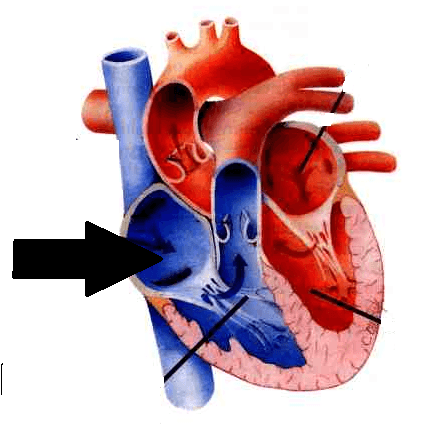
55.
Identify
a)
Left atrium
b)
Right atrium
c)
Left ventricle
d)
Right ventricle
56.

The mammalian heart has ___ chambers.

a)

1

b)

2

c)

3

d)

4

57.
What is pulmonary circulation?
a)
Blood travelling to and from the lungs
b)
Blood travelling to and from the body
c)
A blood clot in the lungs
d)
The vessel that brings blood to the lungs
58.

True or false:

Blood traveling in veins is blue.

a)

True

b)

False

59.

The blood in the vena cava is...

a)

oxygenated, returning to the heart

b)

deoxygenated, returning to the heart

c)

oxygenated, leaving the heart

d)

deoxygenated, leaving the heart

60.
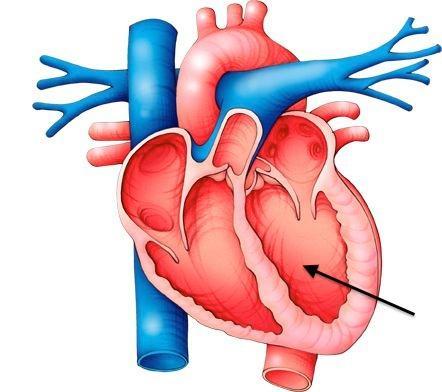
Identify
a)
Left atrium
b)
Right atrium
c)
Left ventricle
d)
Right ventricle
61.
What is the correct name for the windpipe?
a)
Trachea
b)
Bronchus
c)
Bronchiole
d)
Larynx
62.
What is the correct name for the voice box?
a)
Trachea
b)
Bronchus
c)
Bronchiole
d)
Larynx
63.

What is the respiratory surface in mammals?

a)

Alveoli

b)

Bronchi

c)

Bronchioles

d)

Intercostal muscles

64.
Given the following structures:
1. larynx
2. nasal cavity
3. pharynx
4. trachea
Which of the following is the correct order that air would flow during inhalation. 
a)
1,2,3,4
b)
2,3,1,4
c)
2,1,3,4
d)
4,2,3,1 
65.

Gases will move...

a)

from high concentration to low concentration

b)

from low concentration to high concentration