
 Worksheets
AP Biology-Plants Review
Total questions: 64
Worksheet time: 3590secs
Which of these time intervals, based on plant fossils, came last (most recently)?
extensive growth of gymnosperm forests
colonization of land by early liverworts and mosses
rise and diversification of angiosperms
carboniferous swamps with giant horsetails and lycophytes
A student encounters a pondweed which appears to be a charophyte (stonewort). Which of the following features would help the student determine whether the sample comes from a charophyte or from some other type of green alga?
1. molecular structure of enzymes inside the chloroplasts
2. structure of sperm cells
3. presence of phragmoplasts
4. rings of cellulose-synthesizing complexes
1 and 3
1 and 4
2 and 3
2, 3, and 4

The following questions refer to the generalized life cycle for land plants shown in the figure below. Each number within a circle or square represents a specific plant or plant part, and each number over an arrow represents either meiosis, mitosis, or fertilization. In the figure above, which number represents the mature gametophyte?
1
3
7
11
The following questions refer to the generalized life cycle for land plants shown in the figure below. Each number within a circle or square represents a specific plant or plant part, and each number over an arrow represents either meiosis, mitosis, or fertilization. In the figure above, which number represents an embryo?
1
3
7
11
The following questions refer to the generalized life cycle for land plants shown in the figure below. Each number within a circle or square represents a specific plant or plant part, and each number over an arrow represents either meiosis, mitosis, or fertilization. In the figure above, meiosis is most likely to be represented by which number(s)?
2
4
2 & 8
10 & 12
Liverworts, hornworts, and mosses are grouped together as the Bryophytes. Besides not having vascular tissue, what do they all have in common?
They require water for reproduction.
They are all wind pollinated.
They are heterosporous.
They can reproduce asexually by producing gemmae.
Arrange the following terms from most inclusive to least inclusive.
1. embryophytes
2. green plants
3. seedless vascular plants
4. ferns
5. tracheophytes
1, 2, 5, 3, 4
2, 1, 5, 3, 4
2, 5, 1, 3, 4
1, 4, 2, 5, 3
Which of these is a major trend in land plant evolution?
the trend toward smaller size
the trend toward a gametophyte-dominated life cycle
the trend toward a sporophyte-dominated life cycle
the trend toward larger gametophytes
The generative cell of male angiosperm gametophytes is haploid. This cell divides to produce two haploid sperm cells. What type of cell division does the generative cell undergo to produce these sperm cells?
binary fission
mitosis
meiosis
meiosis without cytokinesis
Which of the following is not a function of the root system?
photosynthesis
anchors plant
stores food
conducts water
Where do the seeds of a gymnosperm come from?
fruit
flowers
spores
cones
A plant is ...
Heterotrophic, multicellular, eukaryote
Autotrophic, unicellular, eukaryote
Autotrophic, multicellular, eukaryote
Heterotrophic, unicellular, prokaryote
The two types of vascular tissue in plants are _____________ and _________________?
bark, wood
ground, dermal
roots, stem
phloem, xylem
Xylem carries ...
water
nutrients
blood
protein
All statements below is true about Gymnosperm except
heterosporous
seed
does not enclosed within ovary
non-vascular
plants
less
dependent on water for fertilization
Which of the following characteristics are NOT found in all vascular plants?
Dominant sporophyte generation
Production of seeds
Lignified xylem
Phloem tissue


This is a(n) ...
Angiosperm
Gymnosperm
Seedless vascular plant
Nonvascular plant
Select ALL examples that are matched correctly.
Nonvascular plants >> moss
Seedless vascular plants >> fern
Gymnosperms >> cherry tree
Angiosperms >> rose

Which of these are the combined male reproductive parts of the plant?
Choice A
Choice D
Choice BC or BD
Choice E
Choice AC
Which of these are the combined female reproductive parts of the plant?
Choice A
Choice D
Choice BC or BD
Choice E
Choice AC
Which of the following is the sperm of the plant?
Ovule
Petal
Pollen
Seed
Which of the following structures becomes the fruit?
Stamen
Seed
Ovary
Pollen tube
When pollen from a plant enters the pollen tube of that same plant, this is called __________.
Self pollination
Cross pollination
Mitosis
Seed germination
Which of the following transports sugars and amino acids?
Xylem
Phloem
____________ are actively dividing areas at root tips & buds of shoots.
Perennial
Apical meristem
Stem
Root
Flower
Which of the following is not one of the 3 main organs of a plant?
Flower
Roots
Leaves
Shoots
The most abundant type of plant cell are called ____.
Sieve-tube cells
Tracheids & vessel cells
Parenchyma cells
Collenchyma cells
Sclerenchyma cells
Cells communicate through this structure.
Xylem
Plasmodesmata
Stomata
Leaves

Is this a monocot or dicot?
Monocot
Dicot

Based on this picture of the veins of an onion bulb, an onion is a _____________ with ________________ veins.
Monocot; parallel
Dicot; parallel
Monocot; branched
Dicot; branched
The waxy layer on the plant that prevents water loss is called the _______
Epidermis
Mesophyll
Cuticle
Cortex
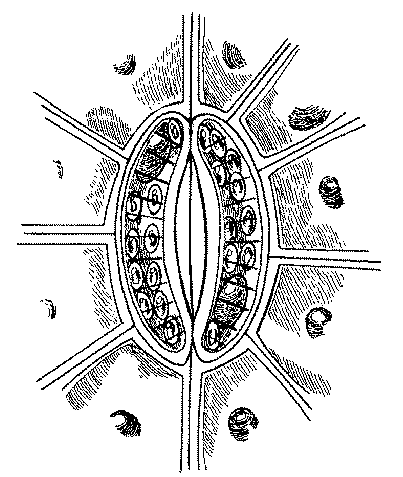
These structures called ____________ are pores for gas exchange and are opened and closed at different times to prevent water loss.
Stomata
Nodes
Epidermal cells
Collenchyma
Cuticle

What kind of response is this?
Geotropism
Photosynthesis
Thigmotropism
Hydrotropism


What is a gymnosperm?
"naked" seeds not inside a fruit; needle or scale-like leaves
moves food
tiny structures that contain cells that later become male cells
plants with transportation tubes for water and nutrients
What is an angiosperm?
flowering plants
seeds not inside a fruit; needle or scale-like leaves
seed leaf that provides food for embryo
plants with transportation tubes for water and nutrients
Where in a plant can auxin be made? Choose all correct answers.
Shoot tip
Shaded side of shoot
Root tip
Upper side of root
What effect does auxin have on shoot cells?
Inhibits elongation
Inhibits cell division
Promotes cell division
Promotes elongation

