wayground logo

Free Printable Worksheets

Font size

S
M
L
XL
Worksheets

Matter Unit 1 Review Quiz-Properties of Matter

Total questions: 46

Worksheet time: 44mins

Name
Class
Date
1.

Define the term soluble.

a)

Can dissolve in water

b)

Cannot dissolve in water

c)

Partially dissolves in water

2.

Define the term insoluble.

a)

Can dissolve in water.

b)

Cannot dissolve in water.

c)

Partially dissolves in water.

3.
What is measured with a graduated cylinder?
a)

time

b)

distance

c)

weight

d)

liquid volume

4.
What is the volume of the fish?
a)
18.0 cm3
b)
6.0 cm
c)
38.0 cm3
5.
Eben is trying to decide whether he is strong enough to pick up the box of toys.  Is this mass or volume?
a)
mass
b)
volume
6.
Amy is trying to decide how many books she can fit in her backpack.  Is this mass or volume?
a)
mass
b)
volume
7.
What is mass?
a)
A solid
b)
The amount of space something takes up
c)
The amount of matter something has
d)
Anything that has mass and takes up space
8.
Volume is the amount of ______________________ in an object or substance.
a)
mass
b)
matter
c)
space
9.
Which statement about atoms is true?
a)
They are all the same
b)
All substances are made of just one kind
c)
You can see them with your eyes
d)
They are too small to be seen with an ordinary microscope
10.
A watermelon has more matter than a grape, so it has more
a)
mass
b)
eat
c)
solid
d)
greater
11.
What is the basic unit of matter (smallest part of an element)?
a)
atoms
b)
elements
c)
protons
d)
compounds
12.
Hydrogen is a pure substance represented by the chemical symbol H. Which of the following best describes hydrogen?
a)
Hydrogen is an element made of two or more kinds of atoms.
b)
Hydrogen is a compound made of only one kind of atom.
c)
Hydrogen is a compound made of two or more kinds of atoms.
d)
Hydrogen is an element made of only one kind of atom.
13.
Atoms combine to form _______. 
a)
electrons
b)
molecules
c)
nuclei
d)
neutrons
14.
All matter is made of
a)
atoms
b)
cells
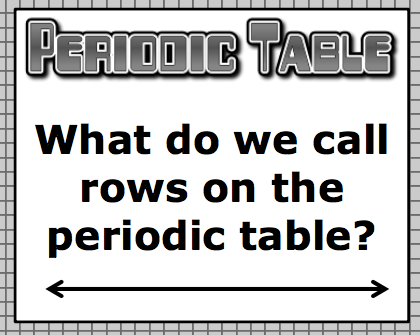
15.
a)
Periods
b)
Groups
16.
What is the name of a single type of atom?
a)
cell
b)
proton
c)
element
d)
atom
17.
What is the term for combining 2 or more atoms together?
a)
atoms
b)
elements
c)
molecules
d)
compounds
18.

Anything that has mass and takes up space

a)

atom

b)

element

c)

matter

d)

molecule

19.

Which of the following is NOT an example of matter?

a)

water

b)

air

c)

cake

d)

sunlight

20.

How many atoms are in NO2?

a)

1

b)

2

c)

3

d)

4

21.

Is CaCO3 an element or a molecule?

a)

element

b)

molecule

22.

How many elements are in CaCO3?

a)

3

b)

4

c)

5

d)

6

23.

How many atoms are in H3?

a)

1

b)

0

c)

2

d)

3

24.

Is H an element or a molecule?

a)

element

b)

molecule

25.
Which of these is most like a recipe? 
a)
An element
b)
A periodic table
c)
An electron formula
d)
A chemical formula
26.

What which scale below would it be best to observe a small tree?

a)

Atomic scale

b)

Planet scale

c)

Human scale

d)

Molecular scale

27.

What which scale below would it be best to observe a molecule?

a)

Atomic scale

b)

Human scale

c)

Planet scale

d)

City scale

28.

What which scale below would it be best to observe a continent?

a)

Planet scale

b)

Atomic scale

c)

Human scale

d)

Universe scale

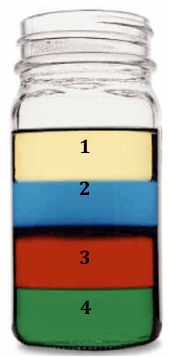
29.
Put the liquids in order from most dense to least dense?
a)
4, 3, 2, 1
b)
1, 2, 3, 4
c)
3, 4, 2, 1, 
d)
4, 3, 1, 2
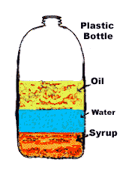
30.
Which liquid is the least dense?
a)
oil
b)
water
c)
syrup 
d)
plastic bottle
31.
What is the formula for density?
a)
density = mass x volume
b)
density = mass / volume
c)
density = mass + volume
d)
density = mass - volume
32.
Jack has a rock. The rock has a mass of 14 g and a volume of 2 cm3. What is the density of the rock?
a)
7 mL
b)
7 g/cm3
c)
28 g/cm3
d)
1/7 g/cm3
33.
Frank has an eraser. It has a mass of 4 g, and a volume of 2 cm3. What is its density?
a)
8 g/cm3
b)
2 g/cm3
c)
1/2 g/cm3
d)
24 g/cm3
34.
Frank has a liquid. It has a mass of 6 g and a volume of 9 mL. What is its density?
a)
3 g/mL
b)
.66 g/mL
c)
1.33 g/mL
d)
54 g/mL
35.
Why do objects sink or float in H2O
a)
Because their densities are higher or lower than compared to water
b)
Because their densities are using gravity to pull down
c)
Because their densities are heavier or lighter
d)
Because their mass and volumes are equal 
36.
Which units of measurement are used for volume?
a)
grams
b)
centimeters
c)
grams/milliliter
d)
milliliter
37.
Density is...
a)
the amount of mass in an object
b)
the amount of space an object takes up
c)
the amount of mass in a given space
d)
the weight of an object
38.
Which property of matter is determined by dividing its mass by its volume?
a)
elasticity
b)
buoyancy
c)
density
d)
viscosity
39.
What is the density of water?
a)
0 g/ml
b)
1 g/ml
c)
10 g/ml
d)
100 g/ml
40.
Which box has a higher density?  
a)
Box A
b)
Box B
c)
cannot be determined
d)
they are the same
41.
What is the measuring unit for mass?
a)
centimeter 
b)
millimeter 
c)
grams 
d)
pounds
42.
Define the term "mass".
a)
Mass/Volume
b)
Anything that has mass and takes up space 
c)
The amount of space an object occupies.
d)
The amount of matter in an object.
43.
What is the volume of Object X?
a)
10.0 cm3
b)
15.0 cm3
c)
20.0 cm3
d)
25.0 cm3
44.
Helium balloons rise on earth because
a)
helium is less dense than air
b)
helium is more dense than air
c)
helium is cooler than air
d)
helium is warmer than air
45.

Another term for the ability to burn is ______.

a)

Flammability

b)

Chemistry

c)

Density

d)

Volume

46.
When a liquid reaches the temperatures of its ___, it can become a gas.
a)
melting point
b)
freezing point
c)
boiling point
d)
density