wayground logo

Free Printable Worksheets

NEW

Font size

S
M
L
XL
Worksheets

ch 12 Genetics Test practice

Total questions: 55

Worksheet time: 1hrs 7mins

Name
Class
Date
1.

Define Alleles

a)

Molecule which contains the genetic information for an organism.

b)

Different versions of the same gene.

c)

all the chromosomes/DNA that code for an individual’s traits.

d)

Condensed DNA that is visible during cell division.

2.

Define Gene

a)

Condensed DNA that is visible during cell division.

b)

Different versions of the same gene.

c)

A section of DNA that codes for specific proteins/traits.

d)

Molecule which contains the genetic information for an organism.

3.

Define Genome

a)

Molecule which contains the genetic information for an organism.

b)

Different versions of the same gene.

c)

Condensed DNA that is visible during cell division.

d)

all the chromosomes/DNA that code for an individual’s traits.

4.

Define Chromosome

a)

Condensed DNA that is visible during cell division.

b)

Different versions of the same gene.

c)

all the chromosomes/DNA that code for an individual’s traits.

d)

1. A section of DNA that codes for specific proteins/traits.

5.

During what process does independent assortment and segregation of alleles occur?

a)

Mitosis

b)

Meiosis

c)

Fertilization

6.

When Mendel crossed true-breeding tall plants (TT) with true-breeding short plants (tt), all of the offspring were tall because...

a)

The allele for tall plants is recessive.

b)

The allele for short plants is dominant.

c)

The allele for tall plants is dominant

7.

What is the relationship between phenotype and genotype?

a)

The phenotype determines the genotype.

b)

The genotype determines the phenotype.

c)

There is no relationship between phenotype and genotype.

8.

What principle states that during gamete formation genes for different traits separate without influencing each other’s inheritance?

a)

Principle of independent assortment.

b)

Principle of recessives alleles

c)

Principle of complete dominance.

d)

Principle of incomplete dominance.

9.

The law of segregation states: Allele pairs separate during gamete formation and randomly unite at fertilization.

a)

True

b)

False

10.

Tt is an example of...

a)

Homozygous Dominant

b)

Heterozygous

c)

Homozygous Recessive

11.

A Punnett square shows all of the following EXCEPT

a)

All possible results of a genetic cross.

b)

The possible genotypes of the offspring.

c)

The alleles in the gametes of each parent.

d)

The actual genotypes of the offspring.

12.

Multiple alleles refer to an inheritance pattern that has more than two allele possibilities within a population that control phenotype.

a)

True

b)

False

13.

Which option below best describes polygenic inheritance?

a)

More than one set of genes contributing to the phenotype

b)

A blending of genes getting an intermediate phenotype

c)

A phenotype that has more than 2 possible alleles for a gene

14.

A white rose and a red rose produce a pink rose, which type of inheritance does this show?

a)

incomplete dominance

b)

codominance

c)

Multiple alleles

d)

Polygenic inheritance

15.

A kitten has spots and stripes. The mother has stripes and the father has spots. Which law of inheritance does this show?

a)

incomplete dominance

b)

codominance

c)

multiple alleles

d)

polygenic inheritance

16.
This is the passing of traits from parent to offspring.
a)
Biology
b)
Genes
c)
Heredity
d)
Punnett squares
17.
If your parents are both hybrids for the trait eye color, what are the odds that you will have the recessive eye color?
a)
0%
b)
50%
c)
100%
d)
25%
18.
Different forms of genes are called
a)
Punnett squares
b)
Chromosomes
c)
Alleles
d)
DNA
19.
If you have the genotype Tt, you are a
a)
Hybrid
b)
Purebred
c)
Recessive
d)

Homozygous

20.
TT, Tt, and tt are all
a)
Homozygous
b)
Heterozygous
c)
Genotypes
d)
Phenotypes
21.
Blue eyes, having freckles, and being tall are all examples of
a)
Genes
b)
Alleles
c)
Genotypes
d)
Phenotypes
22.
Height is inherited through...
a)
Codominance
b)
Polygenic Inheritence
c)
Incomplete Dominance
d)
Multiple Alleles
23.
Meiosis creates ______ new cells.
a)
1
b)
2
c)
3
d)
4
24.
There are _______ as many chromosomes in sex cells as there are in body cells.
a)
Half as many
b)
Twice as many
c)
The exact same
d)
One fourth as many
25.
What is the percentage of offspring that have green pods?
a)
100%
b)
75%
c)
50%
d)
25%
26.
If green is dominant over purple, then what is the genotype for this individual?
a)
Purple
b)
Green
c)
GG
d)
gg
27.
In the Punnett square shown, what must the genotype of the missing parent be?
a)
BB
b)
Bb
c)
bb
d)
Tt
28.
B = brown fur  b = white fur
In the Punnett square, what is the probability for white fur
a)
0%
b)
25%
c)
50%
d)
75%
29.
What are the possible genotypes for this cross?
(Click the picture to see it without the text)
a)
TT = 25% Tt= 50% tt=25%
b)
all tall
c)
TT= 75% tt = 25%
d)
Tt = 100%
30.

(According to Mendelian Inheritance) AA and Aa always show up as

a)
dominant
b)
recessive
31.
Black hair color is dominant to white hair color in mice.  Determine the phenotypic ratio for the offpring of a heterozygous black mouse and a white mouse.
a)
4 Black: 0 White
b)
3 Black: 1 White
c)
2 Black: 2 White
d)
0 Black: 4 White
32.
Phenylketonuria (PKU) is inherited as a recessive condition. A man with PKU marries a woman without any alleles for PKU. What is the probability that their child will inherit PKU?
a)
0%
b)
25%
c)
50%
d)
75%
33.
Why do all the daughters in Generation II carry the colorblind gene?
a)
Because mom passed on the gene.
b)
Because dad passed on the X chromosome.
c)
Because their brother has it.
d)
Because their brother gave it to them.
34.

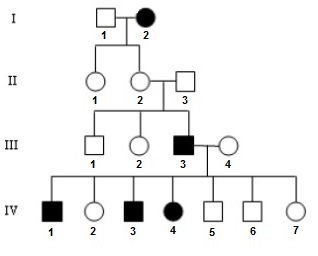
What is the mode of inheritance shown here?

a)

Autosomal Recessive

b)

Sex Linked recessive

c)

Autosomal Dominant

35.
This pedigree represents the inheritance of hemophilia in this family. How many of the females have the hemophilia trait?
a)
8
b)
5
c)
2
d)
3
36.
Is this trait (the shaded individuals) dominant or recessive?
a)
dominant
b)
recessive
37.

CROSSING OVER INCREASES

a)

LIFE SPAN

b)

GENETIC VARIATION

c)

THE NUMBER OF OFF-SPRING

d)

ALL ARE TRUE

38.

MEIOSIS PRODUCES 4 CELLS-THE CHROMOSOME NUMBER IS ...

a)

DIPLOID

b)

HAPLOID

39.

NORMAL HUMANS HAVE 46 CHROMOSOMES, HOW MANY WILL THE GERM CELLS HAVE AFTER MEIOSIS?

a)

46

b)

23

c)

12

d)

92

40.
What process is necessary for the inherited traits of an organism to be passed along by sexual reproduction?
a)
meiosis
b)
mutation
c)
mitosis
d)
fission
41.
If an intestinal cell in a butterfly contains 24 chromosomes, a butterfly egg cell would contain___________.
a)
12 chromosomes
b)
6 chromosomes
c)
3 chromosomes
d)
24 chromosomes
42.
Based only on the sex chromosomes in a human egg and sperm cells at fertilization, the probability of producing a female is 
a)
25%
b)
50%
c)
75% 
d)
90%
43.
When a cell is not actively dividing, it is in what phase?
a)
interphase
b)
anaphase
c)
prophase
d)
telophase
44.
In which type of cells will mitosis occur?
a)
egg cells
b)
sperm cells
c)
jail cells
d)
Body cells except the sperm and egg cells
45.
Chromosomes that have corresponding traits from the opposite sex parent are called:
a)
Heterogeneous chromosomes
b)
homologous chromosomes
c)
Mother and Father chromosomes
d)
Grandmother and grandfather chromosomes
46.
A is:
B is:
C is:
a)
A: chromatid
B: centromere
C: chromosome
b)
A: chromosome
B: chromatid
C: centromere
c)
A: chromosome
B: centromere
C: chromatid
d)
A: centromere
B: chromosome
C: chromatid
47.
Place these cells in order of mitosis.
a)
A, B, C, D, E
b)
B, E, D, A, C
c)
C, E, A, D, B
d)
B, D, A, E, C
48.
The process on the left is:
The process on the right is:
a)
Left: meiosis
Right: meiosis
b)
Left: meiosis
Right: cloning
c)
Left: mitosis
Right: meiosis
d)
Left: mitosis
Right: mitosis
49.
This karyotype is taken from a  ___________.
a)
normal female
b)
normal male
c)
male with Klinefelter's syndrome
d)
female with Turner's syndrome
50.
The sex of a child is determined by
a)
whether the father's sperm contains an x or y chromosome
b)
whether the mother's egg contains an x or y chromosome
c)
the age of the parents
51.
The visual representation of an individual's chromosomes is a 
a)
phenotype
b)
genotype
c)
karyotype
d)
stereotype
52.
Hemophilia is a recessive x-linked disorder.
Which genotype represents a female who is a carrier for hemophilia?
a)
XHXh
b)
XhXh
c)
XHXH
d)
XhY
53.
Hemophilia is a recessive x-linked disorder.
Which genotype represents a male with hemophilia?
a)
XHXh
b)
XhXh
c)
XHY
d)
XhY
54.
Based off this punnett square, what fraction of the offspring will have wrinkled, yellow seeds?
a)
9/16
b)
3/16
c)
1/16
d)
16/16
55.
What fraction of offspring from the cross AaBB x Aabb will be heterozygous for both traits?
a)
1/16
b)
4/16
c)
8/16
d)
3/16